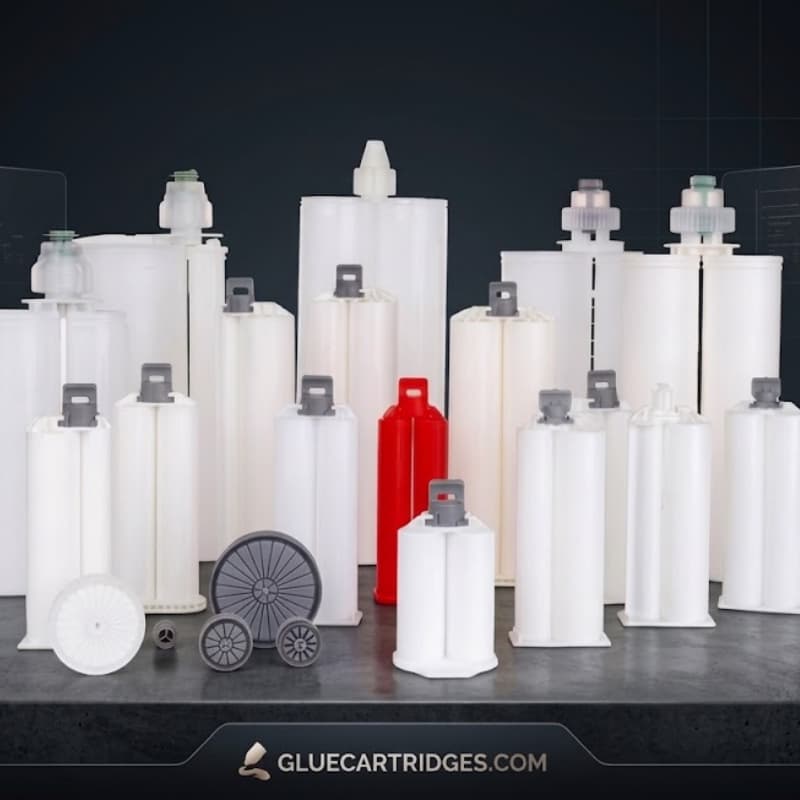
Picking between epoxy, polyurethane and silicone is rarely the real decision. The real decision is whether your dispensing system can deliver each chemistry’s rated performance on the line — because a 2K adhesive’s strength, flexibility and cure behavior are outputs of a system, not properties printed on a datasheet. The same formulation that tests well in a lab can produce a weak, partially cured joint when the cartridge ratio drifts, the mixer under-mixes, or the gun cannot hold backpressure.
This guide reframes the choice around three moves: define what the joint must survive, translate that chemistry choice into concrete cartridge, mixer and gun requirements, then read failure symptoms to tell a chemistry fault from a system fault. If you are still weighing 1K against 2K packaging, our 2K dual-component cartridge systems overview explains where two-component formats earn their added complexity.
Direct answer: choose epoxy when the joint is a rigid load path under high shear and needs chemical or heat resistance; choose polyurethane when the joint must absorb peel, impact and vibration or bridge dissimilar substrates; choose silicone for sealing, thermal cycling and flexible gasketing rather than as a primary structural adhesive. Your final spec then depends less on the adhesive and more on the dispensing hardware that delivers it.
Why “Which Adhesive Is Strongest” Is the Wrong First Question
A high lap-shear number on a technical data sheet describes a coupon tested under ideal conditions. It does not describe the joint your line produces at 18 °C with a hand gun and a partly spent cartridge. The gap between rated and delivered performance is where most 2K adhesive projects fail, and it is almost never the chemistry’s fault alone.
Two forces decide the result, and they divide cleanly:
| Chemistry sets | The system delivers |
|---|---|
| Target properties: modulus, elongation, temperature and chemical resistance | Ratio accuracy between the two components |
| Cure mechanism and speed | Homogeneity from the static mixer |
| Failure mode under load (brittle vs ductile) | Output force from the gun against backpressure |
| Material and substrate compatibility | Clean, de-aerated delivery to the bondline |
Read the other way: a perfect chemistry still fails if the cartridge cannot hold ratio, the mixer cannot homogenize the two parts, or the gun cannot push high-viscosity material. That is why “which is strongest” should come second. First decide what the joint demands; then ask whether your system can deliver it. See the components of a dispensing cartridge system to see where each requirement lives in the hardware.
Step 1: Define What the Joint Actually Demands — Four Inputs, Nothing Else
Stop at the top of the data sheet. Four inputs are enough to eliminate most chemistry candidates before you compare any numbers.
- Load form — Does the joint see predominantly shear, or also peel, impact and vibration? Rigid epoxies resist shear superbly but punish peel; polyurethanes absorb peel and impact; silicones give way before they break.
- Continuous service temperature — The temperature the bondline holds for years, not the peak it touches once. Conventional polyurethanes soften at lower continuous temperatures than epoxies; silicone stays compliant across a far wider band.
- Substrate pair and CTE mismatch — Bonding aluminum to polycarbonate moves with temperature. A stiff, high-modulus adhesive transfers that stress into the interface; a more compliant one absorbs it.
- Environmental exposure — Outdoor UV, solvents, humidity and thermal cycling each favor different chemistries. Silicone leads on weathering; many epoxies chalk and yellow under UV unless modified.
Each input removes options. A joint running above roughly 120 °C continuous typically rules out conventional polyurethane; a peel- or impact-dominated joint rules out an untoughened epoxy; a sealing-and-thermal-cycling role rules out treating silicone as a structural adhesive. Match these four against your bonding and sealing applications before reading any strength figure.
Epoxy vs Polyurethane vs Silicone: The Comparison That Decides Your Spec
The table compares the three on what matters for your specification, not on isolated lab values. Temperature and property bands are industry-typical ranges — confirm the exact figures against the adhesive brand’s TDS, not against a generic chart.
| Selection factor | Epoxy | Polyurethane | Silicone |
|---|---|---|---|
| What it does best | Rigid load path, high shear | Peel, impact, vibration absorption | Sealing, gasketing, thermal cycling |
| Elongation & flexibility | Low unless toughened | High, tunable | Very high, low modulus |
| Continuous service temp (typical) | Moderate to high | Moderate | Very wide |
| Chemical / solvent resistance | Strong | Good, varies by formula | Good, limited vs some solvents |
| UV & weathering | Chalk/yellow unless modified | Good | Excellent |
| Substrate sweet spots | Metals, composites, ceramics | Dissimilar & low-surface-energy | Glass, metals, flexible parts |
| Typical 2K cartridge ratios | 1:1, 2:1, 4:1, 10:1 | 1:1, 2:1, 4:1 | Often 1:1, some 2:1 |
| Viscosity / thixotropy | Wide range, often high | Wide, often shear-thinning | Often high-thixotropy |
| Cure control | Reaction cure, fast to slow | Moisture- and reaction-cure | Addition (platinum) or condensation |
| Usually wins when | Structural shear, chemical duty | Dynamic, flexible, dissimilar bonds | Sealing and extreme-temp service |
| Usually fails when | Peel/impact or high CTE mismatch | High continuous heat, hydrolysis | Asked to carry primary load |
Epoxy verdict: select it when the joint is a fixed structural member under shear and you need chemical or heat resistance. Watch peel and thermal mismatch.
Polyurethane verdict: select it when the assembly flexes, gets dropped, or joins unlike materials. Watch sustained high temperature and humidity-driven hydrolysis.
Silicone verdict: select it for seals, gaskets, potting and thermal cycling — not as the primary load-bearing member. Its low modulus is the point. For the packaging formats behind these ratios, see our dual-component cartridges.
Step 2: Convert the Chemistry Choice into Your Dispensing System
This is the step no competitor’s comparison covers: the chemistry you pick forces specific changes in the cartridge, mixer and gun. Get this wrong and the best adhesive still underperforms.
Mix Ratio Sets the Cartridge Architecture (1:1, 2:1, 4:1, 10:1)
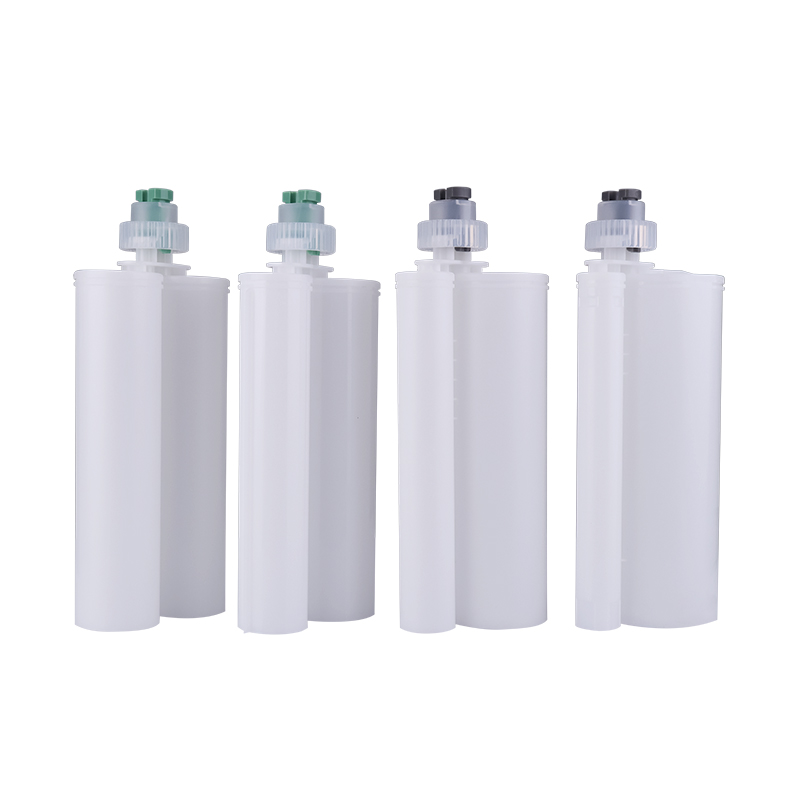
The mix ratio is not a label; it is geometry. A 1:1 cartridge uses symmetric chambers and a single piston that advances both parts evenly. A 4:1 or 10:1 cartridge is deeply asymmetric — the small chamber must meter a fraction of the volume while the large one dominates, and any wall flex in the divider throws the ratio off. That is why off-ratio risks at 4:1 and 10:1 demand a rigid divider wall and reinforcement, not just a different print. Confirm chamber geometry against cartridge sizing and ratio compatibility before specifying.
Viscosity and Thixotropy Set the Mixer Geometry (Helical vs Square)
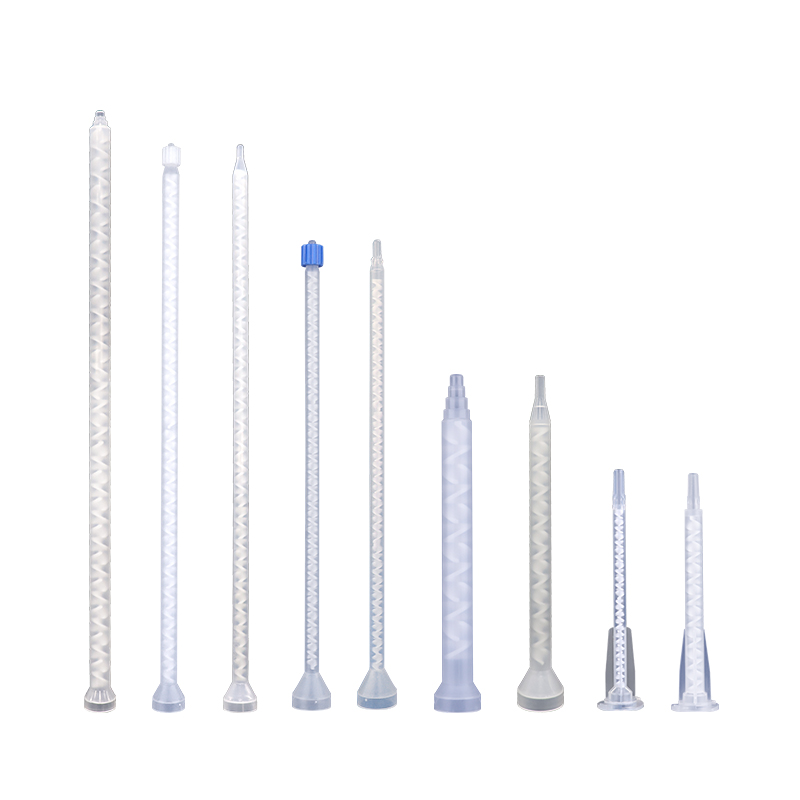
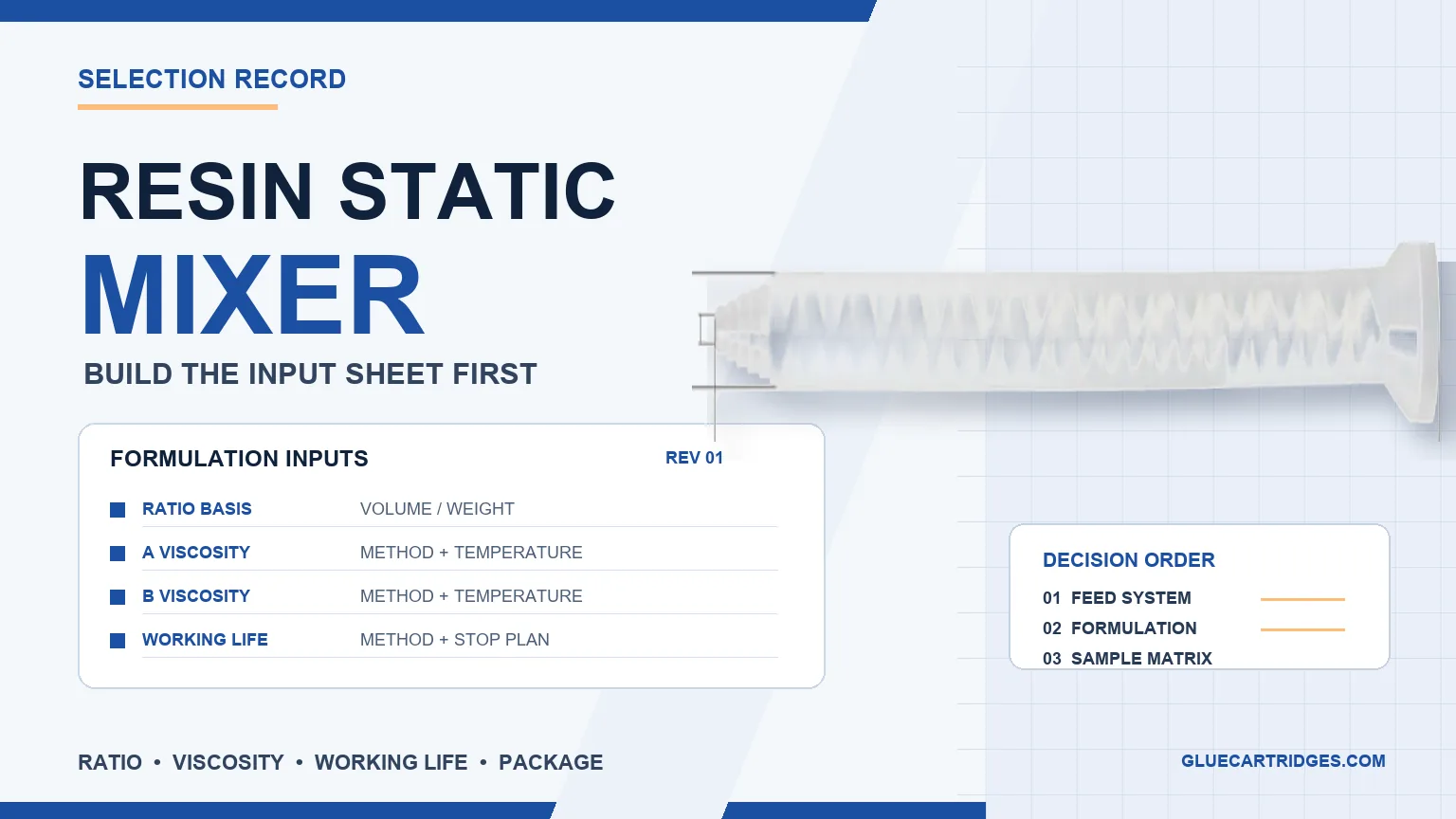
More mixing elements is not better — it is a pressure cost. Mixing quality follows a 2^N layering rule, so element count squares fluid layers, but it also raises backpressure and waste. Lower-viscosity epoxies may need only 12–24 elements; high-viscosity or high-ratio formulations push toward 32–48. Helical elements give lower pressure drop; Square-Quadro geometry reaches the same homogeneity in roughly half the length with less retained material. Silicone’s high thixotropy tends to favor helical geometry to stay inside the gun’s pressure envelope. Compare helical vs Quadro mixing geometry and review element count and mix quality for your viscosity.
Backpressure Sets the Gun Class (Thrust Ratio)
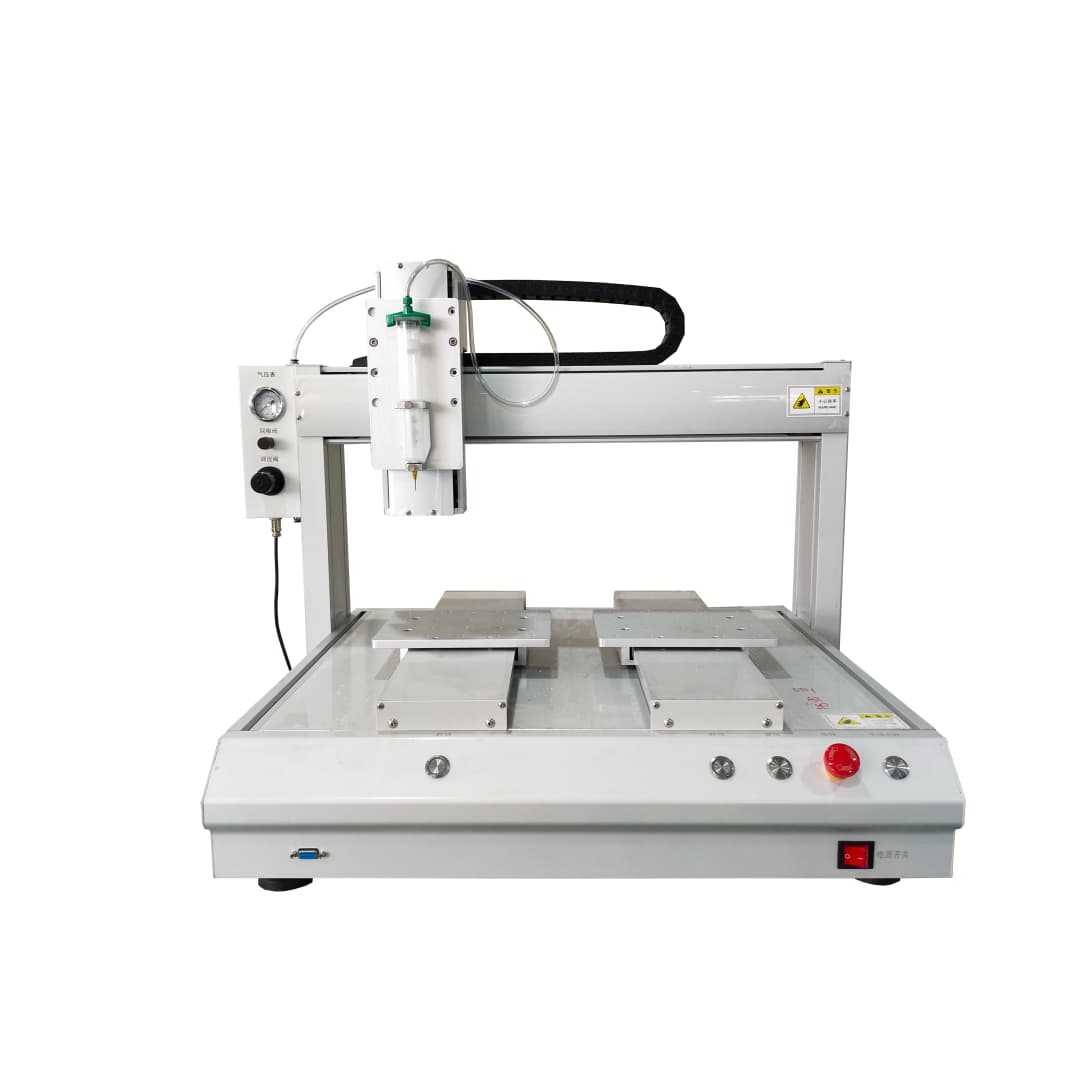
“Hard to push” is a specification problem, not a hand-strength problem. Backpressure accumulates from material viscosity, mixer resistance and cold-line temperature. Thrust ratio is mechanical advantage, not output power — a 26:1 gun multiplies effort far more than a 10:1 gun and suits high-viscosity or high-ratio fills. Above very high viscosity, a reinforced twin-plate manual gun or a pneumatic unit becomes necessary. Choose the class from gun thrust ratio and weigh manual vs pneumatic dispensing for production volume.
Formulation Aggressiveness Sets the Cartridge Material (PP / PA / PBT)
The cartridge body is a function, not a cost line. Some formulations interact with or permeate certain plastics over the shelf life, so the body polymer (PP, PA/Nylon or PBT) is selected against the chemistry and storage window, not against price. Large thin-wall sizes above 400 ml add wall-stiffness and dimensional-stability demands. Match the body to the formulation using cartridge size and material selection. For the full hardware picture, our static mixing nozzle engineering guide connects mixer choice to the rest of the system.
The Silicone Exception: When 2K Silicone Is Right — and What It Breaks
Silicone is not a weaker epoxy. It is a different role: seals, gaskets, potting and flexible bonds that survive thermal cycling where rigid adhesives crack. If you screen it on load alone, it drops out of most structural roles — and that conclusion itself saves you from a misapplication.
The part almost nobody warns about is cure inhibition in two-component addition-cure (platinum) silicone. Sulfur, amines, organotin, phosphorus compounds and certain solvents at ppm levels can suppress curing. The inhibition is irreversible — raising temperature will not rescue it. Practically, for 2K silicone the chemical cleanliness of the packaging and line consumables is a functional requirement, not a purchasing line item: a different cartridge polymer, a contaminated glove, or a shared tool can all read as “the adhesive will not cure.” Always validate empty cartridge qualification and prefer a virgin polymer specification when the formulation is sensitive, and treat any packaging-compatibility claim as something to confirm with a small-scale cure test against your actual formulation, not as a generic guarantee.
Step 3: Read the Failure: Chemistry Fault vs System Fault
When a joint fails, the symptom tells you where to look. Check the system side first — it is cheaper and more common than a chemistry error.
| Symptom | Chemistry-side suspect | System-side suspect | 5-minute check |
|---|---|---|---|
| Stays tacky, never cures | Wrong chemistry or expired part | Off-ratio or no mix | Verify ratio; discard un-mixed head |
| Only the first bead under-cures | — | Unbalanced cartridge, no purge | Purge start; re-prime |
| Cohesive failure at interface, gel fine | Surface prep / primer | — | Check substrate prep |
| Edge cracking, brittle | Brittle system under peel | Load form mismatch | Convert load to shear |
| Jams mid-bead | — | Mixer + cold-viscosity backpressure | Warm material; raise gun class |
| Streaks, grains, crumbs | — | Wrong element count/geometry or reused mixer | Replace mixer |
| Run-on after trigger release | — | Anti-drip or trapped air | Check anti-drip; de-aerate |
| Bleed behind plunger | — | Piston match or over-pressure | Check piston; lower pressure |
This table is the bridge from “read the article” to “use it on the line.” For a deeper walkthrough, see 2K cartridge failure analysis, how to correct uneven 2K dispensing, the link between back-pressure and off-ratio beads, and trapped air in 2K cartridges.
Application Matrix: Where Each Chemistry Usually Lands
The matrix maps a scenario to a load character, a chemistry and the dispensing consequence — not a list of industries.
- EV battery module bonding and potting: thermal cycling and electrical isolation favor silicone and toughened epoxy; see EV battery pack dispensing for thermal-interface demands.
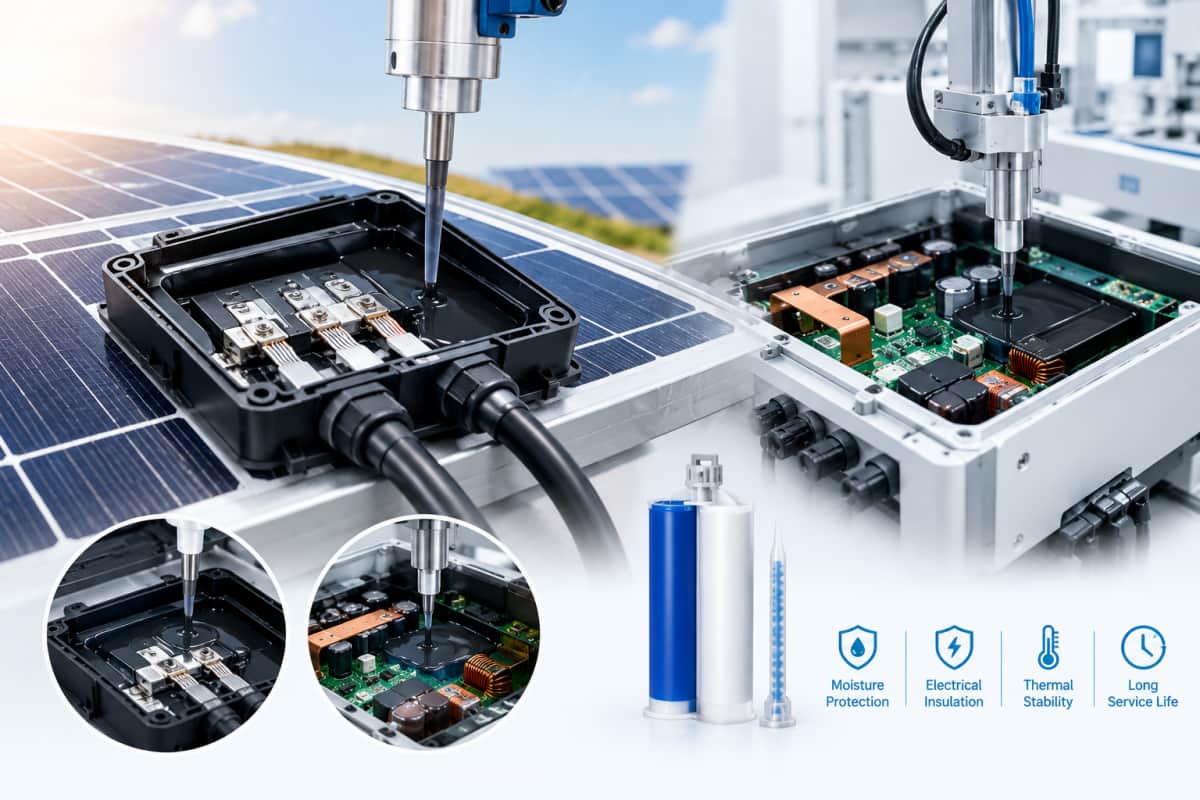
- Electronics potting and component fixing: low-stress encapsulation favors silicone and low-modulus epoxy; review electronics potting and encapsulation dispensing.
- Curtain wall, anchoring and joints: weather and movement favor silicone and PU; ratio and mixer must handle the chosen modulus.
- Metal-to-plastic assembly: CTE mismatch favors compliant PU or toughened epoxy to avoid interfacial stress.
- Near-heat-source roles (engine bay, lighting): silicone and high-temp epoxy lead; confirm continuous temperature against TDS.
- Medical device assembly: biocompatibility and cure cleanliness drive chemistry; validate medical device adhesive dispensing and packaging purity.
What to Put in Your Adhesive Spec Before You Talk to Any Supplier
Hand this table to suppliers so the line delivers what the lab promised.
| Parameter | Why it matters | Confirmed by | Cost if omitted |
|---|---|---|---|
| Volumetric mix ratio | Drives cartridge architecture | Formulator | Off-ratio joints |
| Application-temperature viscosity (not room temp) | Sets mixer & gun class | Formulator | Backpressure failure |
| Target bead rate & size | Sizes mixer output | Both | Throughput loss |
| Acceptable ratio tolerance | Defines QC window | Both | Inconsistent cure |
| Continuous service temp | Picks chemistry | Formulator | Premature failure |
| Substrate pair & exposure | Confirms compatibility | Both | Adhesion loss |
| Storage & moisture sensitivity | Sets cartridge material | Formulator | Shelf-life failure |
Top three most-often-missing: application-temperature viscosity (room-temperature numbers hide cold-line backpressure), acceptable ratio tolerance (without it QC cannot catch drift), and storage/moisture sensitivity (it decides the cartridge body polymer). Validate nozzle behavior with nozzle qualification and audit supply with a factory verification checklist.
FAQ
Is epoxy stronger than polyurethane adhesive? Epoxy usually shows higher lap-shear on a coupon, but “stronger” depends on load form: polyurethane outperforms under peel, impact and vibration where brittle epoxy cracks. Choose by load, not by the headline number.
Which 2K adhesive should I use for bonding metal to plastic? When the pair has mismatched thermal expansion, a compliant polyurethane or a toughened epoxy absorbs the stress better than a rigid adhesive; verify against the specific substrate and temperature swing.
Can silicone adhesive carry a structural load? Generally no — its low modulus makes it a seal, gasket or flexible bond rather than a primary load path. Use it where movement and thermal cycling matter more than load rating.
Why did my 2K adhesive not cure even with the correct mix ratio? Look at the system first: under-mixing, an unbalanced start, or trapped air. For 2K platinum silicone, also check cure inhibition from sulfur, amines or contaminants at ppm levels.
Do I need a different static mixer for epoxy, polyurethane and silicone? Yes. Element count and geometry change with viscosity, thixotropy and ratio; silicone’s high thixotropy often favors helical geometry. See 2K cartridge formats and ratios.
Does a higher thrust-ratio gun fix a hard-to-dispense adhesive? It fixes backpressure from viscosity and mixer resistance, but it cannot repair under-mixing or an off-ratio fill. Address the root cause first.
What mix ratio do 2K silicone adhesives use? Commonly around 1:1, sometimes 2:1, but confirm against the formulation’s TDS — ratios vary by product.
Contact the HaiJing team for technical support
Choosing the adhesive is choosing the system that can deliver it. Send us your chemistry, mix ratio, application-temperature viscosity and current dispensing gun, and our application engineers will return a matched cartridge, mixer and thrust-ratio specification. Formulating a new 2K product? Request a packaging compatibility assessment and a sample kit tested against your formulation class. Download the 2K Chemistry-to-System Specification Checklist before your next supplier meeting, and submit your dispensing parameters through our dual-component cartridge systems team.