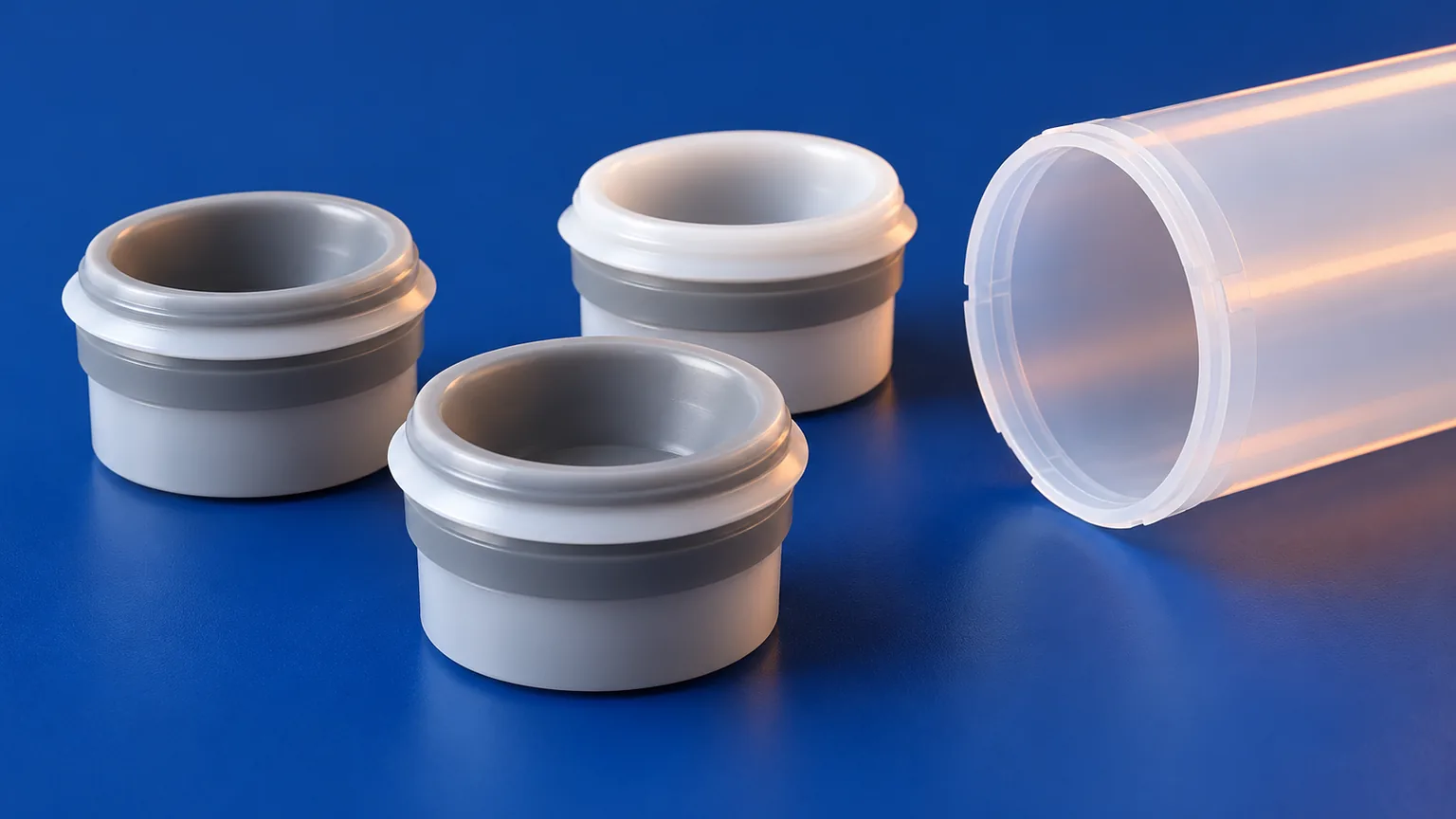
Choose a cartridge piston seal as a matched piston-and-barrel combination. The useful design maintains the required separation between the adhesive and the space behind the piston while moving with acceptable starting and running resistance. A tighter fit is not automatically a better seal: it can increase drag, deform a flexible barrel or make startup less predictable. Compare candidates after filling and formulation exposure, not only as clean, empty components.
This guide helps adhesive packaging teams evaluate contact, friction and bypass leakage. It is about the component inside the cartridge, not a dispenser’s drive mechanism. Dimensional inspection remains essential, but it answers a different question; our cartridge drawing acceptance guide explains how to establish that dimensional baseline.
Start by defining what must stay on each side of the piston
“Leak-free” is incomplete unless the path and operating condition are identified. Adhesive moving behind a piston, gas moving toward the adhesive, and leakage at an outlet closure are different observations. They do not necessarily share a cause or a corrective action. Write down which separation the package must maintain during filling, storage, transport and dispensing.
- Formulation side: identify the actual component contacting the piston, including its relevant temperature and storage conditions.
- Rear side: identify whether the assembly is mechanically driven or exposed to a pneumatic drive condition. A design approved in one arrangement is not automatically approved in another.
- Motion: define the intended stroke, dispensing rate, pauses and restarts. A seal that works while stationary still needs evaluation while moving.
- Acceptance: specify the location, amount and observation method for unacceptable migration, together with acceptable motion behavior. Do not substitute “no visible leak” for a more demanding barrier requirement.
For a dual cartridge, keep the two chambers’ observations separate. Different bore sizes or formulations can create different resistance. Material behind one piston is not, by itself, proof of cross-contamination through the central dividing wall. Preserve that distinction before choosing a different piston.
Contact must be sufficient without making movement unreliable
A sealing edge needs suitable contact with its mating bore. Too little effective contact can leave a migration path; excessive interference can raise friction or distort a compliant part. The outcome depends on the complete geometry and materials, not simply on the free diameter of the piston.
A flexible lip can accommodate some variation, but its behavior depends on its section, orientation and support. Multiple sealing edges may provide useful wiping or separation, yet they also change the contact system. Counting lips does not establish which design will seal better over the entire stroke. A scratch, damaged edge or localized bore defect can undermine an otherwise sensible design.
Nordson EFD’s cartridge-piston information illustrates the importance of a piston developed for its matching cartridge and describes wiper and air-management features. Those are product-specific examples, not dimensional or performance specifications for Haijing parts. Do not transfer a competing supplier’s color code or material selection to another cartridge family.
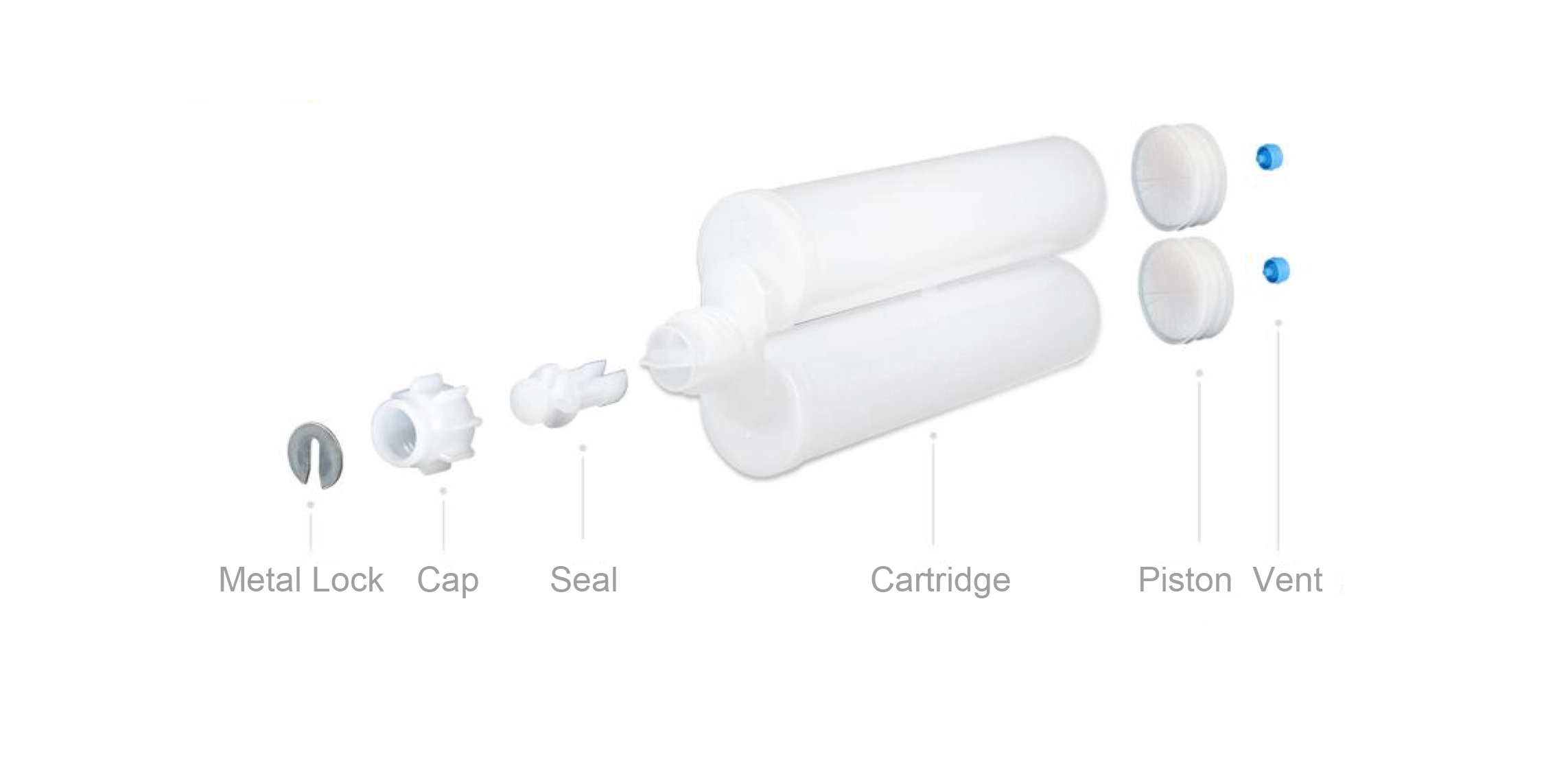
When two candidate pistons appear interchangeable, compare the specified bore contact, sealing-edge geometry, component materials and permitted assembly state. Include any separate sealing or vent component in that identity. A piston body with the same nominal diameter but a different seal package is a different candidate, not an administrative substitute.
Separate starting resistance from running resistance
The force needed to initiate movement after a pause is not necessarily the force needed to continue sliding. A package can move smoothly during a continuous stroke but hesitate at restart. Another can start easily yet show uneven resistance farther down the bore. Reporting one peak force without its location and sequence hides these distinctions.
The Minnesota Rubber & Plastics sealing guide identifies geometry, squeeze, surface condition and operating conditions among influences on dynamic-seal friction. That general principle explains why friction should be evaluated in the actual assembly. It does not prescribe an elastomer hardness or a friction limit for molded cartridge pistons.
In a controlled comparison, record the initial movement, the running portion of the stroke, and restart after a defined pause. Keep speed, temperature, fill condition and the downstream flow path comparable. If they change, a force difference may come from adhesive flow resistance rather than the piston contact alone.
Do not add lubricant merely to obtain a lower force reading. Any lubricant or processing aid becomes part of the package and needs approval for formulation contact and the end application. A low-friction result obtained with an unapproved aid does not validate the production combination.
Check filling and vent closure before blaming the sealing edge
A pocket between the adhesive and the piston can complicate startup and subsequent motion. The first question is whether the piston was seated by the intended filling and venting process, not whether it should simply be made tighter. A vent that is useful during installation may need a separate closure or an approved self-closing function afterward.
Nordson’s piston-insertion guidance discusses designs that manage air during seating. Apply only the instructions for the selected package. A deliberately perforated piston intended for a particular syringe application is not a general storage barrier for a filled dual cartridge.
For a candidate with a vent feature, document the state before filling, after seating and before storage or dispensing. Verify the intended closure step or closure action. If material later appears behind the piston, determine whether it passed around the perimeter, through a vent path, or through a damaged component. Changing perimeter interference will not necessarily correct an unclosed vent.
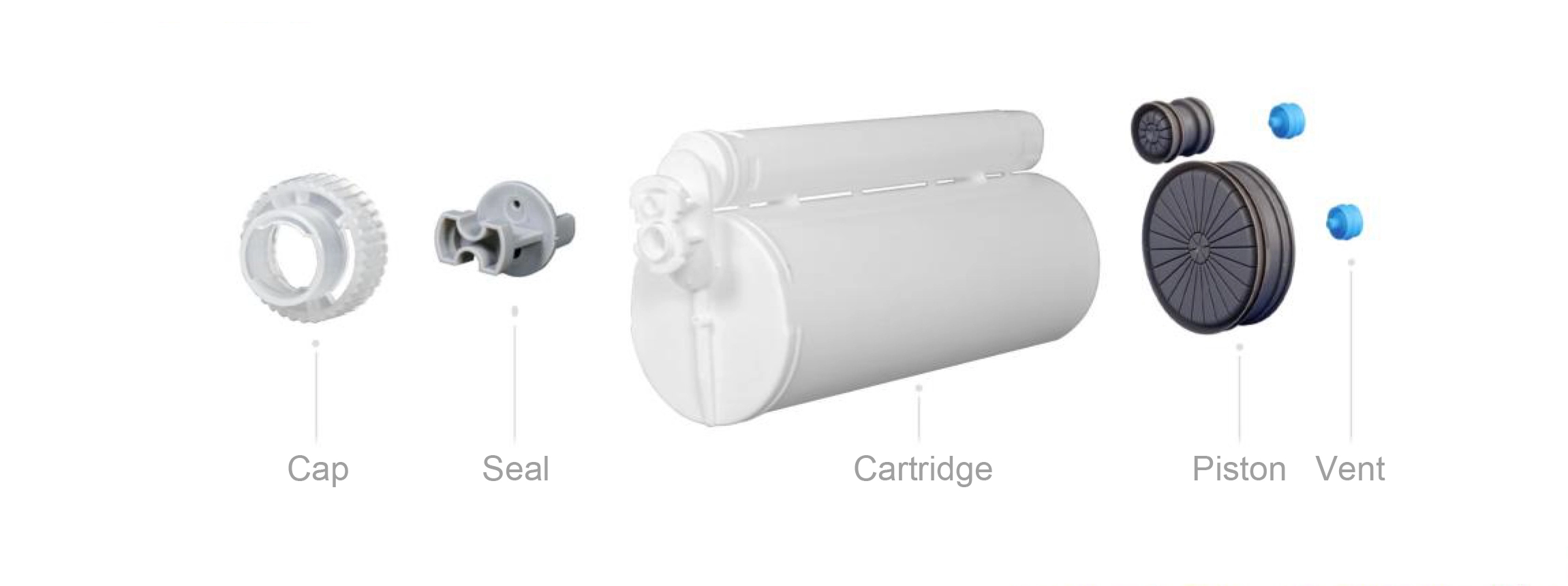
Evaluate the wetted combination, not just the polymer name
A material label is a starting point for compatibility work, not a complete approval. Formulation contact can change the condition of a sealing edge or mating surface. A candidate that performs acceptably when new should therefore be compared again after the agreed exposure and storage conditions.
Inspect for dimensional or appearance changes, softening, cracking, deposits or damage, and repeat the relevant motion and migration checks. The important question is whether the exposed combination still meets the application requirements. A clean-looking part alone cannot establish that result, and a small appearance change alone does not quantify its effect on sealing.
Keep this screening focused on the piston assembly. Full formulation/package compatibility also includes the barrel, closures and other contact materials and needs its own approval scope. Do not infer a shelf-life claim from a short piston test. Where an accelerated exposure is proposed, its relationship to actual storage must be justified rather than assumed.
Compare candidates in stages so the result can be explained
A useful trial isolates component behavior before testing the complete dispensing condition. The following sequence is a planning method, not a universal test standard. Set the sample coverage and acceptance criteria with the formulation and package owners before testing.
- Establish the component baseline. Identify the barrel and piston revisions, molding lots and relevant cavity markings. Inspect sealing edges and the bore at the drawing-defined locations. Hold components with unexplained damage or dimensional discrepancies rather than using the trial to excuse them.
- Compare empty-assembly motion where appropriate. Use an approved method that does not damage or contaminate the components. This can help identify mechanical drag, but a dry result is not a prediction of wetted behavior.
- Fill and seat using the intended process. Record formulation identity, fill condition, piston orientation, seating and vent closure. Keep retained reference assemblies prepared in the same way.
- Apply the agreed exposure and motion sequence. Include relevant storage, temperature, pauses and stroke locations. Check both chambers independently where applicable. Do not increase pressure beyond the assembly’s approved conditions to force a result.
- Inspect and reconcile. Record starting/running behavior, material migration and the condition of the separated components. Compare against the pre-agreed limits and retain nonconforming examples for investigation.
Pressure or chemical-exposure trials require suitable equipment, containment and approved safety procedures. This article supplies no pressure rating, test duration or chemical handling instruction for an unknown cartridge. A substitute fluid can help investigate a mechanism only when its role is defined; passing with that fluid does not approve the actual adhesive.
Change one meaningful factor at a time where practical. If the piston geometry, barrel material and filling method are all changed together, an improved result cannot identify which change mattered. Once a combination works, freeze its complete identity and re-evaluate relevant changes instead of approving a vaguely similar “equivalent” piston.
Use the leakage path and motion pattern to choose the next check
Piston trial observations and discriminating checks
These are diagnostic hypotheses, not confirmed causes. Swipe on a narrow screen to see the final column.
| Observation | Distinguish first | Useful next check |
|---|---|---|
| Adhesive behind the piston | Perimeter path, vent path or component damage. | Preserve orientation; inspect the closure state and localized migration before changing fit. |
| High first movement after a pause | Contact resistance versus changed formulation or downstream resistance. | Compare matched pause/temperature/flow-path conditions and the subsequent running portion. |
| Resistance changes with stroke location | Local bore/contact variation versus a changing material load. | Map the observation to travel position and inspect the corresponding bore and sealing edge. |
| One chamber behaves differently | Different formulation/geometry versus damage or assembly variation. | Retain chamber-specific records; compare the actual piston-and-bore pair, not only combined output. |
If contamination or an abnormal pressure condition is suspected, stop the affected trial and follow the approved safe shutdown procedure. Do not repeatedly cycle a suspect assembly until its evidence disappears. Our 2K cartridge failure-analysis guide explains how to preserve a reproducible supplier claim when a problem needs escalation.
Make the selection decision on the combined result
Illustrative comparison, not a Haijing test: candidate A has less migration in a storage check but unacceptable restart behavior; candidate B restarts smoothly but fails the defined separation requirement. Neither is approved merely because it wins one column. First verify that each observation was produced under comparable conditions, then investigate the failing mechanism. The answer may be a revised geometry, a different compatible material or a corrected seating process, not a compromise acceptance limit invented after the test.
The final approval should identify the barrel/piston combination, formulation scope, filling and venting method, operating conditions, dimensional references and the actual acceptance results. Record any restrictions. Empty-part acceptance, filled-package acceptance and complete dispensing validation should remain distinguishable so a future purchaser does not mistake one for all three.
Questions about cartridge piston seals
Does more wiping contact always reduce waste?
Wiping can reduce residue, but contact also changes resistance. Evaluate usable recovery alongside starting/running behavior and separation requirements with the actual formulation. A cleaner emptied barrel is not sufficient evidence of a better overall package.
Can we reuse a piston after a trial?
Do not assume that a removed or previously exposed piston represents a new production component. Removal, cleaning and contact history can alter it. Use new identified components for qualification unless reuse is explicitly within the approved product and test scope.
Is piston bypass the same as an outlet leak?
No. Piston bypass crosses the piston boundary; an outlet leak occurs at a different interface. Identify and document the physical path before choosing a correction. A new piston cannot be presumed to fix an outlet seating defect.