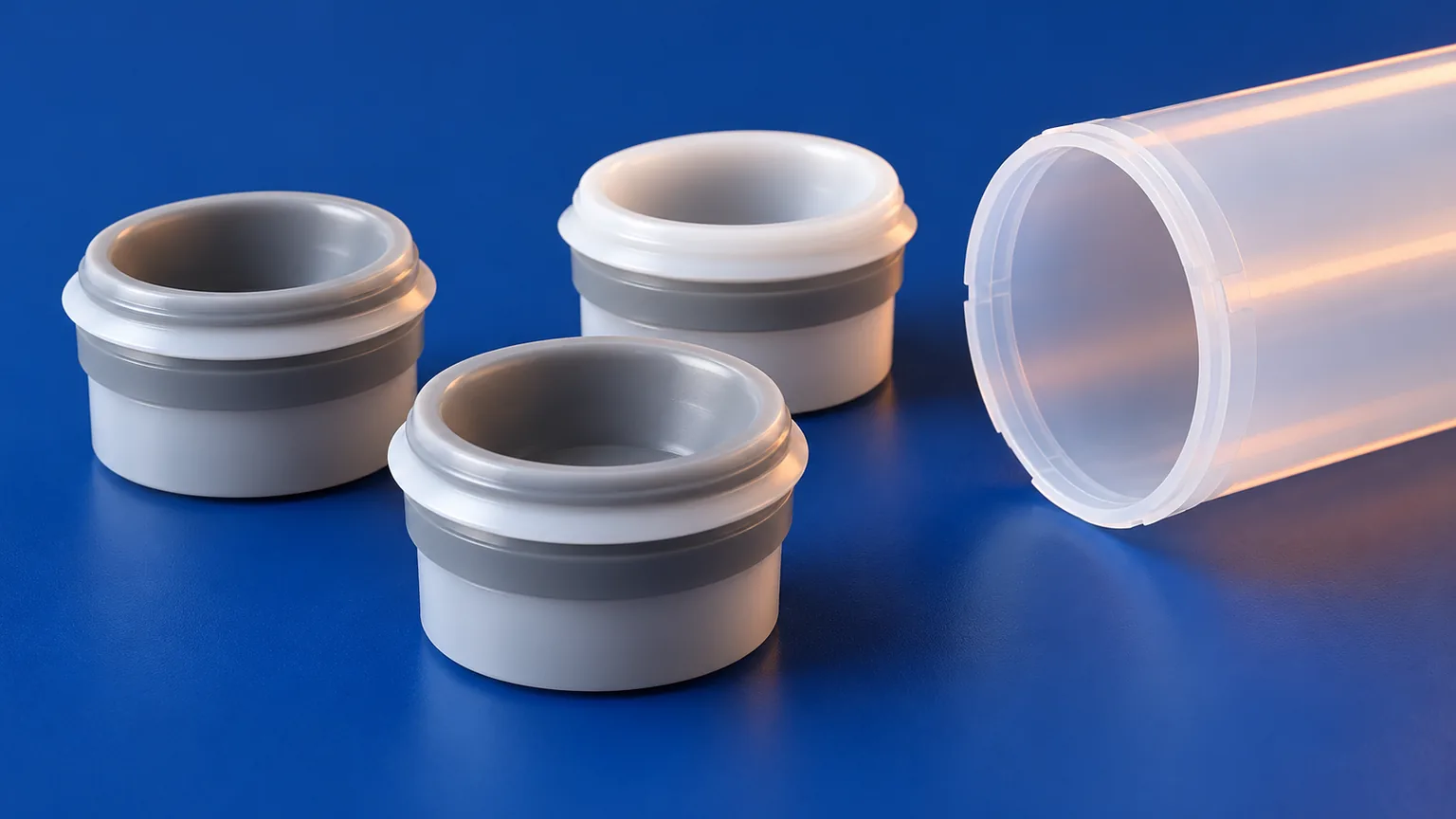
A static mixer nozzle is a disposable part that sits on a two-component cartridge or dispense valve and blends resin and hardener as the material passes through fixed internal elements. It has no moving parts and no drive. Every version you can order is defined by exactly four things: the interface that attaches it, the element geometry and count inside, the bore and length of the housing, and the ratio family of the cartridge feeding it. This page maps those four dimensions and points to the detail page for each one, so a part number stops being a code and becomes a set of decisions.
Key Takeaways
- Four dimensions define every static mixer nozzle. Interface, element geometry and count, bore and length, ratio family. Fix them in that order and the part number follows.
- The interface is the hard constraint. A bayonet inlet cannot be adapted to a Luer cartridge with a washer or an o-ring, and a mismatched interface leaks at the joint rather than inside the mixer.
- Element count is a mixing target, not a maximum. Adding elements past the point where the two streams are already uniform buys pressure loss and retained material, not better mixing.
- Bore and length trade pressure for reach. The same element count in a smaller bore raises pressure drop and shortens the usable dispense window.
- Ratio family changes the inlet, not the mixing elements. A 10:1 cartridge delivers a much smaller B stream, so the inlet geometry and the mixer’s first elements see a different flow split from a 1:1 unit.
The four orderable dimensions
Suppliers describe mixers with long attribute lists, but a buyer only ever commits to four values. Everything else — colour, packaging, whether the housing is natural or opaque — follows from the material choice or from the line’s preferences.
The four dimensions and who constrains each one
Rows are orderable choices, not quality grades. The third column is usually fixed before the mixer is discussed at all.
| Dimension | What you actually choose | Usually fixed by | What goes wrong if it is wrong |
|---|---|---|---|
| Interface | Bayonet, threaded, Luer lock, Luer slip, or a system-specific hub | The cartridge or valve you already stock | Leak at the joint, mixer pushed off under pressure, or no seal at all |
| Element geometry and count | Helical or square (quadro) elements; 6 to 32 elements | The formulation, the ratio, and the bead quality target | Streaks and uncured patches, or excess pressure and retained adhesive |
| Bore and length | Internal diameter and overall length | The dispense rate you need and the pressure your gun or valve can supply | Slow or uneven flow, gun fatigue, burst joints, or adhesive pushed past the piston |
| Ratio family | 1:1, 2:1, 4:1, 10:1 and the inlet layout that matches | The cartridge format | Off-ratio bead even when the mixer itself is correct |
Read the table top to bottom and note that the constraints narrow as you go down. By the time you reach the ratio family, the decision has usually already been made by whichever cartridge the plant buys. That is why specifying a mixer from the material backwards tends to produce a part that mixes well but does not fit.
Interface: the one dimension you cannot fix later
The interface is a mechanical and sealing decision, not a mixing one. It determines whether the mixer stays on the cartridge under dispense pressure, whether it can be rotated to a comfortable angle, and whether it can be removed without damaging the outlet.
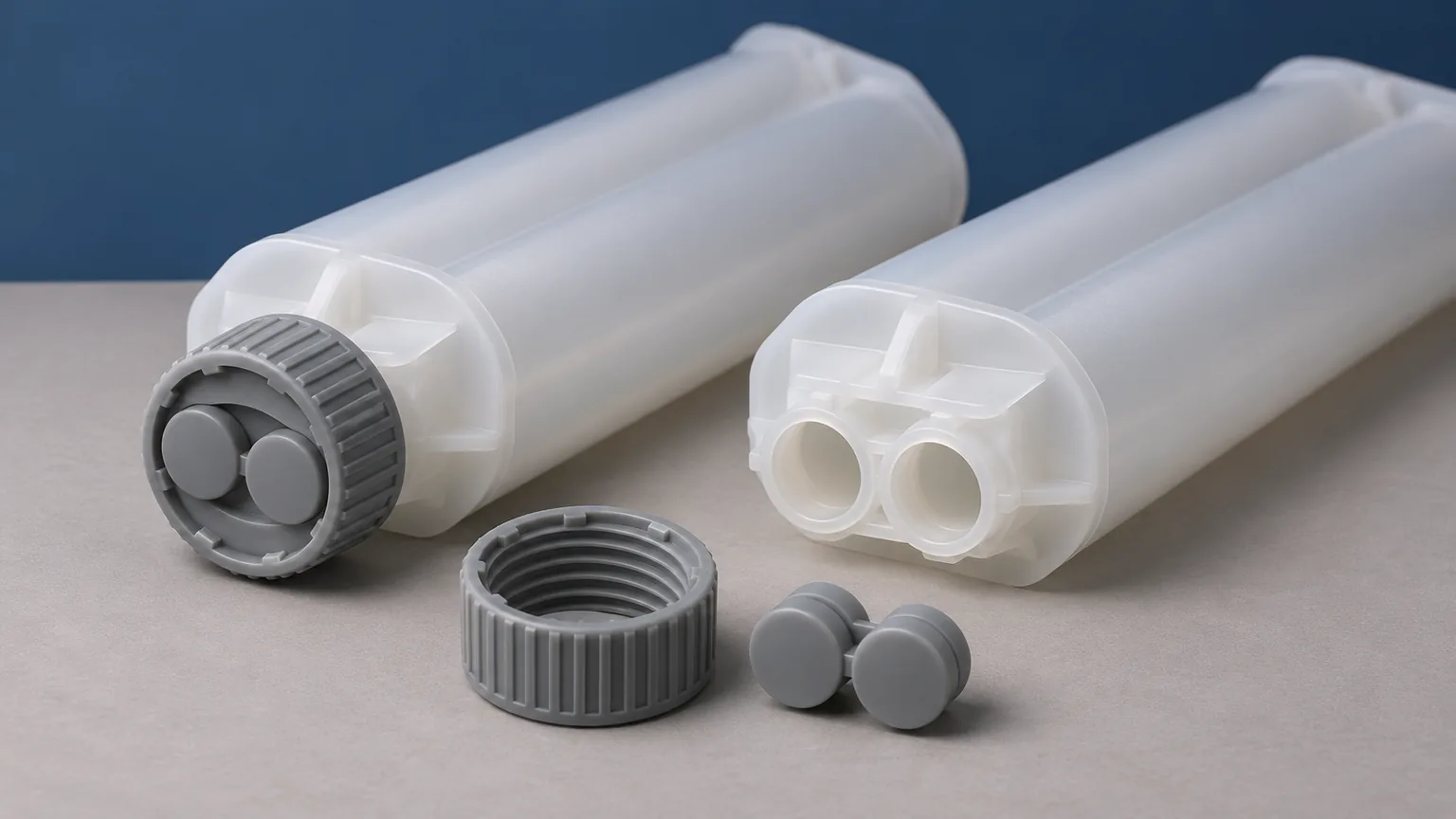
Two families cover most two-component dispensing work. Bayonet-style inlets twist and lock onto a matching cartridge hub and are the common format on 1:1 and 2:1 cartridges in the 200–400 ml range. Luer-style inlets rely on a taper to seal and are common where a specified dispense tip has to be fitted downstream of the mixer. The two are not interchangeable, and neither is improved by adding thread tape, an o-ring, or a clamp.

The interface is also where a mismatch usually shows up first. A mixer that does not seat fully will leak at the joint long before any mixing problem appears, and the leak is often misread as an adhesive or pressure fault. If material is escaping at the cartridge–mixer joint rather than inside the elements, the leaking mixing nozzle troubleshooting guide works through the usual causes in order.
The interface system also has its own naming conventions — A, B, C and F systems, and the MA / MB / MC / MCX families that follow them. Those codes describe which cartridge a mixer will seat on, and they are worth reading properly rather than assuming equivalence from a similar-looking hub. Two mixers that look identical from the outside can differ by a fraction of a millimetre at the locking lugs.
If your question is which system code matches which cartridge, the A, B, C and F interface selection guide walks through the classification, and the MA / MB / MC / MCX interchangeability guide lists which mixer formats seat on which cartridge. Both are more reliable than matching by photograph.
Element geometry: helical or square
Inside the housing, the elements split the stream, rotate it, and recombine it. Two geometries do most of the work in cartridge dispensing. Helical elements form a twisted path that continuously rotates the material around the axis. Square, or quadro, elements use angled plates that repeatedly divide and re-orient the flow through a rectangular cross-section.
The practical difference is not “which mixes better” in the abstract. Helical mixers generally deliver a given mixing quality in a shorter length, which matters when the mixer has to fit inside a nozzle recess or a robot envelope. Square mixers tend to produce a more uniform residence pattern across the cross-section and are often chosen where the bead is wide and the flow is slow. The trade-offs show up as waste volume, pressure loss, and sensitivity to the element-to-housing fit.
If you are choosing between the two for a specific adhesive, the comparison in helical versus quadro static mixers sets them against waste and length rather than against a generic performance claim, and the full selection guide covers how geometry interacts with diameter and cartridge volume.

Element count is a mixing target, not a maximum
Element count is the number buyers ask about first and understand last. More elements mean more splitting and recombining steps, so mixing improves — up to the point where the two streams are already uniform. Past that point the extra elements mostly add pressure drop, dead volume, and purge waste.
Two variables move that point. The first is the ratio: a 1:1 system has two streams of similar volume entering the first element, while a 10:1 system introduces a small B stream into a much larger A stream, and the first few elements have to distribute that small stream before any homogenisation can happen. The second is viscosity difference between the two components. A large mismatch needs more elements than the ratio alone would suggest.
Streaks and uncured patches are not always an element-count problem, though, and adding elements to fix one can make the bead worse. The practical fixes for the defects that actually appear on the bench are collected in tips for effective epoxy mixing with nozzles.
What each additional element buys — and costs
Directions, not values. The actual trade-off depends on bore, formulation and dispense rate, and has to be measured on your own material.
| Adding elements | Effect on mixing | Effect on pressure | Effect on waste |
|---|---|---|---|
| Below the requirement | Visible streaks, uncured patches, variable bead | Low | Low |
| At the requirement | Uniform bead through the run | Acceptable for the gun or valve in use | Acceptable |
| Well above the requirement | No measurable gain | Higher; the dispense window narrows | Higher retained volume per mixer |
The element count question has its own dedicated treatment: how many static mixer elements you really need works from mix ratio, and element count, mix quality and waste compares the count against what it costs in retained material.
Bore and length are pressure decisions
Bore is the internal diameter of the housing. It sets the flow area, and flow area is what converts your dispense rate into pressure loss. A smaller bore gives finer control and a shorter mixer for the same element count, at the cost of a steeper pressure curve. A larger bore flows more freely but needs more length to reach the same mixing quality.
This is where most “the mixer is too stiff” complaints originate. The mixer is often correct and the combination of bore, element count and dispense rate is wrong for the gun. Manual applicators have a comfortable force range; past it, the operator changes technique, which changes the bead. On a valve, the same mismatch shows up as pressure alarms, inconsistent shot size, or adhesive forced past the cartridge piston.
Treat bore, element count and dispense rate as one triple. Changing any one of them changes the other two in practice. The diameter and length section of the selection guide covers how the triple behaves across cartridge volumes, and static mixer back-pressure explains why excess restriction can produce an off-ratio bead even when the cartridge is fine.

Ratio family changes the inlet, not the mixer
Cartridge ratios — 1:1, 2:1, 4:1, 10:1 — describe the volume relationship between the two barrels. They do not describe the mixer, but they do change what the mixer’s inlet sees. In a 10:1 cartridge the B-side outlet is small, and the mixer inlet has to accept that small stream and fold it into the larger one without letting it run down one wall.
This is why a mixer that performs well on a 1:1 cartridge is not automatically right for a 10:1 cartridge of the same volume, even when the interface is identical. The first two or three elements do the distribution work, and their geometry is what the ratio actually constrains.
Ratio also decides how the material behaves after mixing. A 1:1 system has more B component per unit volume, so the same incomplete mixing produces a different defect than it would in a 10:1 system. The volume-versus-weight guide to mixing ratios covers how the ratio is stated and measured, and mixing nozzles for 200 ml and 400 ml cartridges works through sizing and ratio for the two most common package sizes.
Three pairs that get confused
Most specification errors we see are not arithmetic. They are two different parts being treated as one.
Bayonet versus Luer
Both attach a mixer to a cartridge, and both are described as “connections”. Bayonet is a twist-lock mechanical retention with an integrated seal face. Luer is a taper fit, usually used to hold a tip rather than to hold a mixer under full cartridge pressure. A bayonet mixer on a Luer outlet will not seal, and a Luer mixer on a bayonet hub will not lock.
Static versus dynamic
A static mixer has no moving parts and relies on the flow path. A dynamic mixer has a driven element and can handle short pot life, high filler loading, and formulations that set too fast for a passive path. The 2K dynamic mixing nozzle guide covers where the passive approach stops being viable.
Mixer versus dispensing tip
A mixer blends; a tip shapes the deposit. They sit at the same end of the assembly and are often described in the same sentence, but they solve unrelated problems. The comparison of adhesive dispensing nozzles and mixing nozzles separates the two, and the outlet types overview covers what the mixer’s own discharge end controls.
Turning the map into a sample request
Four dimensions plus the material is enough to request a sample without a drawing exchange. The list below is what a supplier needs in order to send something that can actually be trialled, rather than something that looks similar.
What to send with a sample request
The right-hand column is what the supplier cannot infer — if it is missing, the sample is a guess.
| Item | Why it is needed |
|---|---|
| Cartridge or valve make and format | Fixes the interface and the ratio family |
| Ratio, stated by volume | Determines inlet layout and the first elements |
| Adhesive type and filler loading | Drives geometry choice and wear expectation |
| Viscosity of each component, with temperature | Sets how many elements the mixing target actually needs |
| Dispense rate or cycle time | Constrains bore; without it the bore is a guess |
| Gun or valve, and whether operation is manual | Sets the acceptable pressure drop |
| Bead or deposit target | Defines what “mixed” has to look like |
| The defect you are trying to remove | Turns the sample into a test with a pass condition |
With those eight items, a sample can be specified and shipped against a stated purpose. What still has to happen on your side is the trial: a mixer that arrives without a pass condition cannot be accepted or rejected, only discussed. The epoxy mixing nozzle buying guide covers what belongs on the purchase order, and mixing nozzle qualification sets out a production release test that produces evidence rather than an opinion.
Send the four dimensions, get a matched sample
Share the cartridge format, the ratio, both component viscosities, your dispense rate, and the defect you need to eliminate. Haijing reviews the custom mixer and tooling route against those inputs and returns a proposed part with its drawing, so the trial starts from a defined assembly rather than a lookalike. Acceptance stays with your material and your test criteria.
Questions that come up before a first order
What is the difference between a static mixer nozzle and a mixing tip?
A static mixer nozzle contains the mixing elements and does the blending. A mixing tip is the discharge end that shapes the deposit, and on some assemblies the two are one moulded part. When they are separate, the mixer is chosen for mixing quality and the tip for bead geometry.
How many elements do I need for a 1:1 epoxy?
It depends on viscosity difference and bead target more than on the ratio itself. A 1:1 system with closely matched viscosities usually needs fewer elements than a 10:1 system, but a large viscosity gap can reverse that. Start from the mixing target and confirm by trial rather than from a count alone.
Can I use a Luer mixer on a bayonet cartridge?
No. The two interfaces retain and seal differently, and an adapter does not change the sealing principle. Use a mixer whose inlet matches the cartridge hub, then choose the outlet end for the tip or deposit you need.
Does a wider bore always dispense faster?
It lowers pressure loss for the same length, which usually allows a higher rate. But a wider bore also needs more length to reach the same mixing quality, so the net effect on cycle time has to be measured on the actual gun or valve rather than assumed from the bore alone.
Are static mixer nozzles reusable?
Only where the chemistry and the cleaning method both allow it. Most two-component adhesives cure inside the elements, and cleaning has to remove material from a path that cannot be inspected. Reuse is a validated decision for a specific material, not a general property of the part.
What decides the material the housing is made from?
Mostly the adhesive’s carrier and filler, plus any regulatory requirement on the finished assembly. PP, PA and PBT behave differently against aggressive fillers and solvents. The PP versus PA versus PBT comparison covers where each one is appropriate.
Where to go next
- What a static mixer is and how cartridge mixing nozzles work — start here if the mechanism itself is the question.
- The full selection guide — geometry, diameter, length and cartridge volume in one place.
- Static mixer part numbers explained — how the codes on a drawing map to the four dimensions above.
- Outlet types: Luer, stepped, tapered and full-bore — what the discharge end controls.