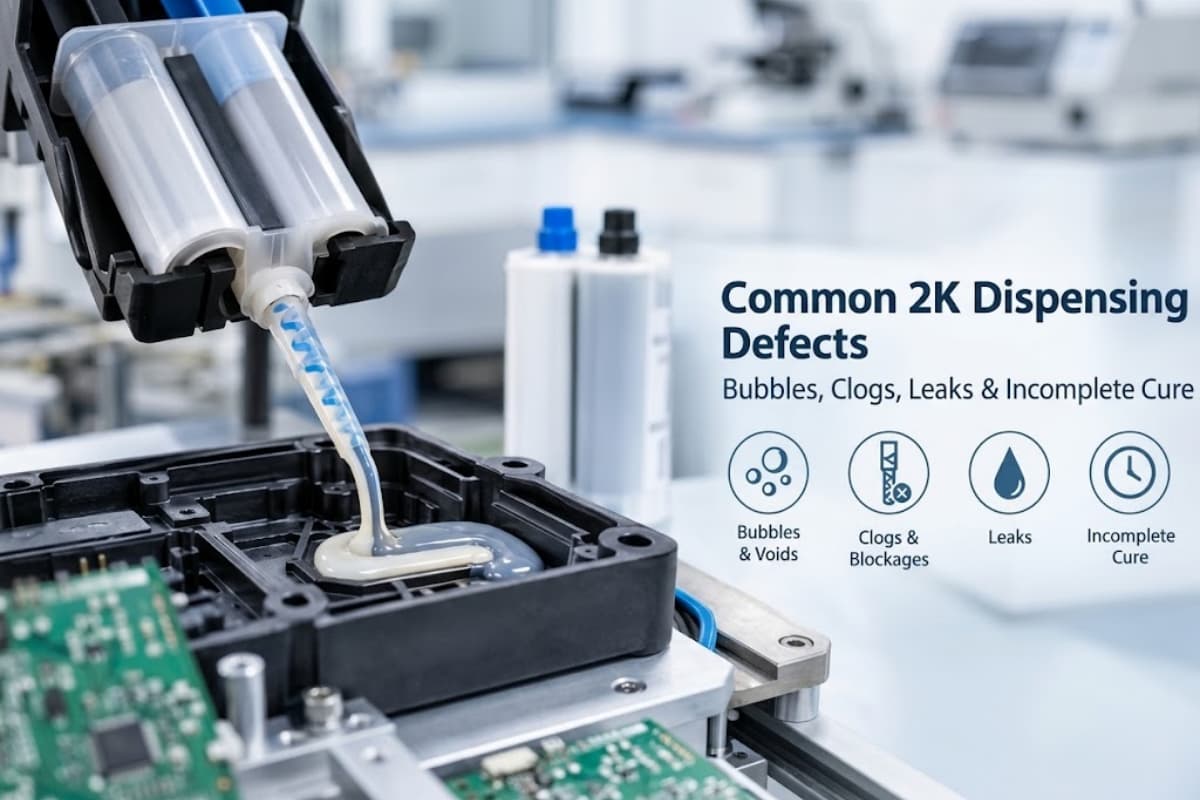
A 2K dynamic mixing nozzle is the right choice when the two components can no longer be homogenised by flow alone: extreme mix ratios, a large viscosity difference between resin and hardener, shear-sensitive materials, or a process where purge waste from a long static mixer has become a cost problem. The difference is mechanical — a dynamic mixer drives a rotating element inside the housing with a motor, so mixing energy comes from the drive rather than from the pressure drop across a fixed element stack. This guide explains the failure signals that point to dynamic mixing, how to read a dynamic mixer specification, and what to confirm before you integrate one.
What Changes Inside the Nozzle
A static mixing nozzle is a passive component. The two components are pushed through a fixed set of elements; each element splits and recombines the flow, and the mixing quality is a function of element count, geometry, flow rate and the pressure the dispensing system can supply.
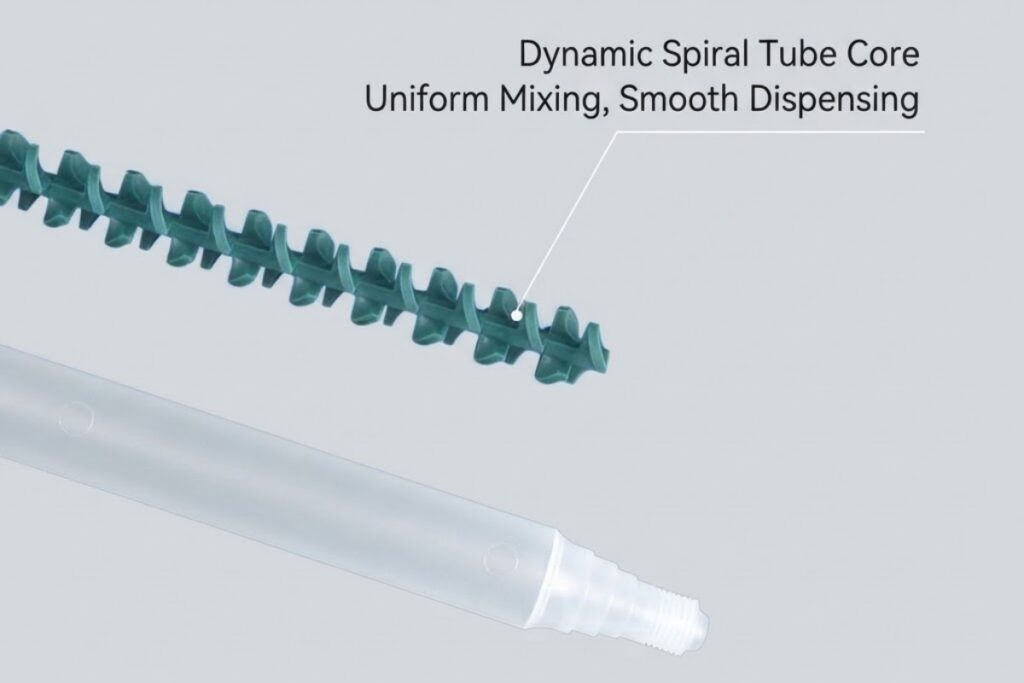
A dynamic mixing nozzle puts a rotating element inside the mixing chamber. The element is connected to an external motor through a drive interface, and the rotation adds mechanical shear on top of the flow. Three consequences follow:
- Mixing no longer depends only on the pressure the pump or gun can deliver. Very different viscosities can be forced together because the rotor does the work.
- Mix quality becomes an adjustable process variable. Rotational speed is a setting you can tune for a material, instead of a fixed geometry you have to replace.
- The mixer can be shorter for the same result, which reduces the volume of mixed material left in the nozzle at the end of each cycle.
The trade-off is that a dynamic mixing nozzle is a driven component. It needs a motor, a drive coupling, a speed controller, and a cleaning or purge routine that accounts for the rotating parts.
Four Signals That Static Mixing Has Reached Its Limit
Most production teams switch after a period of troubleshooting rather than by design. These are the four conditions that most often justify the change.
| Signal observed on the line | Why it happens with a static nozzle | What dynamic mixing changes |
|---|---|---|
| Off-ratio or streaked bead at low flow | Element count and geometry only deliver mix quality within a flow window | Mechanical shear supplies mixing energy independent of flow rate |
| Extreme mix ratio, for example above 10:1 | The minor component forms too few striations to distribute | Active rotor continuously redistributes both phases |
| Large viscosity difference between A and B | The low-viscosity component channels through the high-viscosity one | Rotor drags both phases through the shear zone |
| Shear-sensitive foam or silicone degrades in a long static mixer | Long residence in a high-pressure-drop element stack heats and shears the material | Shorter mixer, lower back pressure, adjustable speed |
| Purge waste per cycle is significant | Long element stack holds a large residual volume | Shorter mixer retains less material per purge |
Off-ratio beads and flow sensitivity
If mix quality collapses whenever the operator slows down, the static nozzle is being asked for more mixing energy than the flow can provide. Adding elements raises back pressure, which costs flow rate and can push the dispensing gun or pump outside its stable range. That is usually the point at which a mixer change stops helping.
Extreme mix ratios
Ratios up to 100:1 are listed as a dynamic mixer application. At those ratios the minor phase can be a few percent of the volume, and passive striation cannot reliably distribute it within a practical nozzle length.
Viscosity difference between the two parts
This is the case the product page calls out directly: dynamic mixers are intended for a large viscosity difference between the two components. A thin hardener and a thick filled resin behave very differently in a fixed element stack, and the thin phase takes the path of least resistance.
Shear-sensitive materials
Structural foams and some silicones change structure when held under shear and pressure. A shorter dynamic mixer reduces residence time, and speed control lets you find a setting below the degradation threshold.
Static vs Dynamic: A Decision Table
Use the criteria that actually change your process rather than a general preference.
| Decision criterion | Favours a static mixing nozzle | Favours a dynamic mixing nozzle |
|---|---|---|
| Mix ratio | Up to about 10:1 in normal conditions | Extreme ratios, including up to 100:1 |
| Viscosity difference between A and B | Components of similar viscosity | Large difference between the two parts |
| Flow rate range | Stable, repeatable flow | Varying flow, frequent starts and stops |
| Capital and maintenance | Low, disposable, no drive | Higher, motor and controller required |
| Purge waste per cycle | Acceptable | Must be minimised, for example with expensive adhesives |
| Material sensitivity | Not shear sensitive | Shear-sensitive foams or silicones |
| Automation level | Manual or semi-automatic guns | Machine dispensing with controlled speed |
If your case sits on both sides, the honest answer is that it depends on the material and the duty cycle, and the only reliable test is a dispensing trial with your adhesive.
Reading a Dynamic Mixer Specification
Dynamic mixer part numbers encode the geometry, and two suppliers rarely use the same coding. Rather than guess at a code, confirm four items with the manufacturer:
- Housing diameter or series: the MR range referenced here includes 16.7 and 22 series, for example MR-16.7-12-16-G-GN and MR-22-12-26-G-GN.
- Element configuration: element count and element geometry are part of the code, and they determine both mix quality and retained volume.
- Length: a shorter mixer reduces waste but must still deliver the required mix for your ratio and viscosity difference.
- Housing and element material: PBT is offered as an element material option, and compatibility with your adhesive chemistry has to be checked.
Custom configurations, including different element numbers, lengths and materials, are available on request for this product range. That matters because the optimum is material-specific; a standard catalogue item is a starting point, not an answer.
When you request a quotation, send the ratio, both viscosities, the flow rate range, the adhesive chemistry and the duty cycle. Those five inputs let a manufacturer propose an element count and length instead of guessing.
Motor Drive and Rotational Speed: The Extra Process Variable
Speed control is the reason dynamic mixing tolerates difficult materials, and it is also the reason commissioning takes longer than with a disposable static nozzle.
Practical points:
- The rotor is driven through a coupling to an external motor; the drive interface is part of the mechanical specification.
- Rotational speed changes shear input. Too low and mixing is incomplete; too high and you may heat the material, whip air into it, or degrade a shear-sensitive formulation.
- There is no universal correct speed. It depends on viscosity, ratio and flow rate, so treat the first setting as a starting point and validate it by cure testing and, where relevant, by sectioning cured beads.
- Once a speed is validated, record it as part of the process specification alongside flow rate and temperature.
Integrating a Dynamic Mixing Nozzle Into a 2K Dispensing Setup
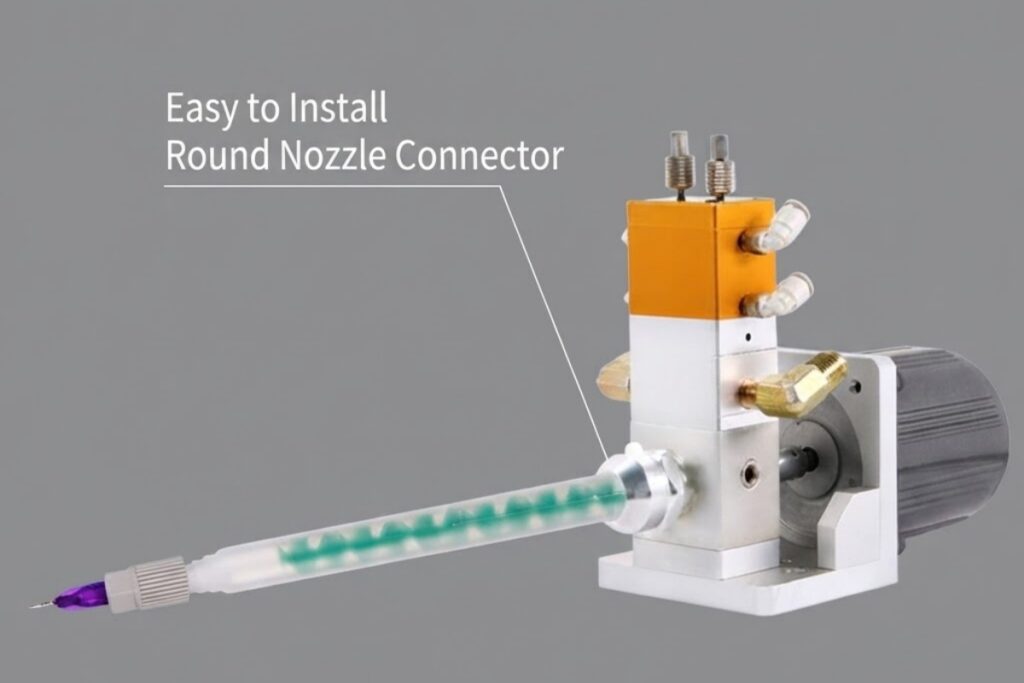
A dynamic mixer is one component in a fluid path. It only performs if the rest of the path supplies it correctly.
- Material supply: confirm the cartridge or bulk system can deliver both components at the required rate. For cartridge-fed systems, the cartridge ratio and the machine or gun thrust ratio both matter.
- Shut-off and purge: because the mixer is not disposable in the same sense as a static nozzle, the line needs a defined purge or cleaning routine and a defined maximum open time for the material.
- Motion and valve: on automated cells, the dispensing valve and the motion platform have to be specified together with the mixer, since mix quality depends on how steadily material is fed during path acceleration.
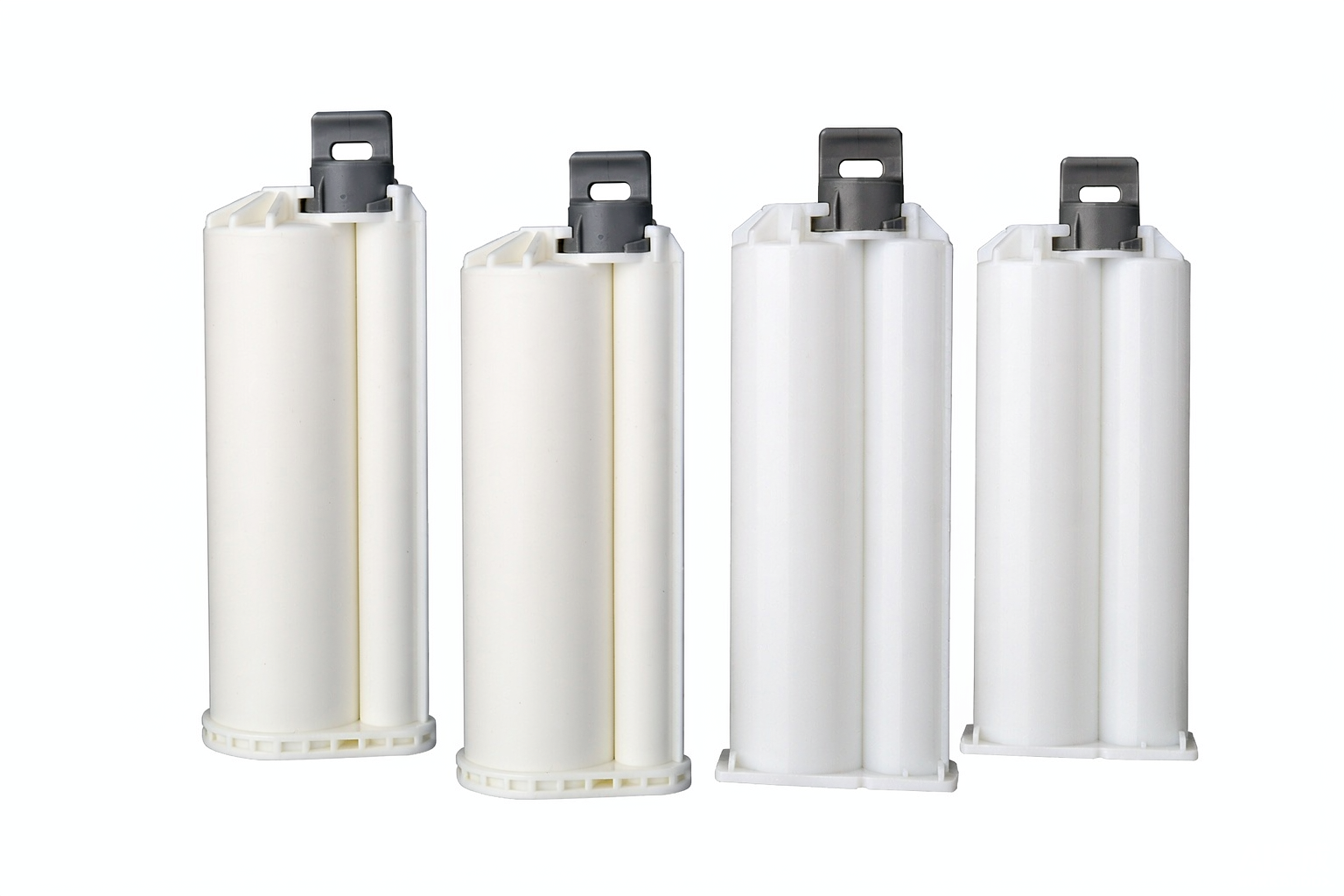
- Interface: the nozzle has to match the cartridge outlet and the A/B connection type used by your cartridge system, whether bayonet, bell mouth or threaded.
For benchtop or robot-mounted 2K dispensing, it is worth specifying the applicator, the cartridge system and the mixer as one assembly rather than sourcing them separately and matching them afterwards.
Material Compatibility and Cleaning
Two practical issues determine uptime on dynamic mixing cells:
- Chemical compatibility of the housing and element material with both components, and with any solvent used for cleaning. Confirm compatibility data for your specific adhesive rather than assuming it.
- Cleaning access. Because the rotor and housing are reused, the cleaning method has to be defined before production starts: solvent flush, purge with a non-reactive compound, or disassembly. The right choice depends on the pot life of the material and the production rhythm.
Where the material has a short pot life inside the mixer, plan the purge interval into the cycle time instead of discovering it during the first production run.
A Pre-Quotation Checklist
Before you ask for a dynamic mixing nozzle quotation, have these eight items ready:
- Mix ratio of the two components.
- Viscosity of each component, with measurement temperature.
- Flow rate range, including minimum and maximum.
- Adhesive or sealant chemistry, and whether it is filled, abrasive or shear sensitive.
- Cartridge or bulk supply method and the outlet interface type.
- Duty cycle: continuous, intermittent, or frequent start-stop.
- Available drive: motor, controller and mounting space on the machine or valve.
- Cleaning method and acceptable purge volume per cycle.
Missing item 2 and item 4 is the most common reason a first proposal does not survive the trial.
Key Takeaways
- A dynamic mixing nozzle adds a motor-driven rotating element, so mixing energy comes from the drive rather than from pressure drop across a fixed element stack.
- Switch when you see off-ratio beads at low flow, extreme mix ratios up to 100:1, a large viscosity difference between the two components, or shear-sensitive foams and silicones.
- Shorter mixer length is one of the main economic arguments: less mixed material is retained and purged per cycle with expensive adhesives.
- Rotational speed is a real process variable with no universal value; validate it against your material and record it in the process specification.
- Specify the mixer together with the cartridge interface, the valve and the motion platform, not as a standalone part.
- Element count, length and material are configurable; send ratio, viscosities, flow range, chemistry and duty cycle to get a proposal that survives testing.
Frequently Asked Questions
What is a 2K dynamic mixing nozzle? It is a mixing nozzle for two-component adhesives in which the internal element is rotated by an external motor. The rotation adds mechanical shear to the flow, so the two components are homogenised by the drive rather than only by the pressure drop across a fixed element stack.
When should I use a dynamic mixer instead of a static mixer? When the mix ratio is extreme, when the two components have a large viscosity difference, when flow rate varies widely, when the material is shear sensitive, or when purge waste from a long static mixer is costing too much. For stable ratios, similar viscosities and disposable use, a static mixing nozzle is usually the simpler choice.
Does a dynamic mixing nozzle reduce adhesive waste? It can. A dynamic mixer achieves the required mix in a shorter length than a comparable static mixer, so less mixed material sits in the nozzle and is discarded at the end of a cycle. The actual saving depends on the material, the nozzle size and the purge routine.
What rotational speed should I run? There is no standard value. Speed depends on viscosity, ratio and flow rate. Start from the manufacturer’s recommendation for your material, then confirm by cure testing and bead inspection, and record the validated setting in your process sheet.
Can dynamic mixers be customised? Yes for this range: element number, length and materials such as PBT are configurable on request. Send the application data with the enquiry so the configuration is based on your material.
Do I need a special dispensing gun or machine? The nozzle needs a drive, so it is used on machine dispensing rather than a purely manual gun. Confirm the motor, controller, mounting and the cartridge interface as one package.
Next step — Send Haijing your mix ratio, both viscosities, flow range and adhesive chemistry, and the engineering team will configure a dynamic mixer, motor and controller package for a dispensing trial.