The Guide in 3 Steps
- Sign a tailored NDA before you send anything — unilateral for one-way reveals, mutual for co-development; cover permitted use, return/destruction, subcontractor flow-down, anti-reverse-engineering and tooling ownership.
- Disclose only what the task needs — share the specs required to quote, not your full product strategy; redact, segment and transfer securely.
- Lock tooling ownership and pick the right shield — state in writing that molds are yours and register trademarks/designs in your markets; use trade secrets for formulations, patents only where disclosure buys you defensibility.
Protecting IP in Custom Dispensing Projects: An OEM Guide
The biggest risk in a custom dispensing project is not a bad mold — it is losing control of your design, formulation or process know-how to the very partner who helped you build it. You protect that value with four moves working together: a tailored non-disclosure agreement signed before any disclosure, disciplined control over what you actually share, clear tooling ownership in writing, and the right choice between trade-secret and patent protection. Get these right and you can develop a custom cartridge, mixer or dispensing system with a molding partner without handing them your competitive edge.
What Actually Needs Protecting
Before you draft a single clause, list the assets a custom dispensing engagement puts at risk. Most OEMs think only of the CAD file; the real exposure is broader.
| Asset | What it covers | Typical risk |
|---|---|---|
| Product designs & CAD | Cartridge geometry, mixer-element layout, applicator form | Copied for a competitor’s program |
| Formulations | Resin blends, ratio windows, additives | Reverse-engineered or re-sold |
| Tooling & molds | Injection molds, fixtures, jigs | Used to make identical parts for others |
| Process parameters | Cure profile, pressure, mix ratio, cycle time | Replicated without your quality controls |
| Commercial terms | Unit cost, volume, margin | Leaked to your customers or rivals |
A practical definition of “confidential information” should enumerate these assets specifically — generic “any information marked confidential” language is a starting point, not a shield. A custom manufacturing confidentiality agreement should name designs, formulations, tooling and commercial terms outright rather than relying on a catch-all clause (see the manufacturer NDA checklist in References).
The NDA Is the First Line, Not the Only One
A non-disclosure agreement is the cheapest protection you have, and the one most often skipped. For most buyers, the NDA for contract manufacturer is the first document negotiated — and the one most often watered down to a generic template. Sign it before you send drawings or samples; disclosure that happens first never catches up. For a custom dispensing project, favor these clauses over a bare template:
- Permitted use — limit the partner to a named purpose (e.g., quoting or a pilot run), not “any purpose.”
- Return or certified destruction — require physical and electronic materials back at project end.
- Subcontractor flow-down — the partner’s plating shop or molding sub-tier must carry the same obligations.
- Anti-reverse-engineering — prohibit deriving your design from made parts.
- Tooling ownership — state molds are yours (see below).
- Governing law — pick a forum that will actually enforce; for a China-based partner, bilingual terms with local jurisdiction are often more practical than a foreign court.
The World Intellectual Property Organization notes that confidentiality agreements with business partners are a core “reasonable step” to qualify information as a protected trade secret — without them, trade-secret status is hard to claim (WIPO Trade Secrets).
Control What You Disclose
An NDA signals seriousness; disclosure discipline does the real work. Share the specification needed to quote, not your full product strategy, and keep the differentiating element — often firmware, a resin blend or an industrial design — separable and released later under a separate agreement if necessary.
Practical controls that pair with the contract:
– Redact early — send single-line BOMs and redacted drawings during quoting.
– Segment — give tooling dimensions without end-use drawings; never send your full customer list or pricing structure.
– Transfer securely — one channel, named recipients, access logs; disable downloads where feasible.
– On-site protocols — sign-in, escorts, no photography on the floor.
Own the Tooling — the Clause Most OEMs Miss
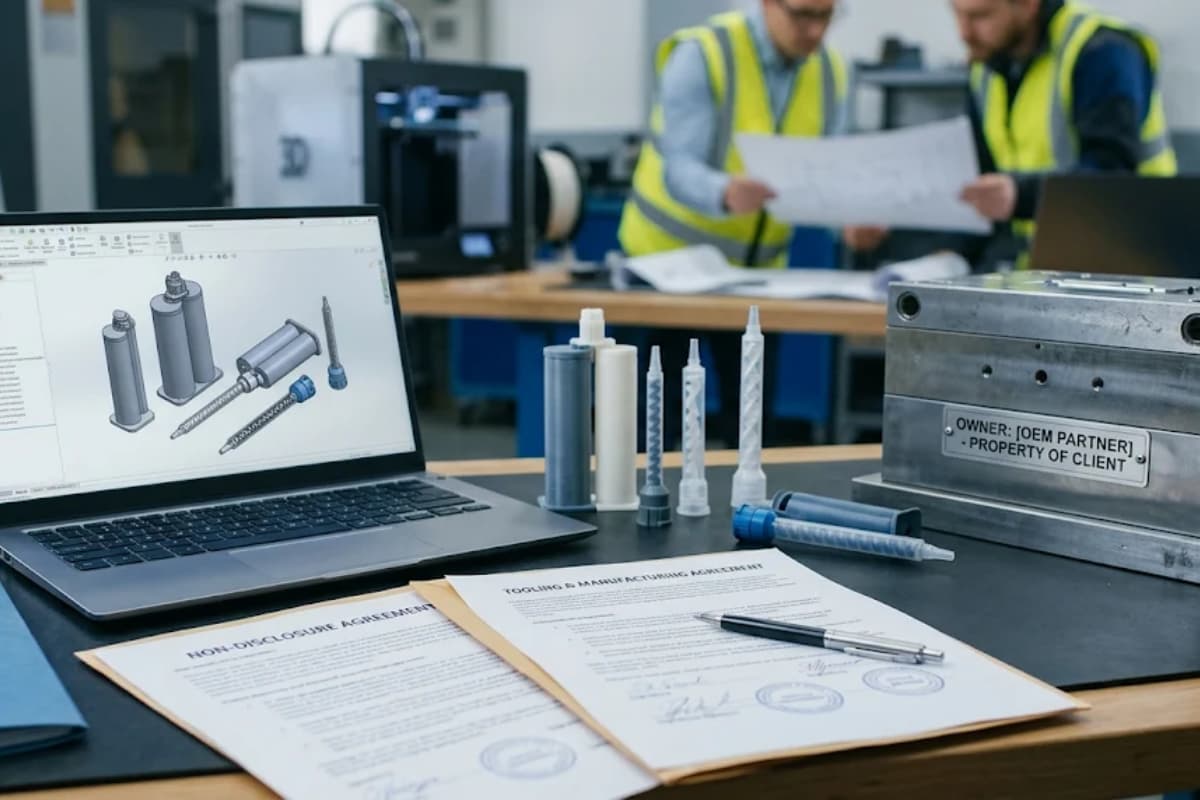
If you pay for custom molds, state in the contract that the tooling is yours, is marked as such, may not be used to produce for third parties, and can be transferred to another factory on request. Without this sentence, the same mold can produce identical cartridges for your competitors. This single clause — explicit tooling ownership in contract manufacturing — matters more than most buyers expect, because tooling is where a custom dispensing program’s residual value sits.
Trade Secrets vs Patents — How to Protect Trade Secrets When Outsourcing
To protect trade secrets when outsourcing production, a proprietary formulation or a quiet process improvement is usually safer as a trade secret than as a patent: it requires no public disclosure and protects anything that gives you an edge, not just novel inventions. WIPO points out that trade secrets protect information — designs, formulas, manufacturing processes — as long as you take reasonable steps to keep it secret, and that this is often the main way SMEs protect their advantage (WIPO — Trade Secrets for SMEs). The trade-off: a trade secret gives no exclusivity if a rival arrives at the same result independently.
Use a patent where disclosure buys you defensibility — a genuinely novel functional invention worth excluding others from. And register trademarks and designs in the markets where you sell, not just where you manufacture; in first-to-file jurisdictions, a brand registered by someone else can block your own shipments.
Vetting a Custom Dispensing Partner for IP Security
The practical protection is working with a partner whose reputation depends on protecting customers’ IP. When you evaluate a molding or dispensing partner, look beyond price:
- Reputation & references — have they served OEMs in your sector without leakage incidents?
- IT security — where do your CAD and BOM live, and what breach-notification duty sits in the contract?
- Subcontractor controls — who else sees your files, and are they bound by flow-down NDAs?
- Audit rights — can you verify access logs and storage segregation on high-value tooling?
Our guide to evaluating an adhesive dispensing system supplier walks through the broader supplier-scorecard, and our OEM/ODM development-process guide shows where confidentiality sits inside the project timeline. If you are weighing whether to build capacity in-house instead, the IP-control argument is one input in our build-versus-outsource capacity analysis. Start any custom program from our customization overview.
Pre-Disclosure Checklist
- NDA signed by an authorized signatory — before any file or sample leaves
- Confidential-information list completed (designs, formula, tooling, terms)
- Redaction applied; only task-required data shared
- Tooling-ownership clause in the supply contract
- Trademarks/designs registered in your sales markets
- Subcontractor flow-down and breach-notification terms included
- Secure transfer channel with access logs in place
FAQ
Do I need an NDA before getting a quote on a custom cartridge?
Yes — if you disclose anything non-public, sign first. A supplier who refuses a reasonable NDA for a custom project is telling you something; disclosure that precedes the agreement is disclosure you can rarely claw back.
Does an NDA stop a manufacturer from copying my product?
It does not physically prevent copying; it gives you a contractual claim and signals you will enforce terms. Real protection comes from disclosure discipline, tooling-ownership clauses and registered rights in your markets — the document is the floor, not the ceiling.
Who owns the molds I pay for in contract manufacturing?
You should, in writing: the tooling is yours, marked as yours, not used for third-party production, and transferable on request. Without that clause, the same mold can produce for competitors.
Should I protect a resin formulation with a patent or a trade secret?
Usually a trade secret — it avoids public disclosure and protects the blend as long as you keep it secret. Reserve patents for genuinely novel functional inventions where excluding others is worth the disclosure.
Is a Chinese-language NDA necessary with a China-based molding partner?
For ip protection when manufacturing in China, a Chinese-language NDA is often advisable. Where a dispute would be heard locally, a bilingual agreement with the local text governing reduces translation disputes and is generally more enforceable than a foreign-court clause.
What is the single most-missed IP clause in custom manufacturing?
Tooling ownership. Buyers focus on price and lead time and forget to state that paid molds are theirs and cannot be used for others — yet that is exactly where a program’s residual value sits.
Conclusion
Protecting IP in a custom dispensing project is a package, not a form: a tailored NDA signed before disclosure, disciplined control over what you share, written tooling ownership, and a deliberate trade-secret-versus-patent choice. Pair the contract with operational safeguards and register rights where you sell. Do that, and a custom cartridge, mixer or system can be developed with a molding partner while your competitive edge stays yours.
References (external, authoritative)
- World Intellectual Property Organization — Trade Secrets: https://www.wipo.int/tradesecrets/en/ (definition, NDA as a reasonable-step safeguard)
- World Intellectual Property Organization — Why Trade Secrets Matter to SMEs: https://wipo.int/en/web/business/trade-secrets (cost/benefit of trade-secret protection for smaller manufacturers)
- Racklify — How To Use NDAs With Suppliers And Contractors — Practical Checklist For Manufacturers: https://racklify.com/encyclopedia/how-to-use-ndas-with-suppliers-and-contractors-practical-checklist-for-manufacturers (pre-disclosure and key-clause checklist)
Contact US
Planning a custom cartridge, mixer or dispensing system and want confidentiality built into the program from day one? Talk to our engineering team about an NDA-first development process, tooling-ownership terms and a secure file-handling workflow.