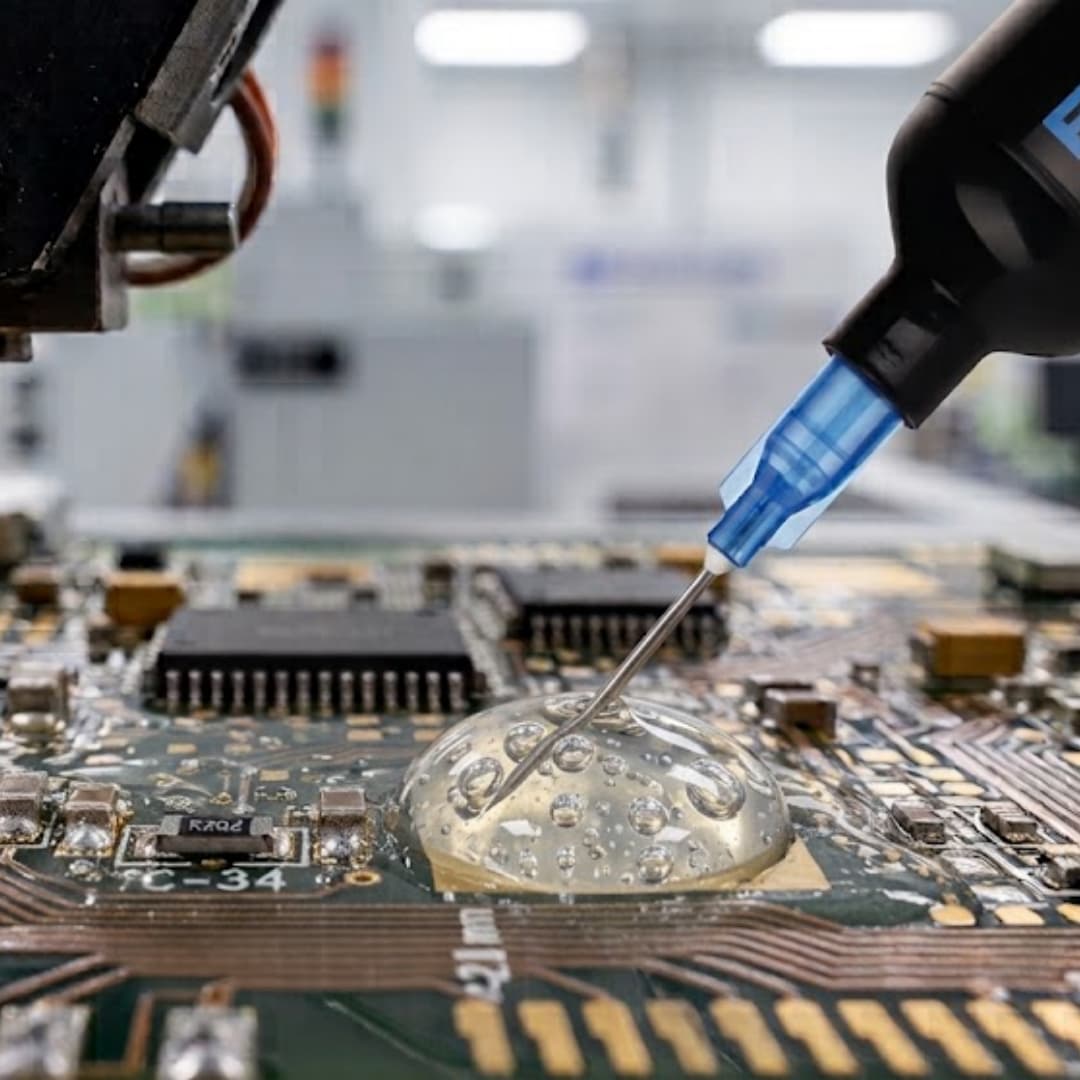
A reliable adhesive dispensing system supplier is one you can score on six dimensions: certification and quality management, quality-control maturity, production capacity and lead-time reliability, technical capability, IP protection, and communication. The fastest way to tell if a supplier is dependable is to check whether they hold ISO 9001:2015, run in-process and first-article inspection rather than end-of-line-only checks, control their own tooling and molding, and answer technical questions with specifics instead of boilerplate. This article gives you a supplier evaluation framework and a printable scorecard so you can compare vendors side by side before issuing a purchase order. You will learn what each dimension measures, the green flags and red flags to watch for, and the exact questions to ask before you commit.
Why Supplier Evaluation Matters More for Two-Component Dispensing
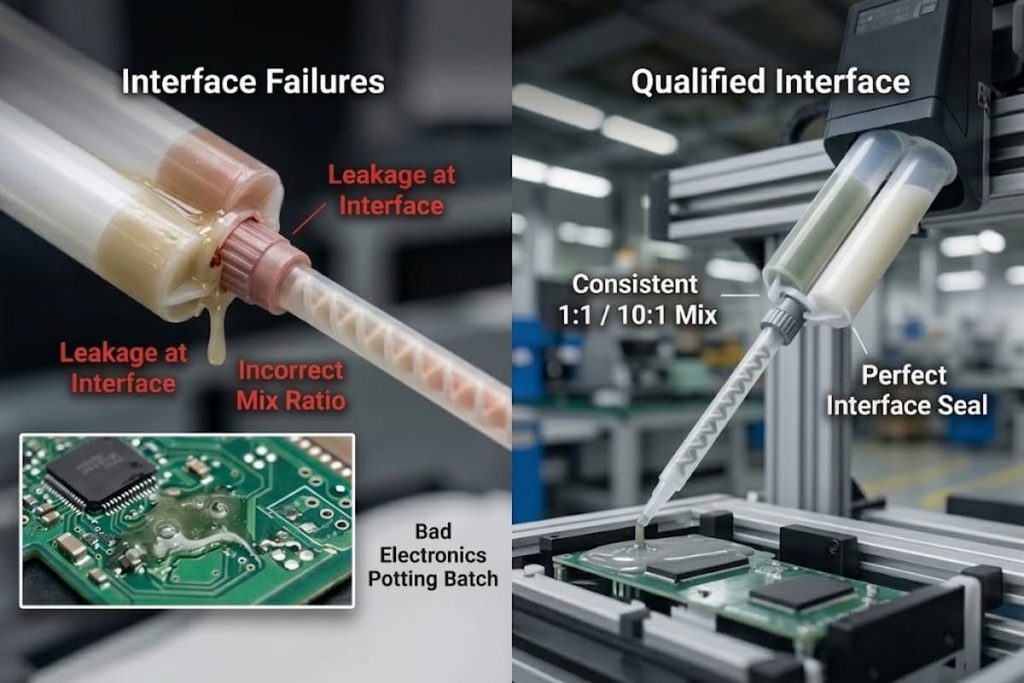
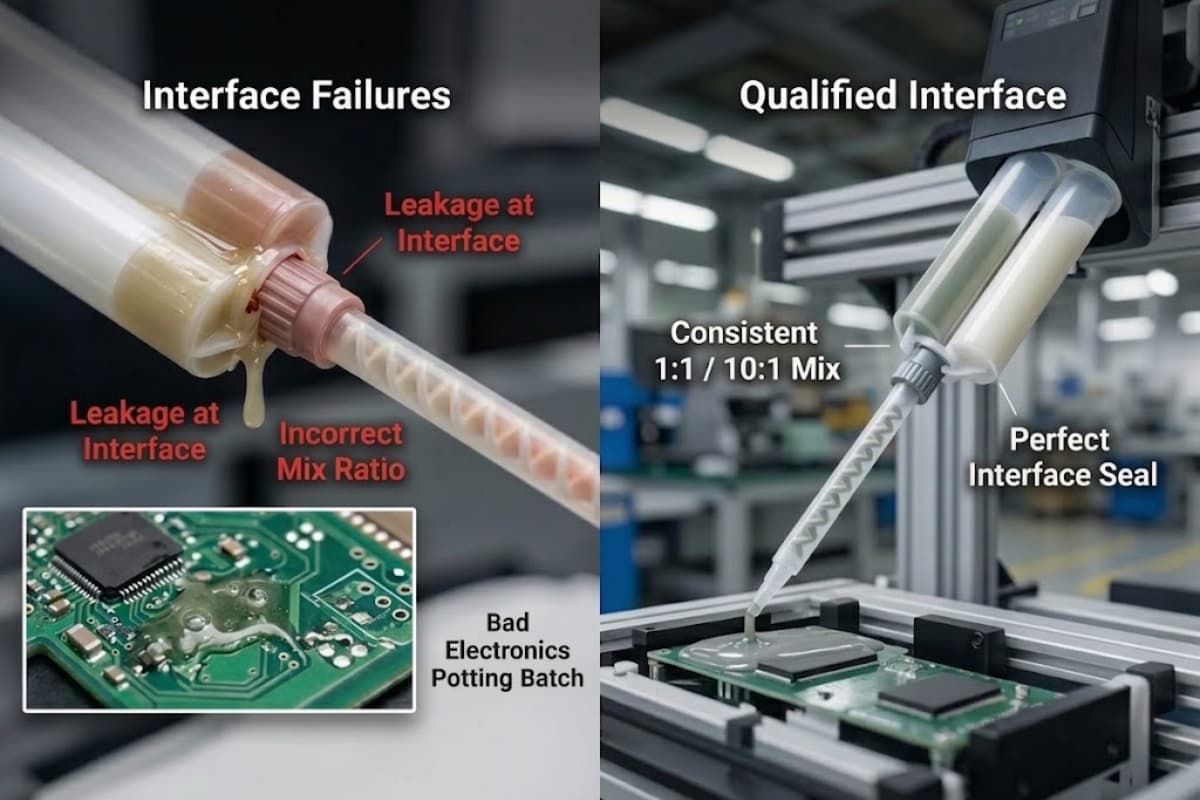
When a two-component (2K) adhesive system fails, the cost is rarely limited to the defective part. A wrong mix ratio, a leaking cartridge seal, or an incompatible mixer interface can ruin an entire potting batch, stall an assembly line, or force a field recall. Standard commodity components fail in predictable, isolated ways; a custom cartridge and mixer fail at the interface between your chemistry and the supplier’s geometry. That is why evaluating an adhesive dispensing system supplier is different from buying standard fasteners or enclosures, and why the evaluation has to happen before tooling is cut. The expensive mistakes — dimensional drift, cure incompatibility, fillers that accelerate mold wear — are cheapest to fix at the design stage. If your adhesive chemistry, mix ratio, or branding rules out a standard part, treat supplier evaluation as a gate, not an afterthought. Understanding how a 1K and 2K cartridge differ helps frame why 2K programs carry more specification risk and deserve stricter vetting.
The 6-Dimension Supplier Evaluation Framework
Score every candidate on the same six dimensions so comparisons stay objective. The table below is the map for the rest of the article: each dimension has a “what to look for” column and a paired green-flag / red-flag column.
| Dimension | What to look for | Green flag | Red flag |
|---|---|---|---|
| Certifications & QMS | ISO 9001:2015, material compliance | System-certified, documented scope | No QMS, vague “we test” |
| Quality control | In-process + FAI + AQL | Monitored molding, FAI reports | End-of-line only, no FAI |
| Capacity & lead time | In-house tooling/molding, machine count | Vertical integration, spare capacity | Fully subcontracted, single-source |
| Technical capability | DFM, tooling, customization | In-house mold shop, DFM feedback | “Send files, we’ll copy” |
| IP protection | NDA, mold ownership | Standard NDA, clear ownership | Reluctant on NDA, shared molds |
| Communication | Responsiveness, technical English | Fast, specific answers | Delayed, generic replies |
1. Certifications & Quality Management (ISO 9001 and Beyond)
ISO 9001:2015 is the baseline quality management system certification for a manufacturing supplier. It does not certify a specific product; it certifies that the factory runs a documented, repeatable process for controlling quality across every order. For adhesive dispensing components, that distinction matters: a part can be made in a certified plant and still be wrong for your chemistry, so ISO 9001 is necessary but not sufficient on its own.
Beyond the system certificate, check material-level compliance. Depending on your market and application, you may need RoHS, REACH, or silicone-free declarations. Silicone-free is not a universal default — it is a specific resin-grade and production-line decision, so confirm it is designed in rather than claimed after the fact. A supplier that can produce both the certificate scope and the material declaration for your target market is showing the first green flag. A red flag is a supplier that treats compliance as a formality or cannot name which directive applies to your region. A manufacturer that publishes its ISO 9001:2015 certification and facility profile makes this verification step straightforward.
2. Quality Control: In-Process, FAI, and AQL
Quality-control maturity is the clearest predictor of batch-to-batch consistency. The lowest-maturity model is end-of-line inspection only: parts are sorted after molding, and defects are caught late and expensively. A stronger model adds two earlier gates.
First, in-process monitoring. Molding machines should track process parameters in real time, and the production line should run patrol inspection. This catches dimensional or cosmetic drift during the run, not after a full batch is packed.
Second, First Article Inspection (FAI). Before mass production, the supplier runs trial parts and measures them against your drawing, then issues an FAI report covering critical dimensions, material, and function. FAI is the formal release gate between development and volume supply — if a supplier cannot produce an FAI report, they are skipping the step where most specification risk is caught.
Finally, Final Quality Assurance uses AQL (Acceptable Quality Limit) sampling so each batch gets a statistically supported pass/fail decision without 100% manual sorting. When you cannot be on-site, ask for the FAI report format and the AQL level they apply; a supplier with a defined, documented QC flow answers this directly. For mixer and tip programs, confirm the same inspection logic applies to the elements and outlet, because those tolerances drive mix quality.
3. Production Capacity & Lead-Time Reliability
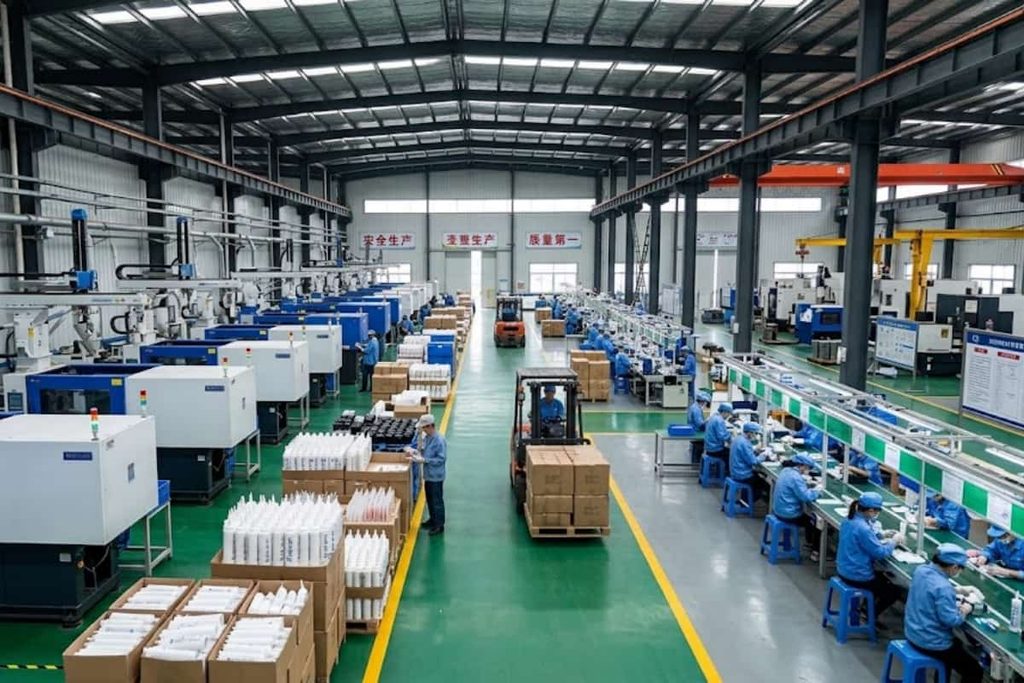
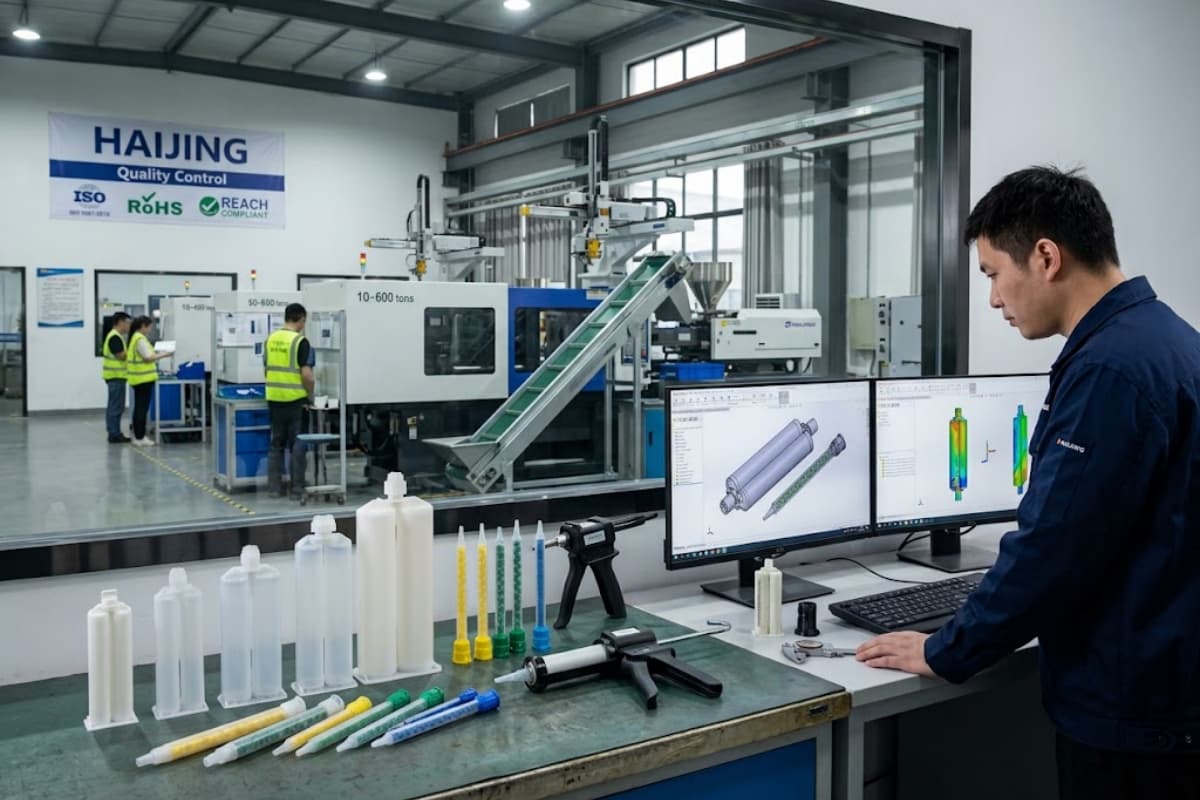
Lead-time reliability depends less on a promised number and more on who controls the process. A vertically integrated supplier — one that runs its own mold workshop, injection molding, and assembly — keeps tooling and production under one roof. That structure shortens the development loop because mold changes do not wait on an outside vendor, and it protects design confidentiality because mold data never leaves one facility.
Compare that with a subcontract-heavy supplier. When tooling, molding, and printing are all outsourced, every stage adds a handoff, a queue, and a confidentiality boundary. Capacity signals to verify include the number and tonnage range of injection molding machines and the facility footprint, because these indicate whether the supplier can absorb your order without displacing others. For reference, a manufacturer running 60-plus injection molding machines across a 10–600 ton range in a 20,000 m² plant has the internal capacity to scale from pilot runs to volume without moving the project between vendors. The red flag is a supplier that cannot tell you where each process step happens.
4. Technical Capability: DFM, Tooling & Customization
Technical capability shows up first in Design for Manufacturing (DFM). A capable supplier reviews your drawings for wall thickness, draft angle, gate location, and mold-flow behavior, then proposes material and process changes that improve yield and reduce cost. This is where most specification risk is resolved — before steel is cut. A supplier that only says “send us the file and we’ll copy it” is offering manufacturing, not engineering, and you inherit the design risk.
In-house tooling is the second signal. A mold workshop with CNC, EDM, and grinding can iterate a tool quickly and keep the data internal. Customization depth is the third: can they adjust cartridge volume and ratio, mixer element count and interface, gun thrust ratio, and add private-label printing? The more of the design and tooling they own, the faster your revision cycles. Confirm what they can change on an existing platform versus what requires new tooling, because that distinction drives both cost and lead time. The OEM and ODM customization pathway lays out how DFM, tooling, and branding are scoped before production begins.
5. IP Protection & Contract Terms (NDA, Mold Ownership)
Custom dispensing components are defined by your drawings and mold data, so IP terms are not boilerplate. Require a non-disclosure agreement before sharing specifications, and confirm who owns the mold and the tooling data after payment. A supplier that is reluctant to sign an NDA, or that reserves the right to reuse your mold for other customers, creates a direct competitive-risk exposure.
Also clarify exclusivity and region. If you are launching a private-label product, you may need a clause preventing the supplier from selling the same customized part to your competitors in your market. These terms are far cheaper to negotiate before tooling than after. A green flag is a supplier with a standard NDA and a clear, written mold-ownership policy; a red flag is vagueness about who controls the tool. Customization programs should state mold ownership and NDA terms up front so both sides are protected from the first conversation.
6. Communication, Responsiveness & References
Communication patterns during quoting predict the partnership after the order. Green flags: replies within a business day, answers that reference your specific parameters (ratio, viscosity, interface), and willingness to share process documentation. Red flags: delayed responses, generic boilerplate, inability to name a technical contact, or pressure to skip the prototype stage.
Ask for references from customers in a similar application or region, and for documentation samples — an anonymized FAI report or a capability summary. A supplier confident in their process will provide these without hesitation. Poor communication at the evaluation stage rarely improves once production starts, so treat it as a weighted factor, not a soft one. If you are also weighing a factory audit, the communication dimension overlaps with what a static mixer factory checklist captures on-site.
Supplier Evaluation Scorecard (Printable Checklist)
Use this scorecard to grade each supplier on the same scale. Assign a weight to each dimension based on what matters most for your program, then score 1–5, where 5 is fully met.
| Dimension | Weight (%) | Score (1–5) | Notes |
|---|---|---|---|
| Certifications & QMS | 15 | ||
| Quality control (FAI + AQL) | 20 | ||
| Capacity & lead time | 20 | ||
| Technical capability (DFM + tooling) | 20 | ||
| IP protection & terms | 15 | ||
| Communication & references | 10 |
A low score in any single dimension can be a disqualifier even if the weighted total looks acceptable — a supplier with no NDA policy or no FAI process introduces risk that a low price does not offset. Print this table and fill it in during supplier calls so decisions stay evidence-based rather than impressions-based.
Questions to Ask Before Issuing a PO
These questions convert the framework into a pre-order checklist. For each, note the healthy answer you want to hear.
- Which quality management certification do you hold, and can you share the scope? — Healthy answer: ISO 9001:2015 with a current, named scope.
- Do you run FAI before mass production, and what does the report cover? — Healthy answer: yes; dimensions, material, and function.
- Where does each process step happen — in-house or subcontracted? — Healthy answer: in-house tooling, molding, and assembly.
- What is your injection molding capacity (machine count and tonnage)? — Healthy answer: specific numbers, not “sufficient capacity.”
- Can you perform DFM review and propose changes before tooling? — Healthy answer: yes, with documented feedback.
- What NDA and mold-ownership terms apply? — Healthy answer: standard NDA; customer owns the paid mold.
- Which compliance documents (RoHS, REACH, silicone-free) ship with the order? — Healthy answer: per-program, named for your market.
- What is the realistic lead time for tooling, sampling, and mass production? — Healthy answer: specific ranges with stated dependencies.
- Can you match the interface system (A, B, C, F) our gun or head requires? — Healthy answer: verified during DFM.
- Who is the technical contact, and what is the response-time expectation? — Healthy answer: named contact with a defined SLA.
For programs that involve bulk mixing-nozzle sourcing, the same questions apply with extra weight on per-unit consistency across large runs.
Frequently Asked Questions
What is the minimum order quantity for custom cartridges and mixers? MOQ depends on whether the program uses existing tooling or requires a new mold, and on component size. Programs built on existing platforms generally support lower starting volumes than fully new tools. Confirm the MOQ for your specific configuration with the supplier.
Can a supplier match Mixpac-compatible A/B/C/F interfaces? Interface compatibility (A, B, C, and F systems) can be designed and verified during DFM so the custom mixer connects correctly to the intended gun or automated head. Provide the target interface in the specification so it is checked before tooling.
Do I need an NDA before sharing drawings? Yes, for custom programs, because the design and mold data are sensitive. Confirm NDA terms before sharing drawings so both sides are protected from the first conversation, and confirm mold ownership in the same document.
Are ISO 9001, RoHS, and REACH enough for my market? ISO 9001 covers the management system, not product compliance. RoHS and REACH are market-specific material directives, and silicone-free is a separate resin-grade decision. Confirm the exact certificates required for your target region before release.
How long does tooling and sampling take before mass production? Sampling and tooling are the longest stages. A light customization on an existing platform is faster than a fully new tooled part. Provide your target date so tooling can be sequenced; exact lead times depend on part complexity and current capacity.
Can the supplier produce 4:1 and 10:1 mix-ratio systems? Yes. Custom development supports 1:1, 2:1, 4:1, and 10:1 ratios; the mixer geometry and element count are selected to handle the viscosity asymmetry of the specific ratio, so state the ratio in the specification.
Conclusion
Evaluating an adhesive dispensing system supplier comes down to one rule: score the same six dimensions for every candidate, and treat any red flag in certifications, quality control, or IP as a potential disqualifier regardless of price. The decision logic is straightforward — choose a supplier that controls its own tooling and molding, proves quality with FAI and AQL rather than end-of-line sorting, and answers technical questions with specifics. Capacity, customization depth, and communication are the factors that determine whether the relationship scales smoothly after the first order.
If you are shortlisting suppliers for a custom cartridge, mixer, or dispensing system, the HaiJing engineering team can review your requirements against this framework and return DFM feedback and a development timeline — supporting your project technically from the first drawing through qualified mass production.