A purchase order that says only “adhesive dispensing nozzles” leaves the most important decision unresolved. The supplier may quote a tapered tip, a steel needle, a cartridge spout, or a static mixer. All four can sit at the end of a dispensing system, but they do different work.
Key Takeaways
- Choose the function before the geometry. Ready-to-use material needs a tip or plain nozzle; two reactive streams need a mixing nozzle before placement.
- A tip does not replace a mixer. A dispensing tip directs or shapes flow. A static mixer changes two incoming streams into one mixed output.
- A mixer may still need a tip. A Luer-lock outlet can accept a downstream needle after mixing when the process needs a finer deposit or harder-to-reach placement.
- Approve the whole fluid path. Package outlet, connection, mixer, final tip and operating method should share one revision-controlled approval record.
- Use real commercial boundaries. Haijing documents a 3,000-piece static-mixer MOQ, while samples are exempt from that MOQ and normally require 3–7 days.
In short: use a dispensing tip when the material is already ready to apply. Use a static mixing nozzle when two components must combine during dispense. Use both in sequence only when the mixed material also needs a smaller or more specialized final outlet.
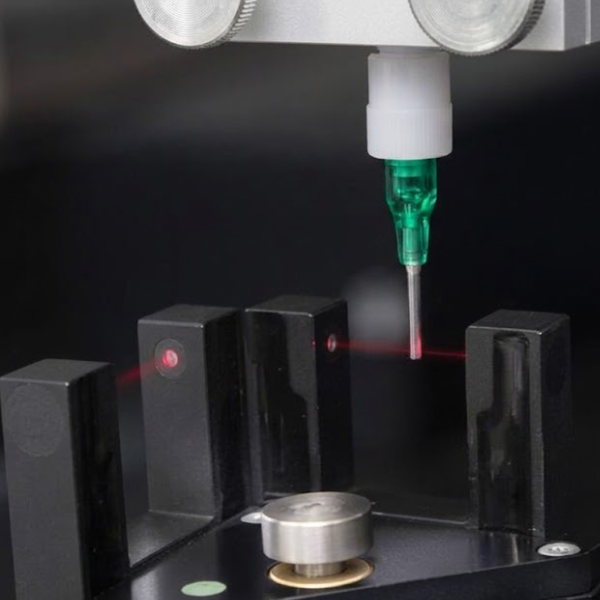
Make The Function Decision First
The fastest selection question is not diameter or material. Ask whether the adhesive is ready to dispense when it reaches the outlet. A one-part adhesive, grease, solder paste, or pre-mixed fluid normally needs guidance and deposit control. A two-part epoxy or polyurethane normally needs controlled mixing first.
The table is the fast answer. The trade-offs that protect the process follow in the later sections.
| Process condition | Primary component | Its job | Verdict |
|---|---|---|---|
| Ready-to-use fluid | Dispensing tip or nozzle | Guide and shape flow | Choose the deposit geometry |
| Two reactive streams | Static mixing nozzle | Mix before placement | Choose interface and mix design |
| Mixed fluid needs fine placement | Mixer plus downstream tip | Mix, then place | Qualify the combined restriction |
| Machine applies ready fluid | Valve nozzle or tip | Control final delivery | Match the valve and motion |
Keep Four Outlet Jobs Separate
Teams often use “nozzle” for every component near the discharge point. That language hides four jobs. Metering establishes quantity or ratio upstream. Mixing combines streams. Shaping forms the bead, dot, ribbon, or fill. Placement brings that output to the target.
A single component may perform two jobs, but do not assume it performs all four. A static mixer can end in a stepped outlet that also shapes the bead. It still cannot correct a ratio error created by the cartridge or metering system.
| Job | Controlled by | Failure signal | Wrong assumption |
|---|---|---|---|
| Meter | Cartridge, pump, valve | Wrong quantity or ratio | The outlet can correct it |
| Mix | Static or dynamic mixer | Streaks or uneven cure | A plain tip mixes flow |
| Shape | Outlet bore and geometry | Wrong bead or dot | Smaller is always better |
| Place | Tip length, angle, motion | Missed target or stringing | Part choice alone fixes motion |
This separation makes troubleshooting faster. A cure problem points upstream to ratio, mixing, or chemistry. A bead-width problem points to flow, outlet geometry, motion, or standoff. Buying another “nozzle” without naming the failed job repeats the ambiguity.
Choose Tips For Ready Material
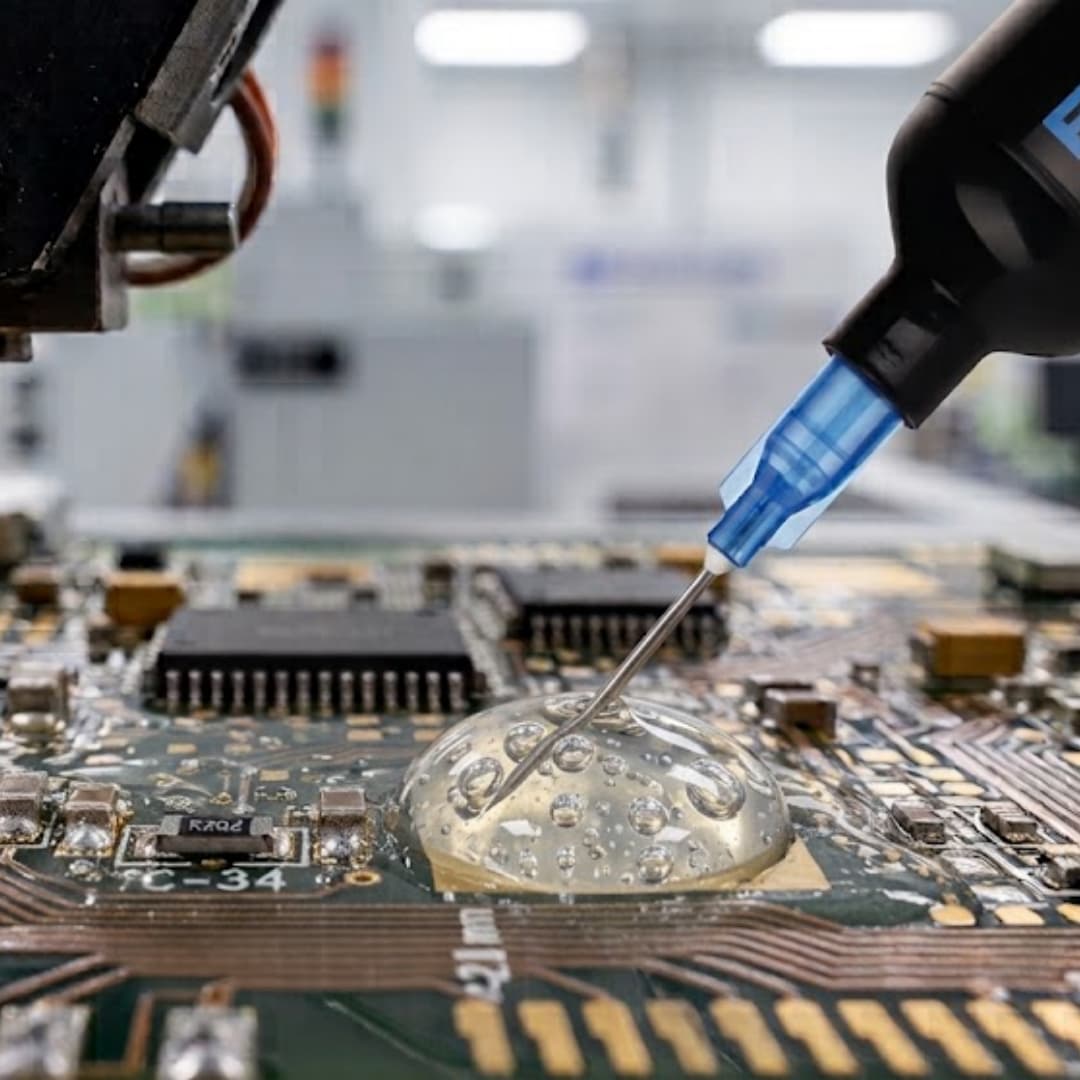
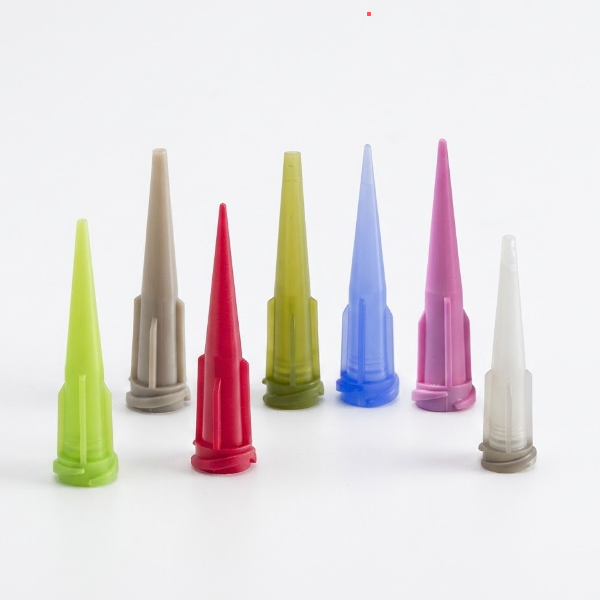
A dispensing tip accepts a material that is already in its usable state. Its design manages restriction, reach, attachment and the final deposit. The tip should not be asked to create homogeneity that does not exist upstream.
Henkel Adhesives separates stainless-steel needles, tapered polyethylene tips, flexible polypropylene tips and static mix nozzles by function. That is a useful starting point because gauge alone says little about the complete process.
For medium or thick fluids, a tapered plastic path often reduces sudden restriction; approve bead stability and chemical fit on the actual material. A steel needle gives tighter access and smaller deposits, but the gauge and length can increase restriction and clog exposure. A flexible tip reaches around obstructions, though its position may vary during machine motion. Ribbon, brush and angled outlets solve specialized placement problems, so approve their deposit directly on the production substrate at the intended speed.
Chemistry can override a convenient geometry. Permabond advises PTFE or PP tips for bulk anaerobic adhesive because contact with metal can trigger cure and clog a metal needle. Treat that as a chemistry-specific warning, not a rule for every adhesive.
Choose Mixers For Reactive Systems
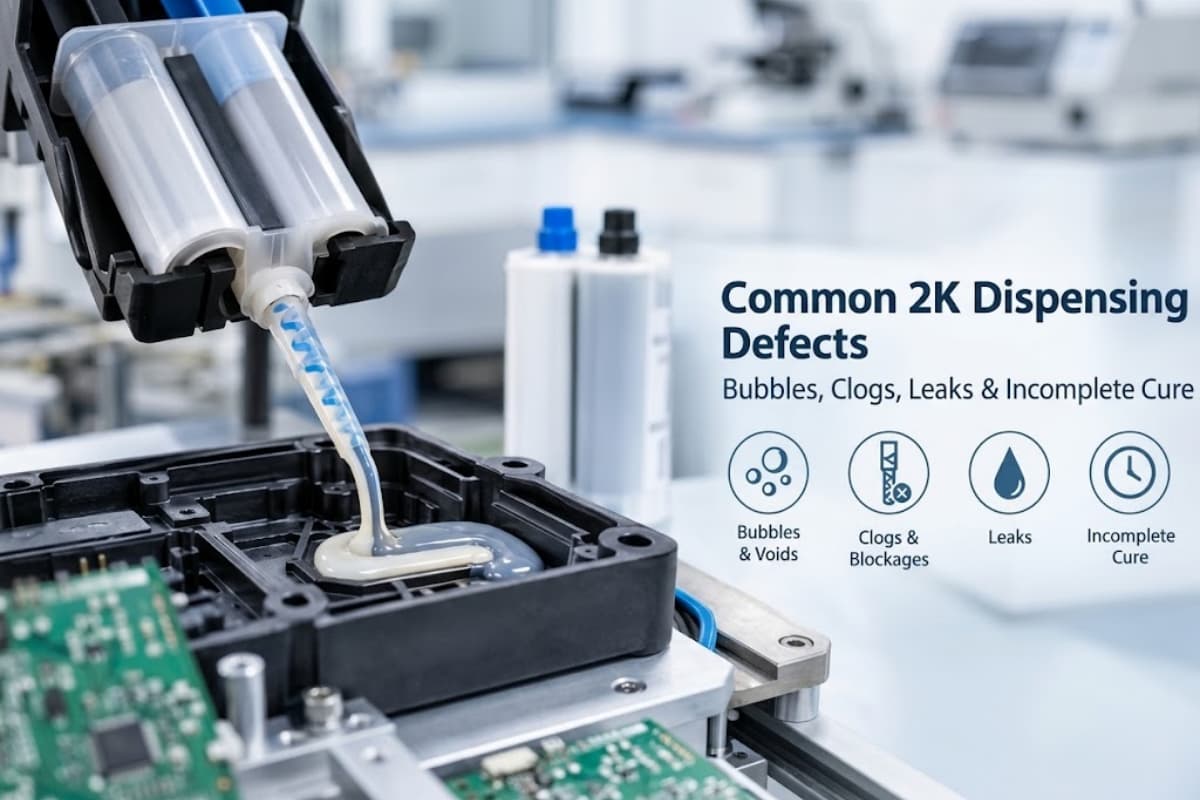
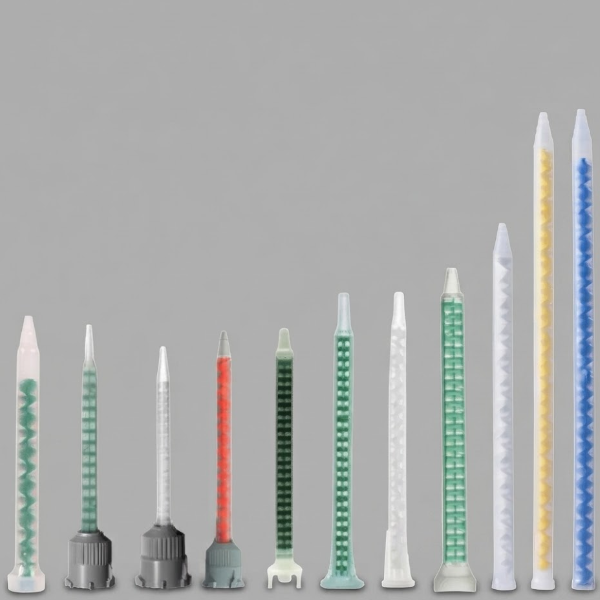
A static mixing nozzle receives separate streams and repeatedly divides and recombines them before discharge. Selection begins at the inlet, not the tip. The connection must fit the cartridge or machine outlet, and the inlet geometry must keep the streams controlled as they enter the elements.
The six useful identifiers are element geometry, ratio family, internal diameter, element count, connection interface and outlet termination. Intertronics documents the same feature groups in its identification guidance.
| Mixer variable | What it changes | Approval question | Owner |
|---|---|---|---|
| Connection interface | Fit and inlet sealing | Does it match the package? | Packaging engineer |
| Ratio geometry | Stream entry pattern | Does it match the cartridge? | Formulation and packaging |
| Bore and elements | Mixing and restriction | Does output pass cure checks? | Process engineer |
| Outlet termination | Final bead or attachment | Is another tip required? | Application engineer |
Haijing’s documented portfolio spans A-, B-, C- and F-System interfaces across 1:1, 2:1, 4:1 and 10:1 configurations. One model example, BH-5.4-16-T-GY, records series, diameter, element count, outlet type and color in the part number. That code helps identification, but the approved drawing and adhesive trial still govern release.
Add A Tip After Mixing
The comparison is not always either-or. Some static mixers finish with a Luer-lock outlet that accepts a needle or specialty tip. The mixer completes the chemical mixing job first. The attached tip then controls reach or the final deposit.
This two-stage stack is useful for a mixed material that must enter a narrow gap or land as a small dot. It also adds restriction and retains more mixed adhesive. Cure can begin inside both components during a pause, so the restart method must cover the full assembly.
Approve the combined stack when any of these conditions apply:
- Fine placement follows mixing — the mixer outlet alone cannot reach the target or form the required deposit.
- Automation controls a small path — the tip must clear fixtures while the robot or coordinate applicator maintains standoff.
- A specialty deposit is required — the downstream outlet creates an angle, ribbon or other defined shape.
- Pause risk is material — mixed adhesive can cure in both the mixer and attached tip before restart.
A physical Luer fit proves only that the components connect. It does not prove acceptable flow, pressure, cure, material compatibility or deposit repeatability. Run the sample with the production adhesive and production motion.
Match The Package And Connection
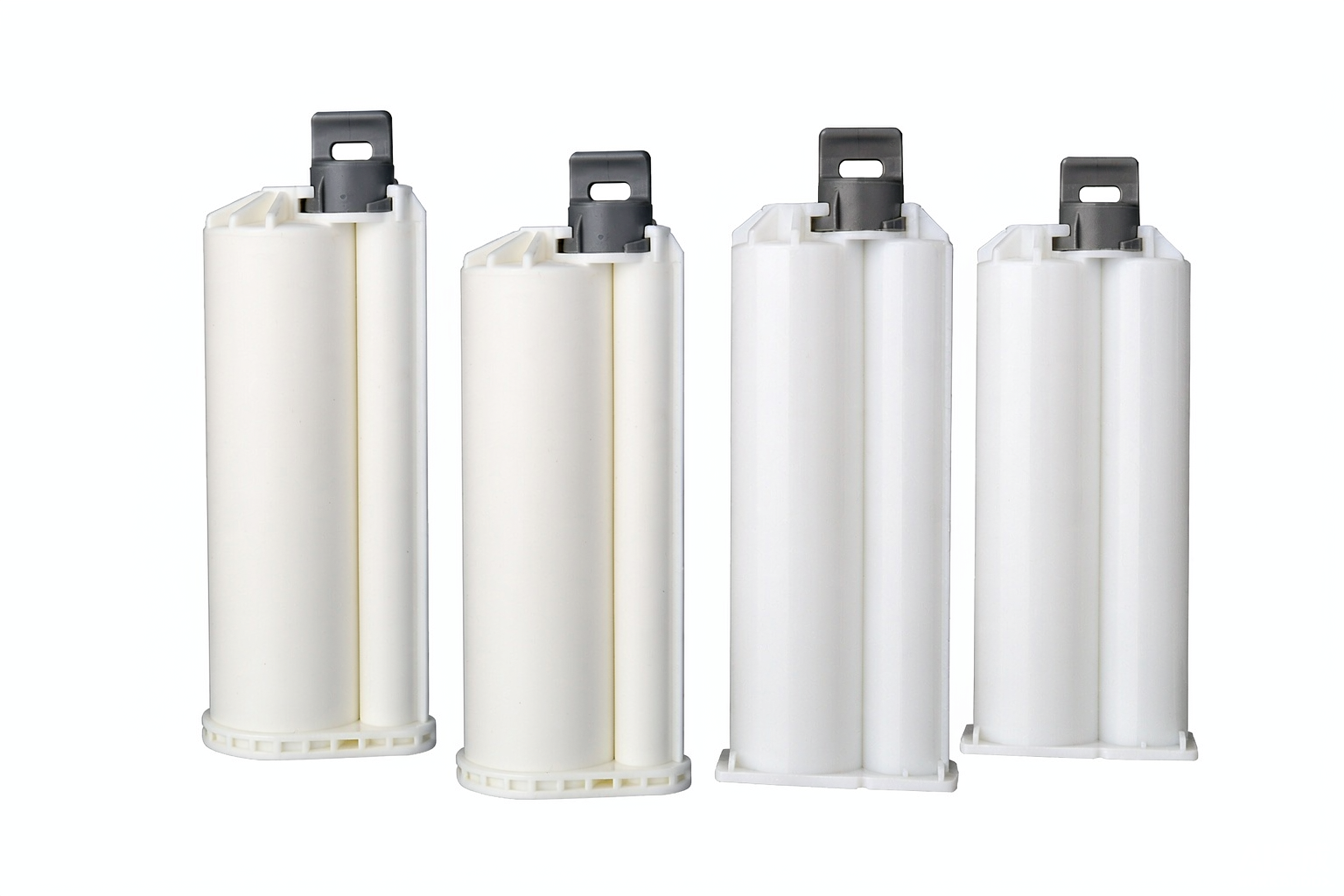
Package format removes many wrong options early. A syringe barrel usually feeds a Luer-compatible dispensing tip. A single-component cartridge uses a plain outlet or screw-on nozzle. A dual cartridge needs a compatible mixer interface before any final tip decision.
Haijing’s single-component cartridge range uses an M15×2.5 outlet in the documented Product Bible. The dual-component range supports A-, B-, C- and F-System mixer families. Do not turn those labels into a universal interchangeability claim; compare the actual outlet drawing, sealing faces and retention method.
Freeze these interfaces before requesting samples:
- Source package — syringe, single cartridge, dual cartridge or machine outlet.
- Connection geometry — thread, bayonet, retaining nut, Luer or project-specific adapter.
- Material state — ready to dispense or still split into reactive streams.
- Final deposit — dot, bead, ribbon, fill or hard-to-reach placement.
- Operating method — manual, pneumatic, valve-controlled or automated motion.
The most common ordering error is choosing the outlet from the deposit alone. A perfect bead geometry is useless if the part cannot seal to the package or if it skips a required mixing stage.
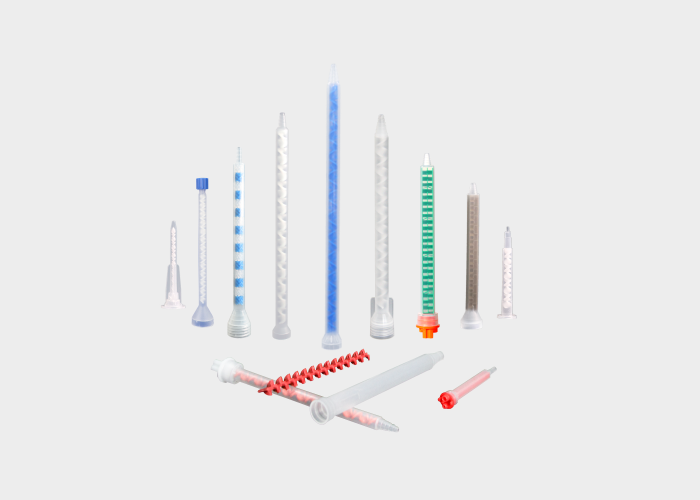
Need The Tip And Mixer To Behave As One Stack?
Send the adhesive chemistry, package outlet, ratio, target deposit, access limits and equipment method. Haijing can review the interface chain before samples are cut.
Control Flow Waste And Restarts
Every outlet adds resistance. A longer needle, smaller bore or additional attachment can demand more upstream pressure. A longer mixer or tighter element path also increases resistance while retaining more mixed material. The right choice balances mixing, placement and the available drive system.
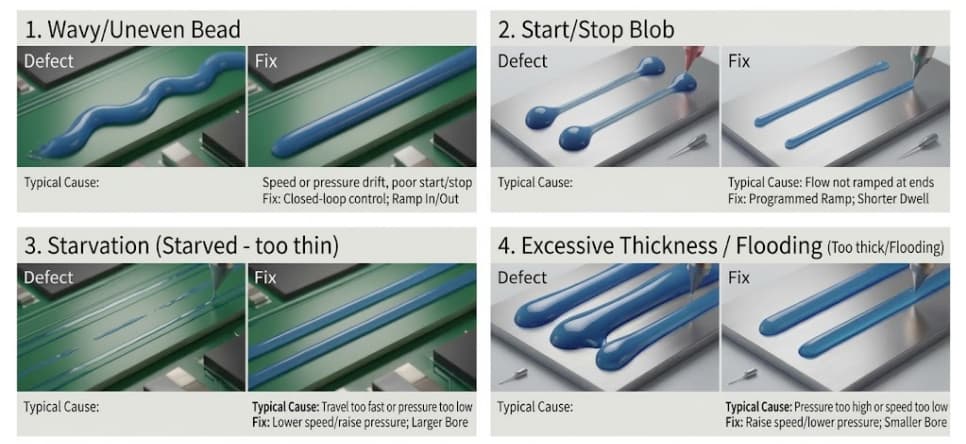
Do not approve only the first clean shot. Test steady running, a planned pause and the restart. A ready-to-use material may drip, wick, string or clog at the tip. A two-part material may continue curing inside the mixer and any downstream needle.
Use a three-state trial rather than a single demonstration:
- Startup — confirm attachment, sealing, purge behavior and the first acceptable deposit.
- Steady run — confirm repeatable bead or dot geometry at the real motion and cycle pattern.
- Pause and restart — confirm the allowed stop, purge rule and replacement trigger for the complete outlet stack.
The replacement trigger should come from the adhesive supplier’s working-time guidance and your own qualification. Do not invent a universal number. Record the actual material, temperature, pause condition and acceptance result instead.
Build A Nozzle Selection Record
A sample that works once is not yet a controlled specification. Capture the decision in a short record that purchasing, engineering and the supplier can read the same way. The record should identify the complete fluid path, not only the item printed on the bag.
| Record field | What to enter | Evidence |
|---|---|---|
| Material | Chemistry, component count, viscosity state | TDS and approved lot |
| Package | Format, ratio, outlet drawing | Drawing and sample |
| Outlet stack | Mixer, adapter and final tip | Part codes and revisions |
| Process | Drive, motion, deposit and access | Trial settings and photos |
| Release | Mix, cure, bead and restart checks | Signed approval record |
Add change control. A supplier substitution that keeps the same color or catalog description can still change bore, element geometry, polymer or interface dimensions. The approved sample, drawing revision and part code should move together.
This record also prevents false troubleshooting. If the final tip changes after the mixer qualification, the fluid path has changed. Recheck flow and placement before treating the original qualification as valid.
Give the record an owner and a revision date. Purchasing can then reject an unapproved substitute before it reaches the line, while production can compare a failed setup with the released stack instead of relying on color or memory. When a trial fails, record which state failed: attachment, startup, steady output, pause, restart, cure, or final deposit. That distinction tells the team whether to investigate the package interface, the mixer, the downstream tip, the drive setting, or the adhesive itself. The result is a testable change request rather than a vague complaint about the nozzle.
Write A Supplier RFQ That Works
A strong RFQ replaces the word “nozzle” with controlled inputs. Include the material state, package drawing, interface, mix ratio when applicable, target deposit, access limits, drive method, pause pattern and required evidence. Ask the supplier to identify every proposed component in the stack.
For static mixers, Haijing documents annual capacity above 85 million pieces. The standard MOQ is 3,000 pieces. Samples are not constrained by that MOQ, and the documented sample lead time is 3–7 days when the buyer covers the sample and freight cost.
Request these deliverables before production release:
- Dimensional drawing — inlet, retention, bore, length and outlet termination.
- Material declaration — polymer or metal specification tied to the proposed item.
- Traceable sample code — the sample and future order must resolve to the same controlled configuration.
- Application trial plan — startup, steady run, pause and restart on the actual material.
- Change-notification rule — no silent geometry, material or tooling substitution.
Use Haijing’s adhesive dispense tip range when the material is ready to place. Use the static and dynamic mixer range when the process still needs in-line mixing. If the package itself is not frozen, start with the cartridge-system interface.
Freeze The Complete Fluid Path
The name on the purchasing line matters less than the function. A tip guides ready material. A mixer combines reactive streams. A mixer-plus-tip stack does both in sequence, and the complete assembly must pass the production trial.
Carry four decisions into the approval record:
- Function first — state whether the component meters, mixes, shapes or places.
- Interface next — match the actual package drawing and retention method.
- Process as a stack — test the mixer, optional tip, equipment and motion together.
- Revision at release — tie samples, drawings and part codes to one approved configuration.
If those four points are explicit, the supplier can quote the right family and engineering can test a defined system. Send the record with your RFQ instead of asking for “a smaller nozzle.”
Why We Write This Selection Guide
Haijing manufactures static mixers and adhesive dispense tips, so the boundary between them should be stated plainly. A buyer should not be pushed toward a mixing nozzle when the material only needs placement control. A plain tip should never be presented as a substitute when two reactive streams still need mixing.
The useful supplier role is to make the interface chain testable. That means naming the function, providing controlled samples and keeping the approved geometry tied to a revision. Clear boundaries create better orders than a longer product list.
References And Source Boundary Notes
- Henkel Adhesives, Consumables and Supplies — separate product roles for dispense tips and static mix nozzles.
- Permabond, Nozzles for Dispensing Adhesives — chemistry-specific outlet guidance.
- Adhesives and Sealants Industry with Intertronics — static-mixer identification features.
- Haijing Product Bible, 2026 edition — product interfaces, annual capacity, MOQ and sample policy.
The external examples explain selection logic. They do not create a universal pressure, flow, service-life or compatibility claim. Confirm those values with the adhesive, equipment and production trial.
Frequently Asked Questions About Nozzles
What is the difference between a dispensing tip and a mixing nozzle?
A dispensing tip guides material that is already ready to use. A mixing nozzle contains elements that combine two incoming components before the material reaches the final outlet.
Does a single-part adhesive need a mixing nozzle?
No. A single-part adhesive normally needs a compatible dispensing tip or plain nozzle for flow and placement, unless another process step requires blending before dispense.
Can a dispensing tip attach after a static mixer?
Yes. A Luer-lock mixer outlet can accept a downstream tip for fine placement, but the added restriction and mixed-material pause risk must be qualified as one stack.
Which nozzle is best for high-viscosity adhesive?
Choose the widest, shortest compatible path that still meets the deposit and mixing requirement. Confirm it with the real adhesive, drive system, motion and restart trial.
What information should a nozzle RFQ include?
Include chemistry, component count, package drawing, ratio, connection, deposit, access, equipment, pause pattern, proposed outlet stack and the evidence required for approval.