A 2K adhesive cartridge only dispenses correctly when the hardware around it holds, connects, and mounts it under pressure. Cartridge retainers clamp the cartridge in a gun or robot; couplers transfer air and lock the mixer; machine adapters bridge the cartridge to automated dispensing equipment. Getting the interface wrong causes leaks, off-ratio beads, and dropped cartridges mid-cycle. This guide explains each part, the bayonet vs screw vs flange choices, and how to select hardware that matches your components of a dispensing cartridge system.
1. What Integration Hardware Actually Covers
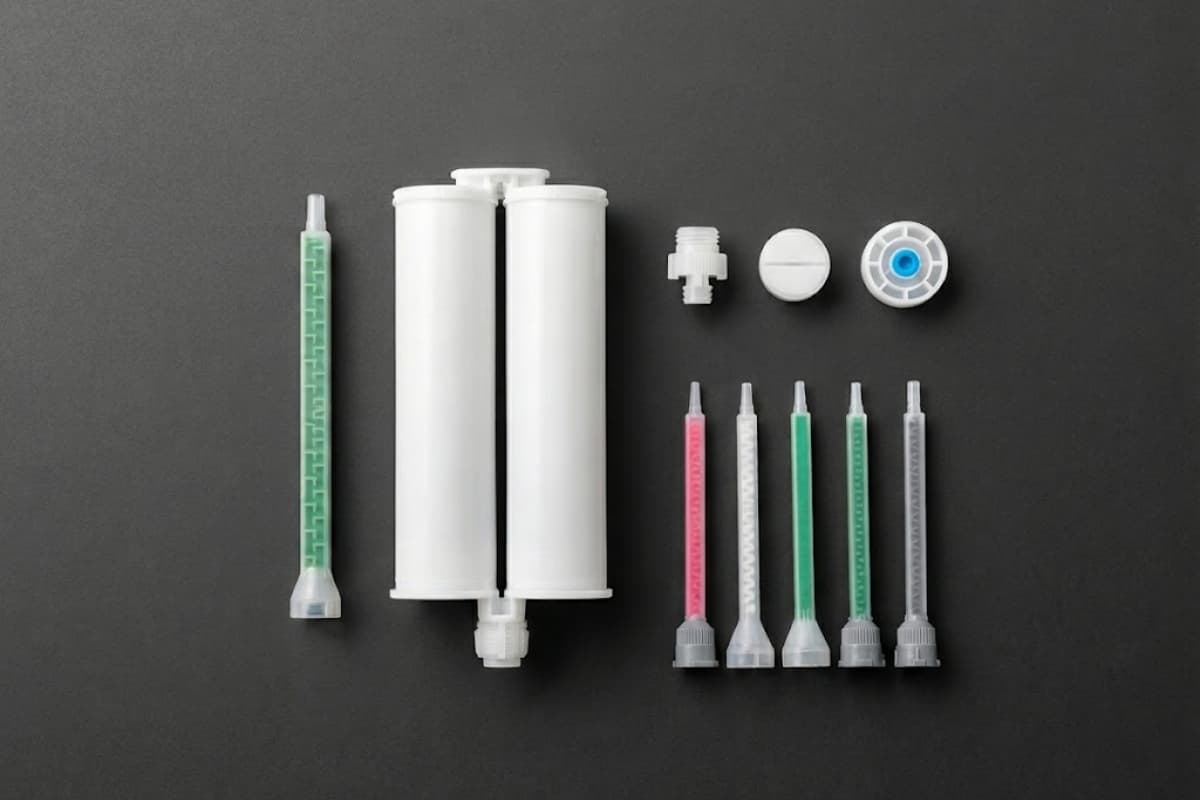
Three distinct parts sit between a filled cartridge and a finished bead:
| Part | Job | Where it lives |
|---|---|---|
| Retainer | Clamps the cartridge body so pistons advance straight and the cartridge cannot back out under thrust | Inside a manual gun, pneumatic retainer sleeve, or robot mount |
| Coupler | Locks the mixer/air-line to the cartridge outlet and seals the pneumatic path | At the cartridge nose, between cartridge and static mixer |
| Machine adapter | Mounts the whole cartridge assembly onto a benchtop or robotic dispenser | Between retainer and the dispenser body / robot flange |
They are sold separately or as a kit. When you source OEM dual-component cartridges, confirm whether the retainer and adapter are included or must be ordered to match your dispenser brand.
2. Cartridge Retainers: Holding the Cartridge Under Pressure
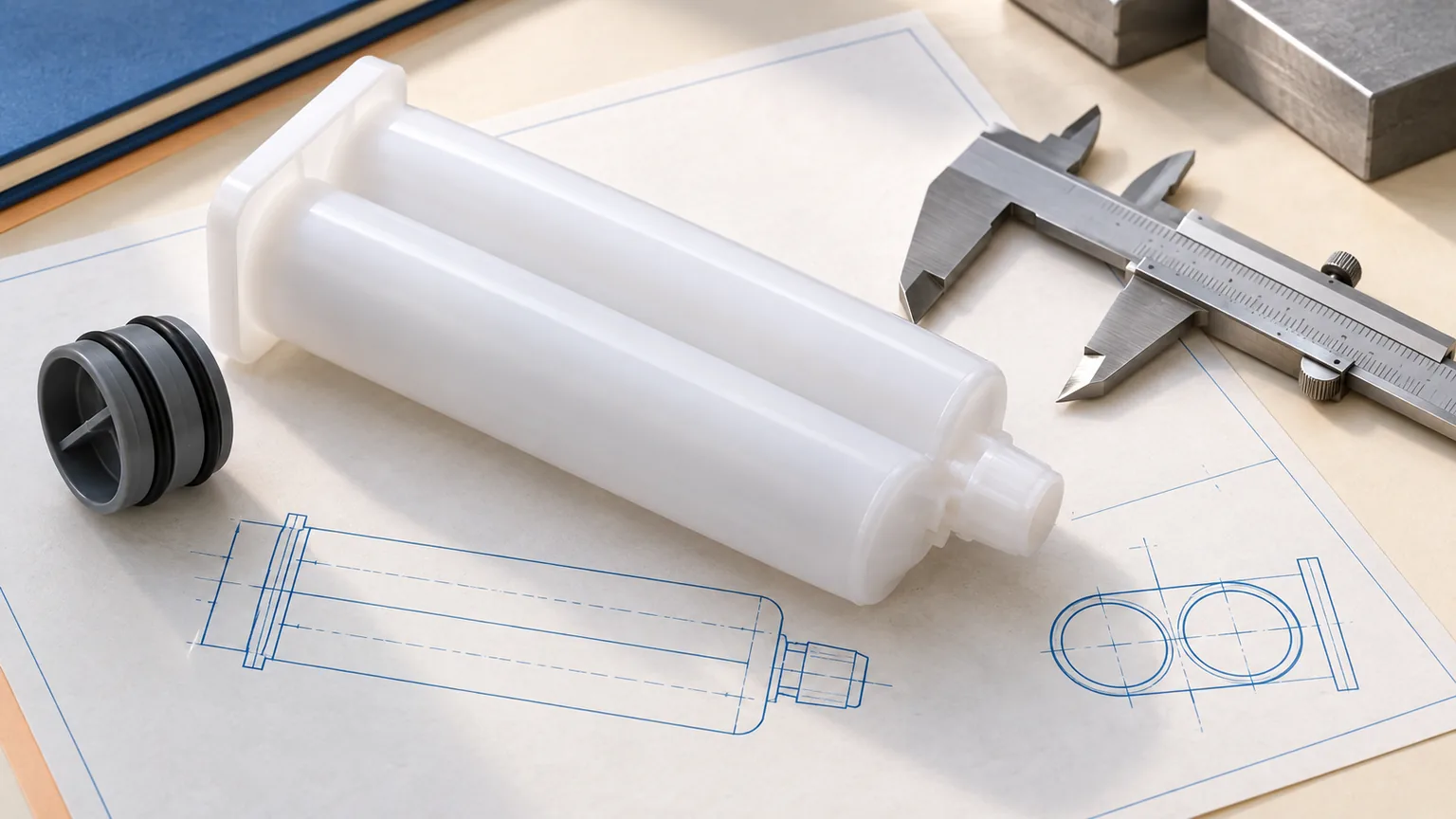
A retainer keeps the cartridge square to the pistons. Manual guns use a molded cradle; pneumatic retainers use an aluminium or steel sleeve rated to 100 PSI; robot-mounted retainers add a bracket and alignment boss. Undersized retainers let the cartridge bulge and break the ratio.
| Retainer type | Pressure rating | Best for | Mount |
|---|---|---|---|
| Manual gun cradle | Hand thrust only | Low-volume field repair | In gun frame |
| Pneumatic sleeve (50–600 ml) | up to 100 PSI | Production lines, medium volume | Handheld or stand |
| Robot-mounted retainer | up to 100 PSI | Automated XYZ / cobot cells | Bracket + alignment boss |
| Bayonet cap retainer | up to 70 PSI | Quick-change single cartridges | Twist-lock on dispenser |
For abrasive or high-pressure formulations, prefer an anodised aluminium or stainless sleeve over acetal. See the OEM custom static mixers note on material choices for custom builds.
3. Couplers & Air-Line Connections
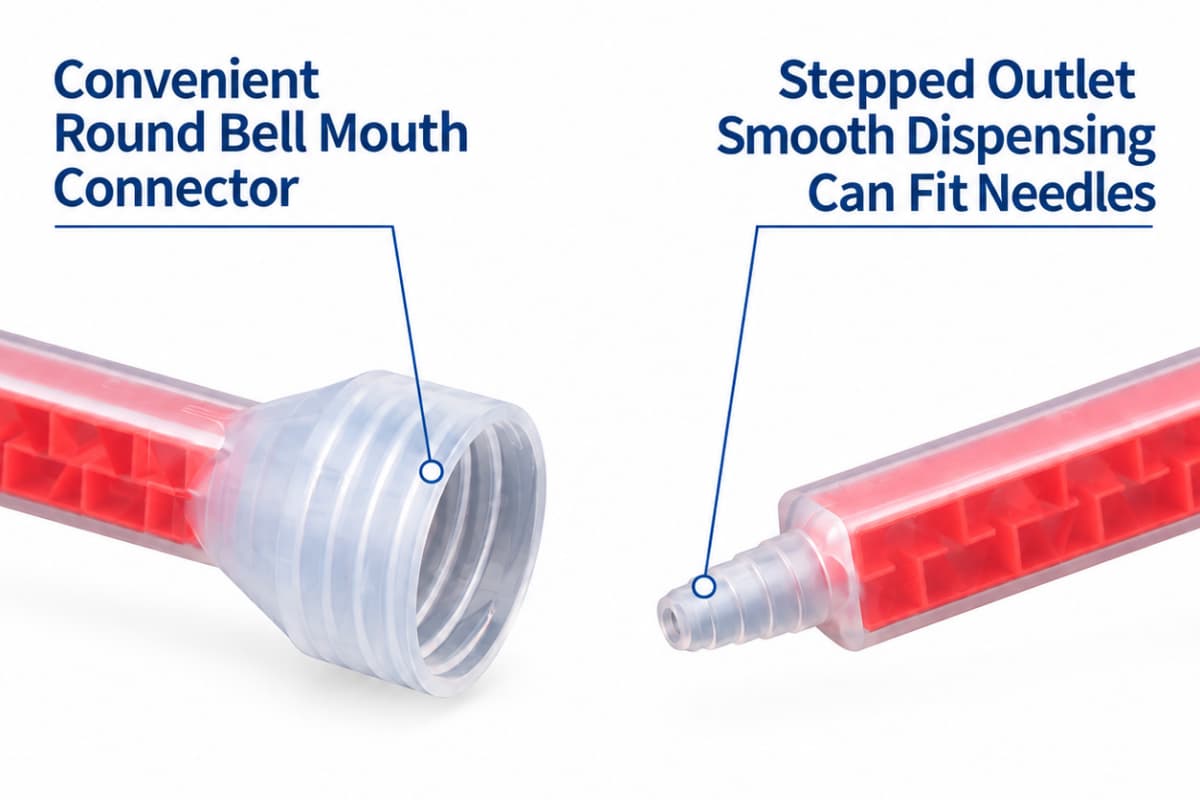
The coupler does two jobs: it seats the static mixer on the cartridge outlet and it carries shop air to the pistons. Quick-connect NPT fittings (typically 1/4″ NPT female) let you swap dispensers fast, while the mixer locks via bayonet or threaded collar. A loose coupler drops pressure and streaks the bead.
| Connection | Interface | Watch-out |
|---|---|---|
| Mixer to cartridge | Bayonet twist or 1/4-turn collar | Must click fully or mixer blows off |
| Air line to retainer | 1/4″ NPT quick coupler | Use thread sealant; avoid cross-thread |
| Vacuum suck-back | Dispenser port | Needed to retract rods on empty cartridge |
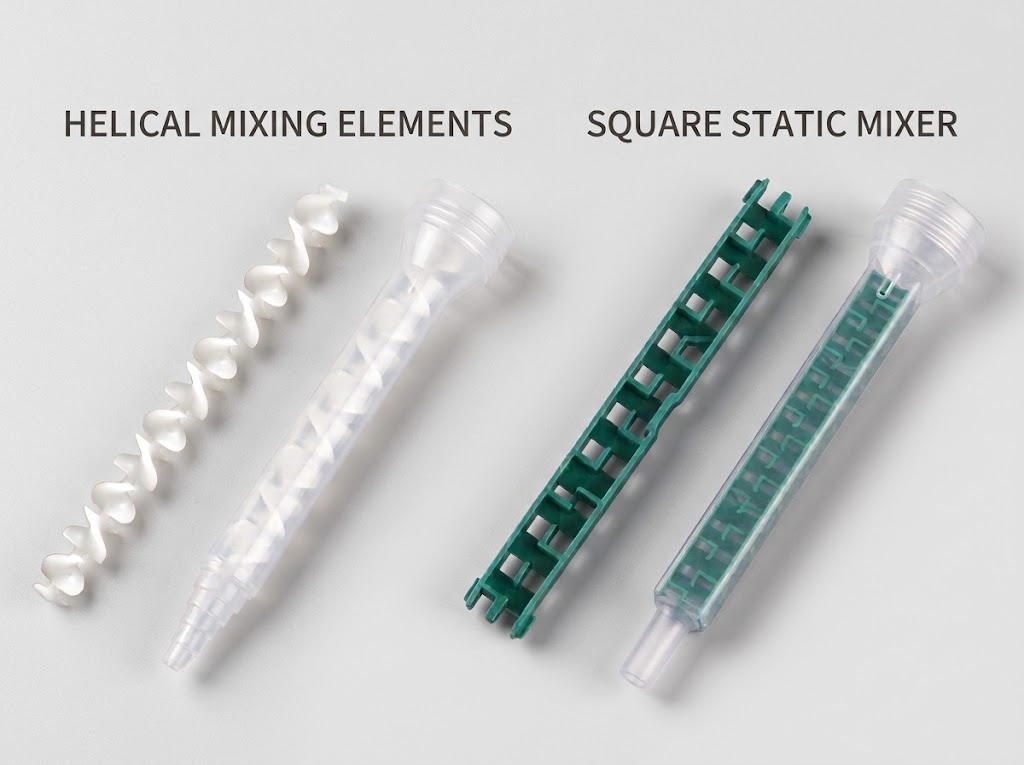
Match the coupler to the mixer family you run. Our static mixer nozzle selection guide covers which mixer outlet styles pair with which cartridge nose.
4. Machine Adapters: Mounting Cartridges to Automated Dispensers
A machine adapter converts the cartridge assembly into a drop-in module for a benchtop dispenser or robot. It defines the flange pattern, threaded boss, and air routing. The adapter must match both the cartridge size and the dispenser’s mounting face, or the pistons will not align with the drive rods.
| Adapter class | Connects | Typical use |
|---|---|---|
| Flange adapter | Cartridge retainer → dispenser body | Benchtop semi-auto dispensers |
| Threaded boss adapter | Retainer → robot end-effector | Cobot / XYZ gantry cells |
| Filling-line adapter | Cartridge → filling machine | High-volume 2K filling (see cartridge filling machines) |
For full lines, the adapter is part of the wider adhesive dispensing equipment overview that links filler, retainer, and robot controller.
5. Bayonet vs Screw vs Flange: Matching the Interface
Interface geometry decides whether parts even mate. Bayonet (twist-lock) is fastest for frequent changeovers; threaded collars seal better at higher pressure; flange adapters carry the load on robotic mounts. Cartridge and mixer systems use letter codes — our C-system and F-system mixer interfaces explains C-system and F-system mixer noses and which cartridges they accept.
| Interface | Speed | Pressure | Use when |
|---|---|---|---|
| Bayonet | Fastest (1/4 turn) | up to ~70 PSI | Frequent cartridge swaps, manual cells |
| Threaded collar | Slower | up to 100 PSI | Steady high-pressure production |
| Flange | Bolted | Robot payload | Mounted on automated equipment |
Confirm the cartridge nose code (A, B, C, F-system) before ordering adapters — a wrong code is the most common cause of “the mixer won’t lock” returns.
6. Selection Checklist: Ratio, Size, Pressure, Mount
Use this checklist to specify integration hardware. It assumes you already know the dual-component cartridge sizing and ratio compatibility for your process.
| Parameter | Confirm | Why it matters |
|---|---|---|
| Mix ratio | 1:1 / 2:1 / 4:1 / 10:1 | Retainer and push-disk must match ratio |
| Cartridge size | 50 / 200 / 400 / 600 ml | Sleeve and flange must fit the body |
| Interface code | A / B / C / F-system | Decides bayonet vs threaded coupling |
| Max pressure | PSI at dispenser | Sleeve material rated accordingly |
| Mount | Gun / stand / robot | Picks adapter class |
A short Btektech dispensing adapters guide from Btektech also lists the retention, air-transfer, and interface checks used in industrial adapter sourcing.
7. Common Integration Failures & Fixes
| Symptom | Likely cause | Fix |
|---|---|---|
| Mixer blows off mid-shot | Coupler not fully locked | Seat bayonet until click; check collar |
| Off-ratio / streaky bead | Cartridge not square in retainer | Use correct-size sleeve; align pistons |
| Air leak at joint | Cross-threaded NPT or no sealant | Re-thread; apply PTFE sealant |
| Cartridge drops on robot | Wrong flange / loose bracket | Bolt flange adapter; torque to spec |
| Rods won’t retract | No vacuum suck-back port | Use dispenser with suck-back function |
Need a retainer, coupler, or machine adapter matched to your cartridge and dispenser?
Send us your cartridge ratio, size, interface type, and mounting requirement. We’ll confirm compatibility and recommend the right integration hardware.
Frequently Asked Questions
What is the difference between a cartridge retainer and a machine adapter?
A retainer clamps the cartridge so its pistons advance straight; a machine adapter mounts the whole retainer-and-cartridge assembly onto a dispenser or robot. The adapter sits upstream of the retainer and defines the flange or threaded interface to the equipment.
Can one retainer handle multiple mix ratios?
Multi-ratio pneumatic retainers (e.g. A-system 50 ml) accept 1:1, 2:1, 4:1 and 10:1 cartridges through quick-change push disks. Single-ratio molded gun cradles do not. Always confirm the ratio range stamped on the retainer before swapping cartridges.
Bayonet or threaded coupling — which should I choose?
Pick bayonet for fast, frequent cartridge swaps at lower pressure (up to ~70 PSI). Choose a threaded collar when you run steady high-pressure production up to 100 PSI and need a tighter seal. Robotic mounts use a bolted flange for load carrying.
Why does my mixer not lock onto the cartridge?
Almost always a mismatch between the cartridge nose code (A, B, C or F-system) and the mixer family. Check the code on the cartridge and match it to the mixer outlet; see our C-system and F-system mixer guide for the matrix.
Do I need a vacuum suck-back port on the dispenser?
If you want the rods to retract automatically when the cartridge empties, yes. Vacuum suck-back pulls plungers back for clean changeover. Manual guns and basic pneumatic retainers without this port require manual rod retraction.
Conclusion
Retainers, couplers, and machine adapters are the small parts that decide whether a 2K cartridge dispenses on-ratio and leak-free. Match the interface code first, then size, pressure, and mount. Start from the components of a dispensing cartridge system and the OEM dual-component cartridges to narrow the options, and confirm the mixer nose with the static mixer nozzle selection guide. If your cartridge, dispenser, or robot is non-standard, OEM custom static mixers can build a matched adapter from drawings or samples.
Not sure which retainer or adapter fits your setup? Send us your cartridge ratio, size, and dispenser model and we’ll confirm compatibility.