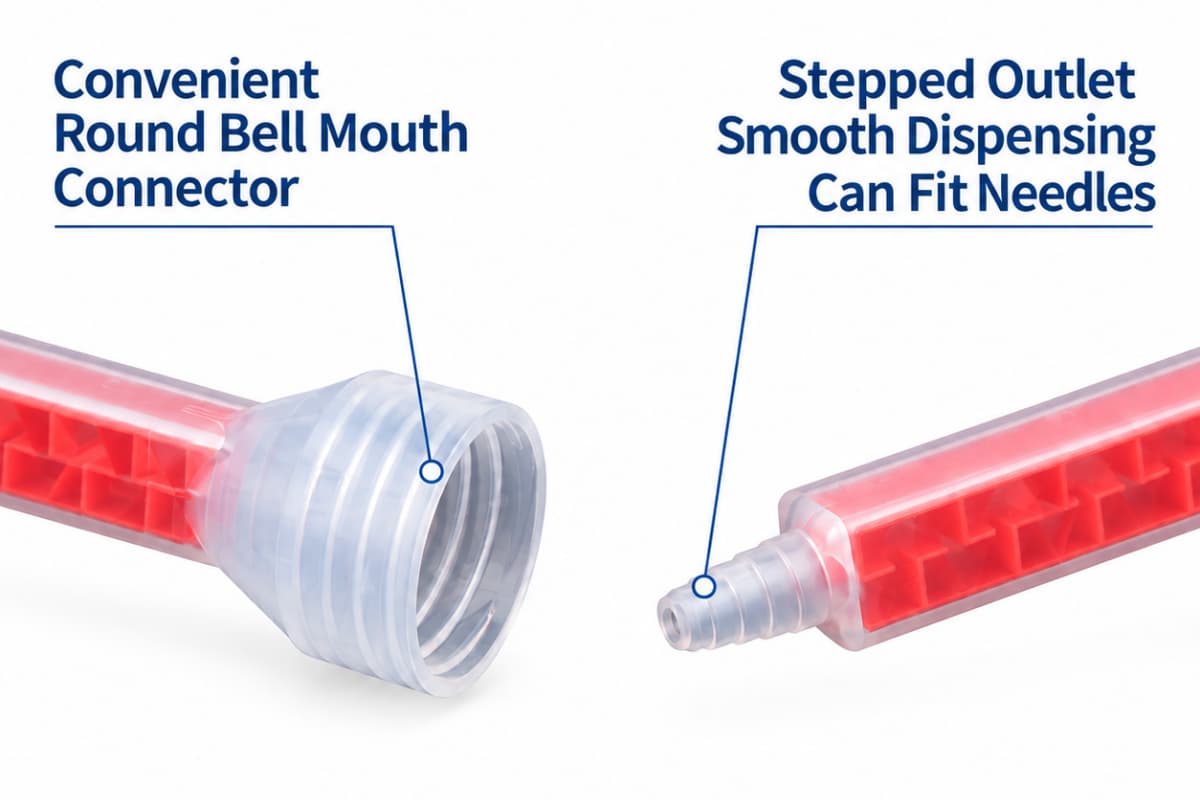
Ceramic and metal-oxide fillers turn a static mixer into a wear device. Under dispensing pressure those particles act like fine sandpaper on the element walls, rounding off the sharp folding edges that actually blend the adhesive. Wear does not just shorten service life — it silently degrades bead quality before the mixer looks damaged. This article explains why abrasive fillers attack mixers, which materials and geometries survive them, how wear shows up in the bead, and what changeover and material choices keep an abrasive formulation mixing cleanly. Match a tougher polymer or quadro geometry and a disciplined changeover, and abrasive adhesives stop eating your mix quality.
Why Abrasive & Ceramic Fillers Attack the Mixer
Fillers do two jobs at once: they raise viscosity and they physically grind. Ceramic, silica, and metal-oxide particles common in thermal-interface materials, potting compounds, and structural adhesives are hard enough to abrade polymer element walls with every shot. As edges round off, the split-and-fold action softens, so mixing quality drops while the mixer still appears intact. The failure is quiet: a bond that cures unevenly or a streak that appears only after weeks of gradual wear. High-wear applications therefore need a tougher internal material or a slightly higher element count to compensate for the loss, not just a bigger mixer.
| Filler type | Wear risk | Typical use |
|---|---|---|
| Ceramic (Al2O3, SiC) | High | Thermal interface, abrasion-resistant coatings |
| Metal oxide | High | Conductive / EMI adhesives |
| Silica / fumed | Medium | General filled epoxies, sealants |
| Glass microsphere | Low–medium | Lightweight, low-shrink compounds |
| Graphite / PTFE | Low (lubricating) | Bearing, anti-seize formulations |
Mixer Materials: What Survives Abrasion
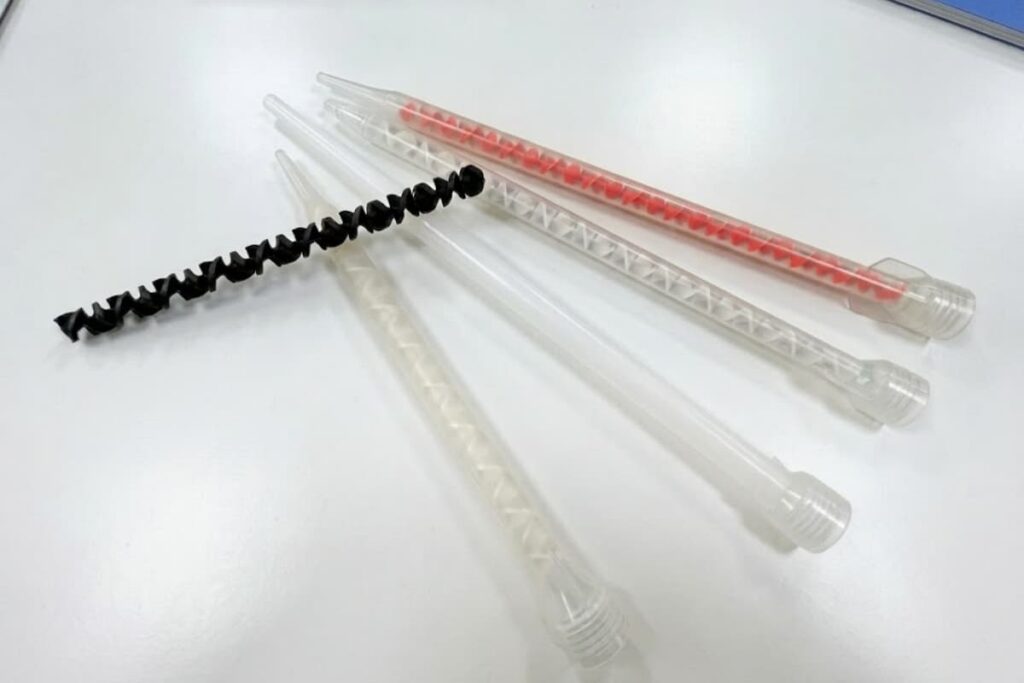
Disposable cartridge mixers are usually polypropylene or acetal bodies with molded elements — cheap and clean, but the polymers themselves wear under hard fillers. For longer-life or inline service, material choice decides survival. Match the body and element polymer to the filler using the static mixer nozzle selection guide. Tougher engineering polymers, PTFE-coated or stainless elements, and elastomeric (flexible) elements all resist abrasion better than standard PP. Industry references note that flexible, rubber-like elements adapt to flow and resist wear with particulate-laden compounds, making them a common pick for ceramic-filled epoxies (Mixpac mixer types overview).
| Material | Abrasion resistance | Best for | Trade-off |
|---|---|---|---|
| Polypropylene (PP) | Low | Mild, low-filler adhesives | Cheap, single-use |
| Acetal / POM | Low–medium | General cartridge mixers | Standard disposable |
| Tougher engineering polymer | Medium–high | Moderate abrasive fillers | Higher cost |
| PTFE-coated / stainless | High | Inline, reusable service | Expensive, not disposable |
| Elastomeric (flexible) | High | Ceramic-filled, particulate | Higher unit cost |
Element Geometry for Filled Adhesives
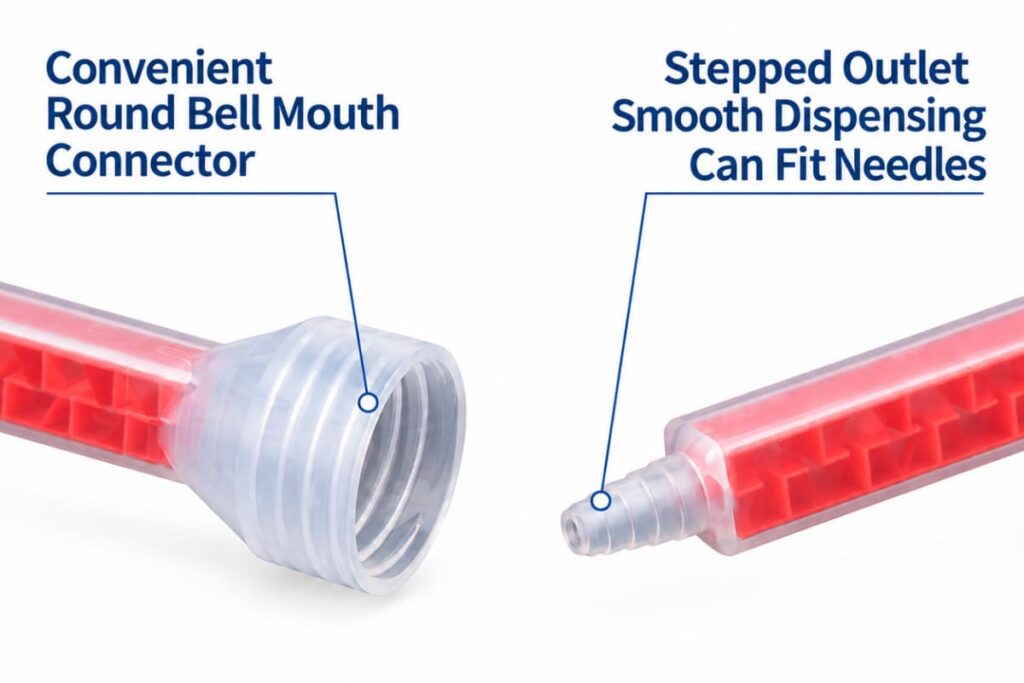
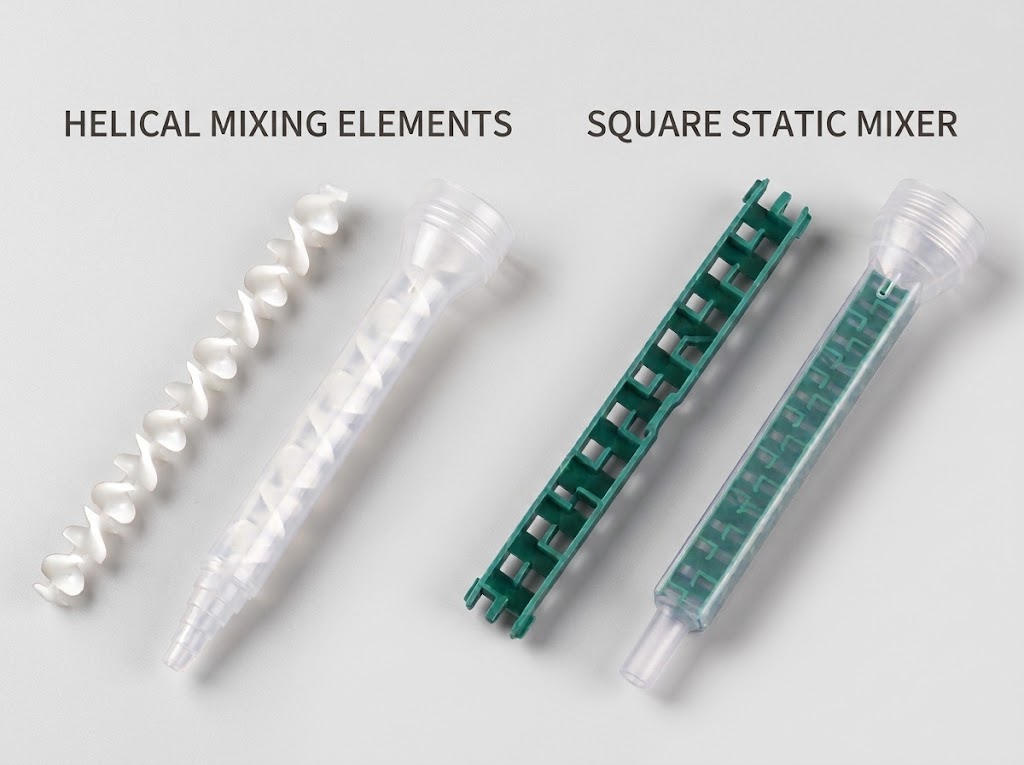
Geometry matters as much as material. Filled and highly viscous chemistries usually pair better with quadro (square) elements, which create sharper shear planes in a shorter length than gentle helical folding. Compare the two paths in the helix vs quadro mixer guide. Because abrasive pastes resist stretching into thin layers, they also need more elements to reach a full blend — confirm the count with the static mixer element-count guide, and add a margin so gradual wear does not push the bead under-mixed. A slightly longer mixer with tougher elements beats a short one that rounds off after a few hundred shots.
- Quadro geometry: aggressive shear in shorter length; better for filled / viscous adhesives.
- More elements for filled pastes: compensate for both viscosity and gradual edge wear.
- Add a safety margin (~20% extra length) so wear does not drop blend quality mid-life.
- Keep diameter matched to gun thrust; a restrictive nozzle only adds back-pressure on top of wear.
How Wear Shows Up in Bead Quality
Worn elements do not announce themselves — they show up as a slowly degrading bead. Before a mixer looks damaged, it starts streaking or cures unevenly. The fix is usually a fresh mixer plus a wear-aware spec, not a chemistry change. Verify a suspect part is still blending to spec with the mixing nozzle qualification test rather than trusting a bead that only looks acceptable.
| Symptom | Worn-element cause | Fix |
|---|---|---|
| Gradual streaking over a run | Rounded element edges lose fold | Replace mixer; tougher material |
| Uneven cure after weeks | Quiet quality drop from wear | Shorter changeover interval; qualify |
| Higher back-pressure late life | Narrowed flow path from deposit | Fresh nozzle; clean interface |
| Inconsistent bead on abrasive line | Edge wear varies shot to shot | Switch to quadro / elastomeric |
| More rejects after filler change | New filler harder than spec | Re-spec element count and material |
Extending Service Life on the Line
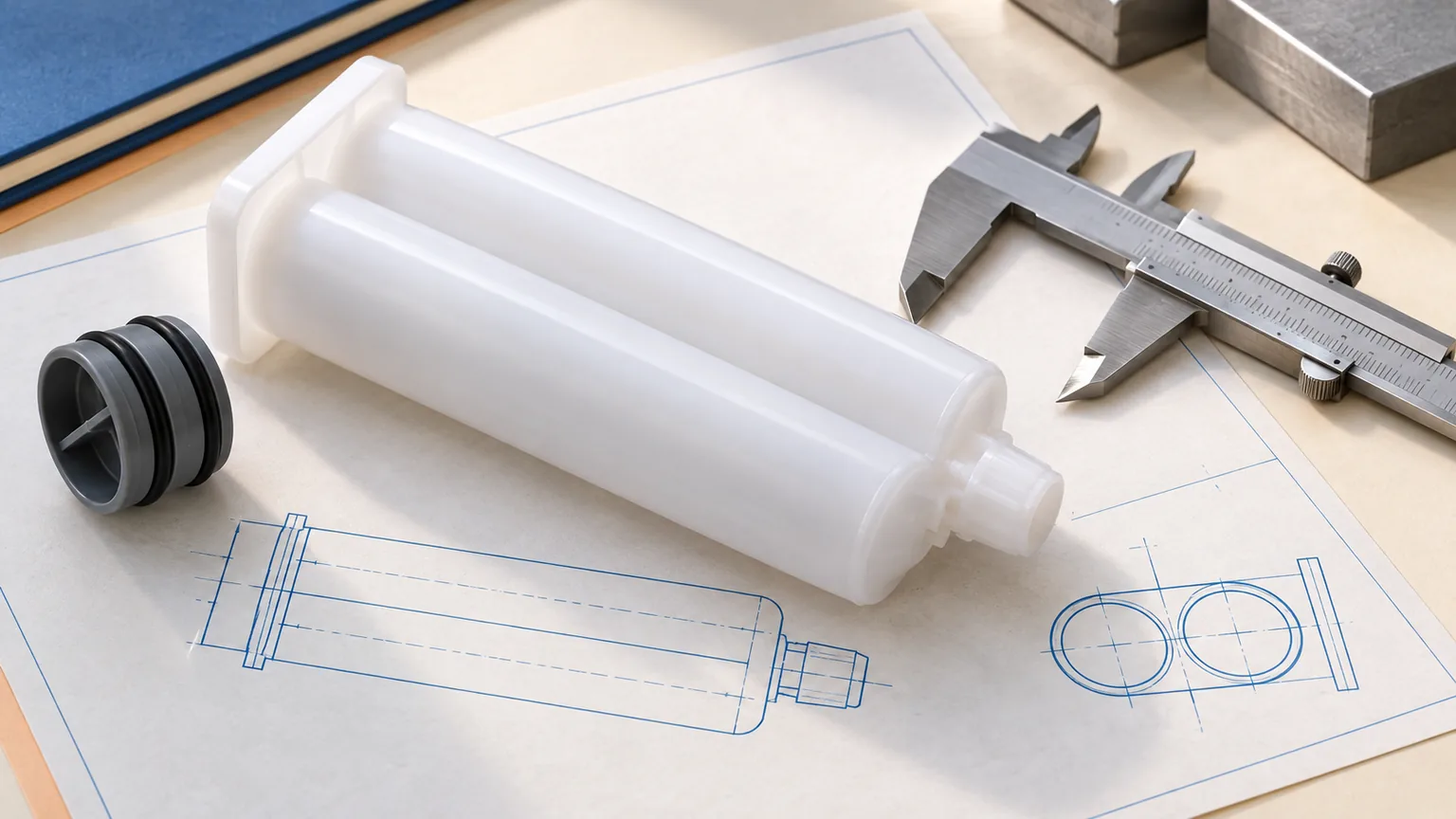
Most service-life gains come from discipline, not from a pricier mixer. On automated lines, frequent changeovers actually limit how much wear any single mixer accumulates, so a planned cadence beats running a mixer to failure. Your dual-component cartridge sizing and ratio choice also sets how hard the filler is pushed through the element stack, so respect the ratio window the adhesive needs.
| Practice | Why it helps | Note |
|---|---|---|
| Planned changeover cadence | Caps wear before quality drops | Set by filler hardness, not by eye |
| Tougher element material | Slows edge rounding | Weigh cost vs reject rate |
| Margin on element count | Absorbs gradual wear | ~20% extra length typical |
| Consistent cartridge ratio | Avoids over-pressuring filler | Check pistons / gun seating |
| Qualify suspect mixers | Catches quiet degradation | Do not trust appearance |
| Log shots per mixer | Finds wear trend early | Feeds cadence tuning |
When Static Mixing Hits Its Limit
Very abrasive or very high-volume formulations can outwear even a tough static mixer. For heavily filled 10:1 systems or continuous bulk service, a rotating (dynamic) mixer may hold up better because its elements are driven and replaceable. The trade-off is cost and cleaning. Review the boundary in the static vs dynamic mixer guide before committing a line to one path — many abrasive jobs still run fine on a well-specced disposable static mixer with the right cadence.
| Condition | Better path | Why |
|---|---|---|
| Mild–moderate filler, cartridge | Static (disposable) | Cheap, clean, frequent change |
| Heavy ceramic, 10:1 | Static + quadro/elastomeric | Aggressive shear, wear-resistant |
| Continuous bulk, very abrasive | Dynamic (driven) | Replaceable, longer life |
| Low volume, field repair | Static (disposable) | No power, portable |
Selection Checklist for Abrasive Formulations
Specify an abrasive-resistant mixer by filler, viscosity, and volume together. For non-standard fillers, a custom or OEM-built mixer often pays back in fewer rejects — see the OEM custom static mixers guide for what to brief your supplier.
| Input | Decision |
|---|---|
| Filler hardness | Ceramic/metal-oxide → tougher polymer, PTFE, or elastomeric |
| Filler loading | Higher load → more elements + margin |
| Viscosity | Thick paste → quadro, shorter length |
| Volume / duty | Continuous bulk → consider dynamic; cartridge → planned changeover |
| Ratio | Wide (4:1, 10:1) → more folding elements |
| Reject history | Rising rejects → shorten cadence, re-qualify |
Need a mixer that survives your filler?
Send your adhesive chemistry, filler type and loading, viscosity, mix ratio, and duty cycle. Haijing can discuss element material, helix vs quadro, and a changeover cadence so abrasive adhesives stop wearing out your bead quality.
FAQ
Do ceramic fillers wear out static mixers?
Yes. Ceramic and metal-oxide particles abrade the polymer element walls under dispensing pressure, rounding off the edges that do the mixing. Wear shortens service life and, more importantly, silently degrades blend quality before the mixer looks damaged. Use a tougher polymer, PTFE-coated or elastomeric elements, and a disciplined changeover.
Which mixer material is best for abrasive adhesives?
For disposable cartridge use, tougher engineering polymers beat standard PP/acetal; for longer-life or inline service, PTFE-coated or stainless elements resist best, and flexible elastomeric elements adapt to flow and resist wear with particulate fillers. Pick by filler hardness, volume, and reject cost, not by price alone.
Helical or quadro for a filled adhesive?
Usually quadro. Filled and highly viscous chemistries need aggressive shear in a short length, which quadro delivers; gentle helical folding may not be enough. Confirm element count for the filler and add a margin so gradual wear does not push the bead under-mixed.
How often should I change a mixer on an abrasive line?
Set the cadence by filler hardness and shot count, not by eye. Planned changeovers cap wear before quality drops; on automated lines, frequent changeovers actually limit total wear per mixer. Log shots per mixer to tune the interval and catch a wear trend early.
When should I switch from static to dynamic mixing?
When a formulation is so abrasive or so high-volume that even a tough static mixer wears out too fast — typically heavily filled 10:1 systems or continuous bulk service. Dynamic mixers have driven, replaceable elements and longer life, at higher cost and more cleaning. Many abrasive jobs still run fine on a well-specced disposable static mixer.
Conclusion
Abrasive and ceramic fillers wear static mixers from the first shot — rounding element edges, dropping blend quality, and shortening service life. Survive them with a tougher element material or quadro geometry, a few extra elements as a wear margin, and a changeover cadence set by filler hardness rather than by appearance. For the toughest bulk jobs, a dynamic mixer may be the better path. Spec the mixer to the filler, not the other way around, and abrasive adhesives stop eating your bead quality.
Need a mixer that survives your filler? Contact our engineering team with your chemistry, filler, viscosity, and duty cycle, or start from the static mixer nozzle selection guide to match material and geometry to your abrasive formulation.