A bad bead is almost never a bad adhesive. Stringing, streaks, and off-ratio output trace back to mixer geometry and the hardware pushing the resin — element count, helix vs quadro design, nozzle diameter, and the L/D ratio — long before the chemistry is at fault. This article explains how static mixer geometry produces a clean bead, what causes stringing, streaks, and off-ratio beads, and how to pick element count and nozzle dimensions so each defect stops at the root. Match geometry to viscosity and mix ratio and most bead problems disappear at the nozzle.
What “Bead Quality” Means, and Why Geometry Is the Root Cause
Bead quality is what the dispensed adhesive looks like and how it cures: a uniform color, a consistent width, clean snap-off, and a ratio that cures evenly end to end. When any of those fail, the first instinct is to blame the resin. But a static mixer is a mechanical device — its internal geometry decides whether two components actually blend. The cartridge sets the A:B ratio; the mixer homogenizes what the cartridge delivers. So a streaky or off-ratio bead usually points upstream to geometry or metering, not to the adhesive batch. Start every diagnosis at the mixer, then move to the gun and cartridge only if geometry checks out.
| Symptom | What it signals | Where to look first |
|---|---|---|
| Stringing (long tail at cut-off) | Tip wetting / elasticity / snap-off | Nozzle tip, adhesive temp, retraction |
| Streaks / marbling | Unmixed pockets | Element count, geometry, ratio |
| Off-ratio (lumpy, never cures) | Ratio shift upstream | Back-pressure, retained volume, gun seating |
| Uneven width | Flow or pressure instability | Gun thrust, cartridge pistons |
How Static Mixer Geometry Produces a Clean Bead
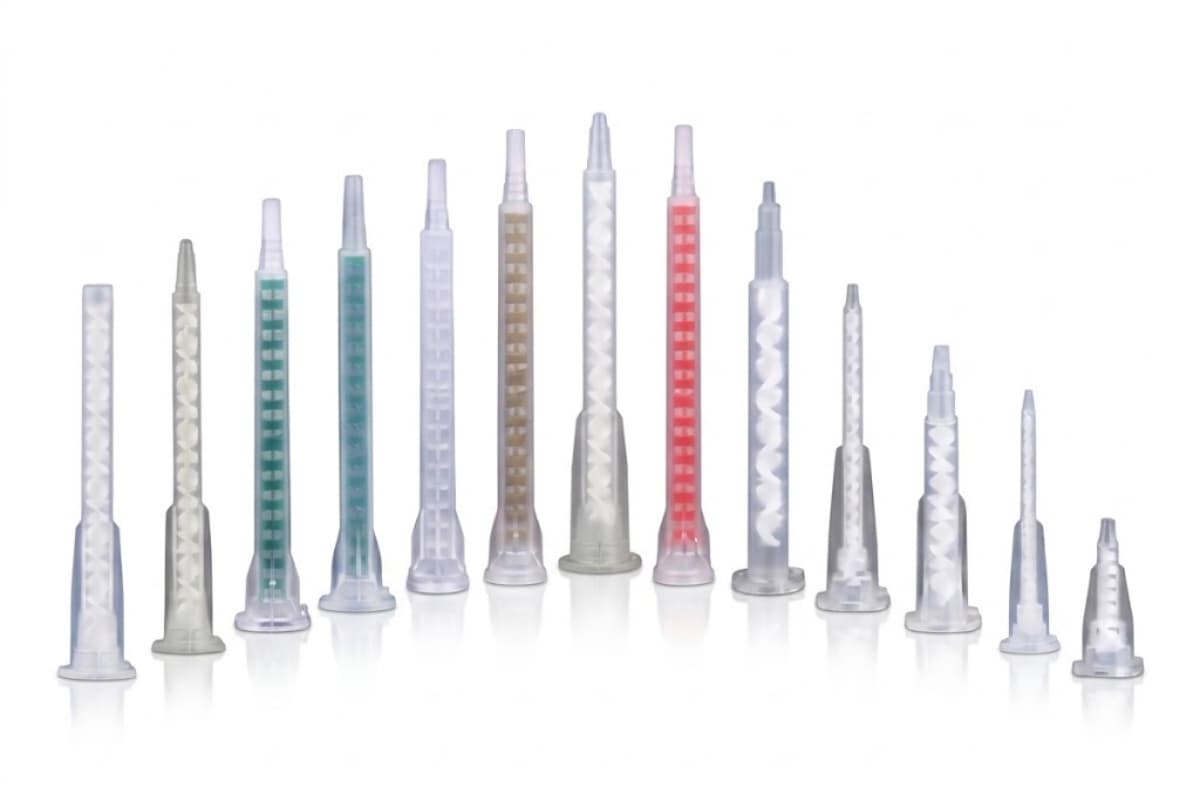
Inside the tube, a series of fixed elements splits the two streams, rotates them, and recombines them — hundreds to thousands of split-and-fold cycles by the tip. Standard helical (spiral) mixers carry roughly 17–24 elements; quadro (square) elements create sharper shear planes and often reach the same blend in a shorter length. Nozzle resistance is described by the length-to-diameter (L/D) ratio: pressure drop rises sharply as diameter shrinks, so a small ID change needs a large jump in gun thrust. Pick geometry and diameter to your adhesive’s viscosity using the static mixer nozzle selection guide — narrow long nozzles mix well but demand more force, wide short ones need less thrust but can undermix a viscous or wide-ratio adhesive.
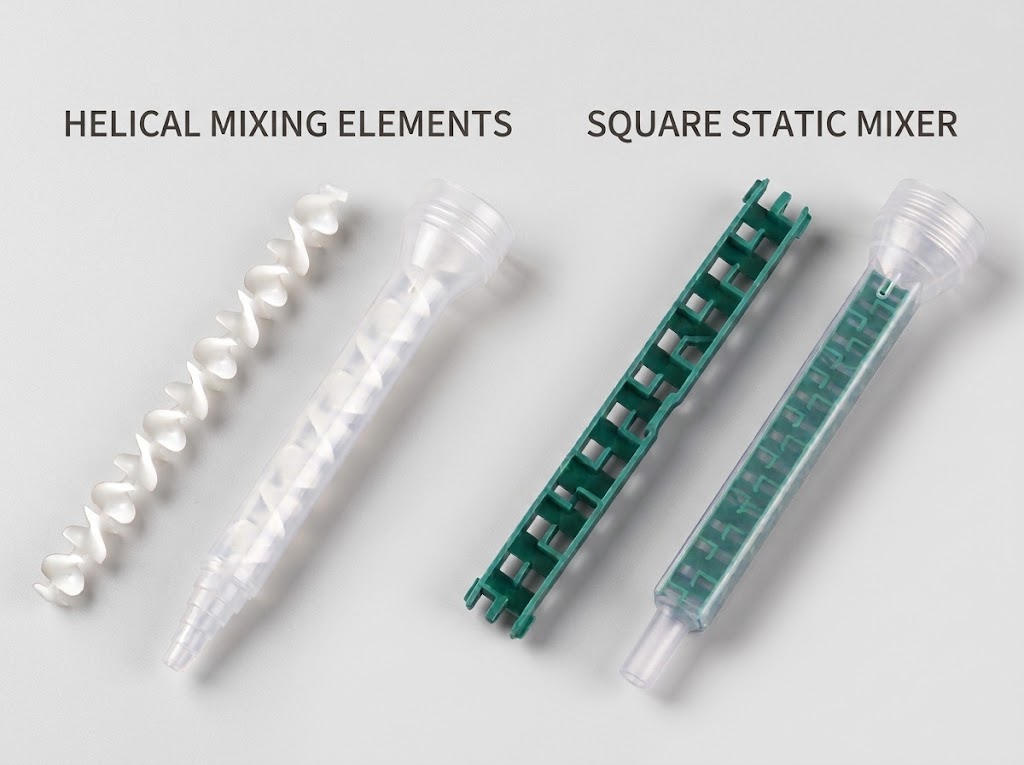
- Helical elements: gentler, lower pressure-drop path; good for larger 400–490 ml cartridges.
- Quadro elements: aggressive shear in shorter length; better for filled or highly viscous chemistries.
- L/D ratio: the real driver of back-pressure — match it to gun thrust, not to a copied spec.
- Element count is a trade-off: too few leaves streaks, too many wastes thrust with no extra benefit.
Stringing: Causes and Fixes
Stringing is the thin thread of adhesive that follows the nozzle when you stop dispensing. It is a tip and rheology problem, not a mixing problem. High elasticity or thixotropy, a blunt or wetting tip, slow retraction, and cold adhesive all make the bead cling and draw a tail. The fix is usually mechanical: cut the tip at a clean 45°, retract faster, wipe the tip, and bring the cartridge to room temperature before use. Selecting the right nozzle diameter also changes how cleanly the bead breaks.
| Cause | Why it strings | Fix |
|---|---|---|
| Blunt / unwiped tip | Adhesive wets and bridges the gap | Sharp 45° cut; tip wipe after each shot |
| High elasticity / thixotropy | Bead stretches before snapping | Faster retraction; lower-viscosity tip |
| Cold adhesive | Thicker, clings more | Warm cartridge to 15–25 °C |
| Slow operator stop | No clean break point | Automate cut-off; consistent dwell |
| Wrong tip diameter | Surface tension holds a tail | Resize nozzle to flow rate |
Streaks and Marbling: Causes and Fixes
Streaks (visible lines of one color) or marble (swirls of unmixed A/B) mean pockets of pure resin or hardener survived to the tip. The usual cause is too few elements for the viscosity and ratio — wide ratios such as 4:1 or 10:1 need far more folding than 1:1, often 24–32 elements, because the minor stream is a thin ribbon that must be cut repeatedly. Worn or broken elements also drop mixing quality quietly. Confirm the needed count with the static mixer element-count guide, and before trusting a suspect part on the line, the mixing nozzle qualification test checks whether it still blends to spec.
| Cause | Why it streaks | Fix |
|---|---|---|
| Element count too low | Minor component not fully folded | Add elements (24–32 for 4:1–10:1); switch to quadro |
| Worn / broken elements | Lost sharp folding edge | Replace mixer; inspect for abrasion |
| Viscous minor component | Resists stretching thin | More elements or finer geometry |
| Color injected at outlet | No mixing downstream | Move color entry upstream of elements |
| Cold adhesive | Behaves like heavier paste | Warm before dispensing |
Off-Ratio Beads: Geometry vs Metering
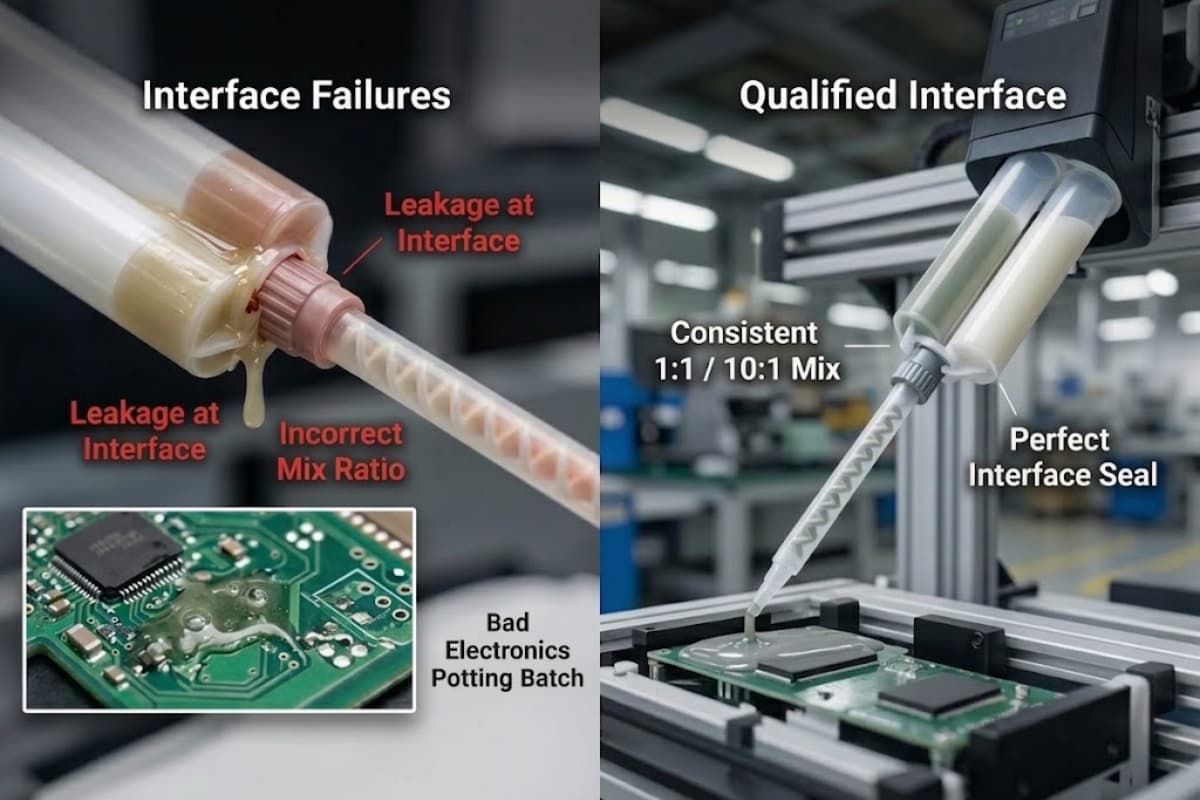
An off-ratio bead is lumpy, sticky in one spot, or never cures at all. In most cases it traces to back-pressure and retained volume inside the mixer — too few elements, a mismatched nozzle diameter, or a worn bayonet — not to the resin itself. The detailed mechanics are in the static mixer back-pressure guide to off-ratio beads. But geometry is only half: the cartridge and gun set the nominal A:B delivery, so a damaged cartridge, piston lag, or a gun that does not seat the plunger evenly can shift ratio before material reaches the mixer. Your dual-component cartridge sizing and ratio choice sets the window you must respect. The practical rule from dispensing specialists is to verify actual A:B output, not just trust a bead that “looks” mixed (Btektech off-ratio troubleshooting).
| Cause | Where it starts | Fix |
|---|---|---|
| Too few elements / wrong ID | Inside the mixer | Match element count and nozzle diameter to viscosity |
| Worn bayonet fitting | Mixer–cartridge interface | Replace fitting; seat fully |
| Cartridge deformation / piston lag | Upstream of mixer | Replace cartridge; check pistons |
| Gun does not seat plunger | Applicator | Use ratio-specific gun config |
| Cold adhesive raises back-pressure | Fluid | Warm cartridges consistently |
A Defect-to-Cause Diagnostic
When a bead fails on the line, map the symptom to the likely cause before swapping parts blindly. The full catalog of line defects and their fixes is in the common 2K dispensing defects guide. Use this quick map as the first pass, then confirm with a purge and a ratio check.
| Symptom | Likely cause | First action |
|---|---|---|
| Thread tail at stop | Tip wetting / elasticity | Cut tip 45°; wipe; retract faster |
| Color streak in bead | Under-mixed (low elements) | More elements; verify geometry |
| Bead soft / tacky after cure | Off-ratio or poor mix | Check ratio; replace mixer; purge |
| Bead lumpy, one side wet | Back-pressure / retained volume | Reseat mixer; match ID; warm adhesive |
| Uneven extrusion from tip | Clogged element / unbalanced back-pressure | Fresh nozzle; equalize A/B |
| Marble after color added | Color entry too late | Move color upstream of elements |
Geometry Selection Checklist
Pick geometry by viscosity, mix ratio, and gun thrust together — not by copying a spec from another adhesive. A short checklist keeps the next order clean.
| Input | Geometry decision |
|---|---|
| Viscosity | Thin → fewer elements; thick / filled → more elements or quadro |
| Mix ratio | 1:1 → 7–16; 2:1 → 10–18; 4:1 → 18–24; 10:1 → 24–32+ |
| Gun thrust | Low thrust → wider / shorter nozzle (lower L/D) |
| Abrasive filler | Tougher wall polymer or +elements to offset wear |
| Cold environment | Warm cartridges; expect higher back-pressure |
| Dispense stop | Sharp tip cut + wipe to kill stringing |
Need the right mixer geometry for your bead?
Send your adhesive chemistry, viscosity, mix ratio, and gun type. Haijing can discuss element count, helix vs quadro, and nozzle L/D so stringing, streaks, and off-ratio stop at the source.
FAQ
What causes stringing at the end of a bead?
Stringing is a tip and rheology issue: a blunt or wetting nozzle, high elasticity or thixotropy, slow retraction, or cold adhesive that clings and draws a tail. Fix it mechanically — a clean 45° tip cut, a faster retract, a tip wipe, and warming the cartridge to 15–25 °C usually remove it. It is not a mixing problem.
Why is my 2K bead streaky or marbled?
A streak or marble means unmixed pockets of resin or hardener reached the tip, almost always from too few elements for the viscosity and ratio. Wide ratios (4:1, 10:1) need far more folding — 24–32 elements — than 1:1. Worn or broken elements also drop blend quality. Confirm the count and replace suspect mixers.
Can a static mixer cause an off-ratio bead?
The mixer does not set the A:B ratio — the cartridge and gun do — but a restrictive, blocked, or wrong-geometry mixer raises back-pressure that can expose cartridge deformation or piston lag upstream. Most off-ratio beads trace to back-pressure and retained volume inside the mixer, or to gun/cartridge seating, not the adhesive.
Helical or quadro — which geometry is better?
Neither is universal. Helical elements give a gentler, lower pressure-drop path suited to larger cartridges; quadro elements create sharper shear in a shorter length and suit filled or highly viscous chemistries. Choose by viscosity and gun thrust, not by habit.
How many mixing elements do I actually need?
It depends on ratio and viscosity: roughly 7–16 for 1:1, 10–18 for 2:1, 18–24 for 4:1, and 24–32+ for 10:1, with more for heavily filled or thixotropic adhesives. Too few streaks; too many only adds back-pressure. Match to the adhesive, then verify by a purge and a ratio check.
Conclusion
Stringing, streaks, and off-ratio beads are geometry and metering problems first, adhesive problems rarely. Match element count and nozzle L/D to your viscosity and mix ratio, choose helix vs quadro by chemistry and gun thrust, and keep tips clean to stop stringing. When a bead fails, map the symptom to its cause before swapping parts — and verify the actual A:B output rather than trusting a bead that only looks mixed.
Need the right mixer geometry for your line? Contact our engineering team to discuss element count, helix vs quadro, and nozzle L/D for your adhesive, or start from the static mixer nozzle selection guide to match geometry to your process.