Modern factories increasingly replace traditional rivets and screws with advanced structural glues. This massive shift helps lightweight cars and miniaturize consumer electronics. But these high-tech adhesives only work if you mix them with absolute precision. A tiny mistake in the fluid line can quickly cause a catastrophic product failure on the market.
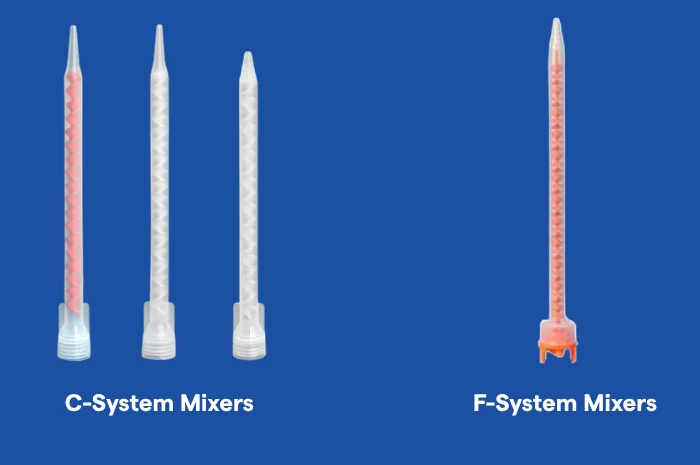
Industrial plants use C-System and F-System mixers because they handle extreme pressure and fast robotic movements. The C-System uses a thick bayonet mount for heavy pneumatic forces, while the F-System uses a twist-lock design for rapid mechatronic assembly.
But choosing the right mixer is not just about the connection style. The raw plastic materials, internal fluid pathways, and precise mold engineering dictate the final bond strength. By examining the technical differences between these two systems, global production managers can stop nozzle blowouts, prevent bad chemical ratios, and keep modern manufacturing lines running smoothly. This technical guide explains the underlying engineering principles of these vital dispensing tools.
What Are C-System and F-System Static Mixers?
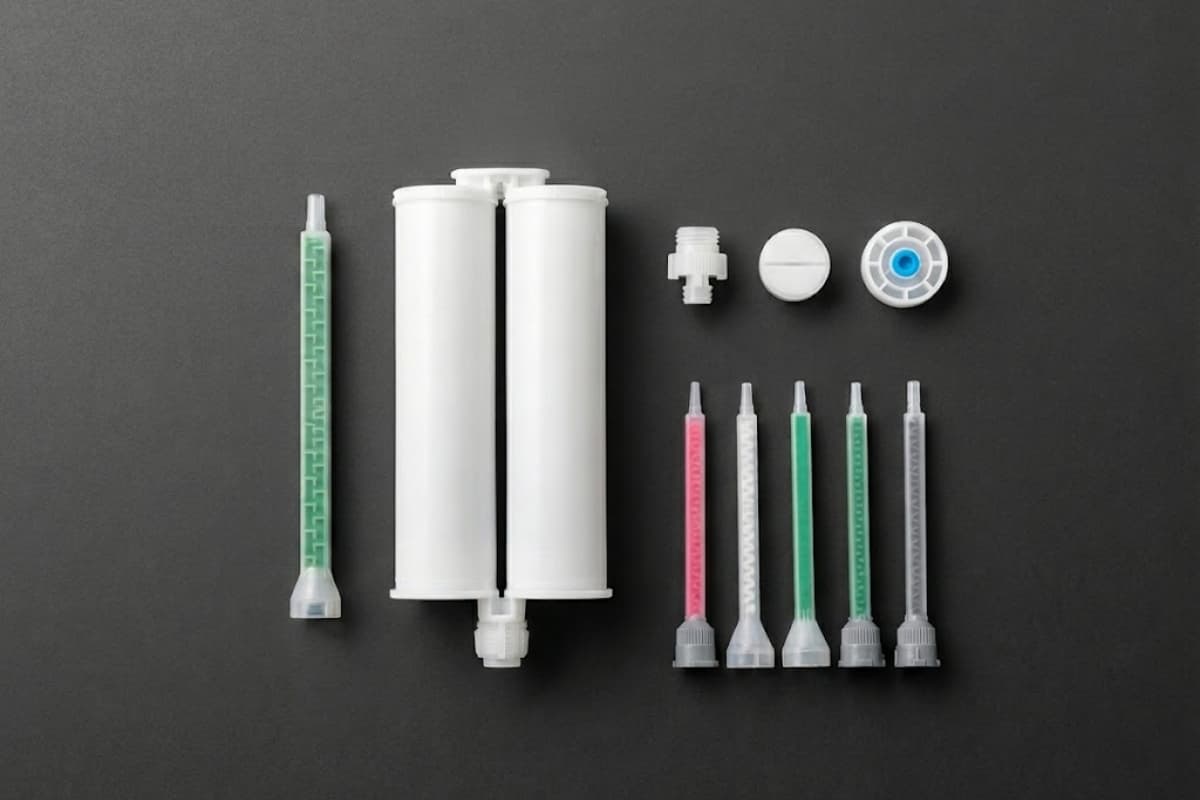
C-System and F-System static mixers are disposable plastic nozzles that blend two-part industrial adhesives. They attach directly to chemical cartridges and force the resin and hardener through geometric blades. The C-System uses a thick bayonet mount, so it handles extreme pneumatic pressure. Then, the F-System uses a twist-lock mechanic, because robotic assembly lines require fast and secure nozzle changes.
The Core Job of a Static Mixer
A static mixer works like a mathematical blender without any moving parts to mix advanced chemical glues.
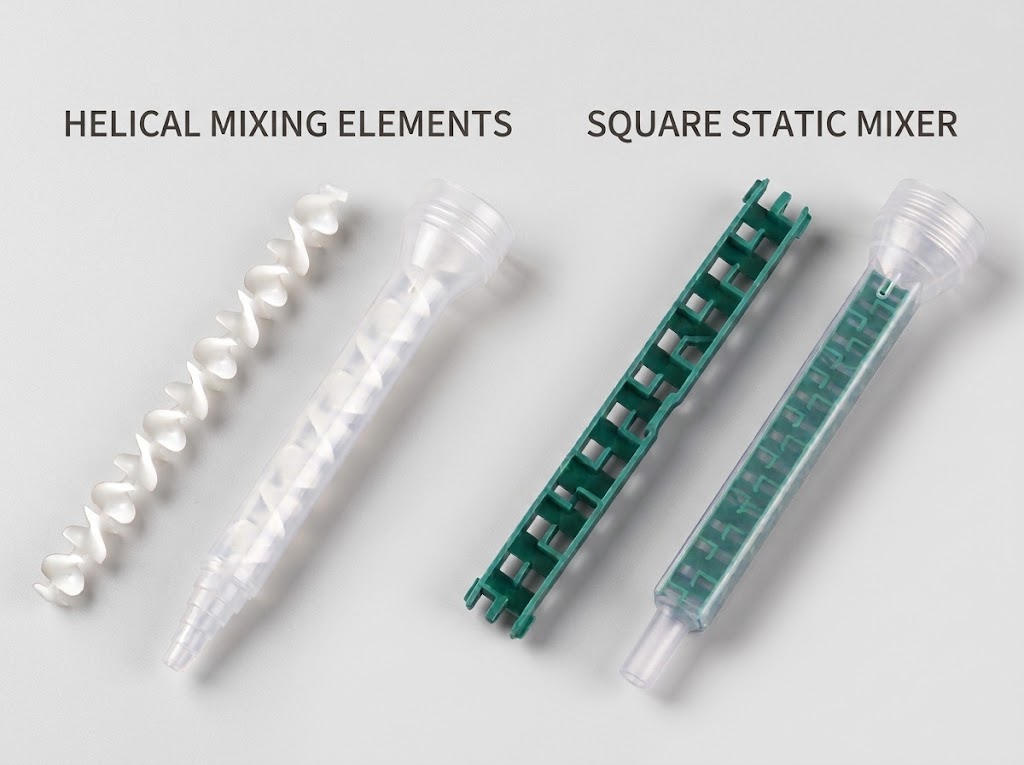
- The plastic tube holds a row of stationary blades that continuously divide and fold the two fluid streams.
- Engineers depend on these rigid tools to blend tricky reactive chemicals with asymmetric mix ratios like $4:1$ or $10:1$.
- They easily process standard 50ml cartridges all the way up to large 1500ml bulk volumes without losing mixing quality.
- The internal geometry forces the thick structural resin into the thin hardener, so the chemical curing process begins perfectly before the liquid leaves the tip.
- Without these geometric elements, the chemicals would channel straight through the tube and ruin the final product.
By forcing the raw materials through these highly engineered pathways, the mixer guarantees a strong, bubble-free bond every single time.
The Heavy Reinforced Interface of C-Systems
Heavy manufacturing plants choose the C-System because they regularly handle extremely thick and difficult industrial chemicals.
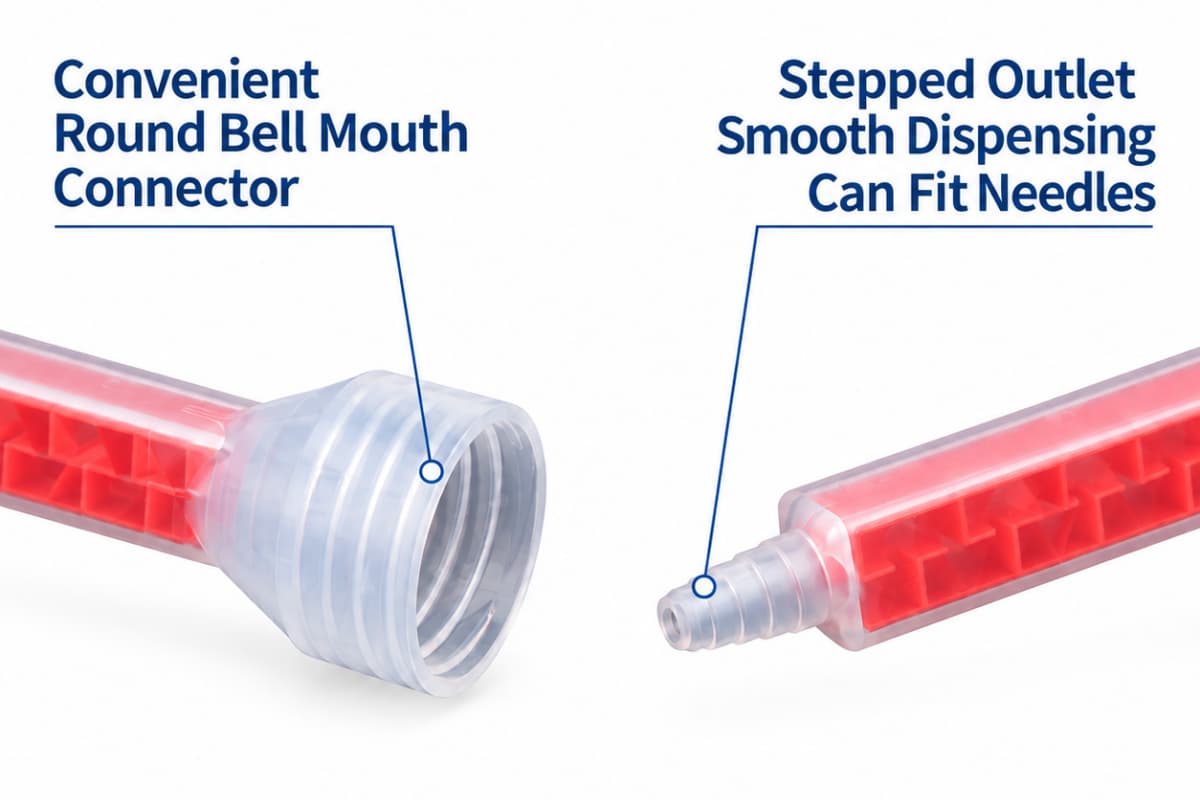
- The base of this nozzle features a heavily reinforced bayonet connection interface that locks deeply into the chemical cartridge.
- This robust physical lock completely stops the nozzle from breaking off when factory workers apply massive pneumatic pressure.
- Assembly lines rely on this specific design to push dense structural polyurethanes that easily snap weaker standard mixing tips.
- Engineers specifically match these tough nozzles with heavy-duty metal dosing guns to handle highly filled thermal pastes.
- The tight seal also stops the raw chemicals from leaking out the sides, which saves money and keeps the workspace clean.
So, when your team pumps heavy pastes under extreme backpressure, the C-System delivers the absolute safest and strongest physical connection.
The Fast Twist-Lock Action of F-Systems
Fast-paced electronics factories take a different approach because they need to keep their robotic assembly lines moving rapidly.
- The F-System uses specialized twist-lock connection mechanics so operators can snap the nozzle onto the cartridge instantly.
- This precise engineering allows machines and human workers to securely attach or detach the mixing tube in just a fraction of a second.
- Since automated robots dispense hundreds of tiny adhesive dots per minute, they absolutely need these rapid changeovers to hit their daily targets.
- You will frequently see this rapid setup integrated directly with precision dispensing platforms moving at rapid speeds up to 800mm/s.
- The locking action also provides a secure click, so the operator knows the nozzle sits perfectly flush against the cartridge outlets.
Ultimately, the F-System keeps high-speed production environments running at maximum efficiency by entirely eliminating slow and clumsy nozzle swaps.
Why Do High-Pressure Environments Need Specific Mixers?
High-pressure environments need specific mixers because heavy pneumatic guns push extremely thick chemicals very fast. Standard plastic nozzles easily crack or blow off under this massive force. So, engineers use reinforced C-System and F-System designs to handle the intense physical stress. This prevents dangerous chemical spills and keeps the adhesive mixing perfectly.
Handling Extreme Pneumatic Backpressure
Air-powered dispensing systems create massive internal pressure that easily destroys weak plastic parts.
- Pneumatic dispensing guns use compressed air to continuously push out heavy epoxies across large surface areas.
- This constant pushing force creates huge backpressure against the small geometric opening of the nozzle tip.
- Standard mixer connections stretch, bend, and eventually leak when operators turn up the heavy air pressure.
- But heavily reinforced mounts lock tight into the cartridge base and easily survive the mechanical stress.
- They also stop microscopic air bubbles from entering the fluid stream during the high-pressure extrusion process.
- As a result, factory workers stay safe from dangerous bursts of industrial chemicals on the assembly line.
So, specific reinforced mixers are absolutely necessary to withstand the brutal force of heavy pneumatic tools on the factory floor.
Managing Highly Viscous Structural Epoxies
Modern structural glues are incredibly thick, so they need specialized heavy-duty channels to flow properly.
- Electric vehicle factories use thermal interface materials that are packed with heavy ceramic or metallic dust.
- These thick chemicals naturally resist flowing and require heavy-duty metal dosing guns just to push them forward.
- If a mixer is too weak, the thick viscous paste simply clogs the geometric blades and stops the machine.
- So, engineers design specific high-shear internal planes that can safely slice through these dense polyurethanes.
- This advanced geometry guarantees that the asymmetric mixing ratios always remain perfectly balanced from start to finish.
- These tough internal channels force the thick resin to mix perfectly with the thin hardener without cracking the outer shell.
Because heavy structural glues act like thick paste, factories must use rigid nozzles specifically built for the heavy job.
| System Type | Primary Connection Interface | Ideal Manufacturing Environment | Core Operational Benefit |
|---|---|---|---|
| C-System | Heavy Bayonet Mount | High-Pressure Pneumatic Assembly Lines | Completely stops nozzle blowouts under extreme physical stress. |
| F-System | Fast Twist-Lock Mechanic | High-Speed Robotic Coordinate Systems | Allows instant and secure nozzle swaps in just seconds. |
Stopping Nozzle Detachments and Blowouts
When a nozzle breaks off during production, it ruins the product and creates a very expensive mess.
- A blowout happens when the internal plastic threads simply fail under the heavy force of the glue gun pistons.
- When the nozzle pops off, unmixed Part A and Part B chemicals spill everywhere across the work area.
- This cross-contamination immediately ruins the expensive aerospace composite panel or the sensitive automotive electronic part.
- Reinforced bayonet and twist-lock designs securely anchor the mixing tube directly to the dual-component cartridge body.
- Furthermore, the highly secure fit prevents any wasted adhesive from dripping onto the clean factory floor.
- This physical lock guarantees the mixer stays perfectly attached, even when pushing dense construction silicones for hours.
By using the correct heavy-duty locking systems, production managers completely eliminate costly blowouts and dangerous chemical spills.
How Does Polymer Selection Control Mixer Strength?
Polymer selection directly controls mixer strength because the raw plastic must withstand massive pressure without stretching or snapping. If engineers use cheap plastics, the mixer will burst under heavy fluid forces. So, top manufacturers strictly use virgin industrial plastics like PP and POM. These specific materials provide the exact chemical resistance and physical rigidity needed to safely handle highly reactive industrial adhesives.
Building with 100% Virgin Polypropylene (PP)
Polypropylene serves as the absolute best foundation for the outer shell of high-pressure static mixers.
- Manufacturers explicitly choose 100% virgin PP because it offers amazing chemical resistance against caustic acids and bases.
- This tough plastic naturally stops moisture from entering the tube, which prevents the glue from curing too early.
- It provides the perfect balance of flexibility and cost-efficiency for disposable industrial parts.
- Because it stretches slightly before breaking, it easily absorbs sudden spikes in pneumatic pressure without shattering into dangerous pieces.
- Engineers use this specific polymer to mold the exterior housing for the vast majority of standard disposable nozzles.
So, virgin polypropylene guarantees that the outer tube safely contains the dangerous chemical reaction happening inside.
Using POM Acetal for Internal Element Rigidity
While the outside shell needs to be tough, the inside mixing blades require absolute structural rigidity.
- Engineers mold the complex internal mixing elements out of POM (Polyoxymethylene), which is widely known as Acetal.
- This advanced engineering plastic is famous for its incredible stiffness and very low friction.
- When thick structural epoxies slam into the blades, the POM material strongly resists bending or twisting under the stress.
- Because it maintains its perfect shape, it forces the chemical fluids to fold accurately at exact mathematical angles.
- This rigid strength is absolutely mandatory when pushing highly viscous glues through very tight spaces.
By using Acetal for the internal blades, production managers ensure the exact chemical mixing ratio stays perfectly consistent.
Why Recycled Plastics Always Fail Early
Cutting costs by using recycled plastics introduces massive safety and performance risks onto the factory floor.
- Recycled polymers naturally suffer from shortened chemical chains because melting them repeatedly destroys their structural integrity.
- These cheap plastics frequently hide microscopic impurities that create tiny weak spots along the nozzle wall.
- When factory workers apply heavy pneumatic pressure, these weak spots stretch out and cause catastrophic ballooning.
- Eventually, the compromised plastic bursts open, spilling toxic Part A and Part B resins across the expensive assembly line.
- Furthermore, mixed plastic scraps cannot provide the exact chemical resistance needed to survive highly reactive polyurethane mixtures.
So, serious manufacturing facilities completely avoid recycled materials to permanently mitigate the risk of sudden structural failures.
What Really Happens Inside the Mixing Channels?
Inside the mixing channels, stationary blades continuously slice and recombine two liquid streams until they become one perfectly blended chemical. Advanced fluid dynamics force the thick resin to fold exactly into the thin hardener. So, even extreme asymmetrical formulations mix flawlessly. This internal geometry prevents premature curing at the base and completely stops fluid channeling.
Dividing and Folding the Fluid Streams
The stationary geometric blades inside the tube execute a precise mathematical process to blend the chemicals.
- When the two liquids enter the nozzle, the first rigid blade instantly cuts the stream into two equal parts.
- Then, the next plastic element forces those separated streams to fold over and recombine into a single unified flow.
- This rapid process of dividing and folding repeats continuously through every single geometric stage in the tube.
- By the time the fluid reaches the exit orifice, the liquid has been folded and sheared thousands of times.
- This aggressive mechanical shearing eliminates microscopic air bubbles, which act as dangerous stress points in cured aerospace glues.
So, this continuous cutting action guarantees a perfectly homogeneous and void-free chemical bond.
| Polymer Material | Mechanical Profile | Primary Mixing Function |
|---|---|---|
| PP (Polypropylene) | High chemical resistance and flexibility. | Forms the outer pressure-resistant shell for standard disposable nozzles. |
| POM (Acetal) | Extreme stiffness and incredibly low friction. | Creates the rigid internal mixing blades that slice viscous fluids. |
| PBT (Polybutylene Terephthalate) | Extraordinary mechanical strength. | Used in specialized maximum-pressure dual-component industrial barrels. |
Handling Difficult $4:1$ and $10:1$ Mix Ratios
Chemical manufacturers frequently formulate structural adhesives with highly asymmetrical viscosity ratios to achieve specific curing times.
- Many heavy-duty construction glues require a tricky $4:1$ or even $10:1$ mix ratio to cure correctly on the job.
- In these advanced formulas, the thick resin base easily overwhelms the very small amount of thin liquid hardener.
- If engineers use standard mixing blades, the thin hardener simply shoots straight through the center channel completely unmixed.
- So, custom fluid dynamics models adjust the specific geometry of the internal shear planes to catch the thin liquid.
- These specialized internal channels force the massive resin stream to aggressively engulf the minor hardener component.
As a result, advanced mixers safely process extreme chemical ratios that would normally ruin standard off-the-shelf nozzles.
Stopping Premature Inter-Chamber Cross-Talk
A loose connection at the base of the mixer will instantly ruin the entire application process.
- Cross-talk happens when Part A and Part B mix together slightly before entering the main nozzle body.
- This premature mixing causes the glue to rapidly cure and harden directly at the critical cartridge interface.
- Even microscopic dimensional deviations in the plastic molding will allow the highly reactive chemicals to touch too early.
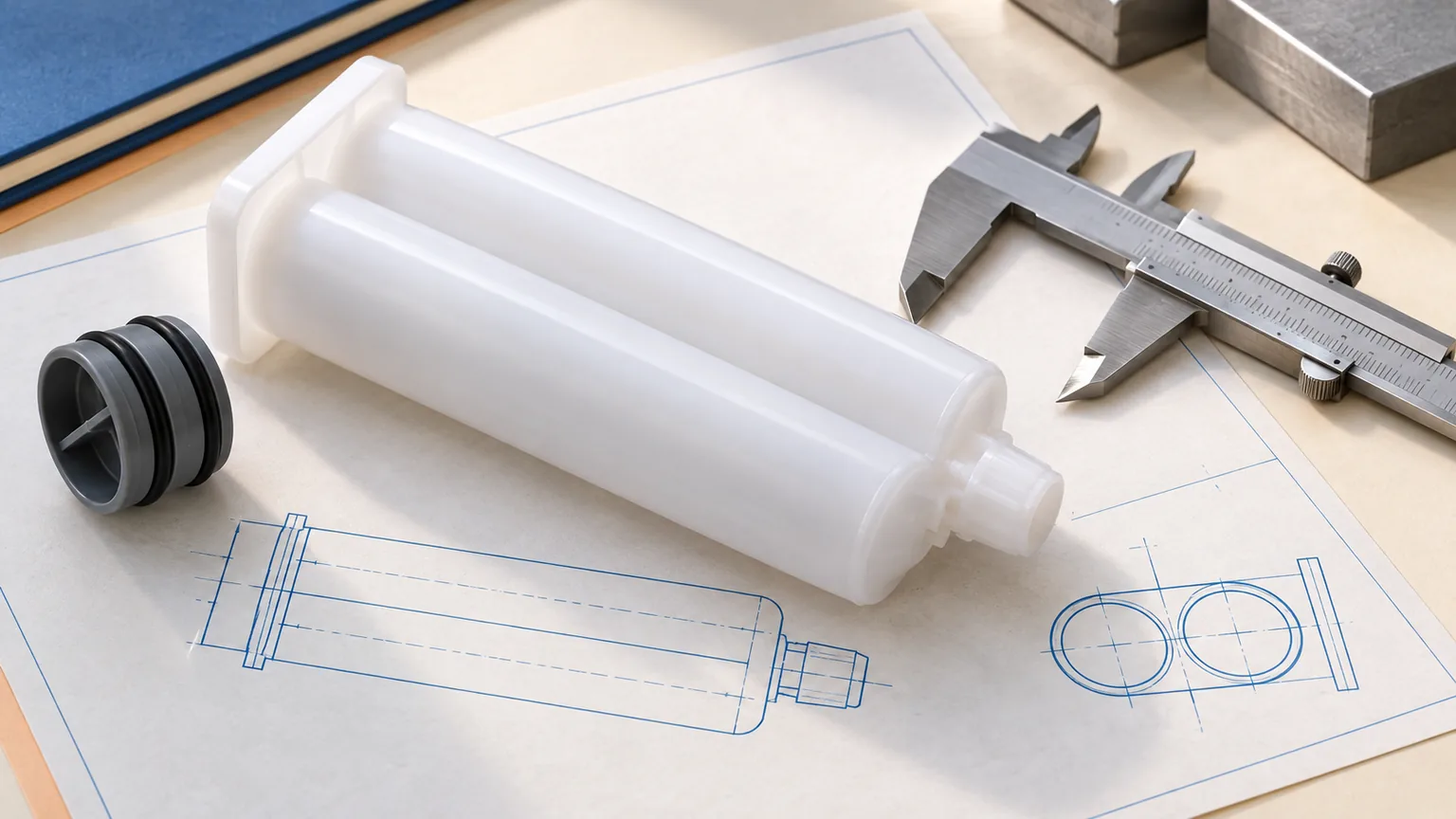
- So, precision injection molding guarantees a flawless, leak-proof interference fit between the cartridge wall and the static mixer.
- This tight physical fit keeps the two chemical streams completely isolated until they safely reach the first cutting blade.
Ultimately, exact manufacturing tolerances stop cross-talk and prevent highly expensive engineering adhesives from curing inside the tube.
Do Automated Assembly Lines Demand Faster Mixers?
Automated assembly lines absolutely demand faster mixers because robots dispense adhesives at incredibly high speeds. Slow manual nozzle changes force expensive machines to stop working. So, engineers use twist-lock F-System mixers to perform instant swaps. This keeps production moving rapidly and ensures the robots hit their daily manufacturing targets without delays.
The Need for High-Speed Nozzle Changeovers
Modern factories cannot afford to shut down their expensive machines for slow and clumsy tool changes.
- Robotic systems apply hundreds of tiny glue dots onto surface mount circuit boards every single minute.
- Because structural epoxies cure very quickly, the plastic mixing tubes naturally clog up if the machine pauses for too long during a shift change.
- When a solid clog happens, the human operator must immediately stop the entire assembly line and swap the blocked tip.
- Traditional threaded screw-on nozzles take entirely too much time to unscrew and replace, which destroys the factory’s strict production schedule.
- Twist-lock mechanisms solve this massive problem completely by allowing workers to swap the part in under one second with a simple flick of the wrist.
By eliminating slow maintenance tasks, fast nozzle changeovers keep expensive robotic systems running efficiently all day long.
Interfacing with Robotic Coordinate Applicators
Advanced dispensing robots require specific lightweight nozzles that fit perfectly onto their moving arms without wobbling.
- Mechatronic dispensing robots use high-end servo motors to achieve an amazing positional repeatability of $\pm 1\%$ across large factory workstations.
- These intelligent machines also use high-resolution CCD vision systems and laser height sensors to keep the nozzle exactly above the curved surface.
- If the mixer connection is even slightly loose or bulky, it completely throws off the delicate calibration of the fast-moving robotic arm.
- So, engineers design highly compact twist-lock F-System tips that lock securely and flawlessly into the automated mounting bracket.
- This perfectly tight fit guarantees that the dispensing tip always lands exactly on the programmed target, even when dispensing microscopic lines of glue.
So, secure mixing tips allow high-tech robots to apply perfect micro-dots of glue without any mechanical shaking.
Maintaining Continuous Extrusion Speeds
High-speed assembly lines force fluid through the mixing channels at extreme velocities, requiring very smooth internal pathways.
- Automotive factories coat engine control circuit boards while moving the applicator at rapid speeds up to 800mm/s to keep up with high consumer demand.
- At these extreme operational speeds, the static mixer must physically blend the heavy resin and hardener instantly without choking the pneumatic flow.
- If the internal plastic blades create too much fluid friction, the fast-moving machine will naturally skip spots and leave dangerous dry patches on the board.
- Custom internal geometries provide a highly optimized, low-pressure flow path so the thick industrial fluids exit the tip flawlessly and continuously.
- This advanced engineering ensures a perfectly continuous bead of protective silicone or epoxy across the entire delicate electronic component.
Ultimately, optimized fluid pathways allow automated machines to dispense perfectly blended adhesives at their absolute maximum operating speeds.
Can Advanced Fluid Dynamics Fix Bad Mixing Ratios?
Advanced fluid dynamics absolutely fix bad mixing ratios because they control exactly how thick and thin liquids move. Standard nozzles fail when mixing extremely unbalanced chemicals. But custom-engineered pathways force heavy resins to perfectly absorb thin hardeners. This prevents unmixed spots and guarantees a strong final cure.
Moving Beyond Basic Off-The-Shelf Designs
Generic mixing nozzles simply cannot handle highly specialized, modern industrial adhesives.
- Standard geometry works perfectly fine for basic $1:1$ glues, but it completely fails with asymmetrical formulations.
- When factory workers push a $10:1$ adhesive through a basic tube, the thin liquid shoots straight down the middle channel.
- Because the two liquids never fold together, the final glue patch remains permanently soft, sticky, and structurally weak.
- So, engineers must change the internal shear planes to specifically catch and redirect the thin hardener component.
- This custom internal geometry aggressively forces the massive resin stream to fold over the tiny hardener stream repeatedly.
So, specialized fluid pathways prevent total chemical failure when your assembly line mixes highly unbalanced adhesives.
| Mixer Design Type | Typical Mix Ratio | Internal Flow Path Action | Final Bond Result |
|---|---|---|---|
| Standard Off-The-Shelf | $1:1$ or $2:1$ | Basic symmetrical folding and dividing. | Reliable curing for standard, evenly matched industrial glues. |
| Custom Fluid Dynamics | $4:1$ up to $10:1$ | Aggressive asymmetric shearing and capturing. | Perfect structural cure for complex, unbalanced epoxy systems. |
Testing Flow Pathways with Computer Models
Before cutting expensive metal molds, engineers test the fluid flow using advanced computer simulations.
- They use Computational Fluid Dynamics (CFD) software to virtually map exactly how the chemicals behave inside the plastic tube.
- This software easily reveals microscopic dead zones where thick polyurethane might get stuck during the heavy extrusion process.
- Engineers then adjust the specific angles of the mixing blades in the software to keep the fluid moving smoothly.
- They can accurately test different blade counts, channel diameters, and outlet shapes without wasting real plastic on the factory floor.
- By simulating the exact viscosity of the specific glue, they guarantee the mixer will perform flawlessly in reality.
Because computer models accurately predict exact fluid behavior, they eliminate guesswork and ensure perfect chemical blending every time.
Machining the Perfect Leak-Proof Fit
Even the best internal fluid dynamics will fail if the mixer connection leaks under extreme pneumatic pressure.
- High-precision injection molding machines create the plastic nozzle with incredibly tight dimensional tolerances.
- If the twist-lock thread deviates by just a fraction of a millimeter, high-pressure fluid will quickly escape the system.
- This microscopic gap also allows the separated Part A and Part B chemicals to bleed together before entering the nozzle.
- So, manufacturers cut their custom steel molds with extreme precision to ensure a flawless physical interference fit.
- This tight physical fit locks the nozzle perfectly against the cartridge outlets, so the fluids stay separated until they hit the first blade.
Ultimately, exact mold machining guarantees a secure, leak-proof system that handles extreme industrial fluid dynamics perfectly.
Which Mixing System Fits Your Production Line Best?
Choosing the best mixing system depends entirely on your specific manufacturing tools and chemical glues. Heavy assembly lines using high-pressure pneumatic tools need the tough C-System to prevent blowouts. But fast electronics factories using robotic arms require the F-System for rapid nozzle changes. So, matching the nozzle to your exact equipment ensures safe and continuous production.
When to Lock Down with the C-System
Heavy industrial plants must choose the C-System when pumping very dense structural glues.
- Construction and aerospace factories constantly use heavy pneumatic machines that create massive internal pushing forces.
- These air-powered tools push thick polyurethane and heavily filled thermal pastes at extremely high pressures.
- Standard screw-on nozzles simply snap off when they face this brutal mechanical stress on the line.
- Because the C-System features a heavily reinforced bayonet mount, it securely locks deep into the 200ml or 400ml cartridge base.
- This heavy-duty lock completely stops dangerous chemical blowouts and keeps factory workers safe from toxic spills.
So, production managers select this strong bayonet system to safely survive the absolute toughest pneumatic environments.
When to Speed Up with the F-System
Fast-paced electronic factories need the F-System to keep their automated robots moving quickly without delays.
- Consumer electronics assembly lines rely heavily on intelligent mechatronic machines to apply tiny glue dots perfectly.
- These precise robotic platforms move very fast, often reaching dispensing speeds up to 800mm/s during daily production.
- If a nozzle clogs, the machine stops, and the factory immediately loses valuable manufacturing time and money.
- The F-System uses a specific twist-lock connection that lets factory workers swap the tip in under one second.
- Also, the secure click lets the operator know the 50ml cartridge is perfectly sealed and ready to work.
Ultimately, this rapid connection system keeps high-speed robotic assembly lines hitting their strict daily targets without fail.
Matching the Mixer to Your Dispensing Guns
The best plastic nozzle will still fail if you pair it with the wrong dispensing gun.
- Manual hand guns work perfectly well for small, low-volume repairs using standard 50ml tubes and basic mixing channels.
- But human hands quickly get tired when pushing highly viscous epoxies through a tight geometric space all day.
- So, high-volume production lines switch to powerful heavy-duty metal dosing guns or regulated pneumatic air tools.
- These strong metal machines effortlessly drive thick glues, but they require the reinforced C-System to handle the extra pushing power.
- If you connect a weak standard nozzle to a strong pneumatic gun, the plastic will stretch, warp, and eventually burst open.
Because the gun and the nozzle work together as a single unit, matching them correctly guarantees a flawless chemical bond.
Frequently Asked Questions (People Also Ask)
What is a C-System static mixer?
A C-System static mixer is a heavy-duty blending nozzle. It uses a thick bayonet mount to lock securely into industrial cartridges. Factories use it safely with high-pressure pneumatic tools to push very thick glues.
How does an F-System mixer connect to a cartridge?
An F-System mixer connects using a fast twist-lock mechanism. An operator simply pushes the nozzle onto the cartridge and twists it once. This creates an instant and secure seal for rapid assembly.
Can I use C-System mixers for low-viscosity liquids?
You can use C-System mixers for thin liquids, but it might be unnecessary. Engineers design these strong nozzles specifically for very thick, heavy pastes. Standard mixing nozzles work perfectly fine for thin fluids under low pressure.
Why do cheap static mixers burst under pressure?
Cheap static mixers burst because manufacturers use recycled plastics. Melting old plastic repeatedly destroys its structural strength. When a heavy glue gun pushes fluid, the weak plastic wall simply balloons and explodes.
Are F-System mixers good for robotic assembly lines?
F-System mixers are excellent for robotic assembly lines. The twist-lock design allows incredibly fast nozzle changes. This keeps expensive automated mechatronic robots running all day without long maintenance delays.
Do I need custom molds for a 10:1 adhesive ratio?
You absolutely need custom molds for highly unbalanced chemical ratios like 10:1. Standard internal blades let the thin hardener flow straight down the middle. Custom fluid dynamics catch the thin liquid and force it safely into the thick resin.
What plastic makes the strongest static mixers?
Virgin Polypropylene (PP) and Acetal (POM) make the absolute strongest static mixers. PP forms a tough outer shell that strongly resists pressure. POM creates ultra-rigid internal blades that effortlessly cut through heavy structural glues.
Conclusion
Modern assembly lines require perfect chemical blending to build strong products. You must choose the right physical interface to prevent dangerous blowouts. The heavy C-System handles extreme pneumatic pressure easily. Meanwhile, the fast F-System keeps robotic platforms running continuously. Also, you must insist on virgin polymers to ensure maximum physical safety on the factory floor. If your global brand requires these exact industrial standards, Haijing Company provides the complete manufacturing solution. We engineer custom fluid dynamics and mold precision delivery systems to match your highly specialized adhesives perfectly.