The Design in 3 Steps
- Set the flow regime first — compute the Reynolds number; adhesive mixing is almost always laminar, and the regime decides which pressure-drop relation applies.
- Size pressure drop as a multiple of the empty pipe — ΔP_mixer = Z × ΔP_empty-pipe, where Z is a geometry-specific factor from vendor data; the bigger the L/D and element count, the bigger the drop.
- Count elements from mixing quality — uniformity improves roughly as K^n with element count n; pick the smallest count that meets your CoV target, then confirm with a trial or the vendor’s own calculation.
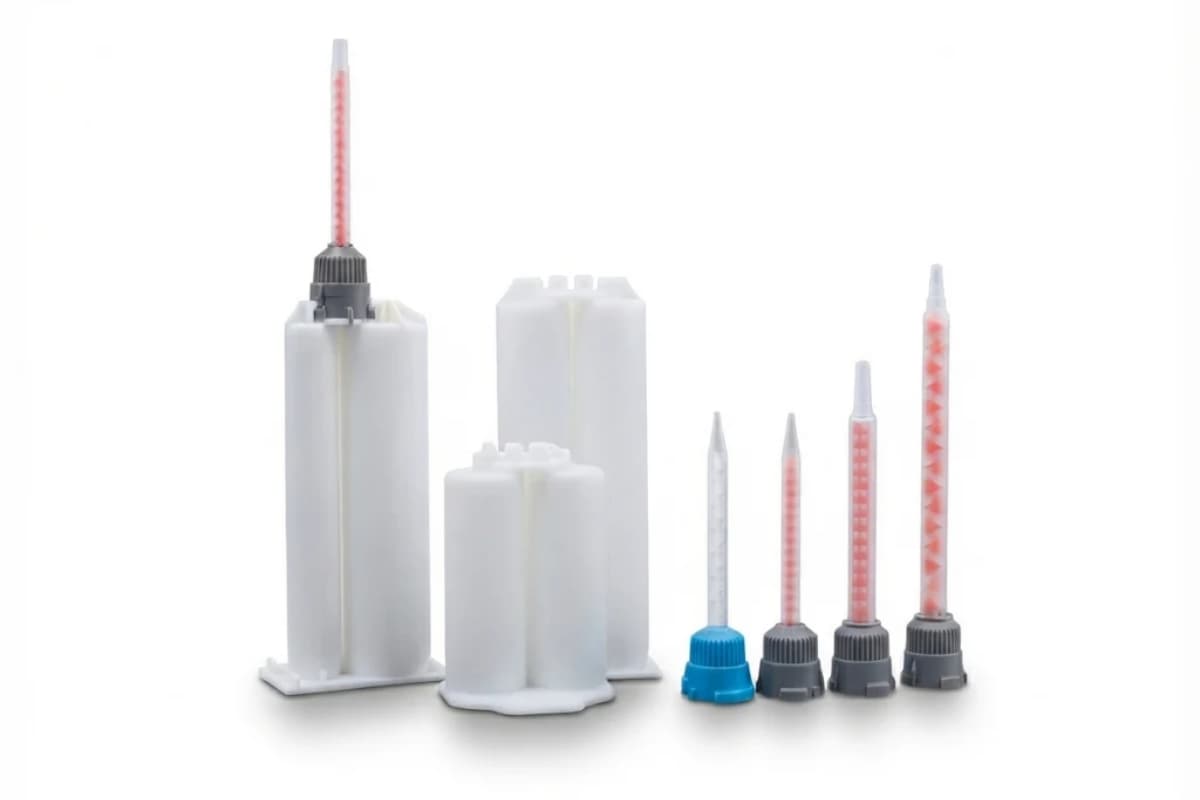
A static mixer looks like a passive part, but it is a calculated one: the number of elements, the mixing length and the pressure drop all follow from four inputs you already know — flow rate, viscosity, density and the mix-quality target. This static mixer design calculation walks through the chain a process engineer uses for 2K adhesive mixing: set the Reynolds number, estimate pressure drop as a multiple of the empty pipe, then count the elements needed to hit your uniformity target. Run the numbers before you quote, and you will know whether a standard helical mixer fits — or whether the process, not the mixer, needs to change.
Step 1: Reynolds Number — Set the Flow Regime
The Reynolds number is the first calculation because the flow regime decides every relation that follows:
Re = ρ × v × D / μ
where ρ is density, v the mean velocity, D the tube inner diameter and μ the dynamic viscosity at the operating temperature. For most filled epoxies and polyurethanes in cartridge-scale diameters, Re is far below the laminar threshold — the flow moves in orderly layers and mixing happens only because the elements repeatedly split, rotate and recombine the stream. That single fact drives the rest of the design: in laminar flow, pressure drop rises in proportion to viscosity, and uniformity comes from element count rather than turbulence.
| Regime | What it means for design |
|---|---|
| Laminar (typical for 2K adhesives) | ΔP ∝ viscosity; mixing by stream splitting; uniformity set by element count |
| Transitional / turbulent | ΔP rises roughly with velocity squared; vendor constants change — re-check with vendor data |
How the regime is set: v = Q/A with A = π·D²/4. Compute Re at both the nominal ratio and the extremes of your ratio window — a 1:1 and a 10:1 material can sit in different regimes at the same diameter.
Step 2: Static Mixer Pressure Drop Calculation — A Multiple of the Empty Pipe
The standard approach starts with the empty pipe of the same length and diameter (Darcy-Weisbach), then multiplies by a mixer factor:
ΔP_mixer = Z × ΔP_empty-pipe, with f = 64/Re in laminar flow
Z (also called K_L) is the ratio of mixer pressure drop to empty-pipe pressure drop at the same flow. It is a geometry-specific constant — published literature values differ by element design, and vendors calculate with their own data. What the formula tells you without any constant:
- ΔP scales with L/D — longer mixer or smaller diameter, proportionally higher drop.
- ΔP scales with μ in laminar flow — a cold morning batch can double the drop.
- Element count adds cumulative drag — each element is one more splitter in the train.
The practical check: your dispensing system must have enough available pressure to overcome the mixer drop at the coldest expected viscosity, or the shot will starve. Our guide to dispensing tip flow rate and pressure drop covers the needle-side budget; the mixer adds its Z-multiple on top of the empty-tube loss for its own length.
Step 3: Element Count — Work Backwards from Mix Quality
Mixing quality is expressed as the coefficient of variation (CoV): the standard deviation of concentration divided by the mean. Uniformity improves roughly by a constant factor per element:
CoV_target ≈ CoV_0 × K^n, where n = number of elements
K is again geometry-specific (from vendor or literature data). You do not need the constant to reason about the design:
| Target | Typical consequence |
|---|---|
| Tighter uniformity (lower CoV target) | More elements — each adds a fixed improvement factor |
| Smaller additive fraction in the carrier | Harder start: CoV_0 rises as the fraction shrinks, so more elements |
| Larger viscosity difference between A and B | Harder to break up and distribute — more elements or a different geometry |
| Higher flow (same diameter) | Shorter residence per element — uniformity target needs re-checking |
In laminar helical static mixers, each element ideally doubles the number of layers — which is why element count, not length alone, is the uniformity lever. Once the count is set, mixer length follows: L = n × element length, and the L/D ratio drops out as the geometry descriptor vendors use to quote. For the qualitative side — how element geometry shows up in the bead as stringing, streaks or off-ratio — see our static mixer geometry and bead quality guide, and for what excess back-pressure does to ratio, see why beads come out off-ratio.
The Design Worksheet (Fill In with Your Data)
| Input | Your value | Notes |
|---|---|---|
| Flow rate Q | Per shot and per minute — use the governing case | |
| Tube inner diameter D | Nominal vs actual ID differ | |
| Density ρ, viscosity μ | At operating temperature — viscosity dominates | |
| Ratio window | Check Re at both ends | |
| CoV target | Set by the process tolerance | |
| Element count n | From CoV relation or vendor table | |
| Mixer length L, L/D | L = n × element length | |
| ΔP budget | Z × empty-pipe ΔP at coldest viscosity |
Run the chain, then confirm: the constants that make these relations produce numbers (Z, K) are vendor-specific, so treat the worksheet as a scoping tool and validate against the supplier’s calculation or a short flow trial. Our epoxy static mixer flow test shows what a validation run measures in practice.
Worked Example (Illustrative Numbers)
A 2K epoxy bead-dispensing case, with illustrative values you should replace with your own:
- Fluid: filled epoxy, ρ = 1,600 kg/m³, μ = 20 Pa·s at operating temperature
- Flow: Q = 5 cm³/s through a 6.35 mm (¼ in) ID tube
- Mixer: 12 helical elements, each ≈ 1.5 D long → mixing length ≈ 18 D ≈ 0.11 m
| Step | Calculation | Result |
|---|---|---|
| Area & velocity | A = πD²/4 ≈ 3.17 × 10⁻⁵ m²; v = Q/A | v ≈ 0.16 m/s |
| Reynolds number | Re = ρvD/μ = 1,600 × 0.16 × 0.00635 / 20 | Re ≈ 0.08 — deeply laminar |
| Empty-tube ΔP over mixer length | ΔP = 32μvL/D² = 32 × 20 × 0.16 × 0.11 / 0.00635² | ≈ 2.9 bar |
| Mixer ΔP | ΔP_mixer = Z × 2.9 bar, Z ≈ 7 (published laminar value for a common helical element type — verify with vendor) | ≈ 20 bar |
| Cold-morning check | μ = 60 Pa·s (3×) → ΔP scales ∝ μ | ≈ 60 bar — over budget |
Two conclusions fall straight out of the table. First, Re ≈ 0.08 is not merely laminar but creeping flow — typical for filled adhesives, and the reason element count, not turbulence, delivers uniformity. Second, the nominal case already consumes a ~20 bar budget, and the cold-viscosity case triples it — which is a design verdict, not a rounding error: the fix is a larger inner diameter or a lower governing flow, because no reasonable pressure source rescues the original geometry. This is exactly the kind of decision the calculation exists to force early, before tooling is ordered.
Why the Measured Pressure Drop Will Differ
Expect your validation run to disagree with the worksheet, and know where the error lives:
- Temperature — viscosity’s strongest lever; a 10 °C swing can move μ (and laminar ΔP) far more than any geometry change.
- Non-Newtonian behaviour — filled adhesives shear-thin, so viscosity at mixer shear rates is lower than at rest; using the rest value overpredicts the drop.
- Nominal vs actual ID — a small ID difference is squared in the ΔP relation.
- Entrance/exit losses and element wear — minor at first, cumulative over a production run.
- Ratio drift — off-ratio material changes the effective viscosity mid-shot.
The worksheet’s job is to get the governing case and the order of magnitude right; the trial’s job is to settle the last 20%.
From Calculation to a Quoted Mixer
The worksheet narrows the choice to a diameter, an element count and a pressure budget — exactly what a supplier needs to quote. Epoxy static mixer selection in practice reduces to that triplet plus one judgement call: whether the geometry that meets your uniformity target also fits the pressure budget at your coldest viscosity. When you send an inquiry, include the governing flow case, the viscosity at operating temperature, the ratio window and the uniformity target; the vendor’s calculation then confirms or corrects the scope estimate. For the broader compare-and-choose step between static and dynamic options, see our static vs dynamic mixer guide, and for the system-level pressure and throughput context, our adhesive dispensing systems overview.
For the reference relations behind this method — Reynolds number, the Z-factor form of mixer pressure drop and the CoV relation for element count — see MyEngineeringTools’ static mixer pressure drop guide and Dutch Valve Vision’s static mixer formulas; literature K values by element type are compiled in nrtechstudio’s static mixer head loss calculator.
FAQ
How many elements does a static mixer need?
Enough that uniformity meets your CoV target: quality improves by a roughly constant factor per element (CoV ≈ CoV₀ × Kⁿ), so the count follows from how uneven the streams start and how tight the target is. A small additive fraction or a large viscosity gap pushes the count up.
How is static mixer pressure drop calculated?
Compute the empty-pipe pressure drop for the same length and diameter (Darcy-Weisbach, f = 64/Re laminar), then multiply by the mixer’s geometry-specific factor Z: ΔP_mixer = Z × ΔP_empty. The result scales with L/D and with viscosity in laminar flow.
What L/D ratio should a static mixer have?
L/D is an outcome, not an input: it follows from the element count needed for your uniformity target (L = n × element length). State the target and the fluid data, and let the calculation — not a rule of thumb — set L/D.
Does viscosity affect static mixer sizing?
Strongly. It sets the Reynolds number (and thus the regime), it scales laminar pressure drop directly, and a large viscosity ratio between A and B makes distribution harder — usually demanding more elements.
Can I size a 2K adhesive static mixer with textbook formulas alone?
You can scope it — regime, pressure budget, element-count ballpark — but final sizing needs vendor constants for the specific element geometry, ideally confirmed with a short flow trial. The textbook chain tells you early whether pressure or length will be the constraint.
What data does a supplier need to quote a static mixer?
Governing flow case, viscosity and density at operating temperature, the ratio window, tube diameter and the uniformity target. With those, the vendor’s calculation can confirm element count, length and pressure drop directly.
Conclusion
A static mixer is sized by a short chain of calculations: Reynolds number to fix the regime, empty-pipe pressure drop times a geometry factor for the pressure budget, and element count from the uniformity target. The constants are vendor-specific, but the chain is universal — run it with your own numbers, and you will walk into a mixer quote knowing the diameter, the count and the pressure you can defend. Fill the worksheet, confirm with the vendor, and the mixer stops being a black box.
References (external, authoritative)
- MyEngineering Tools — Static Mixer Pressure Drop calculation reference: https://mail.myengineeringtools.com/references/pages/static_mixer_pressure_drop.html (regime classification, ΔP formulas, L/D term)
- Dutch Valve Vision — Static mixer formulas: https://dutchvalvevision.com/static-mixer-formulas/ (Reynolds number, Z-factor, CoV vs element count)
- NRTech Studio — Static Mixer Head Loss Calculator: https://nrtechstudio.com/tools/dissipated-headloss-static-mixers (literature K_L / Kp values by element type, cited to published correlations)
- Fluitec — Static Mixing Advanced Mixing Technology (Newton-number method for pressure drop across regimes)
Contact HaiJing for Technical Support
Have the flow rate, viscosity and ratio window for your 2K adhesive? You are welcome to contact the HaiJing team for technical support: send us your static mixer inputs and our engineering team will confirm the element count, length and pressure budget — and quote a matched mixer for your cartridge system.