Ask for “one size smaller” and you expect a modest change. In dispensing, one gauge step is not modest. Because flow through a round bore scales with the fourth power of the diameter, a single step can change the flow by a factor of four or more. That is why a tip change that looked like a fine adjustment turns into a re-qualification.
This is the calculation that makes tip selection predictable instead of empirical, and it is worth understanding even if you never run the numbers by hand.
The governing relationship
For laminar flow of a Newtonian fluid through a round tube, the Hagen–Poiseuille relationship gives:
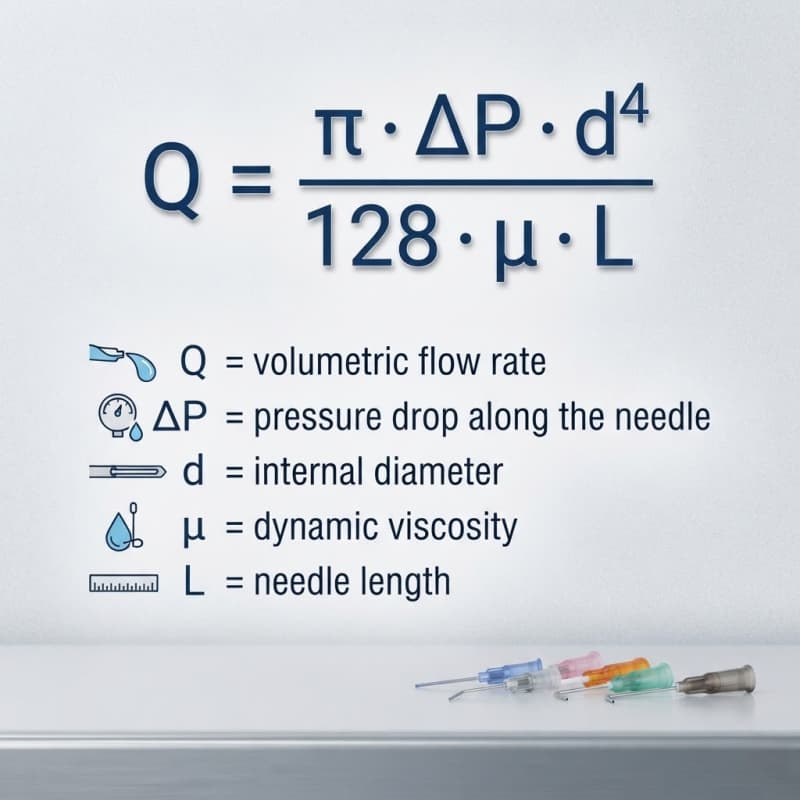
Two things in that equation do the damage. Diameter appears to the fourth power, and length appears in the denominator as a plain linear term. Halve the diameter and you cut flow sixteenfold. Double the length and you halve the flow.
Rearranged for what most people actually need — the pressure required to hold a given flow — the same relationship reads:
ΔP ∝ L / d⁴What that looks like gauge by gauge
Using standard stainless dispensing needle dimensions, holding pressure and length constant and taking 18G as the reference:
| Gauge | ID (mm) | Relative flow | Pressure needed for the same flow |
|---|---|---|---|
| 14G | 1.60 | 13.2× | 0.08× |
| 16G | 1.19 | 4.0× | 0.25× |
| 18G | 0.84 | 1.00× (reference) | 1.0× |
| 20G | 0.60 | 0.26× | 3.8× |
| 22G | 0.41 | 0.057× | 17.6× |
| 25G | 0.25 | 0.008× | 127× |
| 27G | 0.20 | 0.003× | 311× |
| 30G | 0.15 | 0.001× | 983× |
Read the last column again. Going from 18G to 25G does not make flow “a bit slower” — it requires about 127 times the pressure to hold the same flow. In practice you cannot supply that, so you see the symptom as “it won’t dispense” rather than as a flow reduction.
Step by step, the multipliers are what surprise people:
| Change | Pressure needed for the same flow | Flow at the same pressure |
|---|---|---|
| 20G → 22G | 4.6× | 22% |
| 22G → 25G | 7.2× | 14% |
| 25G → 30G | 7.7× | 13% |
Roughly, above 20G each single step costs you about a factor of three to four in pressure. Below 18G the steps are much gentler, because the same absolute diameter change is a smaller proportion of a larger bore.
Where the model stops being true
Being honest about the limits of this calculation is what makes it useful rather than misleading:
- Adhesives are usually not Newtonian. Most are shear-thinning, so effective viscosity falls as shear rate rises. Real flow through a small bore is therefore better than the equation predicts, sometimes substantially. Use the equation for relative comparisons between gauges, not for absolute predictions.
- Laminar flow is an assumption. At high flow rates in larger bores the flow becomes turbulent and pressure drop rises faster than d⁴ suggests.
- The needle is not the whole system. The valve, the cartridge outlet and the mixer all contribute. If total back-pressure is dominated by the mixer, changing the tip gauge moves less than the table implies.
- Filled materials add a yield stress. A paste with a yield point may not start flowing at all until pressure exceeds a threshold, which the equation does not model.
A pragmatic conclusion: the fourth-power rule tells you the shape of the response — steep above 20G, gentle below 18G — and that is the insight worth carrying into tip selection. For an absolute flow figure on a specific adhesive, measure it.
Length: the variable that gets changed by accident
Pressure drop is linear in length, and needle length changes for reasons that have nothing to do with flow — reaching into a deep cavity, clearing a fixture wall, using up stock. Every one of those doubles as a flow decision:
| Needle length | Relative pressure drop (same gauge) | Practical effect |
|---|---|---|
| 6.4 mm (0.25 in) | 0.5× | Fastest flow, least stored energy, best shut-off |
| 12.7 mm (0.5 in) | 1.0× (reference) | Standard |
| 25.4 mm (1.0 in) | 2.0× | Half the flow at the same pressure; more ooze |
The ooze point is the one that gets missed. More pressure drop means more pressure in the system to hold the same flow, which means more energy stored in the compressed fluid, which means more material continues to move after the valve closes. Longer needles are a common hidden cause of drooling. On filled adhesives the same stored energy problem compounds with bore wear, which is covered in tip wear on particle-filled adhesives.
Should you change the gauge or the pressure?
When a line is running too slow, the instinct is to raise pressure. That works, within limits, and it is usually the wrong first move:
| Adjustment | Effect on flow | Effect on deposit consistency | When to use it |
|---|---|---|---|
| Raise pressure | Proportional | Worse — more stored energy, more ooze and variation | Small corrections within a qualified setup |
| Increase bore one step | 3–4× step change | Better — lower pressure for the same flow | When the process is pressure-limited |
| Shorten the needle | Proportional to length | Better — less stored energy | When length was chosen for reach, not flow |
| Reduce viscosity (heat the material) | Inverse to viscosity | Can be better, but adds cure risk | Only with a validated temperature profile |
The pattern: getting flow from a bigger bore rather than from more pressure generally gives a more stable deposit, because the system runs at lower pressure and stores less energy. Running small bores at high pressure is the classic route to a line that dispenses acceptably and drifts constantly.
A five-minute diagnostic
- Note the current gauge, needle length, pressure and shot time.
- Weigh ten shots. Record mean and spread.
- Change one variable only — gauge by one step, or length by one increment.
- Weigh ten again. Compare against the predicted ratio in the table above.
- If the observed change is much smaller than predicted, your back-pressure is dominated upstream (mixer or valve), not by the tip.
Step five is the one that saves money. It tells you whether you are tuning the right component at all, and it prevents the common pattern of buying a range of tips to solve a problem that lives in the mixer.
Bore-to-viscosity matching is tabulated in the dispensing needle gauge size chart; the geometry side is in the tip geometry guide; the hub formats available against each bore are on the dispense tip range. If back-pressure is coming from the mixer rather than the tip, start with mixing element count.
Frequently asked questions
Does a smaller gauge always mean slower dispensing?
For the same pressure and length, yes, and by much more than most people expect — flow scales with the fourth power of diameter. Above 20G, one step typically costs a factor of three to four in pressure. Shear-thinning adhesives reduce the effect but do not remove it.
Why did my flow barely change when I switched from 22G to 25G?
Because the tip was not the limiting component. If most of the back-pressure comes from the mixer, the valve or a narrow cartridge outlet, changing the tip moves total resistance very little. Compare against the predicted ratio; a much smaller change than predicted means the restriction is upstream.
Is it better to use a bigger tip or higher pressure?
Usually a bigger tip. Getting flow from diameter lets the system run at lower pressure, which stores less energy and gives cleaner shut-off. High pressure through a small bore is a common cause of ooze, stringing and shot-to-shot variation.
Does needle length really matter that much?
Pressure drop is linear in length, so going from a 12.7 mm to a 25.4 mm needle of the same bore doubles the pressure needed for the same flow, and doubles the stored energy. It is a common and easily overlooked cause of drooling.