An epoxy static mixer can produce a clean-looking bead and still miss the required dispense rate—or run only when the operator pushes beyond the cartridge’s documented limits. The useful question is not “Which diameter is best for epoxy?” It is: Which candidate gives an acceptable mix at the required flow, with enough equipment margin and tolerable retained material? That answer comes from a controlled trial, not a cartridge-size chart.
Keep the epoxy batch, ratio, cartridge, outlet, temperature and dispense cycle fixed. Compare two or three compatible mixer geometries at the same required flow. Record actual output, drive effort or instrumented pressure, mix/cure evidence, connection condition and material left in the mixer. A candidate advances only when all required criteria pass. Without pressure sensors at the mixer inlet and outlet, call the result a system-effort comparison, not a measured mixer pressure drop.
What an epoxy mixer flow trial can—and cannot—decide
This is a shortlisting test for a disposable two-component cartridge mixer. It assumes the adhesive manufacturer has already defined the formulation, volume-mix ratio and required cure. The cartridge and metering arrangement establish the ratio; the mixer distributes the two streams. If you still need to establish whether the ratio is expressed by weight or volume, resolve that first using the adhesive technical data sheet and our epoxy ratio guide. A new mixer cannot correct an incorrectly filled or off-ratio package.
Three outcomes must coexist. The mixed output has to meet the adhesive maker’s application-specific acceptance method. The dispense system has to deliver the required flow without leakage, deformation or an undocumented rise in effort. And the volume trapped in each discarded mixer has to be economically acceptable for the number of starts and stops in the shift. Medmix treats mixing quality, pressure loss and waste volume as separate mixer characteristics; optimizing only one hides the trade-off that matters to a buyer.1
This article is intentionally narrower than our general static mixer selection guide, which introduces geometry and element count, and the 200/400 ml epoxy nozzle guide, which discusses common package interfaces. Use those pages for background and initial fit questions, not as acceptance criteria for this trial: their broad sizing examples cannot establish a flow window for your epoxy. Here, a geometry is a test candidate rather than a recommendation based on volume alone. Formulation details to send before sample selection belong in the resin mixer input sheet.
Turn the production bead into a flow target
“Fast enough” is not a test condition. Start with the mixed material actually required at the part: bead volume or deposited mass, the available dispense time and the frequency of starts. If the process needs 4 ml of mixed epoxy in 8 seconds, the average deposited flow is 0.5 ml/s, or 30 ml/min. That is illustrative arithmetic, not a Haijing product rating. The metering and mixer system may need a different instantaneous flow if the cycle includes acceleration, pauses or multiple beads. Write down the peak programmed flow as well as the average deposit target.
If the shop measures mass rather than volume, use the mixed material density from the adhesive maker at the relevant condition to convert it. Do not substitute the resin-side density for mixed density without a justified calculation. Record the dispense temperature, since an epoxy’s flow response can change with temperature; record the A and B component viscosities separately, with measurement conditions, rather than labeling the whole system “medium viscosity.”
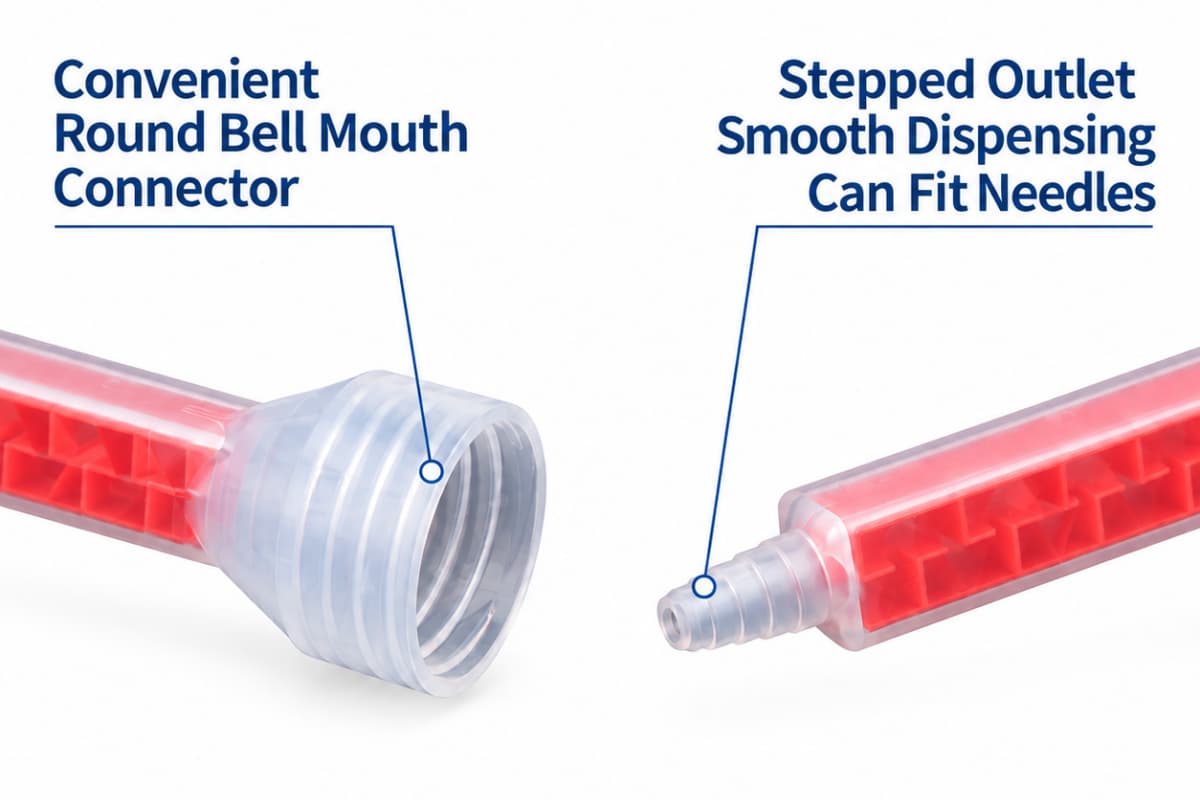
The desired bead also sets outlet constraints. A fine placement tip, an extended outlet or a tight dispensing path can add resistance after the mixer. Compare candidates with the same approved outlet and downstream fixture. Otherwise a change credited to internal mixer diameter may simply be the effect of changing the final tip. Nordson EFD identifies flow rate, material viscosity and outlet configuration as relevant inputs to static mixer selection.2
Do not confuse mixer pressure drop with whole-system effort
Pressure drop across the mixer is the difference between pressure at its inlet and at its outlet while material is flowing at a specified rate and condition. The pressure or drive setting at a pneumatic dispenser is not automatically that difference: cartridge pistons and walls, the connection, outlet and downstream restriction all consume part of the available force. A hand-applied trigger force is an even rougher indicator. Medmix notes that a device with fixed dispense force can have its achievable flow limited by mixer pressure loss; that is a system constraint, not a universal allowable pressure number.1
For a true mixer differential-pressure result, use a qualified test fixture with pressure measurements immediately upstream and downstream of the mixer, compatible with the epoxy and rated for the expected conditions. Record both readings at a steady measured flow and specify their locations. If that fixture is unavailable, log the dispenser setting or measured push force, actual flow and whether the cartridge, joint and housing remain sound. Label this “system effort at flow.” It can compare otherwise identical trials, but it cannot be published as the mixer’s isolated pressure drop.
Before testing, obtain the actual limits from the dispenser, cartridge, connector and mixer documentation. The allowable operating condition is bounded by the weakest approved component and the adhesive’s working time. Do not increase regulator pressure merely to make a restrictive mixer appear acceptable. A quick flow gain is not a pass if the connection weeps, the barrel deforms or the output becomes inconsistent. Existing off-ratio troubleshooting belongs to our back-pressure fault guide; this trial is a controlled comparison before release.

Change one geometry variable at a time
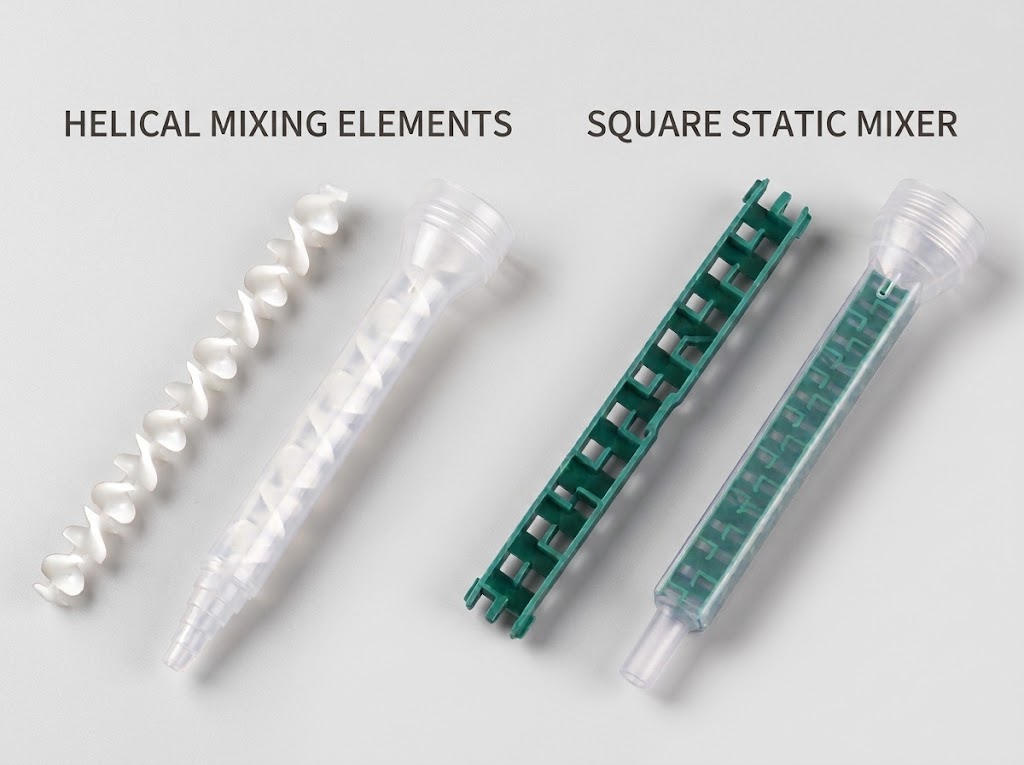
Start with a mixer that physically mates with the selected cartridge and outlet. Then ask the supplier for a small set whose differences can be interpreted. A narrow-bore and a wider-bore candidate may reveal whether the required flow is constrained by resistance. A different element count in the same family may show whether mixing improvement justifies added length and retained volume. A different element geometry can be included, but it is a separate comparison—not a clean diameter experiment.
Diameter, element count and geometry interact. More elements can improve distribution but commonly add flow resistance and material residence. A larger passage may ease flow yet leave more mixed epoxy in the disposable mixer. The exact balance depends on the actual rheology and geometry; therefore this guide does not turn Nordson’s material-specific screening ranges into a universal epoxy specification. Its published ranges are useful for identifying sample candidates, not proof that a specific bond or flow will pass.2
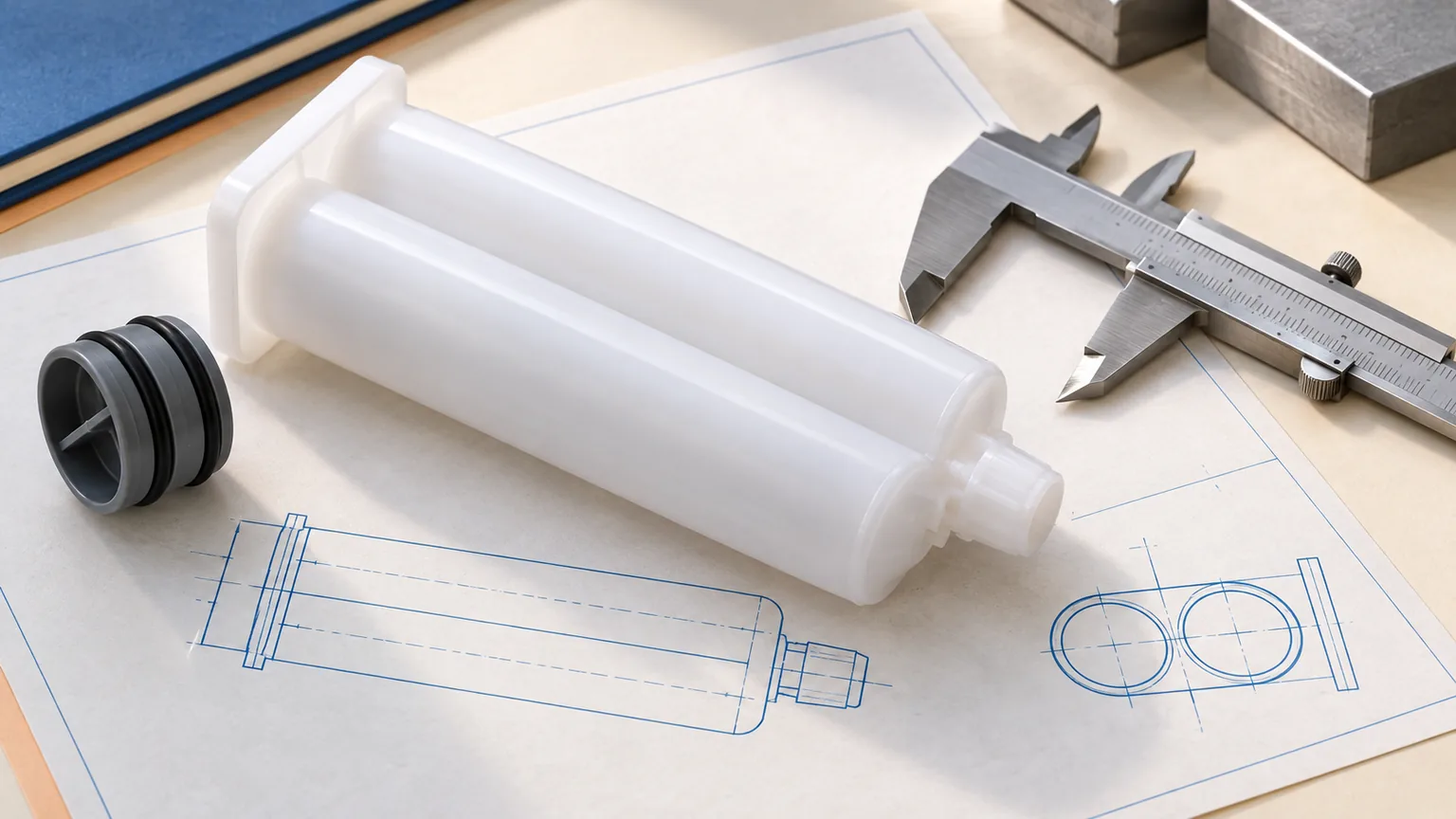
Keep inlet interface, outlet, housing material and cartridge format constant where possible. If a candidate forces a different connector or outlet, mark it as a whole-assembly alternative and test the complete new assembly. Do not attribute the result to bore alone. For filled or thixotropic epoxies, note particle or filler information supplied by the formulator, temperature, shear history and settling time; a single viscosity number may not describe the flow curve. If the supplier lacks compatibility or pressure-limit data for a candidate, it is not ready for a pressure trial.

Run the comparison through start, steady flow and restart
Choose one approved epoxy batch and a defined conditioning window. Use the same cartridge fill state or a controlled equivalent, the same dispenser, outlet, fixture, ambient and material temperature, and the same operator or program. Check that each mixer is seated correctly and that both components are available at the inlet before mixing begins. Follow the adhesive maker’s purge and safety instructions; there is no universal “discard X inches” rule that establishes homogeneous output for every epoxy.
Start-up: capture the transition, not just the best bead
Collect the first output separately, recording the purge quantity established by the adhesive maker’s instructions or a process-owner-approved method and any visible stream imbalance. If neither has established an acceptance method, leave start-up approval open; do not invent a fixed purge length. A colored epoxy can make streaking visible; a clear formulation may require a different validated analytical or cure test. Color uniformity alone is not evidence of correct chemistry. Record any leakage or abnormal effort at the connection. Do not return mixed test material to the cartridge.
Steady flow: compare at the production target
Once the specified start-up condition is met, collect timed output at the intended operating setting. Measure deposited mass or volume and calculate actual rate. Where the rig is instrumented, log inlet and outlet pressure at the same instant and compute differential pressure. Where it is not, log drive setting or measured force with the explicit “system effort” label. Sample mixed material for the adhesive maker’s applicable cure, hardness, or bond method—one that can actually reveal incomplete mixing in that formulation. Record the dispenser and cartridge behavior, not only the nozzle.
Restart: reproduce the real pause
Run the planned maximum pause before the next shot, rather than testing only continuous flow. Record whether flow restarts cleanly, whether the required effort changes and whether the first restart output still meets the chosen mix criterion. A fast-reacting epoxy can change within a mixer during a stop; an otherwise attractive long mixer may fail here. Use a fresh mixer when the adhesive maker’s working-life or replacement instruction requires it. Repeating the same defined sequence on more than one cartridge helps distinguish a geometry effect from a single misfilled or poorly seated sample.
Production qualification is a later gate. This sample trial can identify a candidate and its operating window; it cannot alone release a part for a safety-critical joint. The mixing-nozzle qualification workflow covers configuration freeze, repeatability and production evidence.
A trial matrix that preserves the decision trail
The table below is a template, not test data. Before dispensing, the adhesive/process owner should approve and sign the acceptance limits and method in the same record: minimum actual flow; maximum permitted drive setting or component pressure/force from the relevant manuals; mixed-output cure or other quality method and threshold; maximum retained waste per change; longest planned pause; and number of repeated cartridges or runs. Enter actual readings beside those limits. Each row represents a specific mixer part number or drawing revision at a specific process condition. “Pass” must mean every applicable preapproved criterion was met, not that the bead looked good.
| Record field | Control / candidate A | Candidate B | Why it matters |
|---|---|---|---|
| Approval owner, document revision and date | Preapprove before test | Use same approved criteria | Makes pass/reject traceable instead of retrospective |
| Part number, revision, bore, elements, geometry | Enter exact drawing | Enter exact drawing | Prevents a successful trial being assigned to a similar-looking replacement |
| Epoxy batch, A/B viscosity method, temperature, cartridge and outlet | Hold constant | Same condition, or flag deviation | Separates a mixer effect from material or fixture variation |
| Minimum flow criterion / measured flow | ≥ ___ / ___ ml/min | Same limit / ___ ml/min | Checks the approved cycle demand, not an impression of speed |
| Maximum permitted equipment/component condition / measured pressure or effort | Limit + source / result + instrument | Same approved limit / result | Only paired pressure taps support mixer Δp; use the weakest documented assembly limit |
| Mix/cure method and acceptance threshold / start, steady and restart results | Method + threshold / three results | Same method + threshold / results | Prevents a visual bead check from substituting for material acceptance |
| Approved maximum pause and repeat count / completed repetitions | ___ min; ___ runs / ___ done | Same plan / ___ done | Captures the restart and reproducibility actually required |
| Connection, housing and cartridge condition | Leak / deformation / none | Leak / deformation / none | A high-flow result is unusable if the assembly loses integrity |
| Maximum allowed retained waste / measured waste and replacement frequency | ≤ ___ g / ___ g × ___ changes/shift | Same limit / ___ g × ___ changes/shift | Converts mixer waste into a controlled process cost |
| Decision and open issue | Pass / reject / retest | Pass / reject / retest | Keeps an unverified trade-off out of the approved bill of materials |
To compare waste, weigh a clean dry mixer and the same model after the defined test and disposal condition, or use a validated volume method. State whether the measurement includes material in the outlet tip or connector. For a process that changes mixers often, multiply retained mass per change by changes per shift and by shifts per year. Keep the epoxy unit cost separate: the trial establishes physical waste, while purchasing supplies the cost. Do not claim an exact saving from geometric appearance alone.
What to do when the results disagree
- Mix passes, flow fails: compare a compatible larger-flow-path candidate or a different geometry with the same outlet. Do not simply raise drive pressure beyond a documented limit.
- Flow passes, mix fails: investigate component ratio and start-up first. If they are controlled, test a supplier-proposed element or geometry change, then remeasure flow and effort.
- Both pass, waste is excessive: evaluate a shorter or lower-retention candidate and rerun start, steady and restart acceptance. Cost cannot override a mix failure.
- Steady pass, restart fails: evaluate the real pause length, replacement interval and working-life constraint. A continuous-flow pass is not a restart pass.
One hypothetical example illustrates the logic without pretending to be field data. Suppose A reaches the target flow and passes the chosen cure test but requires unusually high system effort at restart. B lowers effort and retained mass but fails the cure method on the first output after a pause. Neither is a release candidate. The next action is not to pick the cheaper mixer; it is to ask whether a third geometry or a controlled replacement schedule can meet all three constraints, and to rerun the same matrix. The actual acceptance limit belongs to the adhesive and equipment owner.
If no disposable static mixer can achieve acceptable mixing at the required flow inside documented system limits, pause the selection. The process may need a different package, meter-mix architecture, revised cycle or adhesive consultation. Haijing’s static and dynamic mixer range offers starting hardware conversations, but an application-specific trial must still decide whether a proposed alternative works.
Turn the result into a supplier sample request
Send the supplier the resin input record, exact cartridge interface, outlet, target flow and cycle, operating temperature, planned stop, equipment limits, and your trial acceptance method. Ask for two or three compatible candidates with part-numbered drawings showing bore, element count, element type, total length, material and retained-volume information where available. Request any relevant material-compatibility and dimensional documentation. Haijing’s documented project capabilities include mixer geometry and material customization, inspection/FAI reporting, STEP or IGES models, and a chemical-compatibility table; availability for a particular design should be confirmed before treating it as approved.
After a passing trial, freeze the exact part and process condition in the controlled record. If a supplier changes bore, element count, polymer, inlet or outlet, do not assume the old flow window still applies. Move the frozen candidate into production qualification, where repeatability across cartridges, operators and lots can be evaluated. The buyer’s useful output from this article is not “an epoxy mixer size” in isolation; it is a traceable answer to which mixer worked, at which flow, with which pressure evidence and mix result.
Need matched epoxy mixer samples?
Send the cartridge interface, A/B formulation inputs, target flow, equipment limits and your acceptance method. Haijing can discuss a part-numbered sample set and the drawings needed for a controlled comparison.
Frequently asked questions
Can I size an epoxy static mixer from cartridge volume alone?
No. Volume identifies a package family and may narrow compatible inlets, but required flow, epoxy rheology, outlet, mix quality and equipment limits determine whether a particular geometry works. Use volume to shortlist fit, then trial the exact assembly.
Is the pneumatic regulator setting the mixer’s pressure drop?
No. The setting applies to the dispensing system; it does not isolate the pressure consumed by the mixer. A mixer differential-pressure result requires matched inlet and outlet pressure measurements during flow. Without them, report system effort at measured flow.
Should I add elements whenever an epoxy bead looks streaky?
Not before checking cartridge ratio, seating, start-up and the adhesive maker’s test method. More elements may improve mixing but can also increase resistance and retained material. Compare a supplier-proposed candidate at the same process condition and repeat the full acceptance test.
What is the fastest useful sample request to send Haijing?
Provide the epoxy’s volume ratio and separate A/B material data, cartridge and outlet details, required flow, dispenser and component limits, pause pattern, and how you will judge mixed output. Ask for exact drawings and a small candidate matrix rather than a generic “epoxy nozzle.”
Technical references
- medmix, “Parameters to quantify mixing efficiency of static mixers.” Used for the separate quality/pressure/waste dimensions and the flow–viscosity design relationship.
- Nordson EFD, “How to Select a Static Mixer for Two-Part Fluids.” Used for cartridge, material, flow and outlet selection inputs; its example ranges are not treated as universal approval limits.