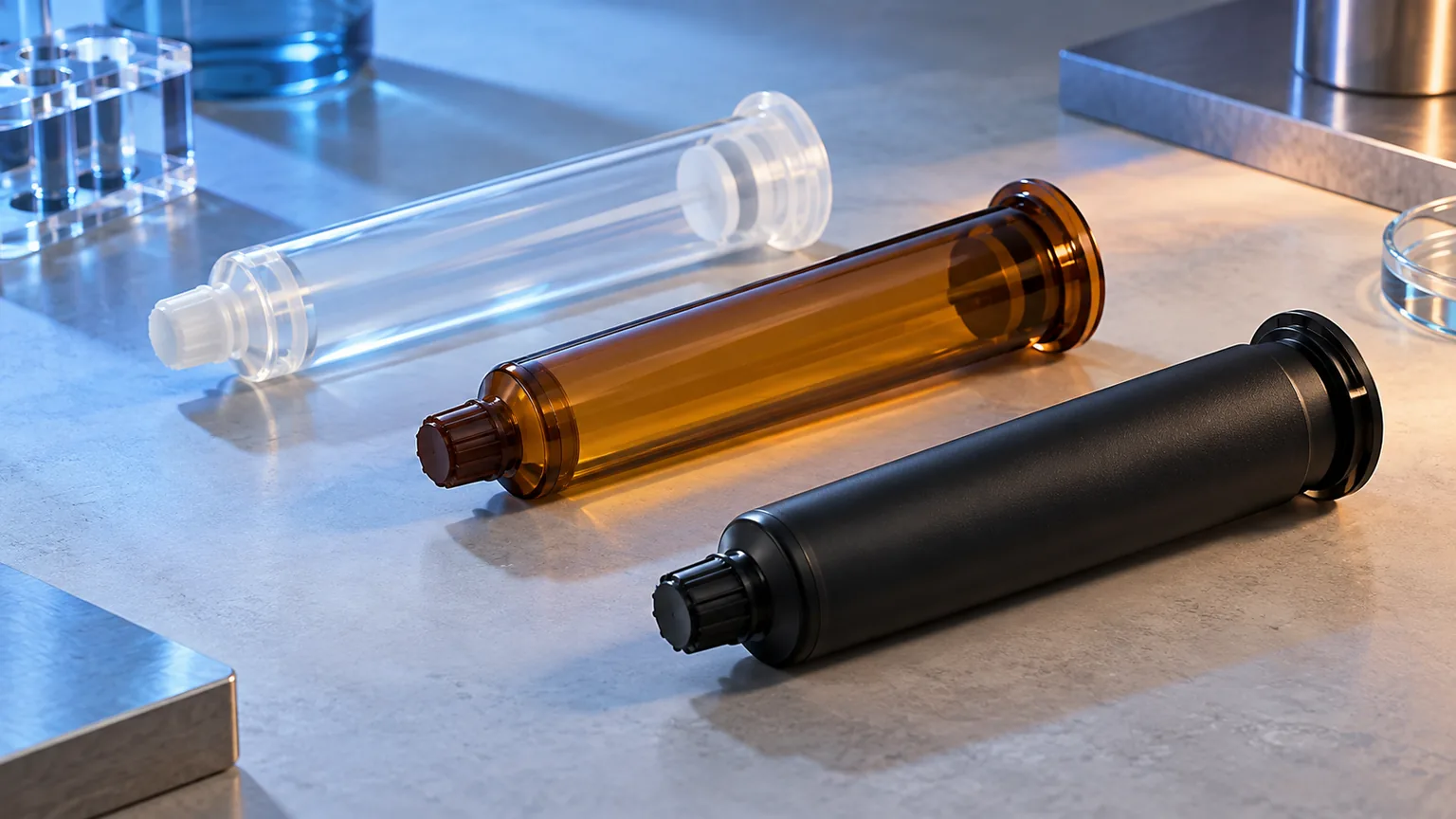
A resin static mixer enquiry often arrives with one useful noun and none of the fields that control selection. “Epoxy,” “polyurethane,” or “casting resin” does not define the ratio basis, individual component viscosities, package outlet, working life, or stop pattern. A supplier can guess a part number from that description, but the buyer cannot defend the guess.
Key Takeaways
- Define the delivery architecture first. A disposable cartridge mixer, a meter-mix outlet, and a reusable inline mixer are not interchangeable product classes.
- Record the ratio basis. A ratio by volume is not the same purchasing input as a ratio by weight.
- Send both component viscosities. One mixed-material value hides the A-to-B imbalance that affects flow into the mixer.
- Put working life into the restart plan. The useful value needs a named test method, temperature, and process condition.
- Make the part number the output. Release a supplier input sheet before choosing the mixer code or asking for samples.
- Use documented commercial boundaries. Haijing lists a 3,000-piece static-mixer MOQ, while samples are exempt and carry a documented 3–7 day lead time.
Direct answer: select a resin static mixer from a controlled input record, not from the resin family name. Record the feed system, package, ratio basis, separate A and B viscosities at process temperature, working life, fillers, outlet need, planned stops, and approval evidence. Then ask the supplier for a small candidate matrix.

Define The Mixer Job First
Search results for resin mixers combine three unlike jobs. A disposable cartridge mixer joins directly to a two-component package and leaves with the spent mixed material. A meter-mix system feeds measured components through a machine outlet. A reusable inline mixer stays inside a larger process line and needs its own cleaning and housing decisions.
This guide covers disposable static mixers for two-component resin cartridges, plus the handoff point to meter-mix equipment. It does not claim that one plastic cartridge mixer can replace a metal inline unit. That boundary protects the RFQ from a common category error.
The process question comes first: where are the A and B components stored, where does metering occur, and where do they first contact? If the answer is unclear, stop before choosing element count or outlet type. A mixer cannot correct an undefined feed system.
This article owns the formulation-and-package input record. After those inputs are controlled, use the static mixer geometry and sizing guide to evaluate element count, diameter, length, and pressure behavior. Keeping those decisions in sequence prevents this input-sheet step from becoming a second, competing geometry guide.
| Delivery architecture | Where ratio is set | Mixer status | First buying question |
|---|---|---|---|
| Dual cartridge | Package chambers and plungers | Disposable | Which cartridge interface? |
| Meter-mix machine | Pumps or metering unit | Disposable or machine-mounted | Which outlet and flow condition? |
| Process line | Upstream process equipment | Reusable inline assembly | Which housing and cleaning method? |
Record Ratio Basis And Package
Write the ratio exactly as the adhesive manufacturer defines it. “Two to one” is incomplete until the record says by volume or by weight. Cartridge chambers meter volume, so a weight-only formulation statement needs a controlled conversion from the material owner before a package can be selected.
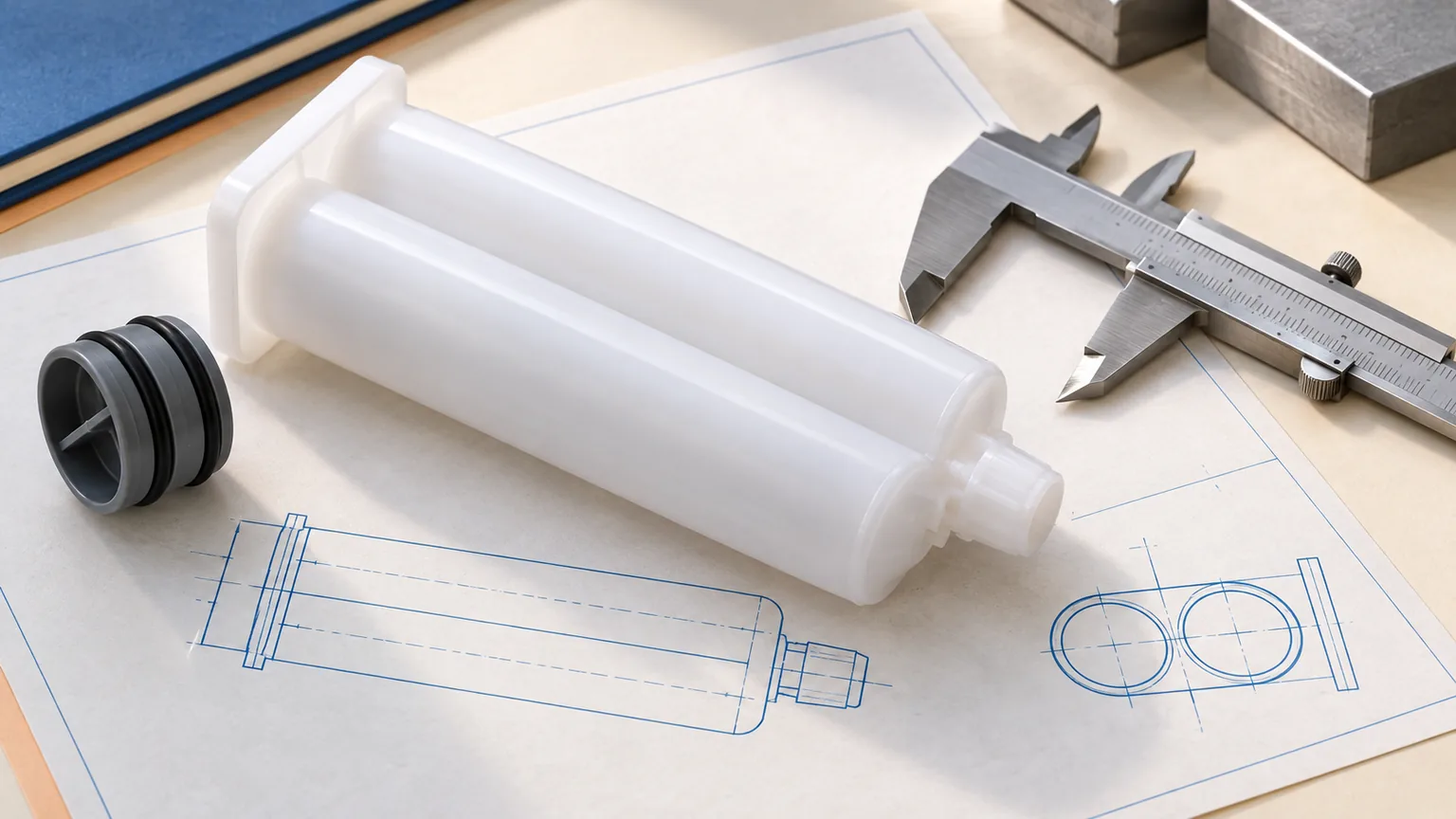
Do not copy a ratio from a label into the mixer RFQ and skip the package drawing. The mixer inlet must meet the actual cartridge outlet, chamber arrangement, and capacity. A correct ratio paired with the wrong interface still produces an unusable sample.
Haijing documents dual-component cartridge and mixer families across the configurations below. Use the table as a starting map, not as a substitute for the approved drawing.
| System | Documented package | Documented ratios | Interface cue |
|---|---|---|---|
| A-System | 50 ml | 1:1, 2:1, 4:1 | Bayonet, single inlet |
| B-System | 50, 75, 100 ml | 1:1, 2:1, 4:1, 10:1 | Separated outlets |
| C-System | 200, 400, 600 ml | 1:1, 2:1, 4:1, 10:1 | Bell or threaded |
| F-System | 200, 400 ml | 1:1, 2:1, 4:1, 10:1 | Bayonet with positive stop |
The detailed distinction between volume and weight belongs in the epoxy mixing ratio explanation. For this input sheet, record the stated basis, package code, nominal capacity, chamber arrangement, and the drawing revision supplied for review.
Capture Each Component Viscosity
Ask for the A-side and B-side viscosities separately. A single value for mixed resin arrives too late in the fluid path and hides the imbalance at the two inlets. The input sheet should also name the process temperature and the measurement method.
Viscosity is condition-dependent. A number without temperature, spindle or geometry, and test speed cannot support a clean comparison between materials or lots. The current ASTM D2196-20(2026) covers apparent viscosity, shear thinning, and thixotropic behavior with a rotational viscometer. Its published scope also explains why readings at more than one speed characterize a non-Newtonian material better than a single-speed reading.
The practical warning is simple. Do not send “high viscosity” and expect the supplier to infer a bore, element path, or pressure result. Send the separate measurements and their conditions, then identify whether the process pumps continuously, moves by a manual plunger, or runs from pneumatic or automated equipment.
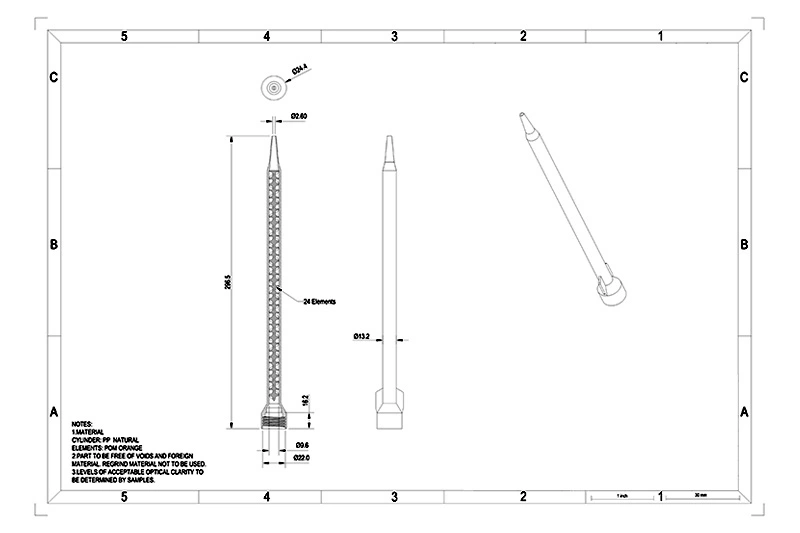
Treat Working Life As Constraint
Working life belongs in the operating record, not in a marketing adjective. It affects how a mixed path behaves during planned pauses, shift changes, alarms, and restarts. A fast-reacting material can turn a short interruption into a blocked mixer or a doubtful restart bead.
BS EN ISO 10364:2024 specifies methods for determining pot life in multi-component adhesives. The standard also states that its different methods do not necessarily produce identical results. A supplier needs the method and condition behind the stated value, not only the number copied from a technical data sheet.
Record the planned maximum pause, what remains attached during that pause, and the restart acceptance rule. If the production method discards an initial bead, state who defines that purge and how the operator records it. Do not invent a universal pause time from the mixer alone.
- Start condition — identify the first contact point between resin and hardener.
- Pause condition — state whether pressure remains on the cartridge or machine.
- Restart condition — define the bead, cure, or application check that releases production.
- Discard rule — assign ownership for mixed material removed after a stop.
Flag Fillers And Flow Hazards
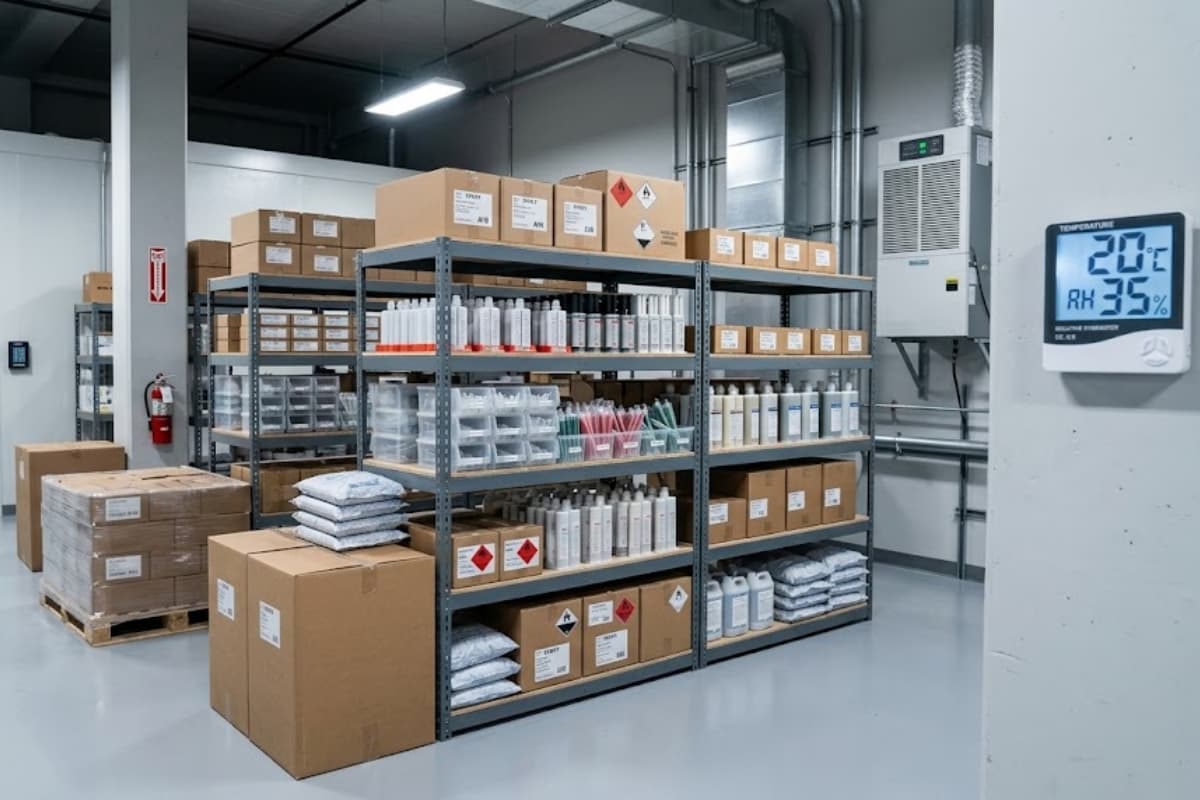
Filled resin needs a fuller description than “filled.” Ask the material owner whether either component contains particles, fibers, crystals, or a settling phase. Record the available particle information, the storage or agitation instruction, and any restriction against shear or heat.
These fields change the risk review. A narrow passage can trap large or poorly dispersed solids. An abrasive fill can change the wear question. A component that settles during storage can reach the mixer in a different condition from the approved laboratory sample.
No universal particle threshold appears in Haijing’s Product Bible, so this article will not manufacture one. The safe purchasing move is to disclose the formulation hazard, request a candidate set, and reject any recommendation that skips the real material trial. If the supplier asks no questions about solids, the input package has not yet produced an engineering decision.

Need A Mixer Sample Matrix Built From Your Resin Data?
Send the A and B component data, ratio basis, package drawing, process temperature, stop pattern, filler notes, and target outlet. Haijing can map those inputs to a controlled sample set without treating the resin family as a complete specification.
50–600 ml documented families | 1:1–10:1 portfolio coverage | Samples outside the 3,000-piece MOQ
Choose Feed System Before Connection
The feed system decides which connection family can enter the shortlist. A cartridge application begins with the cartridge outlet drawing and chamber arrangement. A meter-mix machine begins with the mixing-head outlet, metering method, flow condition, and attachment space.
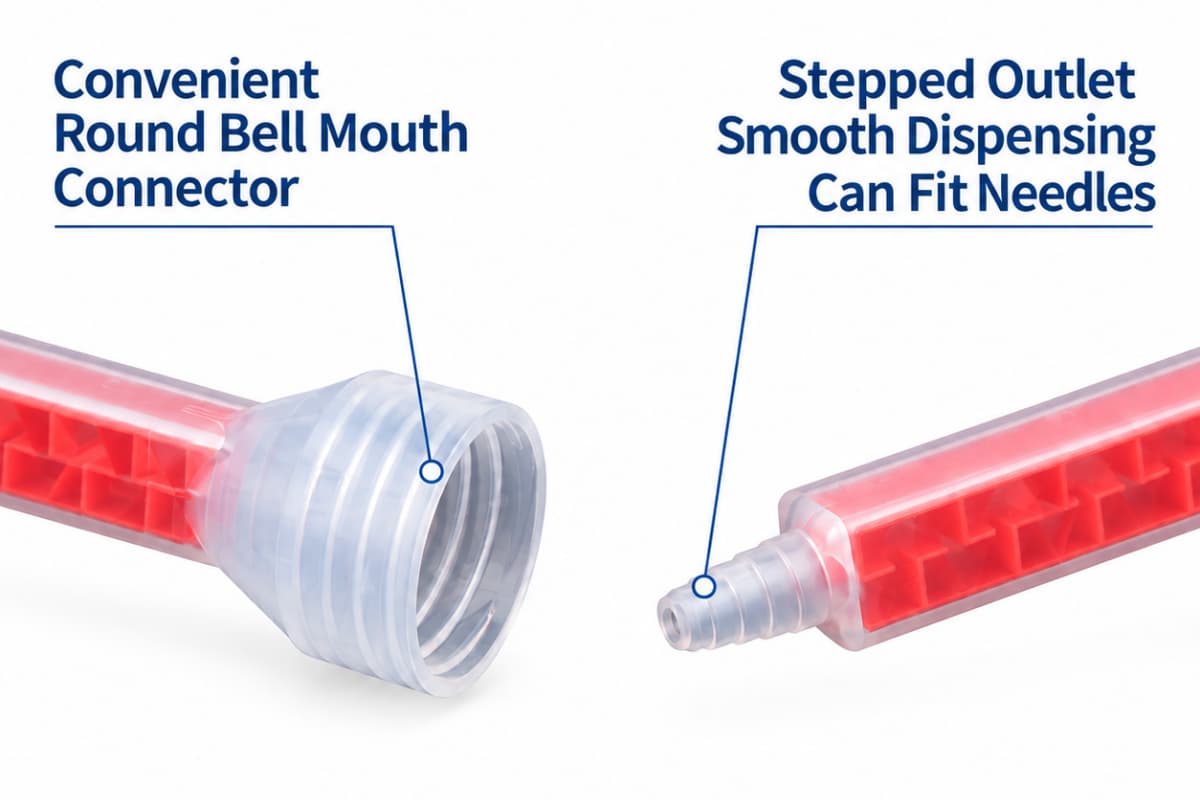
This article stops at that boundary on purpose. Bayonet, bell, threaded, and other interface details have their own fit and sealing questions. Solving those details before the feed architecture is fixed encourages a supplier to optimize the wrong component.
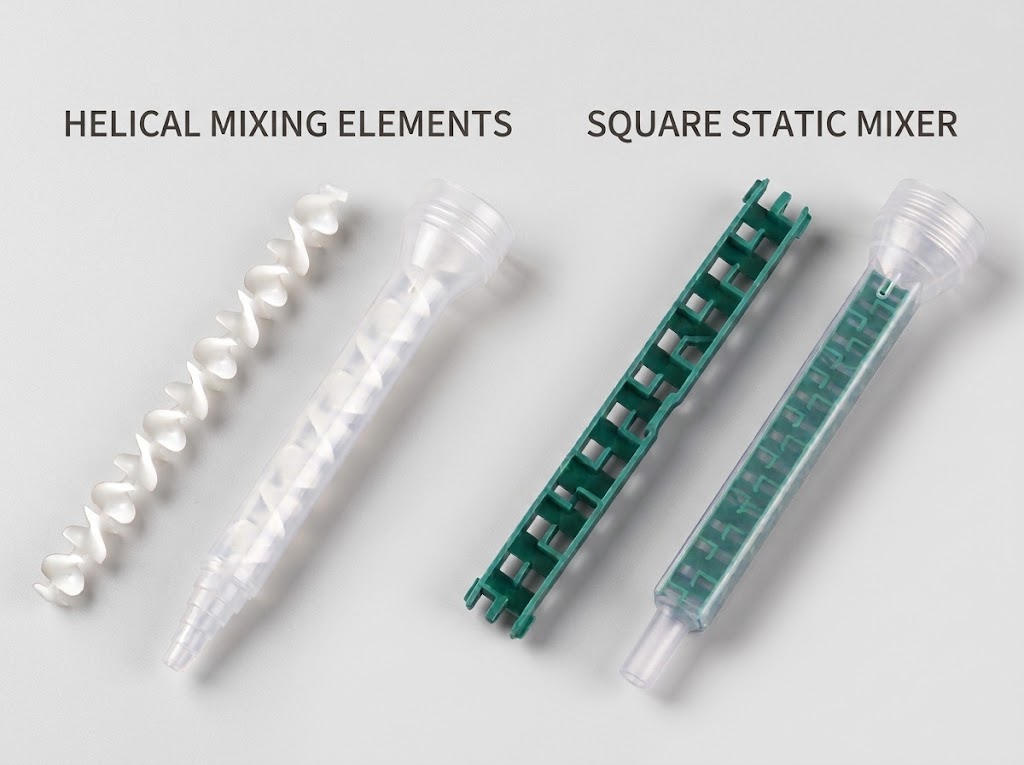
For cartridge work, use the static and dynamic mixer range to identify the supported family, then verify the drawing. For machine work, send the outlet dimensions and operating description. Never assume that a familiar cartridge code fits a machine outlet because both handle the same resin.
Build The Supplier Sample Matrix
A good sample request changes one decision variable at a time. Keep the cartridge, ratio, material, equipment, and application method fixed while the supplier proposes a small mixer set. Each candidate needs an exact code, drawing revision, material, and stated reason for inclusion.
The input record below is the reusable asset. Attach the resin technical data sheet and package drawing, then fill every field that the material owner can support. Mark unknowns openly; an empty field is safer than a guessed number.
| Input block | Required record | Evidence | Release risk |
|---|---|---|---|
| Formulation | A and B identity, ratio basis | Current material data sheet | Wrong volumetric feed |
| Rheology | Separate viscosities and conditions | Named test record | Unbalanced inlet flow |
| Package | Capacity, chambers, outlet revision | Approved drawing | Fit or seal failure |
| Operation | Temperature, flow mode, pauses | Process sheet | Blocked or doubtful restart |
| Hazards | Fillers, settling, sensitivity | Material-owner statement | Restriction or damage |
| Approval | Checks, owner, revision rule | Sample matrix | Uncontrolled substitution |
Haijing documents a static-mixer MOQ of 3,000 pieces, while samples sit outside that MOQ. The Product Bible records a 3–7 day sample lead time when the buyer covers sample and freight costs. The supplier can also provide inspection reports, first-article inspection reports, STEP or IGES models, and a chemical-compatibility table.
Those documents do not replace the resin trial. They make the trial traceable. Ask the supplier to label every candidate and control, then keep the selected sample with the released input record.

Separate Fit From Production Release
A sample can attach cleanly and still fail the process. Fit checks the mechanical interface. Production release checks the mixed output, operating window, restart behavior, cure evidence, and repeatability under the approved equipment and material conditions.
Keep those two decisions in separate columns. Record whether each sample attaches, locks, seals, and clears the fixture. Then route surviving candidates into the mixing nozzle qualification process instead of rewriting that test inside the purchasing guide.
The released specification should name the exact mixer, drawing revision, resin pair, package, ratio basis, and operating condition. A cross-reference is not permission for substitution. The static mixer part-number guide explains why a familiar code still needs drawing and sample control.
Haijing documents annual capacity above 85 million static mixers. Capacity supports supply planning, but it does not release a formulation. The buyer still needs the input sheet, approved sample, and change-control rule for each resin package.
Release The Input Sheet
A resin static mixer decision becomes defensible when the input record precedes the part number. Define the delivery architecture, preserve the ratio basis, record both component viscosities with conditions, carry working life into the stop plan, and disclose fillers before samples arrive. That sequence turns a generic enquiry into a controlled engineering handoff.
- Freeze the architecture. State cartridge, meter-mix, or process-line scope before geometry.
- Freeze the material inputs. Keep A and B data, ratio basis, temperature, and working-life method together.
- Freeze the package interface. Use the approved drawing rather than a verbal connection name.
- Freeze the release evidence. Link the selected code to the sample matrix and production qualification record.
The next step is not a larger catalogue search. Send the completed record and ask for a labeled sample matrix with the supplier’s reasoning. Haijing can review that package against its documented mixer families before the order specification is frozen.
References And Source Boundaries
- BS EN ISO 10364:2024 — official BSI record for pot-life methods for multi-component adhesives.
- ASTM D2196-20(2026) — official scope for rotational-viscometer characterization of non-Newtonian materials.
- Haijing Product Bible dated 2026-09-01 — A/B/C/F systems, documented ratios, materials, capacity, MOQ, sample timing, and available technical records.
The external standards support the test-condition discipline in this guide. They do not certify a specific Haijing mixer or resin combination. The Product Bible supports the stated Haijing portfolio and commercial facts; the production resin trial still owns the final release.
Frequently Asked Questions
Does a 1:1 resin need a ratio-specific static mixer?
Not automatically. The feed package or metering system must deliver the formulation at 1:1 by its specified basis. The mixer must fit that outlet and then be qualified for the two component viscosities, flow, pressure, working life, and mixed result.
Should viscosity be recorded before or after mixing?
Record the A-side and B-side viscosities separately before mixing, with temperature and method. A mixed value hides the imbalance that the mixer inlets receive.
Can one static mixer work for epoxy and polyurethane resins?
Not by chemistry name alone. Compare ratio, separate viscosities, working life, fillers, package, interface, operating method, and the real sample result for each formulation.
What information should a resin mixer RFQ include?
Include component identities, ratio basis, separate viscosities, test conditions, working life, fillers, package drawing, feed system, pause pattern, outlet need, and approval evidence.
Is a longer resin static mixer always better?
No. More length can add restriction and retained mixed material. Size the mixer against mix quality, pressure behavior, waste, and restart needs under the actual process.