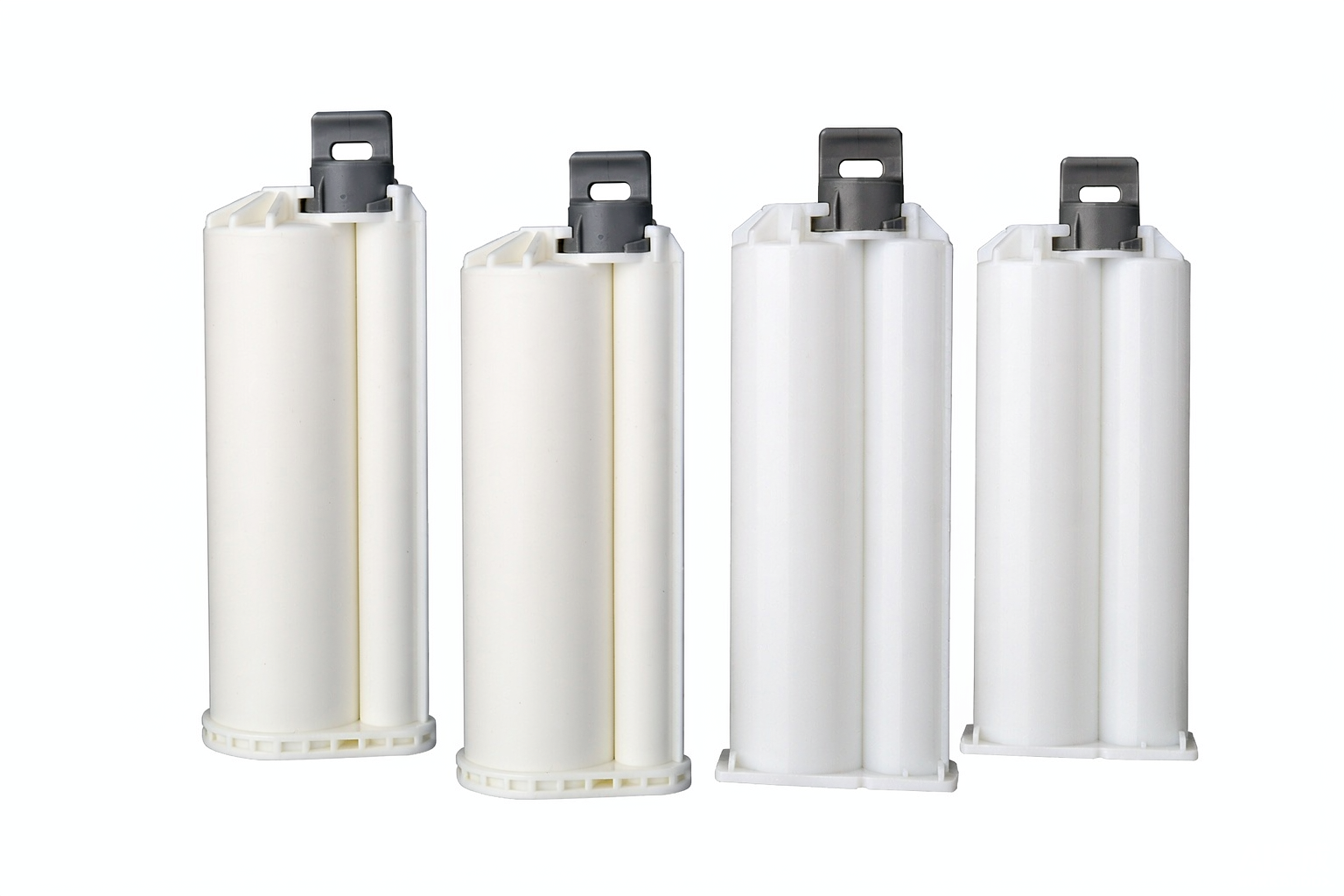
Adhesive packaging compliance means confirming that the cartridge, static mixer, and every fluid-path seal meet the substance restrictions and documentation requirements that apply to your target market and application. The decision comes down to three questions: which regulation is actually in scope, what documents the supplier must hand you, and how you prove those documents are real instead of copy-paste boilerplate. This guide gives procurement and engineering teams a practical framework and a copy-ready checklist for specifying and verifying compliant adhesive cartridges — covering RoHS, REACH, silicone-free requirements, and UL in one place.
Why Adhesive Packaging Compliance Starts With the Cartridge, Not the Formula
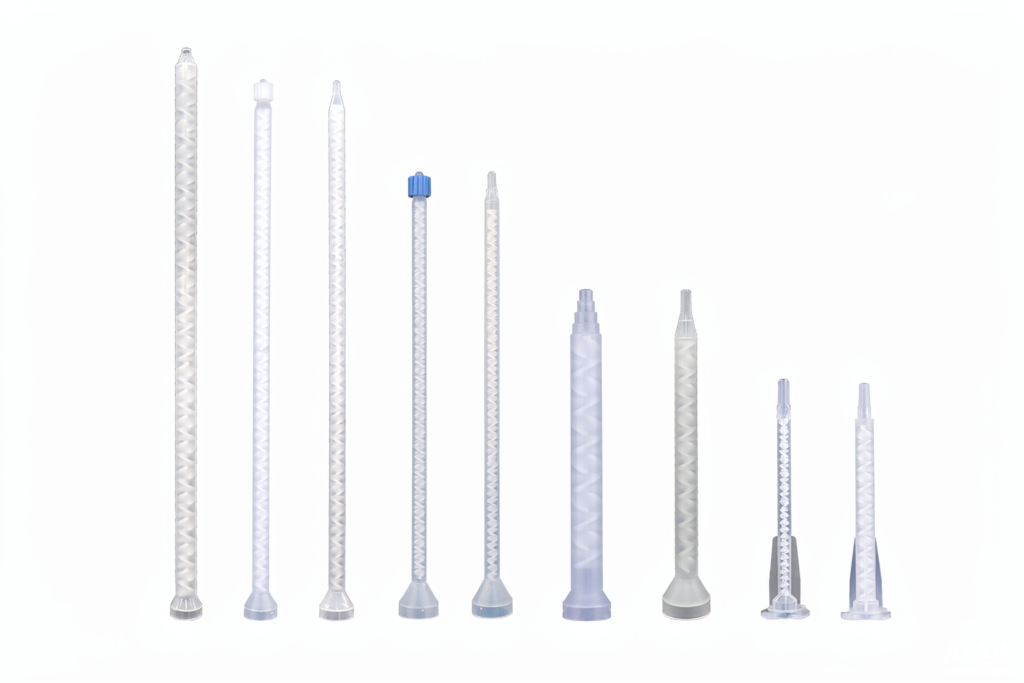
Most compliance writing focuses on the adhesive chemistry. For buyers of dispensing systems, that view misses half the picture. The cartridge, mixer, and seals are physical articles that enter the same regulated supply chain as the adhesive they contain.
A cartridge used inside a consumer electronic device is, functionally, a component of that device. A cartridge made from plastic that crosses the EU border is an article under REACH. When a customer specifies “silicone-free,” the requirement applies to the release agent on the mold and the gasket in the cap — not just the resin. Compliance, therefore, cannot stop at the adhesive datasheet.
| Perspective | What is regulated | Where the cartridge sits |
|---|---|---|
| RoHS | Substances in electrical and electronic equipment (EEE) | In-scope if the finished device is EEE and the cartridge is a supplied part |
| REACH | Chemicals, substances in mixtures, and articles | The plastic cartridge is an “article”; substances above 0.1% w/w may trigger duties |
| Silicone-free | Customer or industry specification for sensitive surfaces | Applies to every material touching the fluid path |
| UL | Electrical and flammability safety of components in end products | Relevant where the cartridge or its contents sit in a powered assembly |
This is why a single “compliant” sticker on the adhesive is not enough. The packaging has to be evaluated on its own terms. For an overview of how cartridges serve different industries, see the applications breakdown.
RoHS for Cartridges: Scope, Substance Limits, and What Buyers Must Request
RoHS (Directive 2011/65/EU) restricts hazardous substances in electrical and electronic equipment. The practical question for cartridge buyers is whether the cartridge falls inside the scope of the finished product.
If you supply cartridges to an OEM that assembles them into covered EEE — sensors, control units, consumer devices — the cartridge is part of that equipment’s technical file. Even when a cartridge is sold separately as a spare or service part, the downstream device still carries the RoHS obligation, so buyers upstream are increasingly asked to document it.
The restricted substances and their maximum concentration values in homogeneous material are:
| Substance | Limit (homogeneous material) |
|---|---|
| Lead (Pb) | 0.1% |
| Mercury (Hg) | 0.1% |
| Cadmium (Cd) | 0.01% |
| Hexavalent chromium (Cr6+) | 0.1% |
| Polybrominated biphenyls (PBB) | 0.1% |
| Polybrominated diphenyl ethers (PBDE) | 0.1% |
| DEHP, BBP, DBP, DIBP (phthalates) | 0.1% each |
Limits per EU Directive 2011/65/EU. Verify against the current official text, as exemptions are added or expire over time.
What to request from a cartridge supplier:
- A Declaration of Conformity (DoC) that names the exact cartridge grade and RoHS version.
- A third-party test report (for example, XRF screening for heavy metals) with sample identity, date, and method.
- Confirmation of any applied exemption and its expiry.
- Match between the product name on the report and the grade you are ordering.
A generic “RoHS compliant” statement without grade, date, and test method should not be accepted. The substance limits apply to homogeneous material, so a single cartridge wall must be evaluated as its own material, not averaged against the adhesive inside.
For two-component systems, both barrels and the assembled mixer fall under the same documentation logic. The OEM dual-component cartridge guide explains how mix ratio and chamber design affect what you specify.
REACH for Adhesive Packaging: SVHC, Annex XVII, and SCIP
REACH (Regulation EC 1907/2006) governs chemicals, substances in mixtures, and articles placed on the EU market. A plastic cartridge is an article, which changes what you must check.
Two REACH obligations matter most for packaging buyers:
- SVHC threshold (0.1% w/w). If the cartridge contains a Substance of Very High Concern above 0.1% by weight in the article, the supplier must provide sufficient information down the supply chain, and the article may require SCIP notification to ECHA.
- Annex XVII restrictions. Certain substances are restricted in articles regardless of SVHC status, including specific azo dyes, certain phthalates, and other listed substances.
Use this decision path to determine REACH exposure for a cartridge:
- Identify the polymer and additives used in the cartridge body, seals, and labels.
- Check each substance against the current SVHC candidate list and Annex XVII.
- If any SVHC exceeds 0.1% w/w, request the supplier’s communication and SCIP status.
- Request a REACH declaration that names the exact grade and reference date.
The SVHC candidate list is updated periodically. Confirm the current entries and thresholds with ECHA rather than relying on a dated declaration. A declaration dated two years earlier may no longer reflect the restricted list.
REACH and silicone-free requirements often overlap for electronics buyers. Silicone-free is about process control and surface sensitivity; REACH is about chemical registration and restriction. They are different obligations, but the same supplier documentation discipline applies. The electronics-grade silicone-free cartridges page covers how release agents and fluid-path materials are controlled.
Silicone-Free: When It Is a Requirement, Not a Marketing Claim
Silicone-free is frequently treated as a vague quality label. For cartridge buyers it is a precise, verifiable specification — but only in the right applications.
Low-molecular-weight siloxanes volatilize and deposit an insulating film on metal contacts. In connectors, relays, and optical modules this raises contact resistance and causes intermittent failures that pass initial test and surface later in the field. The same chemistry is harmless in a building sealant.
Specify silicone-free only where it matters:
| Application | Silicone-free needed? | Reason |
|---|---|---|
| Semiconductor, wire bond | Yes | Siloxane blocks bonding |
| Connectors, relays | Yes | Contact resistance, intermittent failure |
| Optical, sensor modules | Yes | Haze, signal drift |
| Medical, diagnostic | Usually yes | Bonding reliability, biocompatibility |
| Automotive sensors, ECU | Yes | Long-term field reliability |
| Construction, general industrial | No | No sensitive surface nearby |
Verify a silicone-free claim with three questions:
- Which mold-release agent is used on the tool? (Water-based or release-free tooling, not silicone.)
- Are seals and liners in the fluid path silicone-free?
- Can the supplier provide a certificate of compliance and, for high-reliability programs, extractable-silicone test data (FTIR or GC-MS)?
The deciding point is not “is the resin silicone-free” but “can the supplier prove the entire fluid path and process are silicone-free, lot to lot.” The full manufacturing and verification detail is covered on the silicone-free cartridges page, which this article builds on rather than repeats.
UL Certification for Dispensing Cartridges: Electrical, Flammability, and Potting Contexts
UL is not a single requirement. For cartridge buyers it usually appears in two forms: a flammability rating (such as UL 94 for the plastic body) or recognition of a material used in a listed end product.
You need UL-related documentation when:
- The cartridge or its contents sit inside a powered or energized assembly where flammability is assessed.
- The adhesive is used for potting or encapsulating electronic components and the formulator cites a UL rating.
- A downstream safety certification (for example, for a control unit) requires traceable component ratings.
You usually do not need UL on the cartridge when:
- The application is non-electrical (construction anchoring, general industrial bonding).
- The cartridge is a service part with no flammability assessment in the end product.
UL, RoHS, and REACH do not conflict. A UL 94 rated plastic can still be RoHS and REACH evaluated; the cartridges simply meet different obligations. For potting and encapsulation scenarios where UL-rated materials are specified, the electronics potting and encapsulation dispensing guide explains system selection.
Request the specific UL file number or rating from the supplier and confirm it applies to the exact grade and wall thickness you order, not a similar product family.
The Procurement Compliance Checklist: RoHS + REACH + Silicone-Free + UL in One RFQ
This checklist consolidates the article into a single block you can paste into a request for quotation. Each line states the requirement, the document to request, and the verification point.
| Requirement | Request from supplier | Verification point | Common pitfall |
|---|---|---|---|
| RoHS | DoC + third-party test report | Grade name, RoHS version, homogeneous-material limits, exemptions | Accepting “RoHS compliant” with no grade or date |
| REACH | SVHC declaration + Annex XVII statement + SCIP status if applicable | Current candidate list reference, exact grade | Using a declaration older than the latest SVHC update |
| Silicone-free | CoC covering silicone and siloxane + extractable-silicon test for high-reliability use | Release agent, fluid-path seals, lot traceability | Assuming resin certificate proves the whole process |
| UL | File number or rating (if in scope) | Exact grade and wall thickness covered | Citing a rating for a different product family |
| General | ISO 9001 certificate + batch traceability + change control | Site, scope, issuer, validity; lot-level records | No documented incoming or final inspection |
Send this table to suppliers with your target market, application, and sensitive surfaces stated. The same logic applies to static mixers and other fluid-path components, which the bulk static mixer sourcing guide addresses from a procurement angle.
By Application: Where Each Requirement Matters Most
Compliance priority shifts by industry. Use this matrix to focus your RFQ on what the application actually demands.
| Industry | RoHS | REACH | Silicone-free | UL | Notes |
|---|---|---|---|---|---|
| Electronics, semiconductors | High | High | High | Possible | Siloxane control is decisive for yield |
| Medical, dental | Depends | High | Usually | Possible | ISO 13485 system documentation often expected |
| Automotive, EV | High | High | High (sensors, ECU) | Possible | Traceability through PPAP-style records |
| Aerospace | Depends | High | Often | Possible | AS9100 traceability, lot records |
| Construction, general | Low | Medium | No | No | Focus on REACH restricted substances only |
The medical and dental applications page outlines the quality-system expectations buyers in that segment typically request.
Frequently Asked Questions
Is RoHS applicable to adhesive cartridges or only finished devices?
RoHS applies to electrical and electronic equipment. A cartridge supplied as part of covered EEE, or as a service part for it, sits inside that obligation, so downstream buyers request RoHS documentation for the cartridge grade even when the cartridge is sold separately.
Does REACH apply to the cartridge plastic or just the adhesive?
REACH applies to both. The plastic cartridge is an article under REACH, so SVHC thresholds (0.1% w/w) and Annex XVII restrictions apply to the cartridge body, seals, and labels — not only to the adhesive formulation.
Is “silicone-free” the same as RoHS compliant?
No. Silicone-free is a process and surface-sensitivity specification; RoHS is a substance-restriction regulation for EEE. A cartridge can be silicone-free and still need separate RoHS and REACH documentation.
When do I actually need UL certification on a cartridge?
Only when the cartridge or its contents enter a powered assembly where flammability is assessed, or when a potting or encapsulation material is specified with a UL rating. Non-electrical applications generally do not require it.
How do I verify a supplier’s compliance claim is real?
Match the product grade on the certificate to your order, check the issue date against the current regulation version, confirm the test scope and method, and verify the certifying body. A documented ISO 9001 system with incoming and final inspection supports traceability.
What documents prove a cartridge is REACH SVHC compliant?
A current SVHC declaration naming the exact grade, an Annex XVII restricted-substance statement, and SCIP notification status if any SVHC exceeds 0.1% w/w. Confirm the declaration references the latest ECHA candidate list.
Conclusion
Adhesive packaging compliance is not one certificate — it is four separate evaluations mapped to your market and application. Start by confirming which regulations are in scope, then request grade-specific documents with current dates and test methods, and verify them against the actual cartridge, seals, and release agents. RoHS covers substance limits in EEE, REACH covers the cartridge as an article, silicone-free protects sensitive surfaces through process control, and UL applies where electrical safety is assessed. Paste the procurement checklist into your next RFQ and you remove the ambiguity that causes audit failures and shipment rejections.
Contact Us
If you are preparing that RFQ now, send us your target market, application, and any sensitive surfaces or ratings your buyer requires. We match a cartridge configuration to your exact dataset and return a documentation package — RoHS and REACH declarations, silicone-free verification, and UL references where in scope — so your next shipment clears audit and customs without a rework loop.