The industrial manufacturing world is rapidly replacing old screws and rivets with advanced structural adhesives. But these powerful chemicals only work if they are mixed perfectly before they dry. So, sourcing high-quality dispensing hardware is absolutely critical for global buyers.
A static mixer is a precision engineering tool that forces two separate chemicals to blend completely. Buyers must understand polymer science, mixing architectures, and assembly automation to purchase the right bulk equipment.
This guide explains exactly how to select the safest and most efficient dispensing systems. Read on to learn how to prevent chemical failures and speed up your factory assembly lines today.
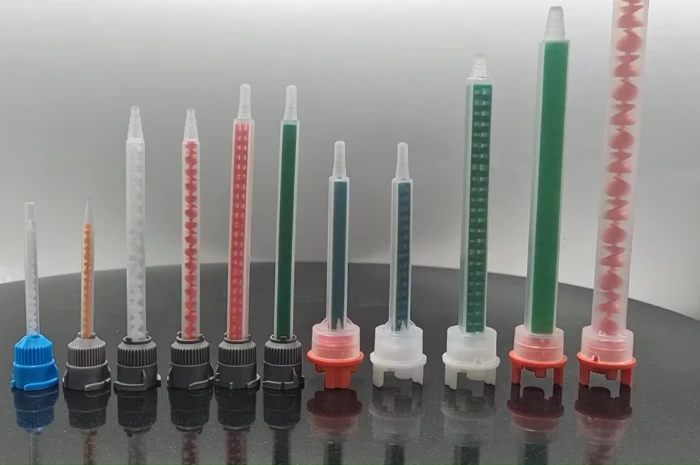
What Are Static Mixers and Why Do They Matter in Manufacturing?
Static mixers are essential disposable plastic nozzles that blend two-part adhesives flawlessly.
The Role of Continuous Fluid Mixing
Adhesives like epoxy and polyurethane require two separate parts to react and harden.
- The mixer contains stationary geometric blades that continuously divide and fold the two fluids.
- This mechanical action guarantees the resin and hardener mix perfectly before leaving the nozzle tip.
- It happens instantly, allowing workers to apply the glue continuously without stopping.
Because the blending is completely automatic, factories save massive amounts of time compared to hand-mixing.
Common Viscosity and Rheology Challenges
Not all industrial glues flow easily like water; many are extremely thick and sticky.
- Engineers call this thickness viscosity, and it makes blending very difficult.
- If the two fluids have vastly different viscosities, they naturally resist mixing together.
- High-quality static mixers use mathematically optimized shear planes to force these stubborn liquids to combine.
Choosing the right internal geometry ensures that even the thickest structural adhesives cure perfectly.
The Cost of Air Voids and Poor Homogeneity
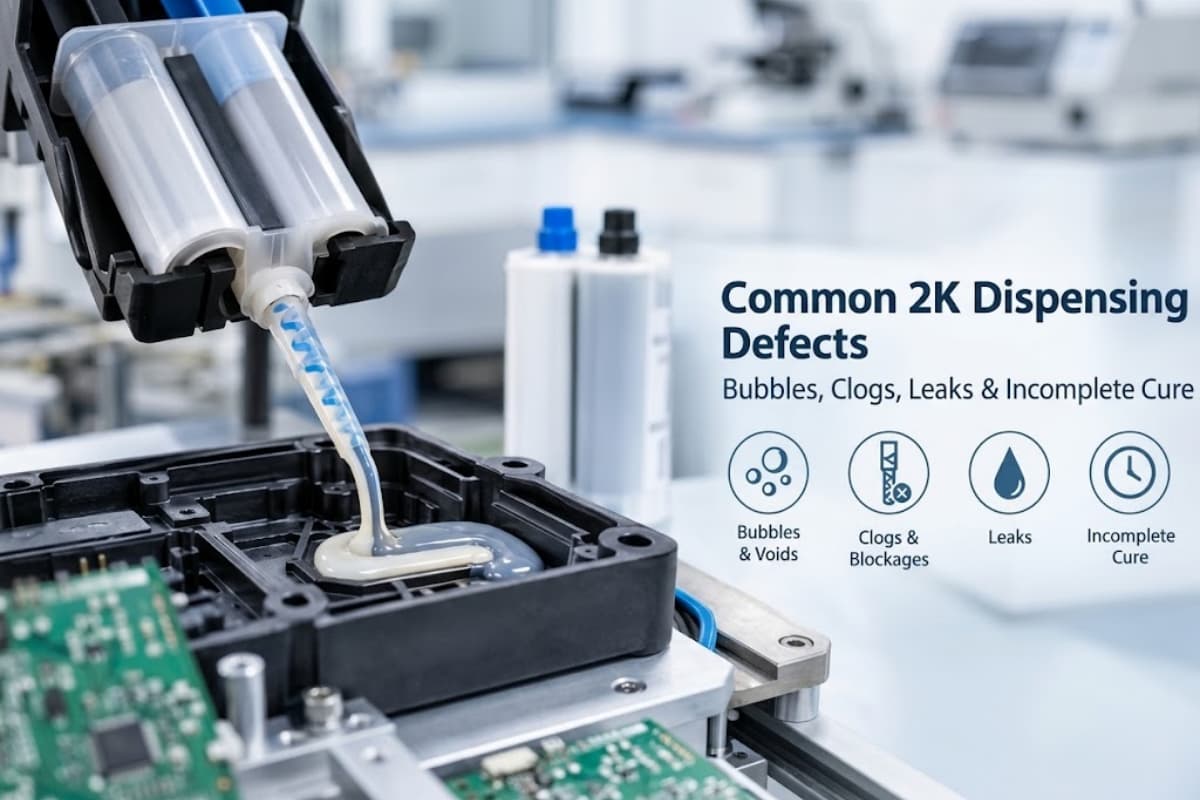
Trapped air is the biggest enemy of strong structural bonds.
- Air bubbles act as weak spots, which can cause composite panels to crack under pressure.
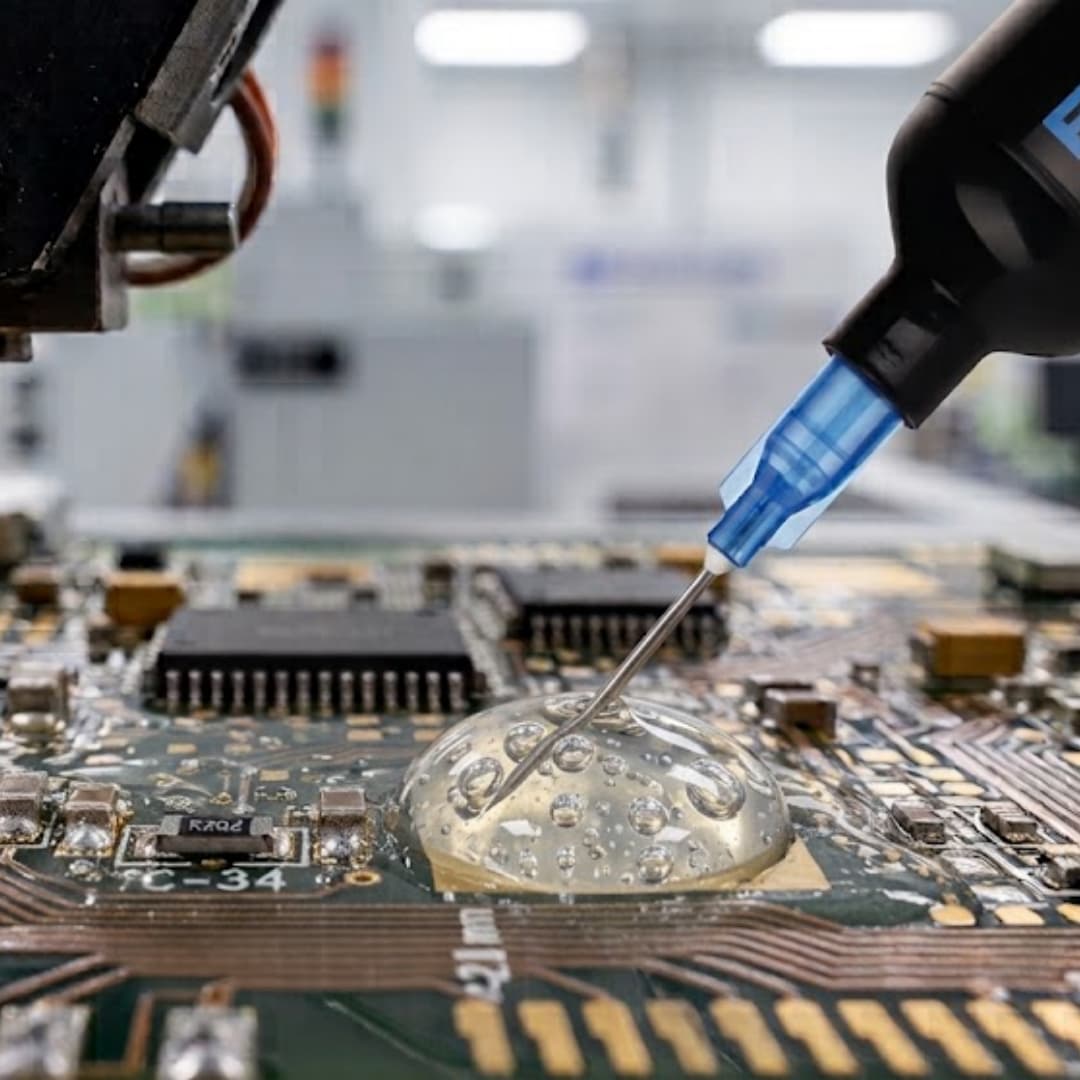
- In electronics manufacturing, poor mixing ruins the IP68 water resistance of modern smartphones.
- If the two parts do not mix completely, the adhesive may never fully dry, ruining the final product.
High-quality static mixers prevent these microscopic errors, saving manufacturers from massive recall costs.
Which Polymer Materials Prevent Premature Curing and Bursts?
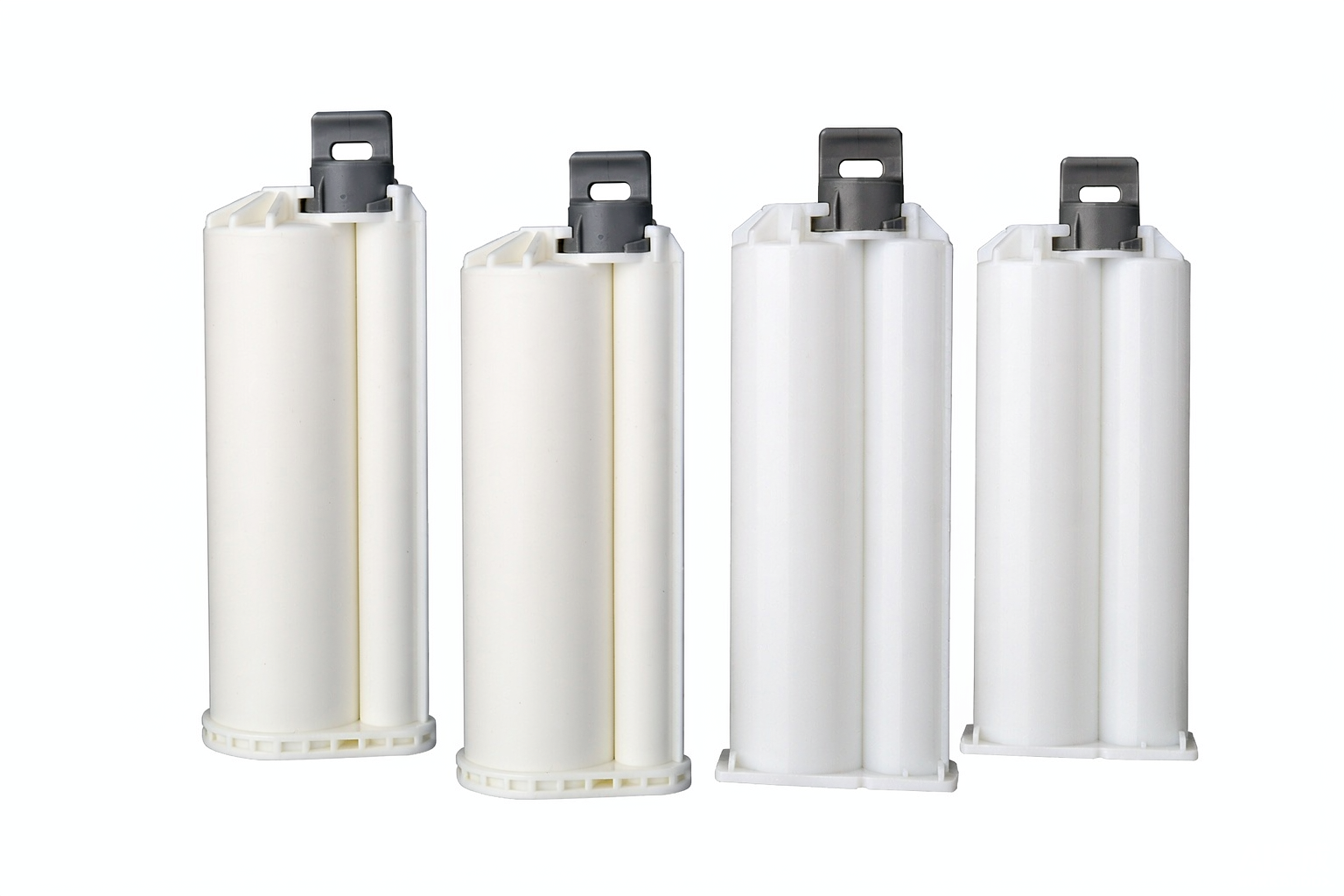
To prevent premature curing and catastrophic bursts, manufacturers must use 100% virgin industrial-grade polymers. Recycled plastics have weak molecule chains and microscopic impurities that cause cartridge walls to fail under pressure. High-performance engineered thermoplastics like Polypropylene (PP), Polyoxymethylene (POM), and Polybutylene Terephthalate (PBT) provide the essential chemical resistance, moisture barriers, and tensile strength needed to keep dual-component adhesives safe and isolated until dispensing.
| Polymer Material | Chemical & Mechanical Profile | Primary Dispensing Applications |
|---|---|---|
| Virgin PP (Polypropylene) | Exceptional chemical resistance against organic solvents and caustic acids. Highly cost-efficient with a low moisture vapor transmission rate. | Standard single and dual-component cartridges, exterior housings for disposable static mixers. |
| POM (Polyoxymethylene / Acetal) | Outstanding stiffness, incredibly low coefficient of friction, and high dimensional stability under prolonged mechanical stress. | Precision internal drive mechanisms in dispensing guns, high-shear internal mixing elements. |
| PBT (Polybutylene Terephthalate) | Semi-crystalline thermoplastic polyester offering extraordinary mechanical strength, dielectric properties, and resistance to thermal degradation. | Maximum-pressure dual-component syringes and industrial barrels (e.g., 250ml 10:1 cartridges). |
Why Virgin PP is the Industry Workhorse
Polypropylene is the most versatile plastic used in adhesive packaging because it blocks moisture so effectively.
- It features a remarkably low moisture vapor transmission rate, which stops ambient humidity from entering the tube and ruining the chemicals.
- Manufacturers use 100% virgin PP to ensure the cartridge walls have maximum tensile strength without hidden microscopic weak points.
- It safely contains harsh organic solvents, caustic acids, and strong bases without melting or degrading over time.
So, engineers rely on virgin PP to build standard structural cartridges and the outer housings for everyday disposable static mixers.
When to Use POM for Structural Rigidity
Some dispensing applications require internal components that will not bend or twist under heavy mechanical stress.
- Polyoxymethylene, also known as Acetal, is famous for its extreme stiffness and incredibly low coefficient of friction.
- It strongly resists long-term creep and fatigue, making it perfect for rapidly moving mechanical parts.
- Factories use POM specifically for the tough internal drive mechanisms inside manual dispensing guns.
Because it stays completely rigid against highly viscous fluid forces, POM is also the top choice for high-shear internal mixing elements.
The PBT Requirement for Extreme Pneumatic Extrusion
Standard plastics will balloon and rupture when pushed by high-power pneumatic air compressors on assembly lines.
- Polybutylene Terephthalate is a high-performance polyester that provides extraordinary mechanical strength under massive stress.
- It easily survives extreme pneumatic extrusion pressures without distorting the delicate central partition wall of a dual cartridge.
- PBT maintains perfect dimensional stability even during intense thermal and chemical degradation scenarios.
Therefore, high-pressure industrial barrels, like the heavy-duty 250ml 10:1 AB glue cartridges, demand PBT construction to prevent dangerous blowouts on the factory floor.
How Do You Choose the Right Mixing Architecture?
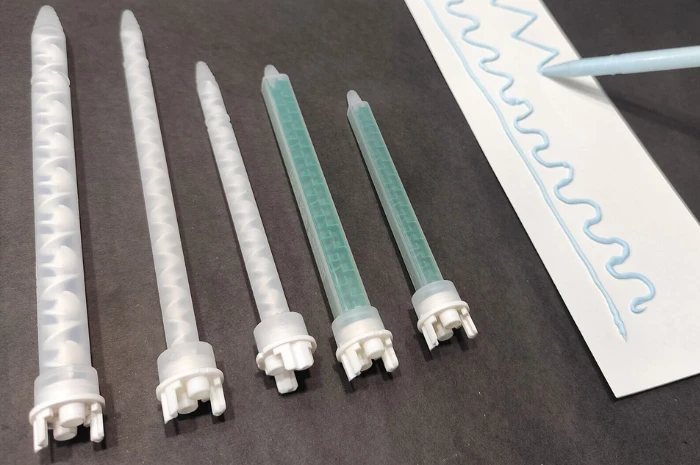
Choosing the right mixing architecture depends on your cartridge size, fluid viscosity, and dispensing method. You must match the nozzle connection to your specific application to prevent leaks and ensure safe operation. Engineers classify these nozzles into distinct letter systems so buyers can easily identify the correct fit for manual or robotic tasks.
| Mixing Architecture | Engineering & Connection Type | Primary Application |
|---|---|---|
| A-System | Push-and-twist interface designed specifically for standard 50ml dual cartridges. | General industrial bonding and detailed electronic component potting. |
| B-System | Reinforced connection collar with universal global compatibility. | Medium-volume manufacturing and reliable everyday manual dispensing. |
| C-System | Heavy-duty bayonet connection built to prevent accidental detachment. | High-pressure pneumatic dispensing for highly viscous structural materials. |
| F-System | Specialized twist-lock connection mechanics for fast changeovers. | Rapid-cycling automated robotic assembly lines and workstations. |
| Dynamic Mixers | Motorized rotating internal elements for active physical shearing. | Difficult formulations with extreme, asymmetric chemical viscosity ratios. |
The A-System and B-System for General Bonding
Standard manual tasks require simple and reliable connections to keep production moving smoothly.
- The A-System uses a quick push-and-twist interface designed specifically for standard 50ml dual cartridges.
- Workers use A-System nozzles for general industrial bonding and precise electronic component potting.
- The B-System features a robust reinforced collar that fits almost all standard two-component cartridge formats globally.
So, these two systems act as the reliable everyday workhorses for medium-volume manufacturing facilities.
Secure Connections with C-System and F-System
High-pressure machines and fast robots need much stronger locking mechanisms to prevent dangerous blowouts.
- The C-System uses a heavy reinforced bayonet connection to stop the nozzle from flying off under extreme pneumatic backpressure.
- This bayonet lock safely handles heavily filled structural epoxies pushed by powerful air compressors.
- The F-System features advanced twist-lock mechanics so operators can attach and detach the nozzle instantly.
Fast twist-lock connections help automated robotic assembly lines maintain continuous high-speed production without long pauses.
Dynamic Mixers for Asymmetric Viscosity Ratios
Some advanced adhesives are too thick or unbalanced for standard stationary mixing blades to blend properly.
- Chemical formulas with extreme viscosity ratios like 4:1 or 10:1 will often slide through a static mixer completely unblended.
- Dynamic mixers solve this because they contain an active motorized rotating element inside the nozzle body.
- This motorized blade physically shears and forces the two different fluids to blend perfectly before exiting.
Engineers always choose dynamic mixers for these highly challenging chemical combinations to guarantee a perfect cure.
Why Is Precise In-House Mold Engineering Critical?
Precise mold engineering is critical because it ensures the static mixer perfectly fits the adhesive cartridge. Even microscopic errors in the plastic mold can cause dangerous leaks or bad mixing. When manufacturers build their own custom molds, they control the exact shape and size of every part. This stops chemical failures and saves companies from wasting expensive industrial glue.
Eliminating Inter-Chamber Cross-Talk
A bad fit between the cartridge and the mixer nozzle can ruin the entire adhesive process.
- If the connection is not perfectly tight, Part A (resin) and Part B (hardener) might leak into each other early.
- This early mixing is called inter-chamber cross-talk, and it causes the glue to harden directly at the connection joint.
- To stop this, factories must machine their molds with extreme precision so the bayonet lug or twist-lock thread fits flawlessly.
Therefore, exact mold dimensions prevent this premature curing and keep the dispensing pathway completely clear.
Customizing Shear Planes for Thixotropic Materials
Standard off-the-shelf mixers often fail when handling very thick or sticky industrial liquids.
- Thick liquids, also known as highly thixotropic materials, need a special internal design to blend properly.
- Engineers can adjust the exact number of cascading mixing elements inside the nozzle to match the specific liquid.
- They also change the internal channel diameters and the precise angle of the shear planes.
- For example, a custom Quadro (square) mixing tip uses aggressive shear planes to mix fluids in a much shorter nozzle length.
So, custom internal geometry guarantees that even the thickest structural adhesives mix perfectly every single time.
The Importance of Rapid CFD Prototyping
When chemical companies invent a new glue, they need a matching delivery system immediately.
- Because new formulas often have extreme mixing ratios like 4:1 or 10:1, old nozzle designs will not work.
- Engineers use advanced computational fluid dynamics (CFD) software to test how the new liquid flows on a computer screen.
- Then, they can quickly design and physically cut a new custom mold right inside their own factory.
This fast testing and building process gets new adhesives into the market safely and without long delays.
What Systems Feed Mixers on the Assembly Line?
A static mixer is useless without a reliable machine to push the adhesive through it. Factories use three main systems to feed the glue into the mixing nozzle: manual guns, automated robotic applicators, and high-speed volumetric filling machines. The right choice depends on the size of the cartridge and how fast the factory needs to operate.
Ergonomic Manual and Pneumatic Guns
Workers need reliable tools to push thick adhesives by hand without getting tired.
- Manual dispensing guns use a high-thrust-ratio mechanical linkage to help workers push highly viscous epoxies easily.
- Standard manual guns fit common 50ml dual cartridges, making them perfect for basic repairs and small assembly lines.
- For larger jobs, pneumatic guns use compressed air to drive the internal pistons, which provides perfectly continuous and effortless dispensing.
Pneumatic power is essential because human hands cannot push heavy adhesives perfectly evenly for an entire eight-hour shift.
Automated Mechatronic Coordinate Applicators
Modern factories are replacing manual labor with highly precise and intelligent dispensing robots.
- These automated applicators use high-end servo motors to achieve an incredible positional repeatability of +/-1%.
- Engineers program the robots using standard CAD files to create complex, three-dimensional gluing paths in minutes.
- High-resolution Charge-Coupled Device (CCD) cameras automatically adjust the robot if the part is slightly out of place.
- Laser sensors continuously monitor the surface height, so the robot applies a perfectly even line of glue on curved objects.
Because these robots move at blazing speeds up to 800mm/s, they are completely changing how electronics are built.
Volumetric Filling Without Trapped Air
Before any gun or robot can dispense the glue, the factory must fill the empty cartridges perfectly.
- If a filling machine pushes air into the cartridge by mistake, that trapped air acts like a spring.
- When the user releases the trigger on their gun, this compressed air expands and causes the glue to keep leaking out.
- To solve this, advanced volumetric filling machines use vacuum-assisted bottom-up filling methods.
This careful filling process keeps the air out, so the adhesive stops flowing the exact second the worker releases the trigger.
How Can Buyers Protect Intellectual Property and Ensure Compliance?
Buyers protect their intellectual property by signing strict Non-Disclosure Agreements (NDAs) with custom mold manufacturers. This stops suppliers from stealing secret chemical formulas or cloning unique nozzle designs. Also, buyers ensure global compliance by only purchasing hardware that carries recognized international safety certifications. These certificates prove the plastics and machines are safe and legal to import.
| Certification Standard | Focus Area & Requirement | Affected Dispensing Equipment |
|---|---|---|
| ISO 9001 | Mandates rigorous, standardized, and repeatable quality management systems across all manufacturing steps. | All factory processes, from raw polymer inspection to final product testing. |
| ROHS | Restriction of Hazardous Substances. Proves products are 100% free from heavy metals like lead and mercury. | Plastic cartridges, static mixers, and electronic applicators destined for consumer devices. |
| CE & TUV | European health, safety, and environmental protection directives required for market entry. | High-pressure pneumatic dispensing guns and heavy-duty volumetric filling machines. |
Navigating Global Patent Risks with OEM/ODM Partners
Global patent laws are incredibly strict, so buyers must choose manufacturing partners very carefully.
- International trade groups frequently launch Section 337 investigations to stop companies from importing cloned or copied plastic cartridges.
- To avoid these dangerous lawsuits, buyers should use Original Design Manufacturers (ODMs) that build completely custom molds in-house.
- Also, buyers must sign strict Non-Disclosure Agreements (NDAs) before sharing their proprietary 4:1 or 10:1 mixing ratios.
Custom in-house mold engineering prevents patent infringement and protects the buyer’s supply chain from sudden legal shutdowns.
ROHS Compliance for Electronics
Hardware destined for modern electronics or electric vehicles must meet strict environmental safety rules.
- The ROHS certification guarantees that the plastic and metal parts contain absolutely zero regulated heavy metals.
- This means the factory tests the materials to ensure there is no hidden lead, mercury, or cadmium inside the polymers.
- Electronics brands demand this certification because toxic plastics can ruin the recyclability of millions of consumer smartphones.
So, verifying ROHS compliance is a mandatory step for any buyer supplying the global electronics or automotive markets.
CE and TUV Mandates for European Import
Heavy industrial machinery must pass rigorous safety tests before entering the European Economic Area.
- The CE mark and TUV certifications prove that the equipment meets top-tier health, safety, and environmental protection directives.
- These certificates are legally required for high-powered pneumatic dispensing guns because they operate under extreme compressed air pressure.
- They are also mandatory for fast volumetric cartridge filling machines to prevent electrical fires or dangerous workplace accidents.
By demanding these specific European certifications, buyers guarantee that their imported machines will clear customs and operate safely on the factory floor.
Will Automation Replace Manual Dispensing Completely?
While manual guns remain useful for small repairs, automation is rapidly taking over high-volume assembly lines. As electronics shrink and labor costs rise, humans simply cannot match the speed and microscopic accuracy of robots. Therefore, highly programmable mechatronic dispensers are quickly becoming the new global standard for modern manufacturing facilities.
The Shift Toward +/- 1% Positional Repeatability
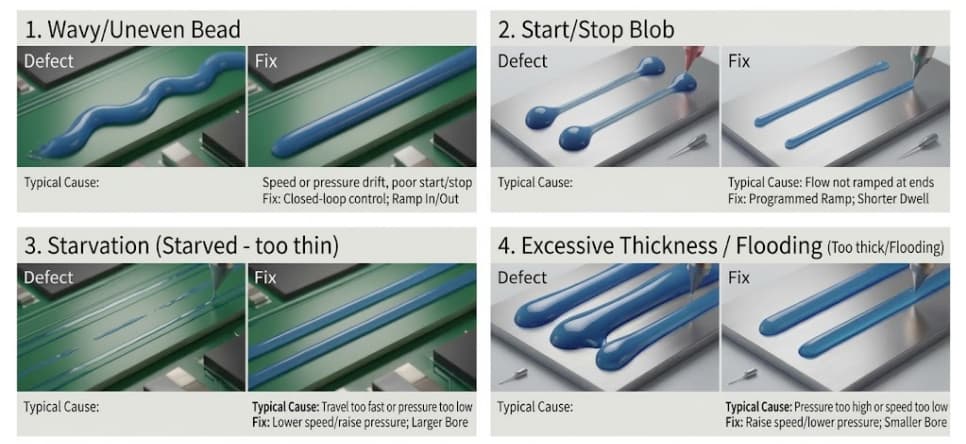
Robotic arms eliminate the natural hand tremors that cause messy and uneven glue lines.
- Advanced dispensing robots use high-end Panasonic servo motors to control their exact physical movements.
- These precision motors deliver an incredible positional repeatability of exactly +/-1% on the assembly line.
- This strict tolerance ensures the robot returns to the exact same microscopic spot for every single part.
This extreme accuracy is absolutely necessary for demanding tasks like micro-underfilling delicate computer chips in smartphones.
CCD Vision Systems and Laser Height Measurement
Smart robots can actually see the workspace and adjust their movements in real-time if a part shifts.
- High-resolution Charge-Coupled Device (CCD) cameras scan the area to find the exact position of the object.
- If the object is slightly crooked, the camera calculates a quick mathematical deviation compensation instantly.
- Meanwhile, laser height measurement sensors constantly check the surface level of uneven or curved parts.
- The laser automatically adjusts the Z-axis nozzle height so the glue bead stays perfectly thick over undulating terrain.
Together, these advanced sensors guarantee flawless adhesive application even when the physical parts are not perfectly aligned.
Future-Proofing with Industry 4.0 Integration
The global shift toward smart factories requires machines that can process complex digital instructions seamlessly.
- Process engineers can easily load standard CAD files right into the robot’s graphical programming interface.
- This intelligent software automatically builds complex 3D dispensing pathways without requiring long, manual setup times.
- Once programmed, these mechatronic systems race across the factory floor at extreme velocities up to 800mm/s.
By adopting these Industry 4.0 technologies, buyers ensure their automated production lines remain exceptionally fast and competitive for decades.
Before sending a bulk RFQ, use the epoxy mixing nozzle procurement checklist to freeze interface, sample evidence, retained material, packaging, and acceptance documents.
Frequently Asked Questions
How do you clean a static mixer nozzle?
You cannot effectively clean a standard static mixer. Because the internal blades tightly trap the cured epoxy, manufacturers design these nozzles as single-use disposable items. Attempting to clean them usually leaves microscopic residue that ruins the next batch of adhesive.
Can you reuse a disposable static mixer?
No, you should never reuse a disposable static mixer once the two-part adhesive fully cures inside it. The hardened chemical permanently blocks the internal shear planes. However, if you are actively dispensing continuously without a long pause, you can keep using the same nozzle.
What happens if you use the wrong mixing ratio?
If you force a 10:1 adhesive through a mixer designed for a 1:1 ratio, the chemicals will not blend properly. This causes a soft, incomplete cure. The adhesive bond will eventually fail under stress, leading to severe physical product damage.
How many mixing elements do I need for high-viscosity epoxy?
High-viscosity epoxies usually require longer nozzles featuring 24 to 32 cascading mixing elements. If the material is highly sticky, engineers often switch to a shorter Quadro (square) mixer because it forces the thick fluid through much more aggressive shear planes.
Why does my dual cartridge leak from the back?
Back-end leaking happens when the plastic cartridge walls are weak or when the internal pistons do not fit perfectly. Using 100% virgin PP or PBT plastics prevents the cartridge from ballooning under pressure, which keeps the back seals tightly closed.
Are dynamic mixers better than static mixers?
Dynamic mixers are not always better, but they are absolutely necessary for extreme, asymmetric chemical viscosity ratios. If your formula has a massive difference in thickness between Part A and Part B, the active motorized blade in a dynamic mixer guarantees successful blending.
What is the minimum order quantity (MOQ) for bulk dispensing guns?
Many top-tier ODM suppliers offer highly accessible minimum order quantities for industrial bulk purchases. For standard 50ml manual dispensing guns, the MOQ is typically around 500 units. For heavy-duty metal dosing guns, the MOQ can drop to just 50 pieces.
How do I verify if a supplier is RoHS compliant?
You must ask the factory to provide their official ROHS certification documents from a recognized independent testing laboratory. This critical paperwork proves they tested their virgin polymers to guarantee they contain absolutely zero restricted heavy metals like lead or mercury.
Conclusion
Choosing the correct static mixer and dispensing system is critical for preventing catastrophic chemical failures on the assembly line. Buyers must always prioritize virgin polymers, exact mixing architectures, and strict compliance certifications like ROHS and CE. As global production speeds increase, investing in custom in-house mold engineering and automated robotic applicators guarantees perfect volumetric accuracy without costly air voids. For global brands seeking these exact high-performance standards, Haijing Company provides the ultimate, NDA-protected manufacturing solution. They deliver the comprehensive precision engineering required to safely package and dispense today’s most advanced structural adhesives.