The global industrial manufacturing landscape is currently undergoing a profound structural transformation. Factories are systematically replacing traditional mechanical fasteners, like heavy metal rivets and threaded screws, with advanced structural adhesives. This massive shift helps the automotive and aerospace sectors build incredibly lightweight vehicles.
Also, this paradigm shift allows consumer electronics brands to relentlessly shrink their smart devices. However, the true strength of these advanced chemical glues depends entirely on the precision of the delivery system. Improper mixing or volumetric inaccuracies during the fast dispensing phase cause massive product failures.
These simple mistakes can easily destroy the thermal management of a high-density battery array or ruin a composite panel. Therefore, factories must carefully control every single drop of fluid to protect their expensive products. Advanced mechatronic robots and complex fluid dynamics guarantee perfect results on the modern assembly line.
Why Are Dynamic Mixers Replacing Traditional Systems?
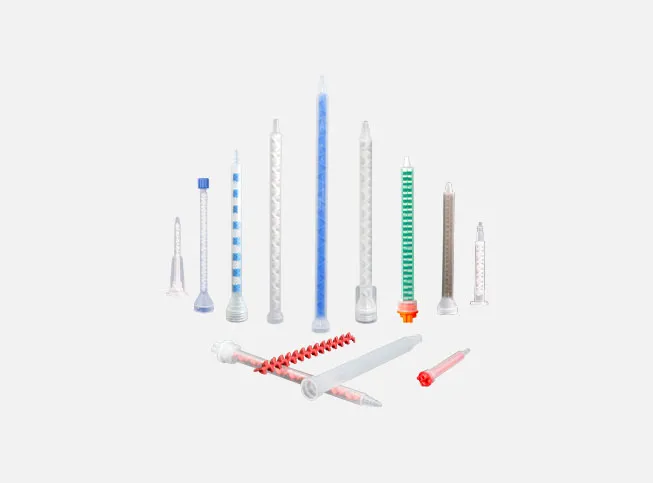
Traditional static mixers rely on fixed internal blades to fold glue passively. However, many modern chemical formulas are simply too thick or unbalanced for this simple method. Dynamic mixers solve this exact problem by using active motorized blades to violently chop and blend tough liquids together. This advanced technology guarantees a perfect chemical reaction for difficult industrial adhesives.
The Limits of Passive Geometry
Static mixing tubes use stationary plastic spirals to force liquids to fold over themselves.
- This passive method works perfectly for watery glues with an equal 1:1 mix ratio.
- However, passive blades cannot generate enough physical force to blend thick, heavy pastes.
- Thick resins simply push past the stationary blades without actually mixing with the hardener.
- This poor mixing creates dangerous weak spots in the final glued product.
So, stationary blades often fail when factories upgrade to stronger, thicker structural adhesives.
Handling Extreme Viscosity Ratios
Modern engineering often requires mixing two completely different types of liquids together.
- Sometimes, factories must blend a thick, heavy resin with a thin, watery hardener at a 10:1 ratio.
- The thin hardener easily channels straight down the middle of a static tube unmixed.
- Dynamic mixers use spinning power to force the thin liquid directly into the thick paste.
- The constant motorized rotation guarantees complete homogeneity regardless of chemical thickness.
Because the motor forces the liquids to combine, factories never suffer from soft, uncured glue lines.
Active Shearing vs. Passive Folding
The physical blending action is completely different between the two technologies.
- A static mixer relies entirely on the forward pushing pressure of the glue gun.
- A dynamic mixer features an external motor that spins an internal plastic paddle at high speeds.
- This fast spinning creates intense mechanical shearing energy inside the mixing chamber.
- This aggressive shearing physically tears the molecules apart and forces them to bond together instantly.
Therefore, active motorization creates a much stronger chemical bond than simple forward pushing.
Waste Reduction in Short-Cycle Operations
Long mixing tubes hold a lot of expensive chemical glue inside them.
- When the factory line stops, the glue inside the static tube quickly hardens and becomes useless waste.
- Dynamic mixers feature a much shorter mixing chamber because the spinning blade is highly efficient.
- This compact design drastically reduces the volume of expensive adhesive trapped inside the dead zone.
- Factories save massive amounts of money because they throw away far less raw chemical material.
Ultimately, a shorter motorized mixing tip keeps expensive chemical waste to an absolute minimum.
| Performance Metric | Static Mixer | Dynamic Mixer |
|---|---|---|
| Blending Mechanism | Passive forward folding | Active motorized shearing |
| Max Viscosity Ratio | Works best up to 4:1 | Easily handles extreme 10:1 |
| Internal Material Waste | High (Long nozzle body) | Low (Short mixing chamber) |
How Do Automated Coordinate Applicators Work?
Automated coordinate applicators are intelligent robotic workstations designed to replace human hands on the assembly line. These smart machines use precise motors, advanced cameras, and computer software to squeeze glue onto parts with perfect accuracy. Because manual workers get tired and make mistakes, these mechatronic robots take over to ensure high-speed, flawless dispensing for mass production.
Servo Motors and Positional Repeatability
The physical movement of the dispensing robot relies entirely on high-quality internal motors.
- Advanced mechatronic chassis use heavy-duty Panasonic servo motors to drive the robotic arms.
- These powerful motors ensure an incredibly precise positional repeatability of exactly +/-1%.
- Because the motors are so accurate, they completely eliminate human hand tremors during delicate glue jobs.
- The rigid metal platform prevents the robotic arm from shaking or bending while moving under pressure.
So, these strong servo motors guarantee that the glue lands in the exact same spot every single time.
Graphical Programming and CAD Integration
Engineers must tell the robot exactly where to move the glue nozzle before production starts.
- Instead of writing complex computer code, factory workers use a simple graphical programming screen.
- Process engineers simply upload standard 3D CAD files directly into the brain of the robot.
- The machine software automatically reads the digital drawing to build a customized dispensing pathway.
- This fast computer integration drastically reduces the time needed to set up a new assembly line.
Because of this smart software, factories can switch between different product designs in just a few minutes.
Real-Time Deviation Compensation
Sometimes, parts sit slightly crooked on the conveyor belt before the glue arrives.
- To fix this problem, the robotic applicator uses a high-resolution Charge-Coupled Device (CCD) camera.
- The smart camera takes a fast picture of the part to recognize its exact physical position.
- If the part is slightly twisted, the camera instantly calculates a new mathematical path for the nozzle.
- This real-time vision system safely prevents the machine from dropping expensive adhesive in the wrong place.
Also, this smart camera technology stops major production mistakes without slowing down the factory line.
Z-Axis Adjustments for Non-Planar Substrates
Many modern electronic parts feature curved, bumpy, or completely uneven plastic surfaces.
- Standard machines struggle to glue curved parts because the nozzle crashes into the raised edges.
- Advanced coordinate robots solve this problem by firing continuous laser height measurement beams.
- The laser constantly measures the changing distance between the dispensing tip and the actual product surface.
- Then, the robot instantly adjusts its vertical height to maintain a perfectly uniform glue bead across the bumps.
- These fast-moving machines can safely travel over rough terrain at extreme velocities up to 800mm/s.
Because the laser acts like a smart eye, the robot safely glues complex 3D shapes at incredibly high speeds.
Which Polymers Make the Best Dispensing Components?
The best dispensing components use engineered thermoplastics like Polypropylene (PP), Polyoxymethylene (POM), and Polybutylene Terephthalate (PBT). These tough plastics must survive extreme pneumatic pressure and resist harsh chemical solvents. Engineers strictly avoid recycled plastics because they easily break or leak under stress. Using pure, virgin polymer material guarantees that the empty cartridge securely protects the expensive chemical formula inside.
The Dangers of Recycled Plastics
Cheap dispensing tubes often use recycled plastic to save money during the manufacturing process.
- Recycled polymers naturally suffer from damaged, shortened molecular chains due to repeated thermal melting.
- These weak plastic chains create hidden microscopic impurities inside the thin wall of the cartridge.
- Under high pneumatic pressure, these weak spots suddenly burst and spray dangerous chemicals everywhere.
- Also, these impurities can accidentally react with the raw adhesive, causing the glue to harden prematurely.
So, high-quality manufacturers strictly use 100% virgin industrial polymers to guarantee absolute safety on the assembly line.
Polypropylene (PP) for Chemical Resistance
Polypropylene serves as the most popular foundational material for standard industrial glue packaging.
- This versatile plastic provides exceptional chemical resistance against harsh organic solvents and strong acids.
- It blocks ambient moisture perfectly, which safely stops sensitive polyurethane glues from drying out too early.
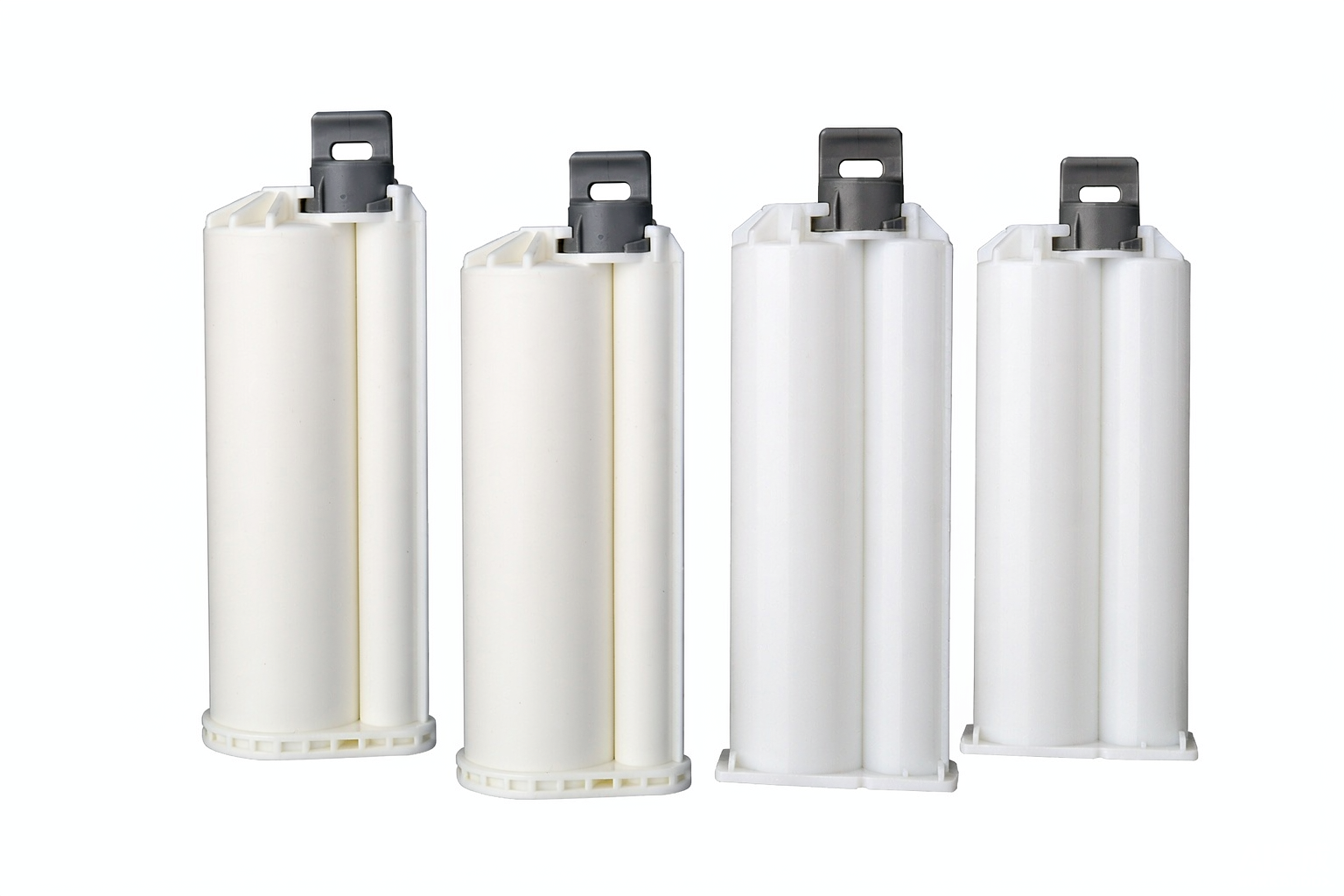
- Engineers use PP to mold standard single tubes and traditional dual-component structural cartridges.
- Also, almost all disposable static mixer outer housings rely heavily on this flexible but tough material.
Because PP blocks moisture so well, it greatly extends the storage shelf-life of expensive chemical adhesives.
Polyoxymethylene (POM) for Dimensional Stability
Engineers choose Polyoxymethylene when internal plastic parts must survive constant, heavy mechanical friction.
- POM offers incredible physical stiffness and a remarkably low coefficient of friction against other moving parts.
- This tough plastic strongly resists creeping or bending when exposed to prolonged mechanical stress over many hours.
- Factory designers frequently use POM to build the precision internal drive mechanisms inside manual dispensing guns.
- It also works perfectly for internal static mixing blades that must aggressively cut through thick, viscous fluids.
Therefore, POM ensures that moving plastic parts do not warp or snap during heavy industrial production.
Polybutylene Terephthalate (PBT) for Extreme Pressure
Polybutylene Terephthalate is a premium plastic reserved strictly for the most extreme, high-pressure dispensing jobs.
- This semi-crystalline polyester delivers extraordinary mechanical strength against brutal thermal and chemical attacks.
- Standard plastics easily balloon outward or violently explode under maximum pneumatic extrusion pressure.
- PBT perfectly holds its shape, maintaining exact liquid volume ratios even under massive forward thrust.
- Engineers specifically demand PBT for large, heavy-duty industrial barrels like the 250ml 10:1 AB glue cartridge.
Ultimately, PBT safely handles the massive pushing forces required to dispense highly unbalanced, thick chemical pastes.
| Polymer Material | Key Mechanical Characteristic | Primary Dispensing Application |
|---|---|---|
| PP (Polypropylene) | High chemical & moisture resistance | Standard structural cartridges & mixer housings |
| POM (Polyoxymethylene) | Extreme stiffness & low friction | Moving gun mechanisms & internal mixing blades |
| PBT (Polybutylene Terephthalate) | Maximum burst strength against pressure | High-pressure 10:1 heavy-duty syringes |
What Is the Role of Fluid Dynamics in Custom Molding?
Fluid dynamics is the complex science of how liquids move under pressure. When chemical companies invent new glues, standard off-the-shelf plastic molds often fail to mix them properly. So, engineers use advanced computer software to study the specific flow of these new chemicals. Then, they design custom plastic molds that perfectly match the unique movement of that specific adhesive.
Mapping Asymmetrical Viscosity Ratios
Engineers face major problems when two liquids have completely different thicknesses.
- Part A might be a thick, heavy resin, while Part B is a thin, watery hardener.
- In standard tubes, the thin liquid rushes forward too fast, ruining the 10:1 mix ratio.
- Computer fluid models map exactly how these unequal liquids push against each other inside the tube.
- Engineers then adjust the internal channel sizes in the plastic mold to slow down the thinner liquid.
Because of this precise mapping, both liquids arrive at the mixing nozzle at the exact same time.
Designing Cascading Mixing Elements
Once the liquids enter the nozzle, they must fold together perfectly to create a strong bond.
- Fluid dynamics software helps designers calculate the perfect shape for the internal mixing blades.
- Engineers simulate how the fluid splits and recombines across multiple cascading shear planes.
- They can adjust the exact number of mixing elements needed to achieve a 100% homogeneous blend.
- For example, a short Quadro (square) mixer forces the fluid through tighter corners than a standard spiral tube.
So, custom mold designs ensure that the mixing geometry perfectly matches the unique chemical formula.
Preventing Inter-Chamber Cross-Talk
The connection point between the glue cartridge and the mixing tip must remain absolutely perfect.
- Even microscopic plastic defects can allow the two reactive chemicals to touch too early.
- This premature mixing, called cross-talk, instantly cures the glue inside the tube and permanently blocks the nozzle.
- Engineers use advanced molding machines to create completely flawless twist-lock or bayonet connections.
- A leak-proof interference fit guarantees that Part A and Part B stay isolated until they enter the mixer.
Because the mold is incredibly precise, factories never waste expensive glue from sudden nozzle blockages.
How Do High-Viscosity Materials Behave in EV Manufacturing?
High-viscosity materials are extremely thick and sticky liquids. In Electric Vehicle (EV) manufacturing, engineers use these thick pastes to build safe, powerful batteries and protect smart car computers. Because these materials are so thick, standard glue guns struggle to push them out smoothly. Let us see how advanced equipment handles these tough automotive chemicals.
Thermal Interface Materials (TIM) in Battery Packs
Electric vehicle batteries get extremely hot while driving and charging on the road.
- Engineers use special Thermal Interface Materials (TIM) to safely absorb this dangerous heat.
- Machines pump this thick paste directly between the hot lithium-ion cells and the metal cooling plates.
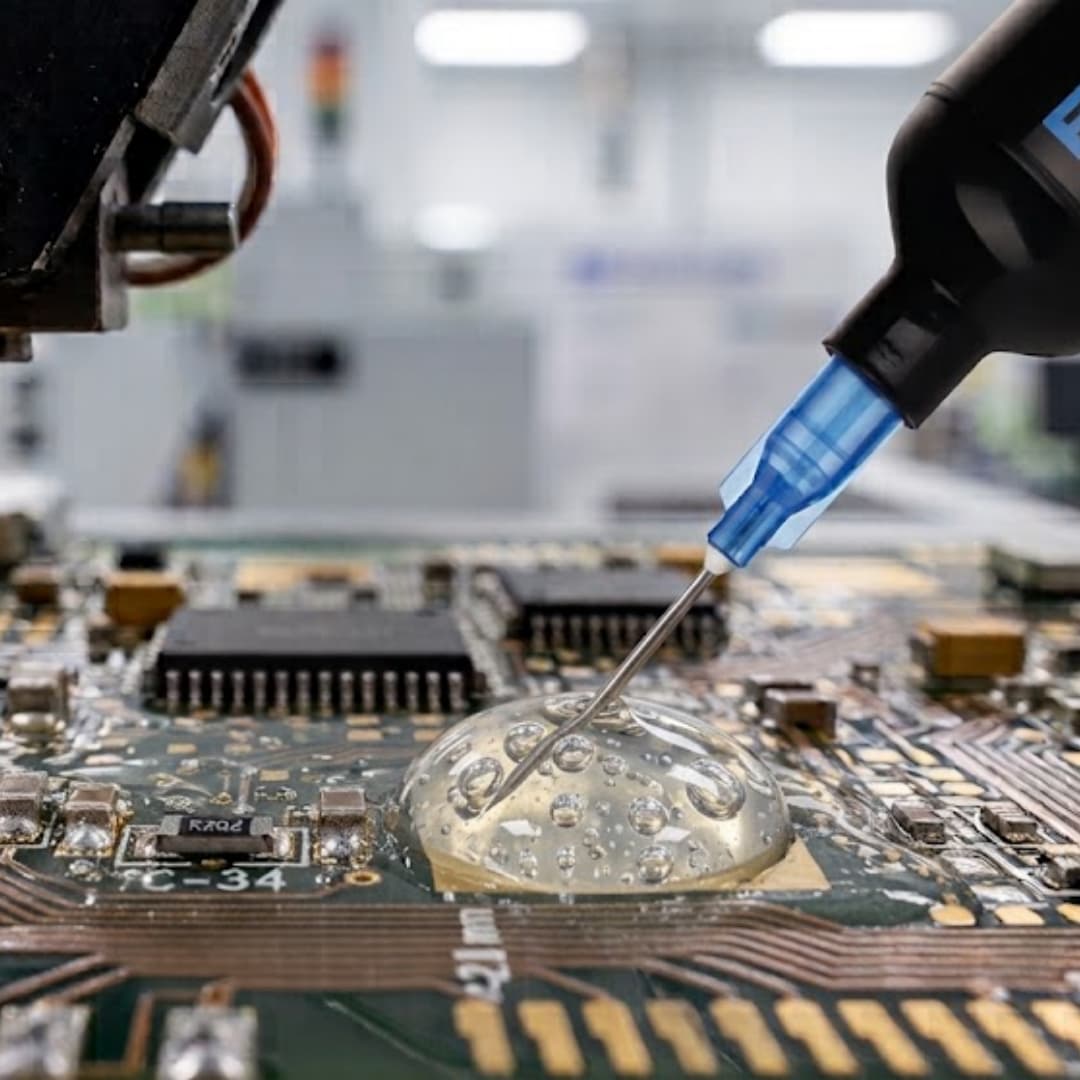
- The dispensing robot must squeeze the paste perfectly to avoid trapping any insulating air bubbles.
- If an air bubble gets stuck, the surrounding battery cells can easily overheat and catch fire.
So, precise automated dispensing absolutely guarantees that the EV battery stays cool and completely safe.
Managing Abrasive Ceramic and Metallic Particles
Thermal pastes are not just thick; they are also filled with hard microscopic rocks.
- Chemical companies mix abrasive ceramic or metallic powders directly into the glue to conduct heat better.
- These hard, sandy particles act exactly like sandpaper inside the plastic dispensing nozzle.
- Standard plastic mixing blades quickly wear down and snap when pushing these abrasive liquids.
- Engineers must use heavy-duty, reinforced mixers to survive the brutal friction of the metallic fillers.
Therefore, strong internal nozzle designs prevent abrasive pastes from physically destroying the application tools.
ECU Conformal Coating at High Speeds
Modern cars rely on complex Electronic Control Units (ECUs) to manage the engine, steering, and brakes.
- These sensitive computer boards must survive heavy harmonic vibration, extreme engine heat, and road water.
- Robots quickly spray a thin, protective conformal coating over the entire circuit board to block moisture.
- The machine must spray this thick liquid without accidentally covering important electrical connection pins.
- Advanced mechatronic applicators execute this delicate coating job at extreme speeds reaching up to 800mm/s.
Because the robot moves so fast, car factories can safely protect thousands of smart computers every single day.
Are CCD Vision Systems Necessary for Micro-Dispensing?
Yes, CCD vision systems are absolutely necessary for micro-dispensing. Modern electronic parts are incredibly tiny. If a machine drops a microscopic glue dot even a millimeter off target, it ruins the whole computer board. Smart cameras act like digital eyes, guiding the robot to apply perfect micro-dots exactly where they belong.
Recognizing Microscopic Variations on Assembly Lines
Factory conveyor belts cannot hold tiny parts perfectly still.
- Small electronic chips often shift slightly when moving down the fast factory line.
- A high-resolution CCD camera takes a quick picture before the glue gun fires.
- The computer compares this picture to the original 3D CAD file to find any mistakes.
- If the part moved, the robot instantly corrects its path by a fraction of a millimeter.
So, the vision system guarantees perfect accuracy even when parts vibrate or shift.
Surface Mount Technology (SMT) and Red Glue
Modern circuit boards use Surface Mount Technology (SMT) to attach tiny components.
- Engineers use special SMT red glue to hold these microscopic chips in place before soldering.
- The dispensing robot must place perfectly spherical dots that measure less than 0.5mm wide.
- If the dot is too large, the glue spills over and blocks the electrical connection pins.
- Fast piezoelectric valves shoot these tiny glue dots without ever touching the actual board.
Therefore, vision-guided robots easily handle microscopic gluing tasks that human hands simply cannot do.
Camera Module Sealing for IP68 Waterproofing
Flagship smartphones need perfect glue seals to survive underwater drops.
- Phone makers use an IP68 waterproof rating to prove the device blocks dust and water.
- The robot must apply a perfectly continuous liquid gasket around the tiny glass camera lens.
- Even a microscopic air bubble in the glue line creates a direct leak path for water.
- The CCD camera carefully watches the dispensing nozzle to ensure the glue line never breaks.
Because the camera monitors every single drop, the smartphone stays completely safe from water damage.
| Feature Capability | Manual Dispensing Gun | Automated Coordinate Robot |
|---|---|---|
| Positional Accuracy | Varies entirely by human skill | +/-1% mechanical precision |
| Dispensing Speed | Slow and highly fatiguing | Extreme speeds up to 800mm/s |
| Vision Correction | Basic human eyesight | CCD Camera real-time tracking |
| Ideal Application | Low-volume repair work | High-speed micro mass production |
How Does Proper Volumetric Filling Prevent “Run-On”?
Volumetric filling is the careful process of pumping raw chemical glue into empty plastic cartridges. If factories do not fill these tubes correctly, trapped air creates a massive problem called run-on. Let us explore how advanced filling machines stop this annoying issue before the glue ever reaches the final assembly line.
The Fluid Dynamics of Dual-Component Filling
Filling two separate chambers at the exact same time is a delicate fluid balancing act.
- Industrial machines pump Part A and Part B into the dual cartridge using high-pressure metal nozzles.
- The machine must stop filling at the exact millisecond to guarantee perfect volumetric dosing.
- If one chamber overfills even slightly, the final 1:1 or 10:1 mix ratio is permanently ruined.
- Also, the factory must quickly seal the back of the cartridge with tight plastic pistons to prevent leaks.
So, precise volumetric dosing ensures that the customer receives the exact chemical ratio printed on the label.
Trapped Air as a Pneumatic Spring
Air bubbles trapped behind the thick glue act exactly like a compressed metal spring.
- When the operator squeezes the manual dispensing gun, the trapped air bubble violently compresses inside the tube.
- When the operator releases the trigger, the compressed air suddenly expands and pushes the glue forward.
- This delayed expansion causes the glue to uncontrollably ooze from the tip, which engineers call run-on.
- Run-on creates massive messes on the assembly line and wastes highly expensive chemical adhesives.
Therefore, removing hidden air bubbles is the only way to stop the glue gun from dripping uncontrollably.
Vacuum-Assisted and Bottom-Up Filling Protocols
High-quality filling machines use advanced engineering tricks to keep air completely out of the tube.
- Some advanced machines place the empty cartridge inside a sealed vacuum chamber before pumping the glue.
- The vacuum completely sucks all the ambient atmospheric air out of the plastic tube.
- Other machines use a smart bottom-up filling method to push the empty air out naturally.
- The filling nozzle dives to the very bottom of the tube and slowly rises as the heavy fluid fills the space.
Because these smart machines eliminate trapped air, the final customer enjoys a perfectly clean, dripless gluing experience.
Before freezing an ODM automation concept, compare a fixed coordinate workstation with articulated motion in this automated adhesive dispensing architecture guide.
Frequently Asked Questions
What is the difference between static and dynamic mixing?
Static mixers use passive stationary blades inside a plastic tube to fold the glue naturally. Conversely, dynamic mixers use a fast-spinning motorized blade to aggressively shear thick chemicals together.
How do 10:1 mix ratios work in structural adhesives?
A 10:1 ratio means the cartridge holds ten parts of thick resin for every one part of thin hardener. Special cartridges and custom nozzles ensure these unequal amounts blend perfectly.
Can automated applicators handle curved surfaces?
Yes, advanced robotic applicators use continuous laser height sensors. The laser constantly measures the curve and instantly adjusts the dispensing nozzle to keep the glue bead perfectly even.
What causes adhesive cross-contamination in cartridges?
Poorly molded plastic dividers or weak twist-lock connections allow the two glue chemicals to touch too early. This plastic defect cures the expensive glue inside the tube instantly.
Why use PBT over standard plastics for glue cartridges?
Polybutylene Terephthalate (PBT) is an incredibly strong engineered plastic. Engineers use it to build heavy-duty cartridges because it survives maximum pneumatic pressure without bursting or ballooning.
How fast can automated dispensing robots operate?
High-quality mechatronic robots using heavy-duty servo motors can move extremely fast. They easily dispense thick glue at extreme velocities reaching up to 800mm/s without ever losing positional accuracy.
What is adhesive “run-on” and how do you stop it?
Run-on happens when trapped air inside the cartridge compresses and pushes extra glue out after you stop squeezing. Vacuum-assisted filling machines completely remove this air to prevent the messy problem.
Conclusion
The shift from traditional mechanical fasteners to advanced structural adhesives requires absolute precision. Whether factories need bubble-free static mixing, extreme dual cartridges, or high-speed mechatronic applicators guided by cameras, the hardware must perform flawlessly. Using virgin polymers and advanced fluid dynamics guarantees safe, repeatable mass production. For global chemical brands and electronics manufacturers seeking these exact engineering standards, Haijing Company provides the ultimate custom manufacturing solution. Simply put, Haijing Company designs, molds, and builds the reliable dispensing systems that power modern assembly lines worldwide.