Non-contact dispensing pays when the cost of touching the part is higher than the cost of the jet valve. That happens in four situations: the dispense surface varies in height, the program is dominated by many small dots, the part cannot tolerate a tip mark, or the nozzle cannot reach the target. In every other case — long beads, heavily filled pastes, deep cavities, low volume — a contact tip is cheaper to buy, cheaper to run, and more forgiving of material variation.
The choice is not between two valve brands but whether material reaches the part through contact or across an air gap. Z motion, standoff tolerance, material window and cycle time all follow from that one difference. The metering families behind both methods are compared in dispensing valve types; this page assumes the volume is under control and asks only how it reaches the substrate.
The short answer
- Height varies across the dispense area → non-contact. The jet absorbs variation the tip reads as a changing gap.
- Mostly small dots → non-contact. Removing the Z move removes the largest block of time in a dot-dense cycle.
- Part cannot be touched, or tip cannot reach → non-contact. No witness mark, no downward force, line of sight is enough.
- Long beads, filled paste, deep cavities, short pot life, low volume → contact. Cheaper capital and consumables, wider material window.
The air gap is the decision, not the valve name
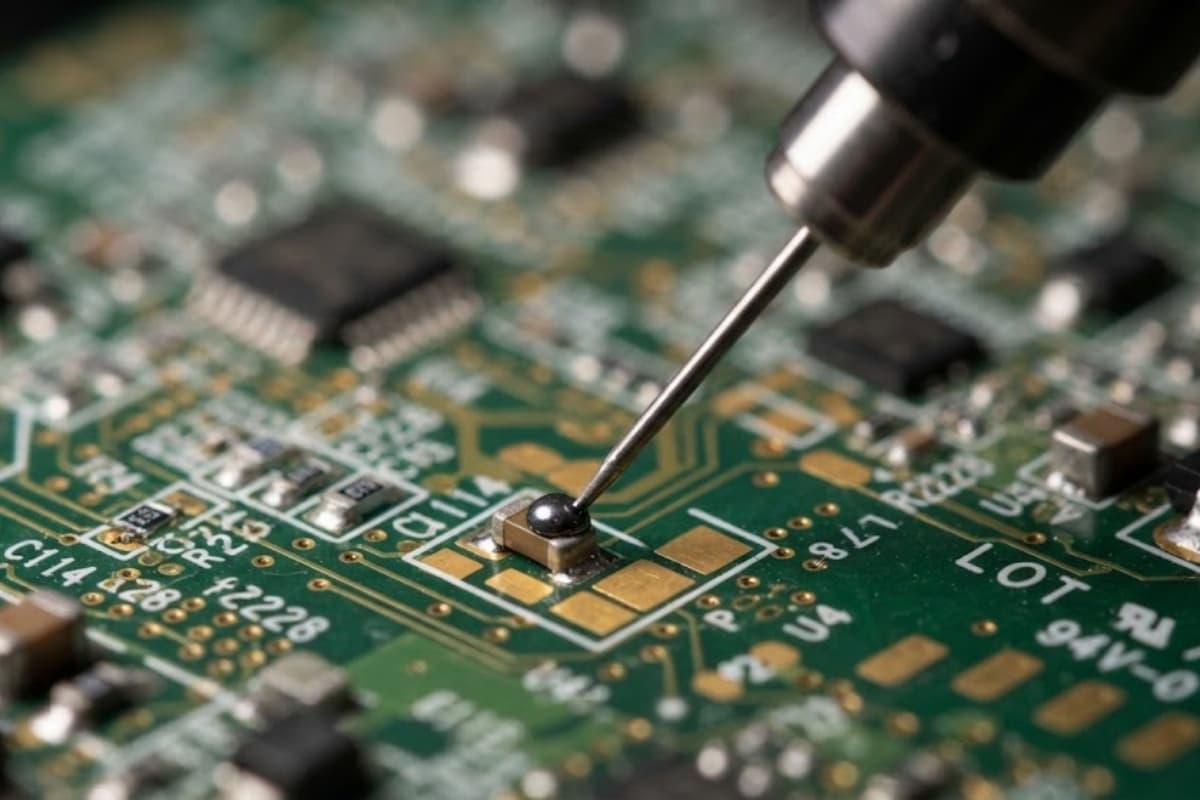
Contact dispensing delivers material while the outlet sits at a fixed distance from the part — touching it in needle-in-bead work, or hovering at a standoff small enough that the bead wets the surface as it is laid down. That gap is part of the recipe, measured in fractions of a millimetre. Jetting fires a droplet across an open gap instead: a ball or needle strikes a seat, the impact launches material, and the nozzle stays clear. The gap becomes a working clearance rather than a process variable, so deposit size is set by the valve rather than by the distance to the workpiece.
That single difference carries the commercial argument. A contact process holds deposit size through a gap it can only hold if the part is where the program believes it is. A jet holds deposit size through an actuation it repeats regardless.
Contact
- Deposit formed where material meets the surface
- Z move, dwell and lift around every dot
- Size depends on gap and wetting
- Wide material window, filled paste included
Non-contact (jet)
- Drop launched across a gap, nozzle never lands
- XY only, cycle time set by valve frequency
- Size largely independent of gap inside the range
- Narrow window; satellites and tailing are the failure modes
Terms. Standoff — outlet-to-substrate distance when material leaves it. Satellite — a stray micro-droplet landing away from the deposit. Tailing — a thread left between deposit and nozzle at close.
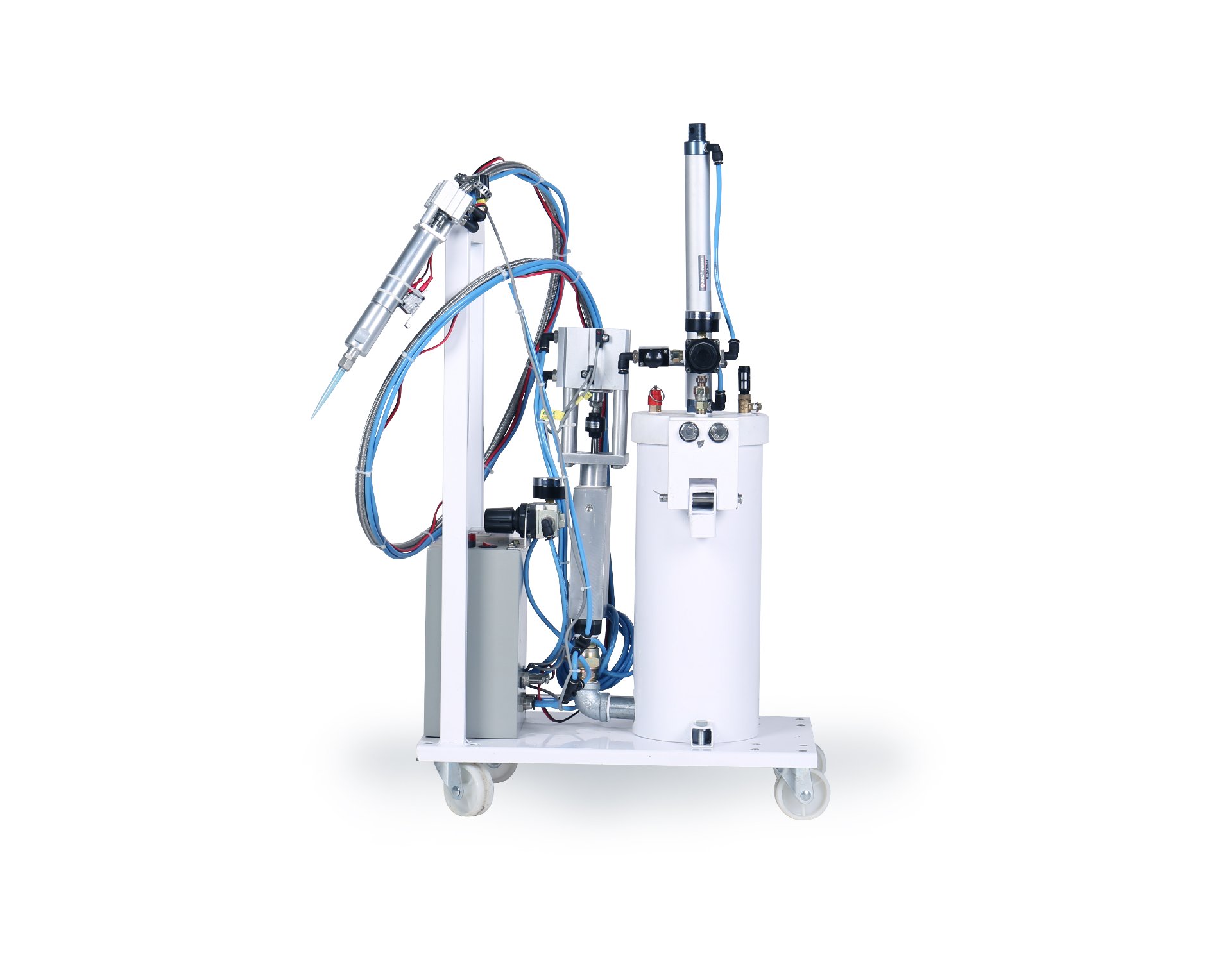
What changes when the nozzle never touches
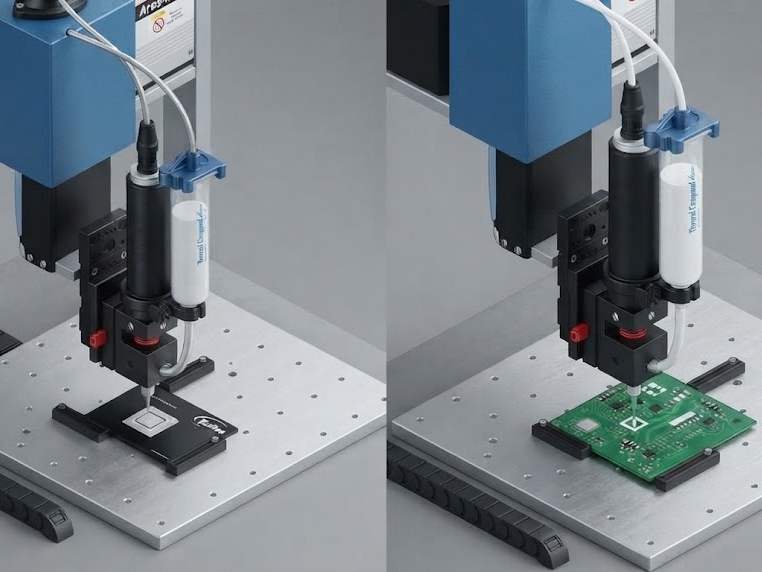
The Z axis leaves the program. A contact process lifts between dots to avoid dragging: down, dwell, up around every deposit. A jet fires from a fixed height, so the program is XY only and cycle time follows valve frequency — the motion side is set out in the desktop dispensing robot guide. Manufacturer actuation figures are ceilings, not production rates, as the industry review at EPP Europe argues.
Height variation stops being a defect source. Stampings, castings, flex circuits and stacked assemblies rarely sit at constant height. A contact tip reads that as a changing gap, and a changing gap produces a changing bead: wider as the tip comes closer, narrower as it lifts. A jet absorbs the same variation while the surface stays inside its working range.
Wetting stops helping. Contact lays material against the surface, so surface energy holds part of the deposit. A jet deposits a drop that has to land and stay — first visible on surfaces that repel the adhesive, or on deposits tall enough to slump.
Four conditions where non-contact pays for itself
Non-contact is justified by a process constraint, not by newer hardware. One condition is normally enough.
1. The dispense surface varies in height
Measure total height variation across the dispense area, not the tolerance on the drawing. If it is comparable to the standoff the contact process needs, that process already runs at the edge of its window and every fixture change becomes a re-validation.
2. The program is many small dots
Count deposits per unit and the Z round trip per deposit. If dots dominate, removing Z motion is a throughput gain that scales with dot count, not part size. Long beads are the opposite case: one Z move serves the whole bead.
3. The part cannot tolerate contact
Thin diaphragms, exposed wire bonds, optical surfaces, soft gaskets and pre-plated pads show a tip mark or a witness line. Some cannot be pushed on at all, which rules out the light force a tip needs.
4. The nozzle cannot reach the target
A jet nozzle can be angled because only the drop needs line of sight, and the working gap is millimetres rather than the near-zero clearance a tip needs. Recesses beside tall components and surfaces behind a raised wall are where geometry decides the method.
Where contact dispensing is still the better tool
The reverse boundary matters more than the sales case, because a jet specified outside its window reproduces the same defects at higher cost.
Long beads and continuous seals. A jet builds a bead from overlapping drops, so the result is a chain of deposits rather than a continuous extrusion. Gasket lines, fillets and long seals are simpler with a tip laying material down — and a jet firing at its own rate can be slower than a tip dragged at constant speed.
Heavily filled and high-viscosity materials. Particles larger than a fraction of the orifice block a jet, and abrasive filler wears the seat. Higher filler loading means a narrower window and shorter wear life. A contact tip wears too, but it is a consumable priced as one.
Deep cavities. Some joints need material placed into a feature rather than dropped onto a surface. Contact lets the tip follow the geometry; a jet needs a flight path a wall can block.
Short pot life and low volume. Mixed 2K material resting in a jet nozzle is curing where it cannot be purged — the failure modes are in common 2K dispensing defects. At low volume, filtration, development and nozzle spares arrive with the valve and do not scale down.
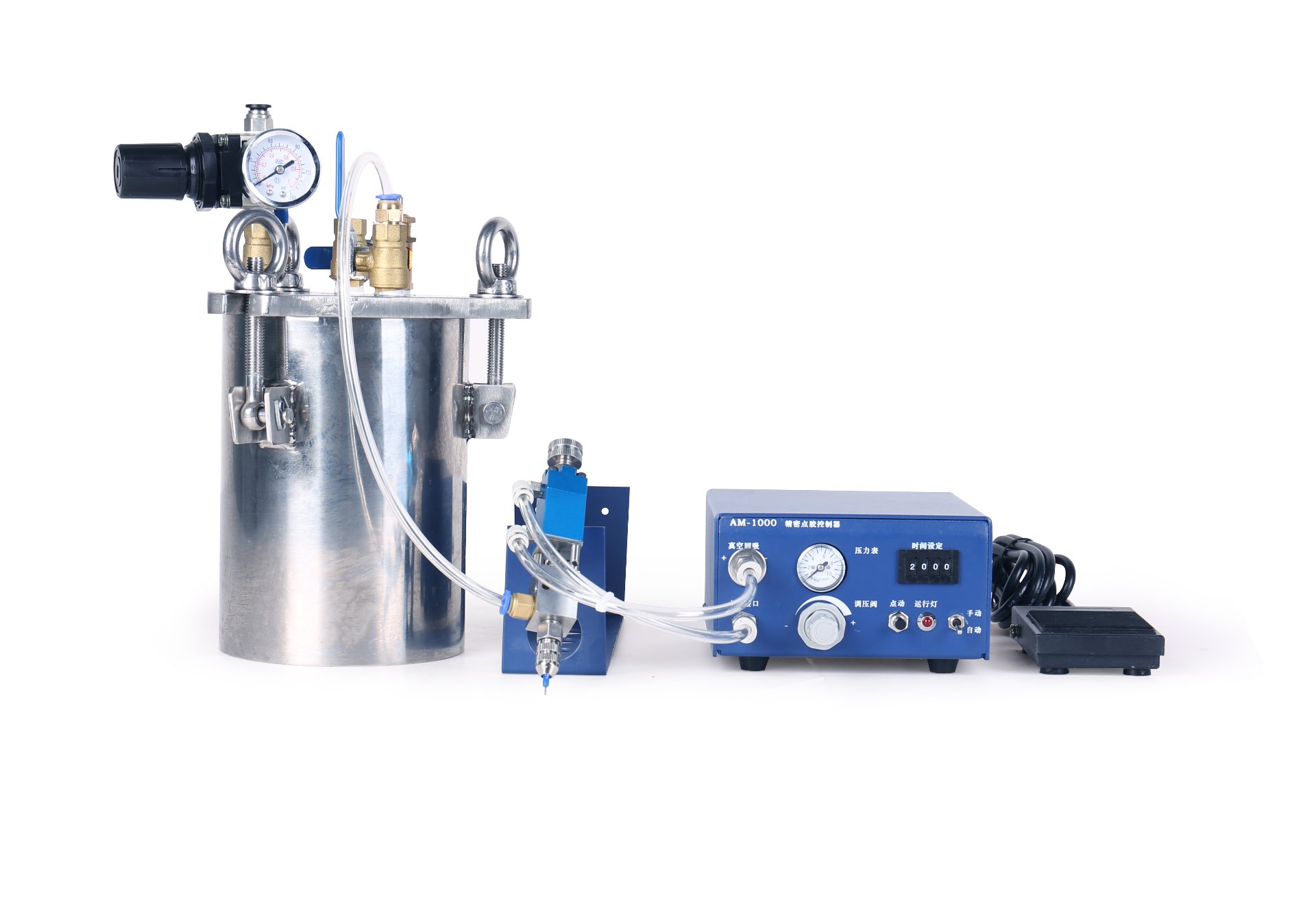
The material window a jet will not forgive
A jet is a rheology device before it is a motion device: the material needs enough body to break cleanly from the nozzle and enough flow to leave it. That window is narrower than a contact tip accepts.
Table 1. Material characteristics and what happens at the nozzle
Typical behaviour, not a specification. Limits are set by the valve and confirmed on the material actually run.
| Material characteristic | At the nozzle | What to confirm |
|---|---|---|
| Low viscosity, low surface tension | Drips, wets the face, satellites | Smaller orifice, faster stroke |
| High filler loading, large particles | Partial clog, drifting dot size | Particle size against orifice; filtration at point of use |
| Entrained air | Missing or short shots | Deaeration or vacuum packaging |
| Fast cure or short pot life | Skin formation at the seat | Purge routine, nozzle cooling, or another method |
| Abrasive filler | Seat and nozzle wear, slow volume loss | Wear-part interval and cost per nozzle set |
Two of these are preconditions, not preferences: filtration and deaeration. A jet fed unfiltered material is a maintenance schedule, not a process. Bore and hub for the needle hardware downstream are specified in the dispense tip range, and the same bore logic applies to jet nozzles.
Cost beyond the valve
A quote covers the valve and controller; running one covers more. Jet adds filtration, longer process development and wear parts, and removes Z time. What decides the purchase is payback from cycle time against that added cost of ownership — never valve price against valve price. If the program holds few dots, the saving is small and the payback is long however good the valve is.
A six-check decision sequence
Run these in order. The first two eliminate most cases before cost is discussed.
- Deposit type. Continuous bead or individual dots? Beads favour contact, dense dot arrays favour non-contact.
- Height variation. Measure it. If it is comparable to the standoff the contact process needs, non-contact removes a variable you cannot control.
- Z time per deposit. Contact costs XY + Z down + dwell + Z up per dot; a jet costs XY + flight. If the gantry or the cure oven is the constraint, removing Z changes no output.
- Material data. Viscosity in production, filler type and particle size, pot life, cure, air content. Any one can veto the method before cost matters.
- Access and fixturing. Line of sight to every deposit, working gap available, no wall in the flight path, fixture holding the part inside the range.
- Volume and payback. Annual deposit count against added capital and consumables. Low volume with a long payback justifies staying with contact.
Failure signatures: which side of the gap the defect comes from
Most deposit defects are blamed on the valve when they belong to the interface between valve and part.
Table 2. Symptom to cause, by method
Read the symptom, then inspect the component that the method depends on.
| Symptom | Contact dispensing | Non-contact (jet) |
|---|---|---|
| Deposit size drifts through a shift | Pressure, temperature or standoff drift | Nozzle wetting, partial clog, seat wear |
| Bead width varies along the path | Height variation, gap not held | Frequency and travel speed out of step |
| Satellites or mist | Rare — not a contact failure mode | Tail breakup, stroke setting, gap too large |
| Missing or short dots | Clog, air at the needle | Clog, air in the chamber, refill starvation |
| Stringing between dots | No suck-back at close | Tailing from an unsuitable actuation profile |
On a jet showing satellites or a drifting dot, check the material first — filtration, air content, temperature — before the stroke is touched; integrators publishing on jet tailing describe the same order in their valve, screw and jet comparison. On a contact process showing a varying bead, check the part before the valve.
Tell us the height variation first
Send the deposit target, the measured height variation, the material data and the existing gantry with its Z capability. We will say whether the material sits inside a jet window and whether the saving covers the valve. For the system around it, see coordinate applicators and adhesive dispensing systems.
Key takeaways
- The decision is whether material crosses an air gap, not which valve brand is fitted.
- Non-contact pays for height variation, dot-dense programs, parts that cannot be touched, and geometry the tip cannot reach.
- Contact stays better for long beads, filled paste, deep cavities, short pot life and low volume.
- A jet is a rheology device first: filtration and deaeration are preconditions, not options.
Frequently asked questions
Is jet dispensing always faster than contact dispensing?
No. It removes the Z move from every deposit, which dominates programs built from many small dots. On a long continuous bead there is little Z time to remove, and a contact tip dragged at constant speed can be faster.
Can a jet dispense a continuous bead?
Yes, by overlapping drops, but the result is a chain of deposits rather than a continuous extrusion. Gasket lines, fillets and long seals are usually better served by contact dispensing.
What materials cannot be jetted?
Materials with particles larger than a fraction of the orifice, heavily filled or abrasive compounds, very high-viscosity pastes, and 2K mixes with a short pot life all narrow or close the window. The exact limit depends on the valve and must be confirmed with the supplier.
Why do jets produce satellites?
A satellite is a stray micro-droplet. It usually comes from tail breakup, an unsuitable stroke setting, a gap larger than the working range, or material whose viscosity or air content changed during the shift.
Sources. Actuation ceilings versus production rates: EPP Europe, “The real production is the benchmark”. Valve, screw and jet behaviour including tailing practice: Jaten Instrument technical note. All accessed 3 November 2026. No independent test data is claimed; specifications must be confirmed against the valve data sheet and a trial on the production material.