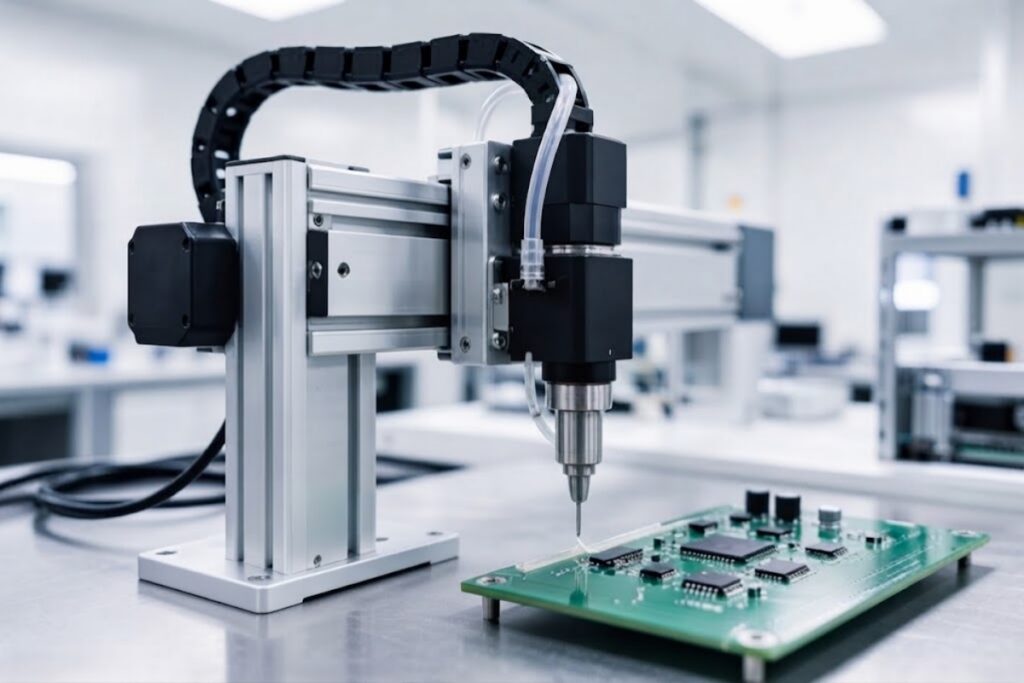
A desktop dispensing robot earns its place when the defect you are chasing is a path problem rather than a fluid problem: inconsistent bead position, varying travel speed on curves, or an operator who cannot hold the same motion across a shift. The specification sequence matters — size the work envelope from your largest part, separate path accuracy from repeatability, and choose the valve and feed method before you choose the motion platform. This guide sets out that sequence and closes with the questions to put in a vendor enquiry.
First Decision: Is Your Bottleneck Motion or Fluid Control?
Automating a dispensing cell does not fix a fluid problem. If the real cause of variation is viscosity drift, wrong gauge, trapped air, or an adhesive that skins over in the barrel, a robot will reproduce the defect with better positional accuracy.
Check the following before specifying motion:
- Is the deposit volume consistent when the same operator dispenses slowly by hand? If not, the problem is in the fluid path.
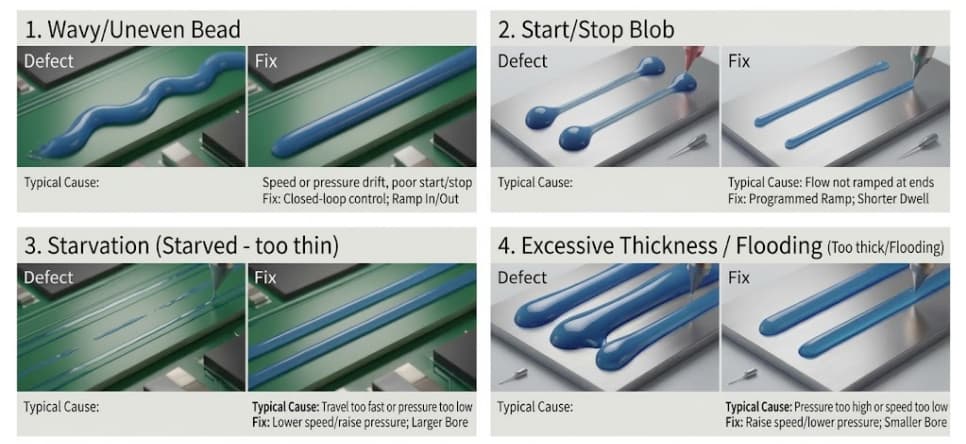
- Does the defect follow the path geometry — corners, curves, start and stop points? That points to motion and speed control.
- Is the variation between operators or between shifts? That points to a repeatability problem that automation can address.
If the answer is a mix of both, fix the fluid path first. Stable fluid delivery is the precondition for a robot to show any benefit, and it is far cheaper to correct on a bench than after the cell is installed. For a deeper look at how motion architecture and fluid delivery interact, it is worth comparing automated dispensing system architectures before you buy.
Size the Work Envelope From the Largest Part, Not the Smallest
The work envelope is the volume the tool can reach, and it is the specification most often undersized because it is quoted from a sample part rather than from the full product range.
Work through it in this order:
- List every part that will run on the cell, including the largest and any fixture, jig or tray it sits in.
- Add the tool height. The dispensing valve, the needle and the cartridge or syringe holder consume Z travel before the tip ever reaches the part.
- Add clearance for the tallest component on the board or housing, plus a loading margin so the operator is not threading parts into the envelope.
- Decide whether the part moves or the tool moves. A moving-part design can reduce the required machine size but adds fixture cost.
The HJ-XYZ-600 coordinate glue applicator in this range is a servo-driven platform with an integrated PLC, and its travel range is model-specific. Confirm the envelope against your largest fixture rather than against a nominal axis number.
Path Accuracy vs Repeatability: Ask for Both
These two terms are used interchangeably in quotations and they are not the same thing.
- Path accuracy describes how closely the deposited bead follows the programmed geometry.
- Repeatability describes whether the same path produces the same result on cycle 1 and cycle 10,000.
For adhesive dispensing, repeatability is usually the number that drives yield, because a consistent offset can be programmed out, while a drifting one cannot. A rigid platform and a servo drive matter here: frame deflection under acceleration shows up as bead variation at corners.
Ask the vendor:
- What is the stated repeatability, and under what load and speed was it measured?
- What is the maximum travel speed under load, not unloaded?
- How is corner behaviour handled: does the controller slow down automatically, and can that be tuned?
- What is the resolution of the teaching or programming system?
Choose the Valve and Feed Method Before Choosing the Robot
The valve and the material feed determine whether the robot can dispense your adhesive at all. Match them first; the motion platform is the easier of the two to specify.
| Material and package | Suitable feed method | Notes for the cell |
|---|---|---|
| Low-viscosity instant adhesive, small deposits | Peristaltic dispenser | No air pressure required; wear-resistant rotor extends tube life; the HJ-TP50 in this range runs on 220–240 V, 50 Hz, 30 W and weighs 3.5 kg, with an automatic reversal at glue stop |
| Single-component medium viscosity, time-pressure | Syringe or cartridge with pressure control | The 886A manual applicator is an air-driven time-pressure unit with foot switch control, stated accuracy of 0.01% and a cycling frequency above 800 times per minute |
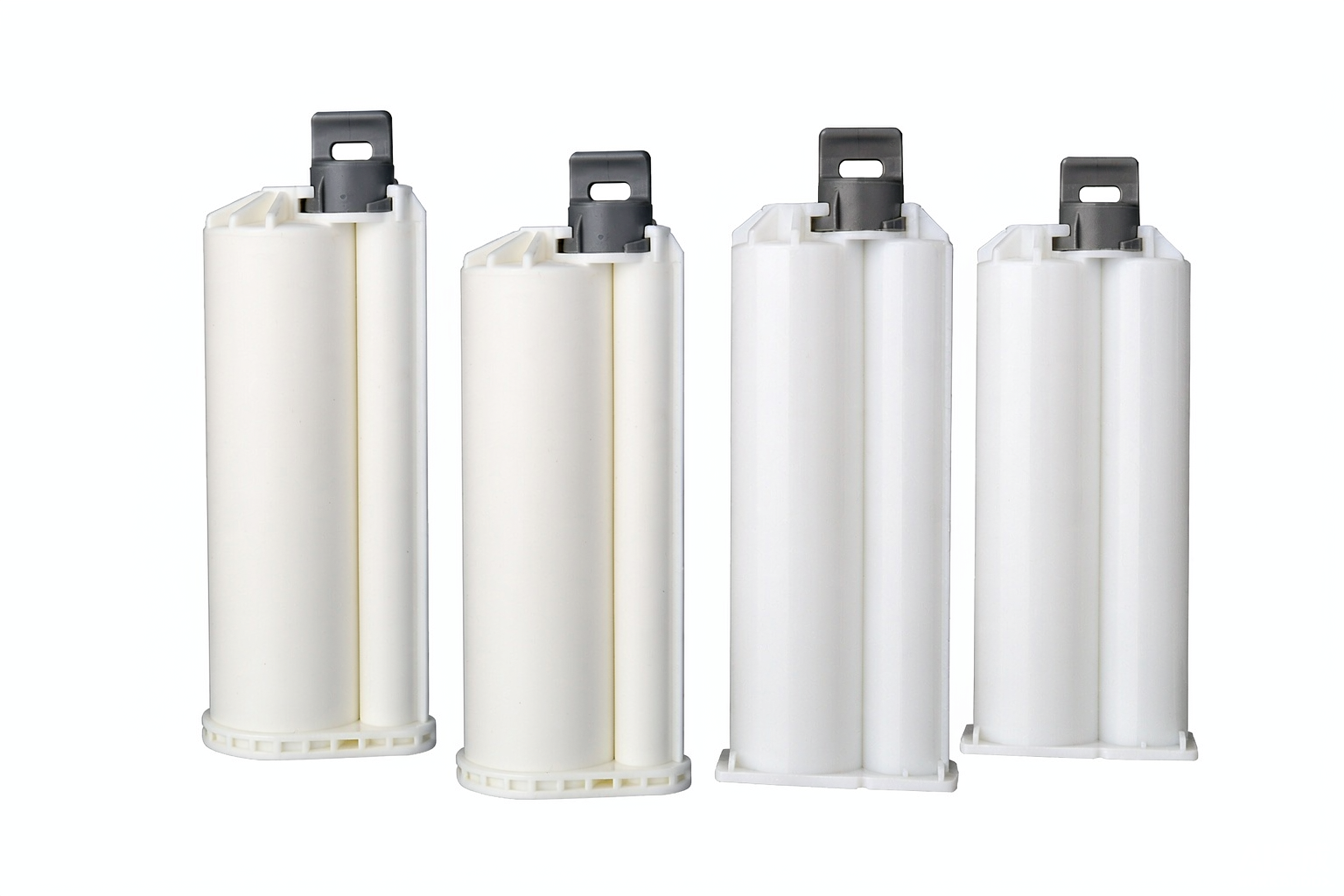
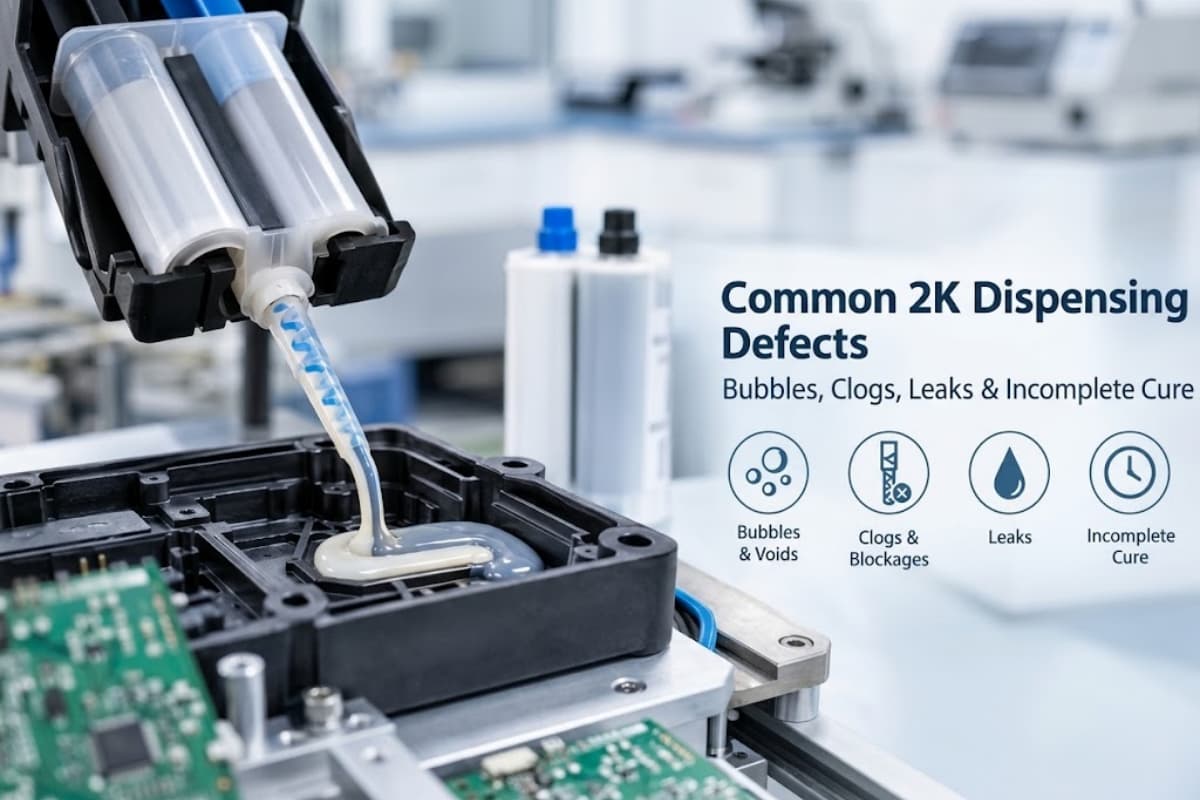
| Two-component adhesive, cartridge fed | Dual cartridge with static or dynamic mixer | Mixer choice depends on ratio and viscosity difference between the two parts |
| Two-component with extreme ratio or viscosity difference | Dynamic mixing nozzle on a driven head | Requires motor, controller and a defined purge routine |
| Abrasive or heavily filled materials | Valve type selected for wear | Confirm wetted-part materials with the supplier |
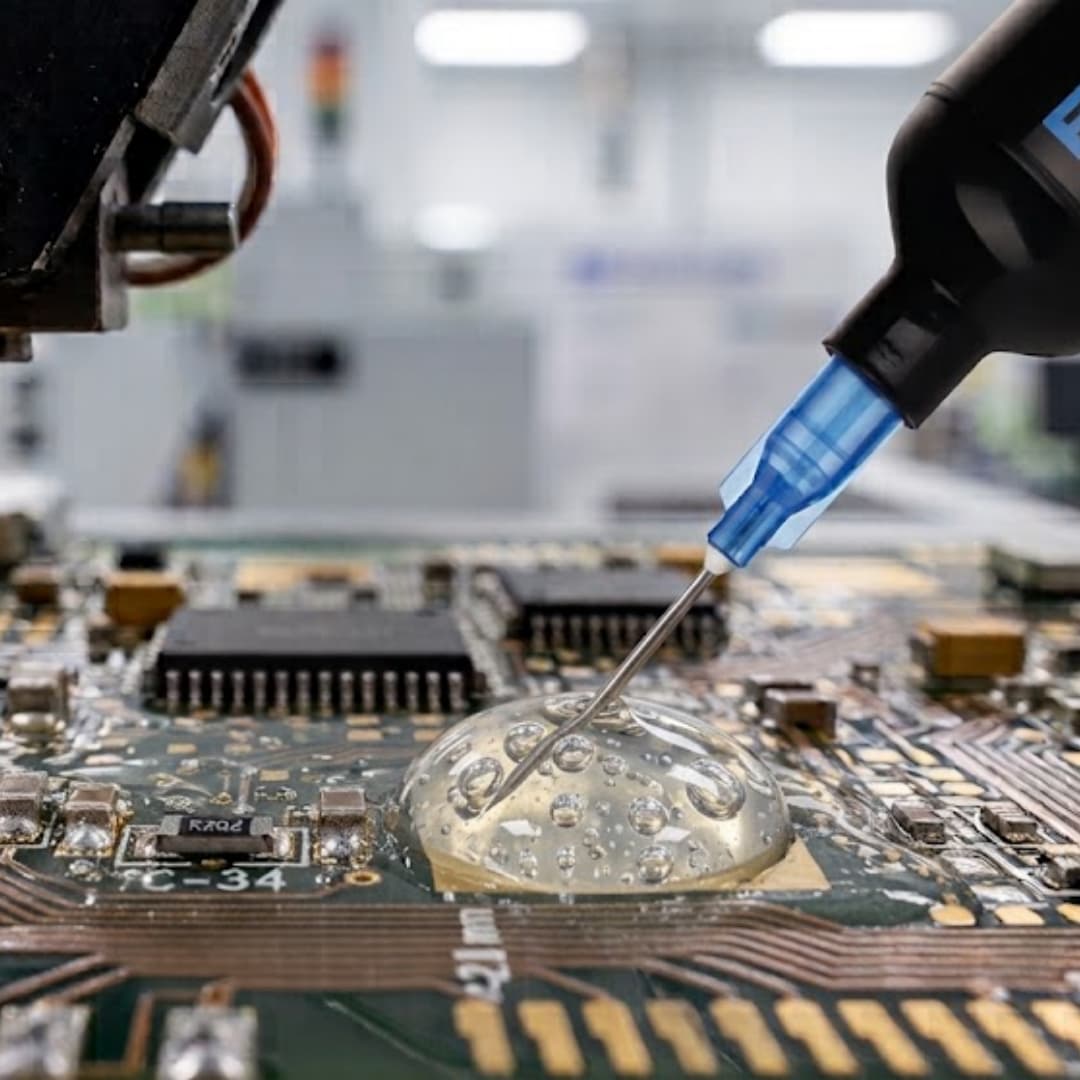
Two notes that save rework. First, confirm the dispensing tip gauge and hub type as part of the cell, not afterwards — the tip is where the fluid path meets the motion path, and the wrong gauge reintroduces the clogging and flow problems that automation was meant to solve. Second, for 2K materials, specify the cartridge, the mixer and the valve as one assembly so that ratio and mix quality are validated together.
Programming, Changeover and Who Runs the Cell
A robot that only one engineer can program becomes a bottleneck. Evaluate the control side with the same weight as the mechanics.
- Programming method: teach pendant, offline CAD import, or PC software. For high-mix production, offline programming and stored recipes reduce changeover dramatically.
- Recipe management: can an operator select a program by part number without editing parameters?
- Integrated control: an integrated PLC, as on the HJ-XYZ-600, keeps motion and dispensing signals in one controller, which simplifies I/O with upstream and downstream equipment.
- Operator skill: how long does it take to train someone to load, run and stop safely?
If your mix is high volume and low variety, programming sophistication matters less. If you change parts daily, put changeover time in the acceptance criteria.
Where a Manual Applicator Still Wins
Automation is not always the answer. Manual and semi-automatic applicators remain the better choice for repair stations, short runs, and processes where the operator’s judgement is part of the quality gate.
| Situation | Better fit | Why |
|---|---|---|
| Repair, rework and low-volume cells | Manual applicator such as the 886A | No programming; foot switch control; fast set-up |
| Small deposits of instant adhesive | Peristaltic dispenser such as the HJ-TP50 | No compressed air needed; easy installation; automatic reversal at stop reduces dripping |
| High-volume repeating paths with tight position tolerance | Desktop dispensing robot | Consistent travel speed and path; removes operator variation |
| Validation before committing capital | Benchtop semi-automatic unit | Proves the fluid path before automating motion |
Many lines run both: manual stations for exceptions and a robot for the standard path.
Utilities, Footprint and Integration Checklist
Confirm these before the machine is ordered:
- Compressed air: time-pressure and air-driven applicators need a stable supply. Confirm pressure and flow at the point of use; peristaltic units such as the HJ-TP50 remove the air requirement entirely.
- Electrical: confirm voltage and frequency. The HJ-TP50 is specified at 220–240 V, 50 Hz, 30 W.
- I/O with the line: if the cell is fed by a conveyor or triggers a cure station, confirm the signal interface. The HJ-TP50 provides an input that accepts contact or no-contact signals and a standard level output for dispensing end.
- Benchtop versus floor space: confirm machine weight and whether the bench can carry the moving mass without deflection.
- Extraction and safety: confirm requirements for the specific adhesive, including ventilation and handling rules. Treat safety as an application question, not a formality.
- Commissioning support: confirm whether installation, commissioning and process development are included. Application engineering support during start-up is usually the difference between a cell that hits rate in week one and one that does not.
Application-to-Specification Matrix
The specification that matters depends on what you are dispensing.
| Application | Typical process | Specification priority |
|---|---|---|
| FPC/PCB conformal coating | Continuous thin path over a board | Travel speed stability, corner control, consistent film thickness |
| Underfilling and edge bonding | Small controlled volume at a defined edge | Deposit repeatability, needle gauge, low-viscosity fluid control |
| Camera module sealing and frame bonding | Fine bead on a small part | Path accuracy, small needle, vision or fixture alignment |
| ECU conformal coating and sensor potting | Larger fill volume, defined boundary | Fill volume repeatability, valve shut-off, pot life management |
| Battery pack thermal interface material | High-volume deposit over a large area | Work envelope, throughput, material feed capacity |
| Solar junction box potting and inverter encapsulation | Large volume, long open time | Feed method, tank or cartridge capacity, purge and cleaning routine |
| Catheter, needle bonding and microfluidic sealing | Micro deposits on small parts | Precision at low volume, tip selection, clean handling |
If your process sits in more than one row, specify the cell for the most demanding row and confirm the others during commissioning.
Vendor Questions to Include in the Enquiry
- What is the usable work envelope with the actual valve and cartridge holder installed?
- What repeatability is specified, and under what speed and load?
- Which valve and feed method do you recommend for this material, and why?
- What is the changeover time between parts, including program loading and fixture change?
- Which programming method is supported, and can recipes be stored by part number?
- What are the compressed air, power and I/O requirements?
- Is installation, commissioning and process development included?
- Can you run a trial with our material and parts before we commit?
Request a trial with your own material and a real part. A dispensing cell is specified by results on your product, not by a datasheet.
Key Takeaways
- Confirm the bottleneck is motion, not fluid, before automating. Automation reproduces a fluid defect with better positional accuracy.
- Size the work envelope from the largest part plus fixture, tool height, component clearance and loading margin.
- Ask for repeatability and path accuracy separately; for yield, repeatability under load usually dominates.
- Specify the valve, feed method and dispensing tip before the motion platform, and for 2K materials specify cartridge, mixer and valve as one assembly.
- Judge the control system on changeover: recipe storage, programming method and who can run the cell.
- Manual and peristaltic applicators remain the better fit for repair, rework and low-volume work; many lines run both.
- Put a material trial into the acceptance criteria.
Frequently Asked Questions
What is a desktop dispensing robot? A benchtop motion platform, usually with three linear axes, that moves a dispensing valve along a programmed path so that adhesive is deposited at a consistent position, speed and volume. It is used where manual dispensing cannot hold the required path repeatability.
How accurate is a desktop dispensing robot? Accuracy and repeatability depend on the platform, the load, the travel speed and the valve. Ask for both figures, and ask under what conditions they were measured. Model-specific values should be confirmed with the supplier.
Do I need compressed air? Time-pressure and air-driven applicators require a stable compressed air supply. Peristaltic dispensers do not; the HJ-TP50 in this range operates without air pressure and runs on 220–240 V, 50 Hz, 30 W.
Can one robot handle two-component adhesives? Yes, when the cell includes a 2K feed path: a dual cartridge system with a static or dynamic mixer, plus a valve and purge routine matched to the material. Choose the mixer from the ratio and the viscosity difference between the two components.
Should I automate or keep a manual applicator? Automate when variation comes from the path or from operator-to-operator differences at volume. Keep a manual or peristaltic applicator for repair, rework, validation runs and low-volume work. Many production lines use both.
What should I send with an enquiry? Part dimensions and the largest fixture, material with viscosity and pot life, required deposit volume and tolerance, cycle time target, available air and power, and whether the cell must communicate with upstream or downstream equipment.
Next step — Send Haijing your part drawings, material data and cycle time target, and the application engineering team will propose a dispensing cell configuration and run a trial with your parts.