The gauge gets specified. The geometry gets argued over. The hub gets whatever the buyer used last time. That is backwards, because the hub is the only part of the tip that has to match a component you already own, and it is where the two most common failures live: a tip that will not seat, and a joint that leaks under pressure.
This is a guide to the interfaces used in industrial adhesive dispensing, not in clinical injection. The distinction matters: the same words describe different hardware, and a tip that is correct for a syringe is not necessarily correct for a cartridge or a mixing nozzle.
Start from what the tip has to mate with
There are three different upstream components in a typical adhesive line, and each imposes a different interface:
| Upstream component | Typical interface | Pressure range | What fails first |
|---|---|---|---|
| Syringe barrel | Luer lock (threaded collar) or luer slip (taper only) | Low–medium | Tip blown off the taper, or thread stripped by overtightening |
| 1K cartridge / caulk gun | Threaded nozzle, or a retained front cap | Medium–high | Cross-threading, seal extrusion |
| 2K cartridge or static mixer outlet | Bayonet, bell-mouth, or threaded A/B/C/F system | Medium–high | Incomplete engagement, ratio shift at the joint |
Reading down that column is a useful exercise before ordering anything: the interface is not a preference, it is set by the hardware upstream. The cartridge sizing and ratio compatibility guide covers the 2K side in more detail.
Luer lock: the 6% taper plus a thread
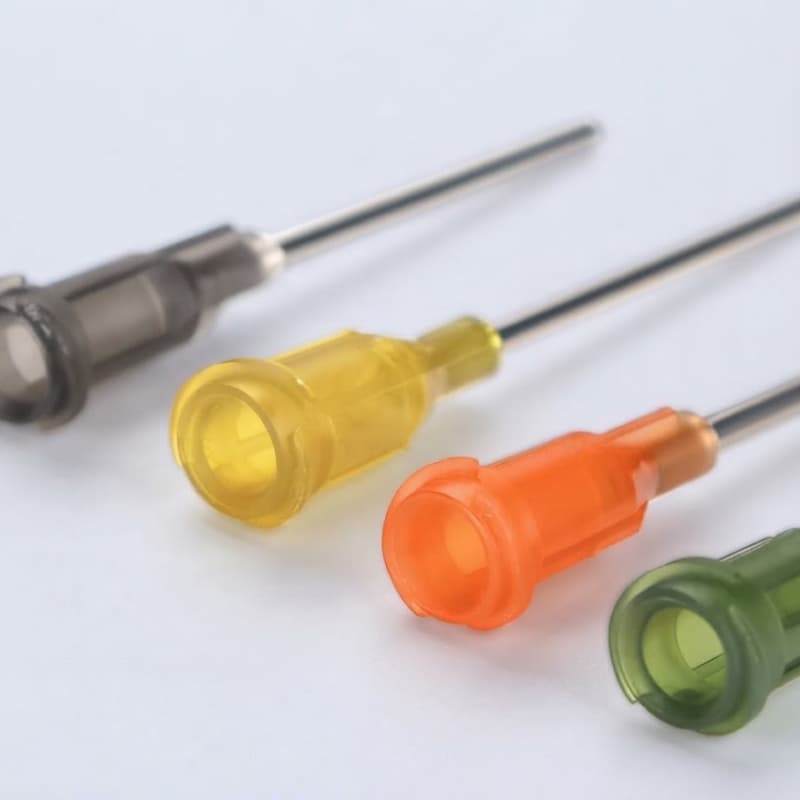
The luer interface is a conical joint with a 6% taper — that is the part that actually forms the seal. The thread around it is a retention feature, not a sealing feature. This distinction explains most luer problems: a joint that leaks is usually a damaged or mismatched taper, and tightening the collar harder will not fix it.
Two variants matter in industrial use:
- Single thread. One continuous thread. Adequate for low pressure. Cheaper.
- Double thread (double-helix). Two interleaved threads, so the collar engages in half a turn instead of a full one. Faster to change, and the load is distributed over more of the collar, so it resists blow-off better under pressure. Standard on most precision dispensing hubs for exactly this reason.
The failure mode to know: if the tip is blown off rather than leaking, the collar was not the problem — the taper was not seating, usually because the hub is worn or the two parts came from different taper standards. Replace the tip and check the barrel nose for a moulding flash line.
Bayonet: quarter-turn, blind-mate
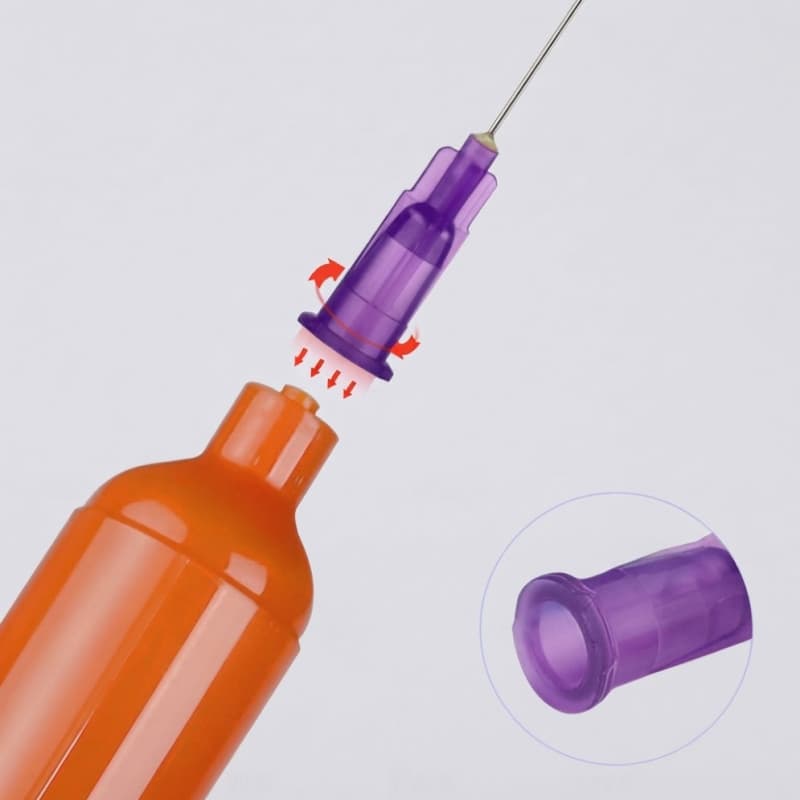
A bayonet connection uses two lugs and a cam slot: push and twist. It is the interface of choice on cartridge outlets and mixing nozzle inlets because it can be engaged without seeing the joint, which matters when the nozzle is inside a fixture.
The advantage is speed and repeatability of engagement. The risk is partial engagement — the tip goes on far enough to hold, but not far enough to seal. Under pressure the joint opens slightly, material extrudes into the gap, and you get a slow leak that looks like a mixing problem. If a bayonet joint weeps, check engagement depth before suspecting anything else.
Bayonet geometry is not standardised across manufacturers the way the luer taper is. A bayonet tip from one supplier will usually not fit another supplier’s cartridge outlet, even when both call it a bayonet. When you change cartridge suppliers, re-check every downstream part.
Push-fit and friction connections
A plain taper with no retention. Fastest to change, least secure. In industrial use, push-fit appears mainly on low-pressure manual work and on brush or applicator tips where the load is negligible.
Do not use a push-fit joint on a pressure vessel. The joint holds by friction alone, and friction is exactly what a pulse of pressure overcomes.
Threaded cartridge outlets and A/B/C/F systems
Many 1K cartridges and some 2K outlets use a coarse thread with a specific pitch and diameter. These are proprietary in practice — there is no universal thread standard for cartridge nozzles, so a thread that “looks right” is the most common source of cross-threading and seal damage.
For 2K systems the outlet is usually described by a system letter (A, B, C or F), which encodes the outlet geometry and the ratio family. Mixing nozzles and dispensing tips are matched to that letter, not to a measurement. If you are unsure which system you have, measure the outlet diameter and the ratio, then match by drawing rather than by eye — the dispensing nozzle versus mixing nozzle guide walks through the identification.
Mixing nozzle outlet: where a tip goes after the mixer
A dispensing tip can be fitted to the outlet of a static mixing nozzle, and this is one of the more useful configurations in precision 2K work, because it lets a standard mixer body serve several deposit sizes. Two cautions:
- You are adding pressure drop downstream of the mixer. A small tip on a long mixer can push total back-pressure past what the cartridge or gun will deliver, and the symptom is a ratio shift rather than an obvious blockage — see element count and back-pressure.
- You are adding a dead volume. The transition between mixer outlet and tip hub holds mixed material. With a short pot life, that pocket cures between shots and the next shot carries a lump.
Diagnosing a leak by where it appears
| Leak location | Most likely cause | Check |
|---|---|---|
| Around the hub thread | Taper not seated, or worn hub | Moulding flash on the barrel nose; hub cracks under magnification |
| Between tip and nozzle on a bayonet | Incomplete engagement | Engagement depth; compare against a known-good pair |
| At the base of the cannula | Bond failure between cannula and hub | Whether the leak follows the tip when you swap tips |
| Along the thread of a cartridge outlet | Cross-threading or a missing seal | Thread start damage; whether the original seal was reused |
| Everywhere at once, only at high pressure | Wrong interface for the pressure, not a defective part | Rated pressure of the joint versus actual line pressure |
What to send a supplier
The interface question resolves fastest with four facts: a photo of the mating part with a scale in frame, the outlet diameter, the ratio (for 2K), and the working pressure. With those, a match can be confirmed from a drawing before anything ships. Without them, both sides are guessing at a joint that has to seal.
Continue with tip geometry selection once the interface is settled, use the gauge chart for bore sizing, and check the dispense tip range for which hub formats are available against each geometry.
Frequently asked questions
Will a luer lock tip fit a luer slip syringe?
It will seat on the taper and hold by friction, but the thread will not engage, so you lose the retention the lock was designed for. It is acceptable at low pressure only. The reverse also works — a luer slip tip on a luer lock barrel — with the same caveat.
Are all bayonet dispensing tips interchangeable?
No. Bayonet geometry is not covered by a single international standard, so lug position and slot depth vary between manufacturers. A tip described as bayonet will fit the cartridge family it was designed for, and usually not another.
What is a double-thread luer lock hub for?
It engages in roughly half a turn instead of a full turn, which speeds up tip changes, and it spreads load across more of the collar, which resists blow-off under pressure. Most precision dispensing hubs use it as standard.
Why does my tip keep blowing off under pressure?
Almost always a taper that is not seating, not a weak thread. Look for moulding flash on the barrel nose, a cracked or worn hub, or a tip made to a different taper standard. Increasing torque will damage the collar without fixing the seal.
Contact Us
If you have any questions regarding dispensing nozzle selection, matching, or custom specifications, please feel free to contact us, and we will provide you with professional technical support and efficient solutions.