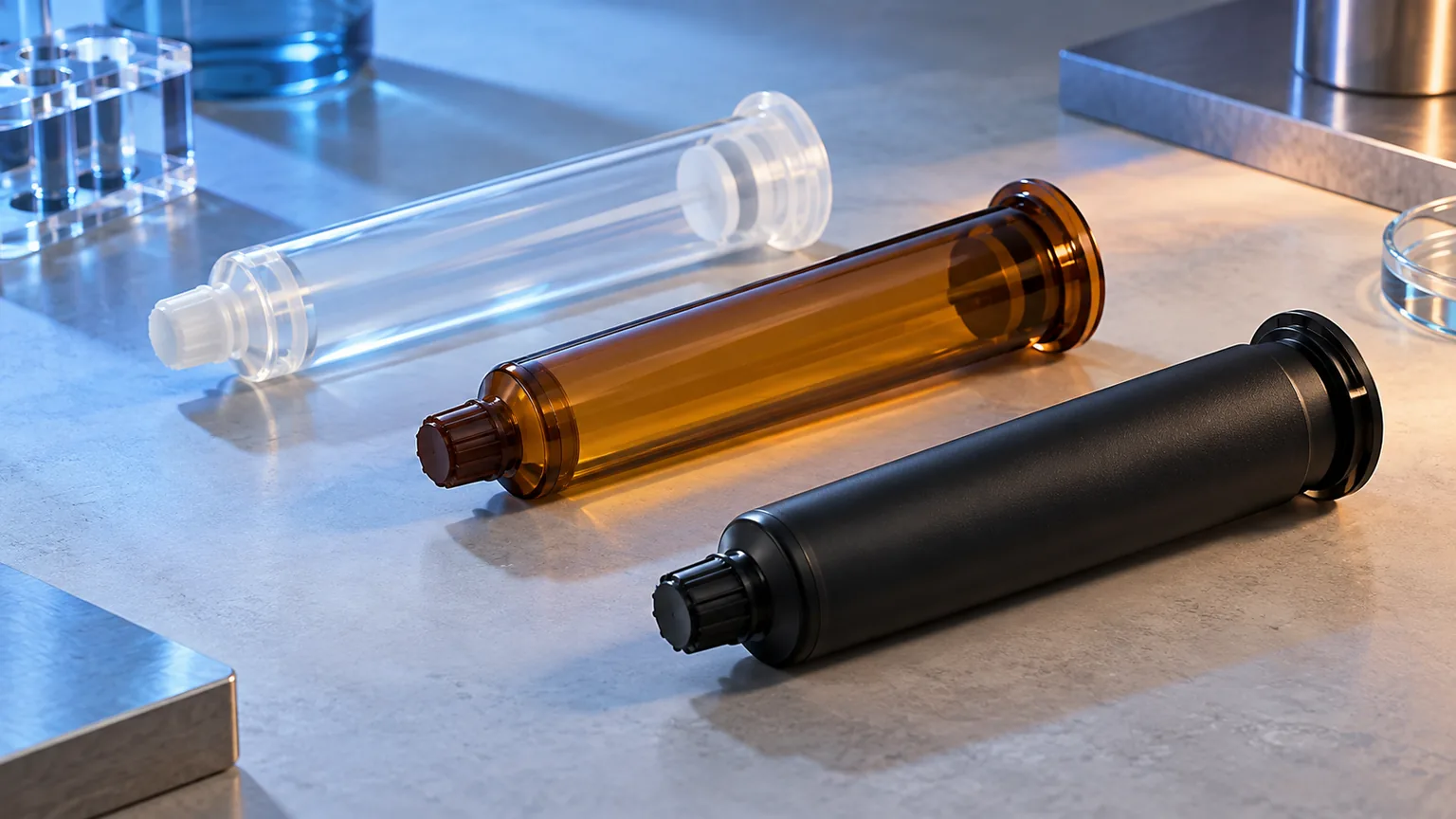
A static mixer is a motionless dispensing attachment that splits, shears, and recombines two-component (2K) adhesives as they are pushed through it, producing a homogeneous blend without any moving parts. It screws or twists onto the outlet of a dual-component cartridge, and the energy for mixing comes entirely from the pressure of the dispensing gun or meter-mix pump driving material through a fixed internal geometry. When the adhesive leaves the nozzle, the two components are already blended and ready to cure.
For buyers and engineers, the static mixer is the one true consumable in the dispensing stack, discarded once the adhesive cures inside it, yet its geometry decides whether a cartridge of structural epoxy bonds correctly or ends up as scrap. Understanding how that geometry works is the difference between specifying a reliable line and chasing cure failures.
What a Static Mixer Actually Does
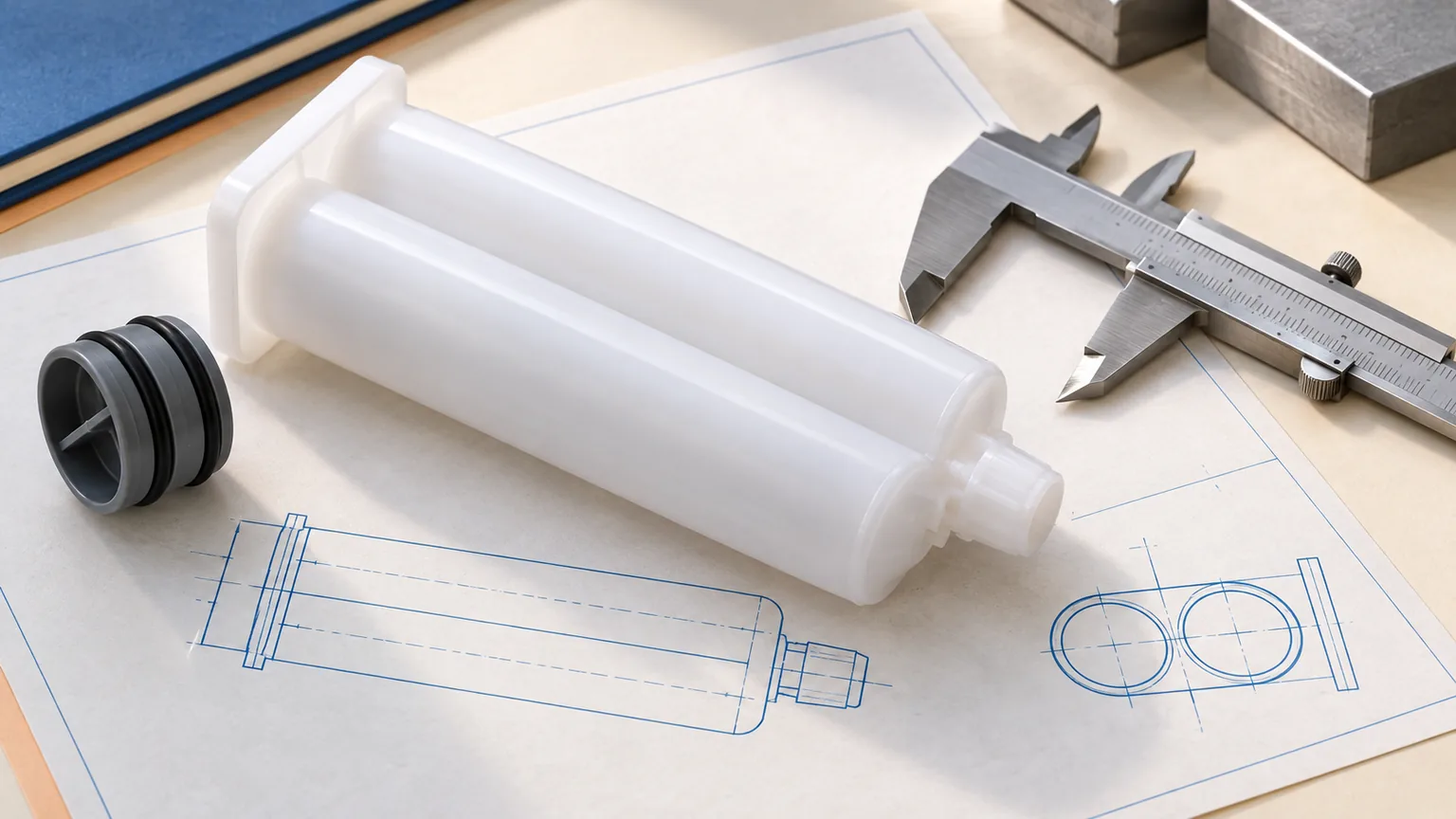
Two-part adhesives, epoxies, polyurethanes, methacrylates, silicones, ship as separate components because they would cure if premixed. The cartridge keeps Part A (resin) and Part B (hardener) in sealed chambers, and the static mixer is where they finally meet. Its job is to take two distinct streams and fold them together so thoroughly that the ratio is uniform across the entire bead, from the first drop to the last.
It does this with no motors, no impellers, and no external power. The only energy input is the pressure already present in the dispensing system. That makes static mixers exceptionally reliable and cheap, but it also means the mixing quality is entirely determined by the internal geometry. There is nothing to adjust; the element design either works for your material or it does not.
How Static Mixing Works: Splitting and Folding
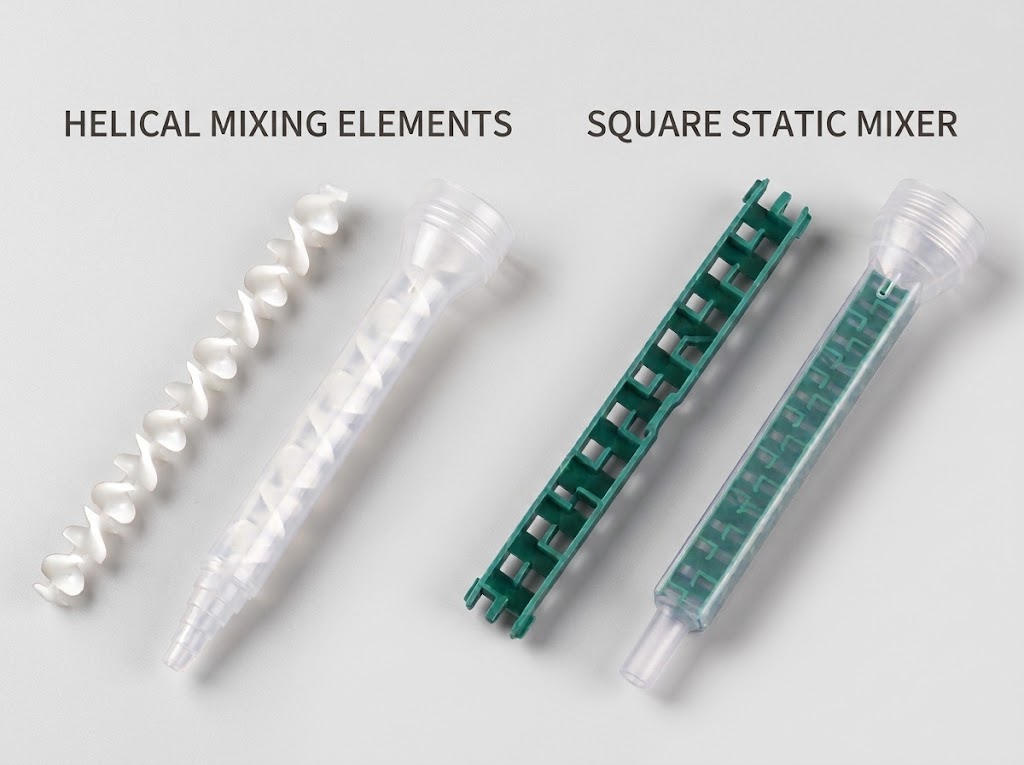
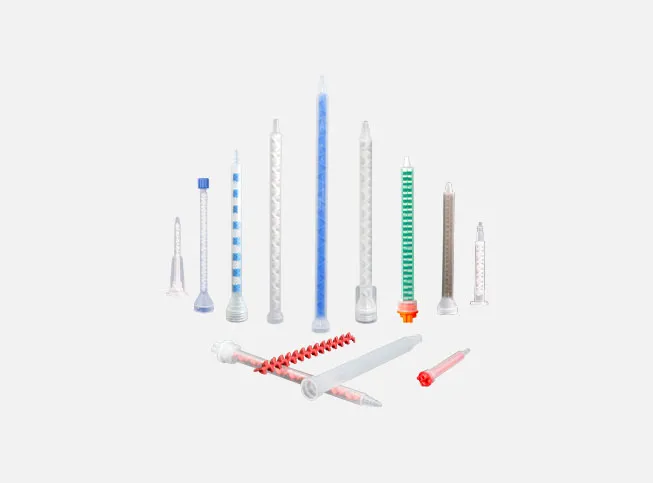
The core of a static mixer is a stack of molded elements, most commonly a helical (spiral) geometry. As the two components enter, each element divides the streams, rotates them, and recombines them. The number of distinct fluid layers doubles with every element, a geometric progression often written as 2^N, where N is the element count. After 16 elements, the original two streams have been divided into more than 65,000 alternating layers, thin enough that diffusion completes the blend.
This is why element count, not overall length alone, drives mixing quality. A high-viscosity epoxy or a wide ratio such as 4:1 needs more elements, and therefore a longer housing, than a thin 1:1 resin. Selecting too few elements leaves streaks of unmixed material; selecting too many adds unnecessary backpressure and retained volume.
Where the geometry shows up in practice
Manufacturers tune the element pitch, diameter, and count to the adhesive’s viscosity and ratio. Square (quadro) element designs fold the streams more aggressively per stage than round helical designs, reaching the same homogeneity in a shorter housing, which matters where the dispensing point is recessed or where robotic arms need a rigid, short nozzle.
The Three Parts of a Cartridge Static Mixer
Every cartridge static mixer has three functional zones, and each one maps to a specification you should check when sourcing.
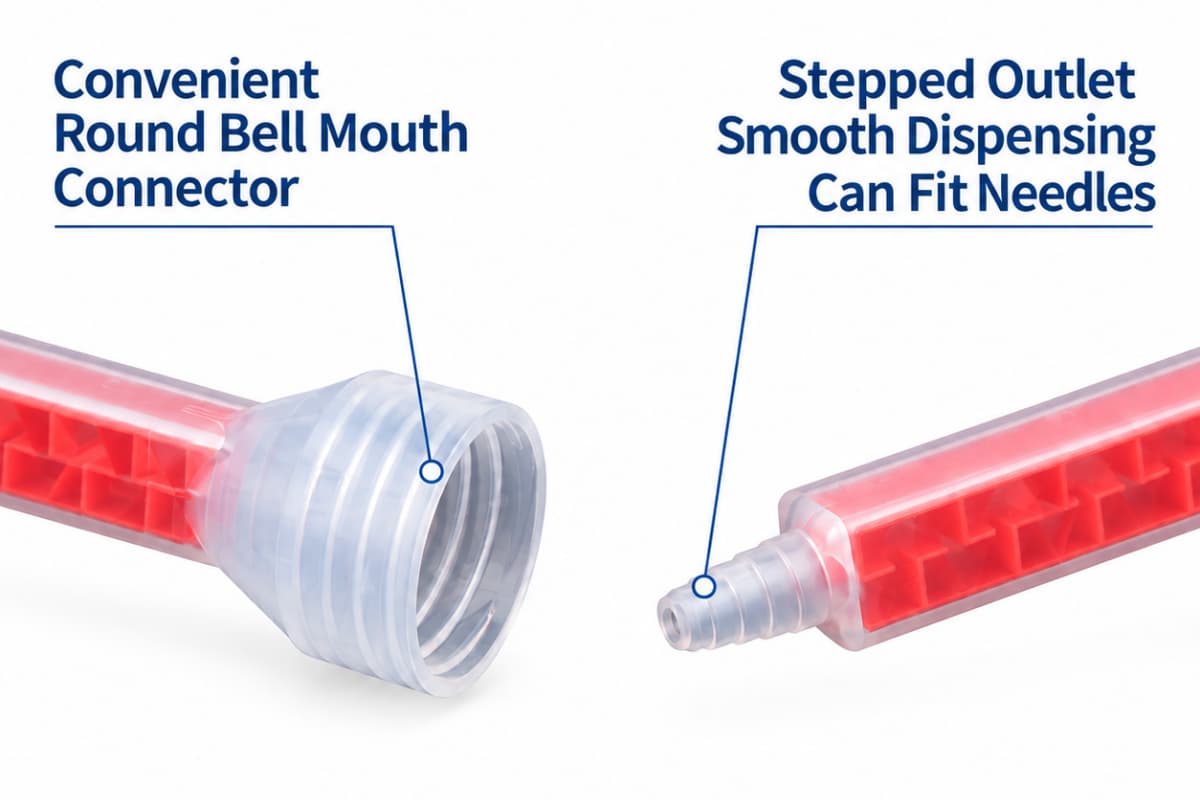
- Inlet / interface. The connection that mates to the cartridge outlet. Common standards are bayonet (twist-lock) and threaded. The interface must match your cartridge system exactly, or you get leaks and cross-contamination.
- Element core. The molded helical or square stack that performs the splitting and folding. Element count and material are chosen for your viscosity and ratio.
- Outlet. Either a stepped tip that can be cut to set bead diameter, or a Luer Lock fitting that accepts precision stainless dispense needles for fine deposits.
Interface Systems: Matching Mixer to Cartridge
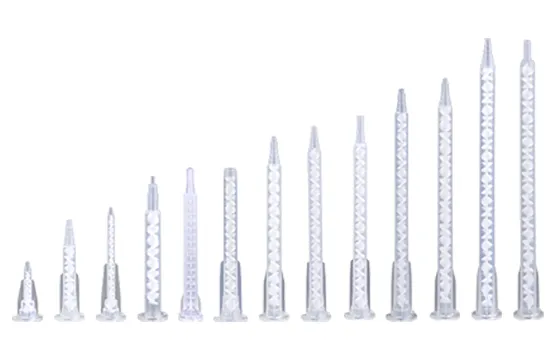
Static mixers are grouped into interface families so they drop onto standard cartridge outlets. The four common systems, and the cartridge sizes they serve, are:
| System | Interface | Typical cartridge | Common ratios |
|---|---|---|---|
| A-System | Bayonet, single inlet | 50ml | 1:1, 2:1, 4:1 |
| B-System | Dual separate outlets | 50 / 75 / 100ml | 1:1, 2:1, 4:1, 10:1 |
| C-System | Bell or threaded | 200 / 400 / 600ml | 1:1, 2:1, 4:1, 10:1 |
| F-System | Bayonet, separated ports | 200 / 400ml | 1:1, 2:1, 4:1, 10:1 |
The B- and F-systems keep the two components isolated right up to the element core with separate outlet ports, which prevents cross-contamination and premature clogging at the nozzle base. If you are running reactive chemistry that skins over quickly, that separated-port design is worth specifying. You can review the full range on our static and dynamic mixers page.
Choosing Material, Ratio, and Outlet
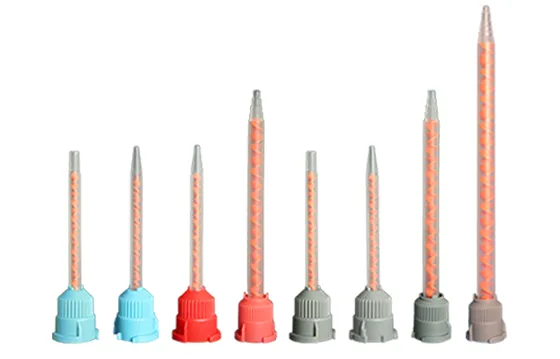
Housings and elements are molded from engineering polymers, most often polypropylene (PP), with polyamide (PA) and PBT offered for higher strength or chemical resistance. For the vast majority of epoxies and polyurethanes, standard PP is correct; PBT earns its place in demanding industrial applications.
Ratio is the next gate. Standard geometries handle 1:1 and 2:1 easily. As the ratio widens to 4:1 and 10:1, the low-volume component becomes a thin streak that is hard to fold in, so wide-ratio mixers use element designs with more aggressive shear. If your formulation sits beyond 10:1, or the two parts have vastly different viscosities, a static mixer may reach its limit.
When a Static Mixer Is Not Enough: Dynamic Mixing
A dynamic mixer adds a motor-driven rotating element, injecting mechanical shear that a static geometry cannot provide. This handles extreme ratios up to 100:1, large viscosity mismatches, and shear-sensitive foams or silicones where static mixing leaves soft spots. The trade-off is cost and complexity: a motor, controller, and rotating seal. Most production lines use static mixers by default and reserve dynamic mixing for the formulations that provably fail static trials.
If you are evaluating that boundary, our dynamic mixers range covers the motor-driven side, and the cartridge systems page shows the packaging each mixer family mates to.
Sourcing Static Mixers: What Buyers Should Specify
Because the mixer is a molded consumable, sourcing comes down to a handful of controlled specifications rather than price alone. Ask for the interface standard, element count, housing material, and outlet type in writing, and confirm dimensional consistency for automated lines.
From a manufacturing standpoint, the numbers that matter are capacity and control. A dedicated facility running 60+ injection molding machines from 10 to 600 tons, producing 85 million-plus static mixers a year on 100% virgin polymer, with 100% dimensional and functional inspection under ISO 9001:2015, is what keeps batch-to-batch mixing performance stable. Full traceability from raw polymer lot to shipped mixer is the safeguard for automotive and medical programs.
On commercial terms, plan around HaiJing’s mixer MOQ of 3,000 pieces, with samples available in 3 to 7 days for qualification. Production lead time scales with volume: under 10,000 pieces around one week, 10,000 to 50,000 around two weeks, and above 50,000 around three weeks. Validate any new mixer with a stripe test on your own line before committing to volume.
For the full container-to-deposit chain around the mixer, use our adhesive dispensing systems selection guide.
Frequently Asked Questions
Is a static mixer the same as a mixing nozzle?
Can I reuse a static mixer?
How do I know the element count is right?
Do static mixers work for 10:1 ratios?
Ready to specify a mixer for your formulation? Send your adhesive viscosity, mix ratio, and cartridge size to the HaiJing engineering team and get a recommendation plus test samples.
A mixer handles homogeneity, while a downstream tip may still handle reach or deposit shape. The dispensing tip versus mixing nozzle comparison shows when to specify one component or a qualified two-stage stack.