How to Choose a Needle Length in 3 Steps
- Measure the reach — distance from the mounting surface to the bond line, plus any wall or boss clearance.
- Buy the shortest needle that reaches — backpressure, dead volume and tip wobble all grow with length.
- Check the exceptions — deep recesses need extra length or a bent tip; shear-sensitive dots may want a slightly longer dampening length.
Dispensing Needle Length: Reach, Flow and When Longer Helps
Of all the dispensing needle sizes on a supplier datasheet, gauge gets the attention — but length decides whether the tip reaches the bond line, and what the extra millimetre costs you in backpressure and dead volume. The short answer: choose the shortest standard length that clears the part — 0.5 in for surface dots, 1 in when the machine or fixturing sits the tip back, and 1.5 in (or a bent tip) only when geometry forces it. Everything else is detail, and it fits in this guide.
What Needle Length Actually Changes
Length does three things at once, and two of them get worse as it grows:
| Factor | As length increases | Why it matters |
|---|---|---|
| Reach | ✅ Improves | Deeper recesses and set-back fixtures become accessible |
| Backpressure | ❌ Rises in proportion | Laminar flow pressure loss scales with length (ΔP ∝ L) — the same physics as our tip flow rate guide |
| Dead volume | ❌ Grows | More adhesive cure-trapped in the bore; slower colour changeover, more waste at shutdown |
| Tip stability | ❌ Degrades | A long thin cantilever deflects; the first contact point wanders on small dots |
Because gauge dominates the pressure term (bore diameter is squared in the relation), length is the second lever — but on high-viscosity material, doubling length measurably starves the shot.
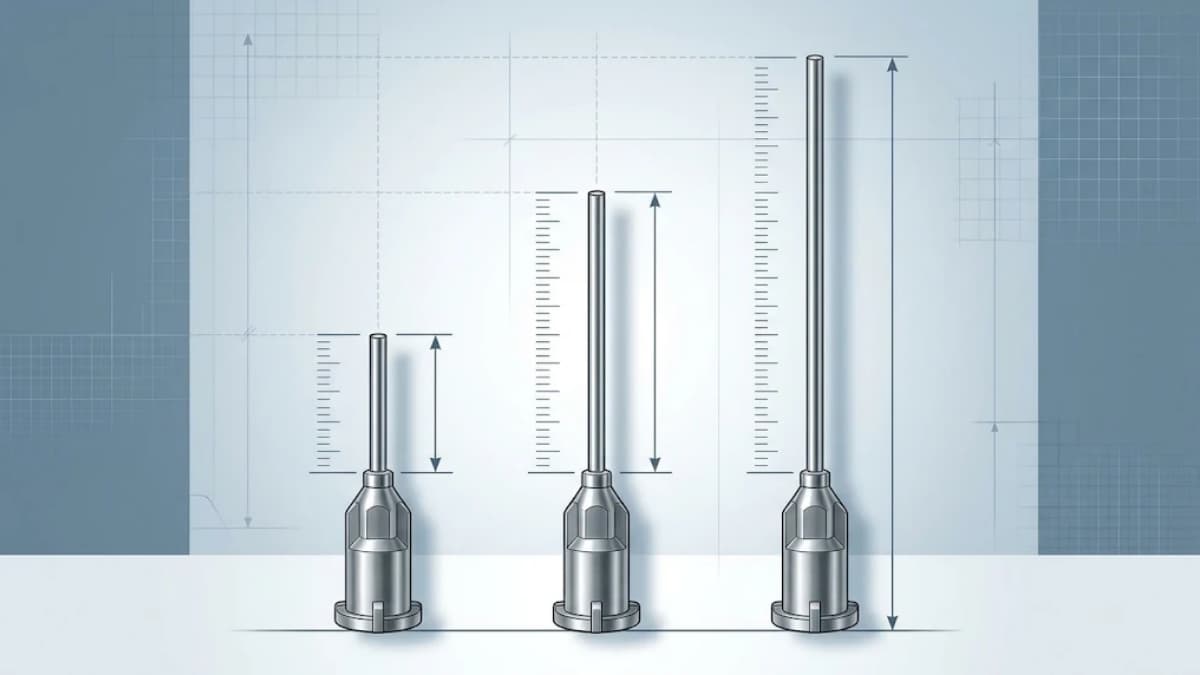
Needle Length Chart: Standard Half-Inch Steps
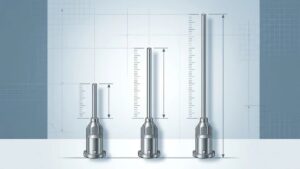
Blunt needle lengths come in half-inch steps, shipped as luer lock needle assemblies in every common gauge; these are the industry-standard lengths you will see on every needle gauge size chart:
| Length | Typical use |
|---|---|
| 0.5 in (13 mm) | Default for surface dots and beads — shortest bore, least waste |
| 1 in (25 mm) | Standard when dispensing from a z-axis set-back, or over fixture walls |
| 1.5 in (38 mm) | Deep recesses; prefer bent tip if the approach is angled |
| Custom / cut | A teflon dispensing needle and flexible-steel tips can be trimmed — metal tips cannot |
Match the length to the gauge before ordering: the combinations that exist off-the-shelf are listed on the gauge chart, and not every gauge ships in every length.
Reach and Clearance: Measure Before You Order
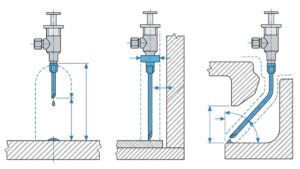
“Reach” is the distance from the needle hub seat to the bond line plus any clearance the part geometry forces. Three situations decide it:
- Flat, open surface → 0.5 in wins almost always.
- Set-back z-axis or fixture wall → add the set-back distance and round up to the next half-inch step.
- Deep or angled recess → a straight 1.5 in needle may not clear the wall at a safe approach angle; a bent dispensing needle reaches sideways without the wobble of an extra-long straight tip.
One habit worth building: measure the reach on the fixture, not on the drawing — clamps, sensors and connector bodies eat clearance that CAD never shows.
Needle Length vs Pressure Drop: The Trade-off Table
| If you… | You gain | You pay |
|---|---|---|
| Go shorter than needed | Nothing | Missed reach; tip fouls on fixture |
| Pick the shortest that reaches | Lowest ΔP, least dead glue, most stable dots | — (this is the target) |
| Go one step longer “for safety” | Comfort during setup | Higher ΔP on viscous material, more trapped adhesive, softer dot placement |
The safety-length habit is the common one, and on thin solvents it costs little. On epoxies and silicones above ~50,000 cP, it quietly doubles backpressure — if dots start undershooting after a length change, that is the first place to look (and the clogging and gauge-mistake guide covers the gauge-side causes).
How to Choose a Needle Length in 4 Questions
| Question | Answer → Decision |
|---|---|
| Reach to bond line + clearance? | ≤ 12 mm → 0.5 in; ≤ 25 mm → 1 in; more → 1.5 in or bent |
| Approach angle blocked? | Yes → bent tip, not a longer straight |
| High viscosity (>50,000 cP)? | Yes → keep length minimal; recover pressure via gauge, not length |
| Frequent colour/material change? | Yes → minimize dead volume: shortest length that reaches |
For the volume side of the same decision — how bore and length set the deposit — the dispense volume calculator walks the numbers.
FAQ
What is the standard dispensing needle length?
Half-inch steps: 0.5 in (13 mm), 1 in (25 mm) and 1.5 in (38 mm). The 0.5 in length is the default for surface dispensing; longer steps exist to clear fixturing and recesses, not to improve the dot.
Does a longer needle change the dispensing volume?
Only indirectly. Volume per shot follows bore diameter, pressure and time; a longer needle raises backpressure, which on time-pressure systems reduces flow and shrinks the shot. Volumetric valves are far less sensitive.
How do I choose needle length for a deep recess?
Add the set-back distance to the reach and round up to the next half-inch. If the approach angle is blocked, use a bent needle of the same nominal reach instead of a longer straight one — you keep stiffness and clearance together.
Which needle length has the least needle dead volume?
The shortest one that reaches. Dead volume scales with bore area × length, so a short large-gauge needle and a long fine-gauge needle can trap similar amounts — check both numbers before a frequent changeover process.
When do I need a 1-inch dispensing needle?
When the dispensing point sits roughly 12–25 mm back from the mounting face — a z-axis set-back, a fixture wall, or a shrouded boss. Below that, 0.5 in wins; above it, step to 1.5 in or switch to a bent tip.
Can I cut a dispensing needle shorter?
A teflon dispensing needle and soft flexible tips can be trimmed cleanly. Metal blunt needles cannot be cut without deforming the burr and the luer seat — order the length you need instead.
Conclusion
Needle length is a reach problem first and a hydraulics problem second: pick the shortest standard length — 0.5, 1 or 1.5 inches — that clears the part, switch to a bent tip when the approach is angled, and treat every extra inch as added backpressure, dead adhesive and dot wander. Measure on the fixture, match the gauge, and the length decision takes one line in the setup sheet.
Contact HaiJing for Technical Support
Need a length–gauge combination your fixture can live with? You are welcome to contact the HaiJing team for technical support — send us your part geometry and material data and our engineering team will confirm the needle spec — and the cartridge, mixer and valve around it — in one pass.