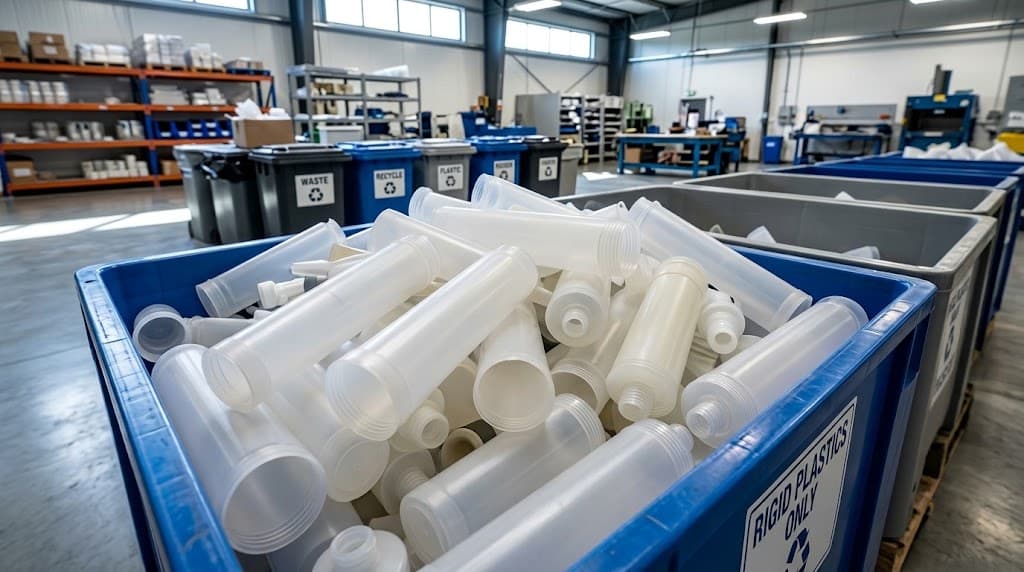
When a smart label must perform chip encapsulation, flexible-antenna bonding, and housing edge-seal on a thin flexible substrate—at a volume of tens of millions of units per day—dispensing stops being a secondary step and becomes the constraint on yield and cost. That was the real challenge Trackonomy (a Physical AI company; its IoT/smart-label business was formerly Identiv) brought to Haijing . Using micro-precision dispensing nozzles, dual-component cartridges with static mix nozzles, and a CCD-vision automatic dispensing robot with ±1% repeatability, Haijing delivered consistent, controlled micro-dispensing that eliminated overflow damage to devices. Below is the actual problem, the solution, and the results.
Key Takeaways
- Smart-label dispensing means applying tiny, precisely placed dots of adhesive/encapsulant to flexible NFC/RFID/BLE substrates—overflow or excess stress ruins the device.
- Trackonomy is a Physical AI leader (formed Sept 2026 by acquiring Identiv’s IoT business) with 500+ employees and roughly 20 million shipments processed per day.
- The core problems Haijing solved: overflow shorting antennas/contacts, flexible-substrate stress damage, two-component ratio drift, and high-volume consistency.
- The fix: micro nozzles + dual cartridges/static mixers + CCD-vision robot at ±1% repeatability = overflow-free, low-stress, traceable dispensing.
- This same precision dispensing stack also fits medical micro-assembly, automotive electronics, filter encapsulation, and consumer electronics.
What Is Smart-Label Dispensing?
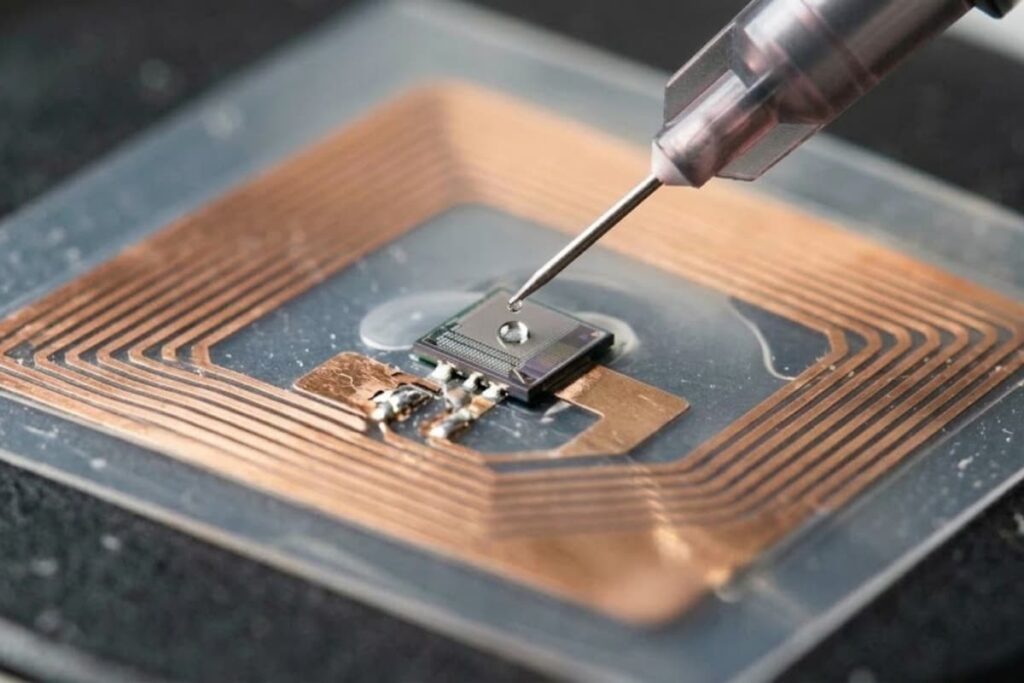
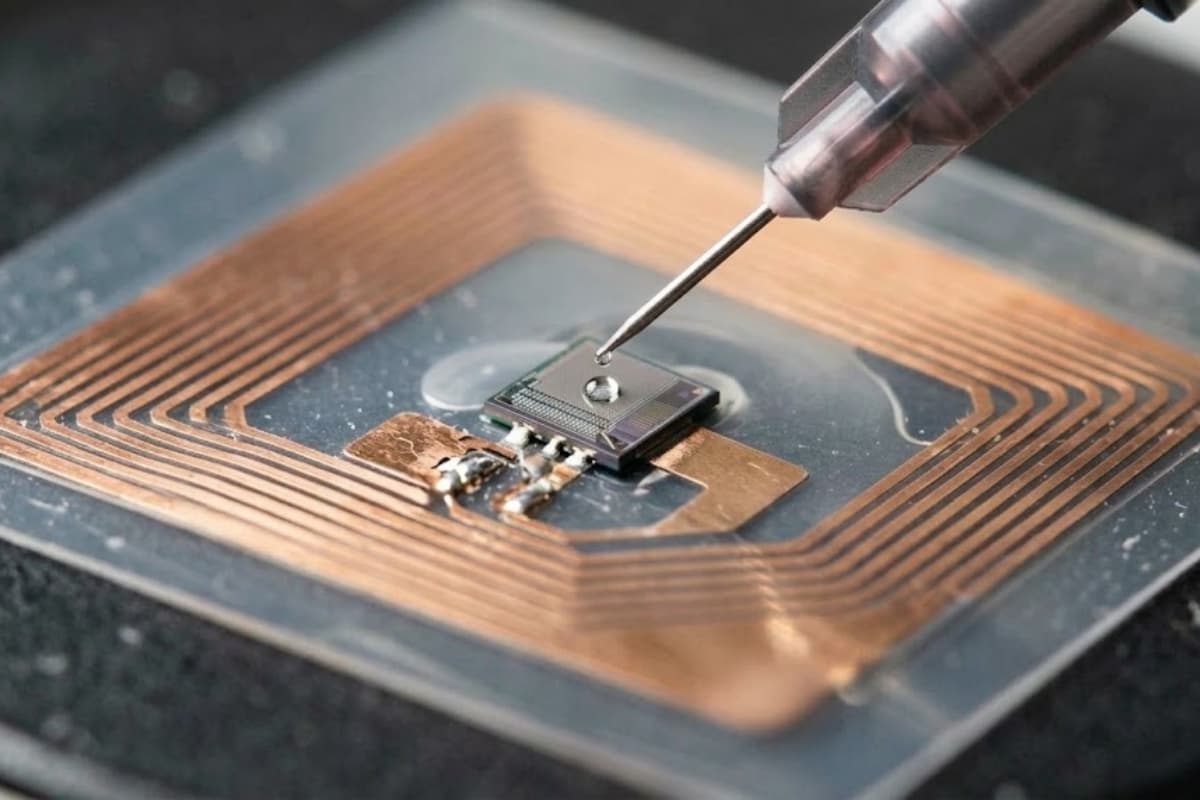
Smart-label dispensing is the process of applying very small, accurately positioned amounts of adhesive, encapsulant, or sealant to flexible substrates that carry an NFC, RFID, or BLE antenna and a chip/module. A smart label’s signal, reliability, and lifespan depend on three dispensing operations being done correctly:
- Chip encapsulation – the bare die or module is covered with resin for protection; too much resin covers contacts, too little leaves it exposed.
- Flexible-antenna bonding – the antenna is printed on PET or PI film; the adhesive layer must be thin and uniform or signal gain drops.
- Housing / edge seal – the label housing or encapsulation edge needs a continuous, break-free bead without overflow into functional areas.
Together these steps face two hard limits: flexible substrates tolerate almost no excess stress, and a single overflow of micro-adhesive can short or cover an antenna/contact and scrap the device.
Why Is Dispensing So Difficult on Flexible Smart-Label Substrates?
Two failure modes dominate, and both are amplified at volume:
- Overflow destroys function. Adhesive that bridges onto an antenna trace or contact pad causes signal failure or a short—an instant scrap.
- Excess stress deforms the substrate. Standard dispensing guns apply high thrust through coarse needles, which can wrinkle or curl PET/PI film and degrade antenna performance.
Who Is Trackonomy, and What Scale Were We Solving For?
Trackonomy Systems is a Physical AI company whose Trackonomy Group was formed in September 2026 by acquiring Identiv’s IoT smart-label business, combining InPlay semiconductors, Identiv smart-label manufacturing, and Sentient end-to-end solutions. Public figures: 500+ employees and nearly 20 million shipments processed per day. Haijing’s cooperation was with the smart-label / IoT business line (the former Identiv label operation, now part of Trackonomy Group). At that throughput, dispensing quality is a direct driver of scrap cost.
What Dispensing Problems Did Trackonomy Face?
On the customer’s actual production line, four dispensing challenges stood out:
- Flexible substrates damaged by high thrust – coarse needles and high pressure on PET/PI antennas caused deformation and signal loss.
- Overflow scrap at volume – any adhesive onto contacts/antennas meant scrap; at ~20M units/day even 1% defect equals ~200K potential losses daily.
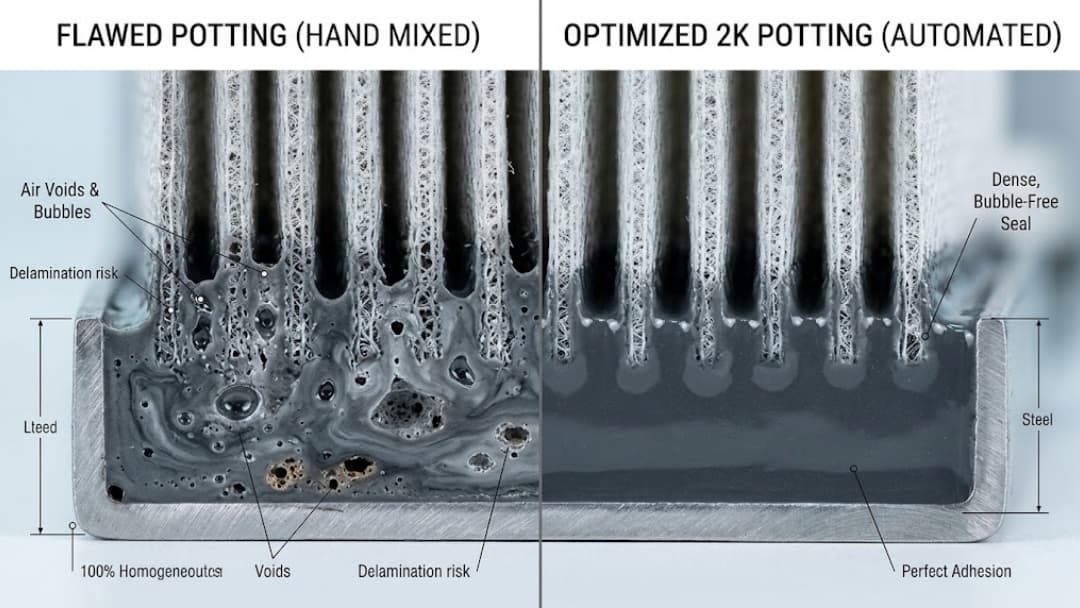
- Two-component ratio drift – structural and encapsulant adhesives are two-part (epoxy/polyurethane); off-ratio mixing means non-cure or brittle joints.
- Frequent material changeovers – semiconductor modules, flexible antennas, and housing seals use different adhesive families, demanding fast, clean changeover.
How Did Haijing Solve Them?
Haijing delivered an integrated “consumables + equipment + process” solution that maps each problem to a result:
| Customer Problem | Haijing Solution | Result |
|---|---|---|
| Flexible substrate damaged by high thrust | Micro-precision dispensing nozzle (small orifice, low dispense pressure) | Low-stress application; antennas and chips protected |
| Two-component ratio drift / non-cure | Dual-component cartridge + static mix nozzle (pre-packaged exact ratio) | On-demand mixing, uniform and ratio-stable |
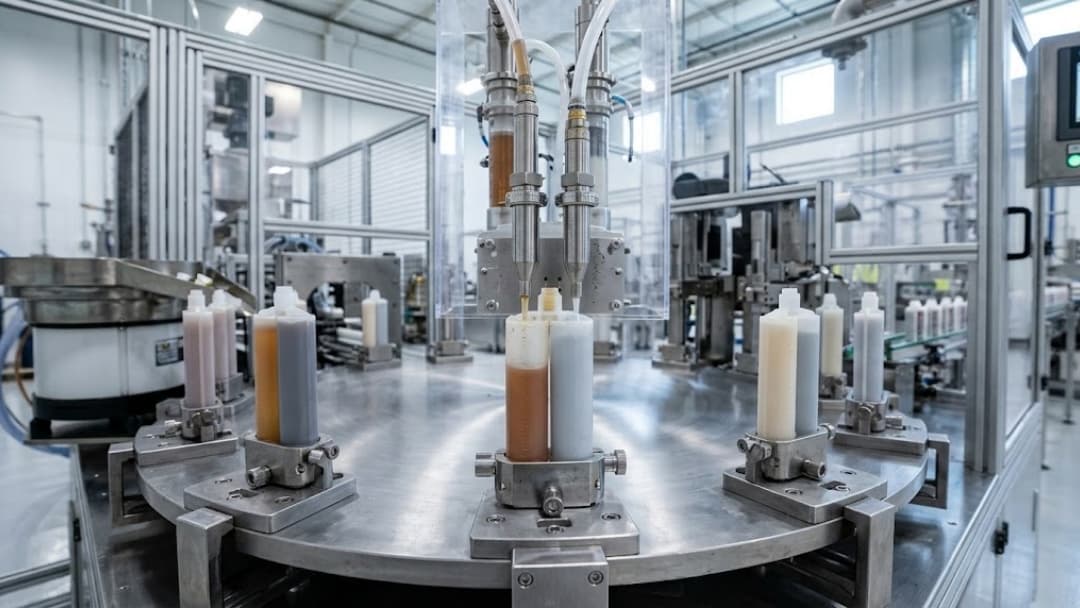
| Inconsistent dispensing and overflow at volume | CCD-vision-aligned automatic dispensing robot (±1% repeatability) | Consistent, controlled micro-dispensing; no overflow damage |
| Frequent multi-adhesive changeovers | Modular cartridges / mix nozzles / nozzles supporting 1:1, 2:1, 4:1 ratios | Fast changeover; less downtime and waste |
| Yield and traceability at scale | Automated cycle + vision-inspection loop | Higher consistency, lower scrap, process traceable |
Specifically, Haijing solved five things for the customer:
- Consistent, controlled micro-dispensing – CCD vision positioning plus ±1% repeatability makes every label’s adhesive volume and placement reproducible.
- Overflow damage eliminated – micro nozzles reduce deposit volume to the device level, removing the short/scrap risk from adhesive on antennas or contacts.
- Low-stress protection of flexible substrates – low-thrust application prevents PET/PI wrinkling and preserves signal performance.
- Accurate on-site two-component metering – cartridges + static mix nozzles turn bulk resin into ready-to-use standardized consumables with zero ratio drift.
- Higher yield at high volume – automated dispensing replaces manual variation, directly cutting defect loss at tens-of-millions-per-day scale.
Why Do ±1% Repeatability and CCD Vision Matter?
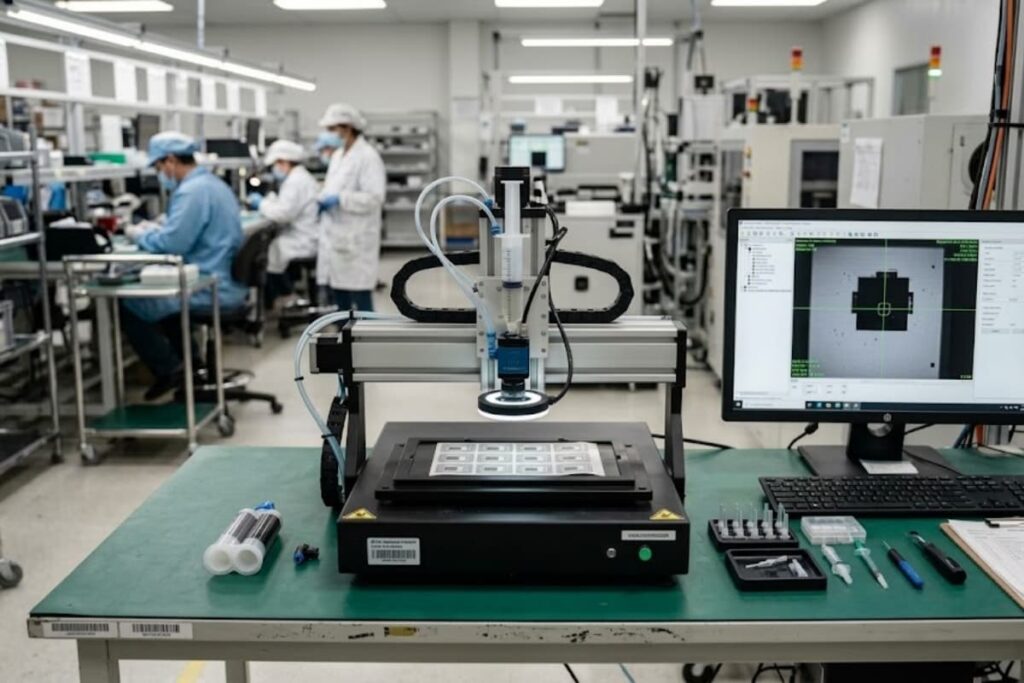
In smart-label production, “close enough” is a defect. ±1% repeatability locks the adhesive volume and placement deviation of millions of consecutive dots into a very small band. CCD vision performs alignment and defect identification before each dispense, keeping micron-level offsets—invisible to the human eye—off the line. Together they turn flexible-substrate micro-dispensing from “by feel” into “by data,” which is the technical foundation of the overflow-free result Haijing delivered for Trackonomy.
Where Else Can This Precision Dispensing Approach Be Used?
Smart labels are only the start. The same precision fluid-dispensing capability serves any domain that demands low stress, no overflow, and high consistency:
- Medical device micro-assembly – catheter/needle bonding, bone cement.
- Automotive electronics – sensor potting, ECU conformal coating.
- Filter encapsulation – cartridge end-cap potting.
- Consumer electronics – camera modules, flexible-circuit dispensing.
Whenever a part is small, thin, flexible, or expensive and needs precise coating, this stack applies directly. See our dual-component cartridge guide, static mix nozzle engineering guide, and desktop dispensing robot spec guide.
Frequently Asked Questions
What is the most common problem in smart-label dispensing?
The two most common failures are overflow adhesive covering the antenna or contact (causing signal loss or a short) and flexible-substrate deformation from excessive dispensing pressure. Both scrap the device and, at high volume, multiply losses.
Why use a cartridge plus static mix nozzle for two-component adhesives?
Two-part epoxy or polyurethane must be mixed at an exact ratio before use. The cartridge pre-packages the A:B ratio, and the static mix nozzle delivers bubble-free, uniform mixing during extrusion—ensuring zero ratio drift and avoiding on-site weighing contamination.
What does ±1% repeatability mean for label production?
It means the adhesive volume and placement deviation of millions of consecutive dispenses stays within a very small range, making yield and consistency predictable and traceable—directly reducing defect loss at tens-of-millions-per-day scale.
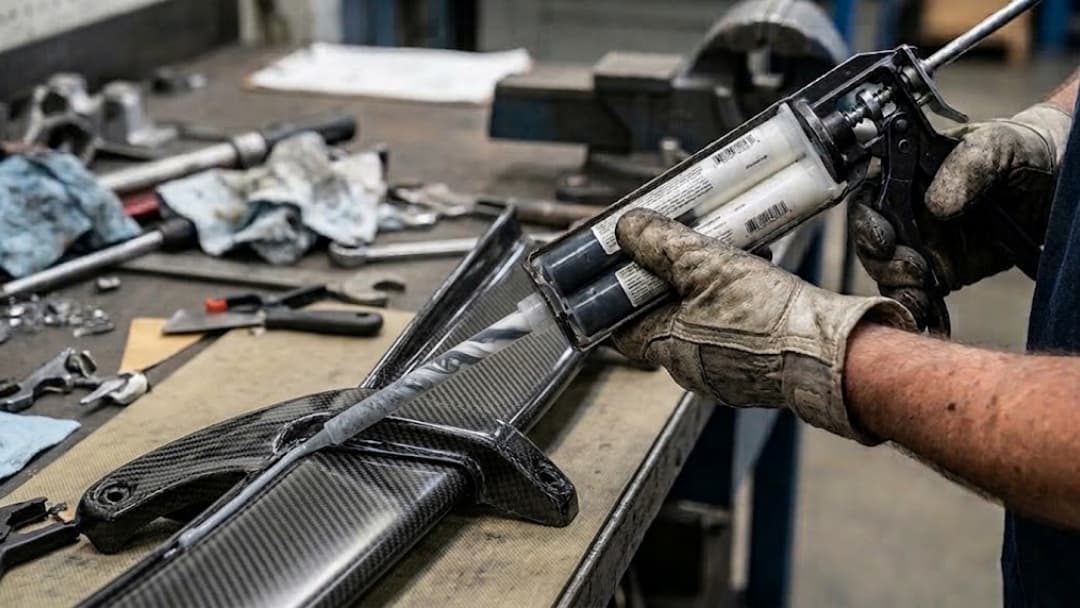
Can you dispense on flexible substrates with a standard dispensing gun?
Not recommended. Standard guns apply high thrust through coarse needles that can damage PET/PI film or cause overflow. Use a micro-precision nozzle with low thrust and vision-aligned automatic dispensing equipment instead.