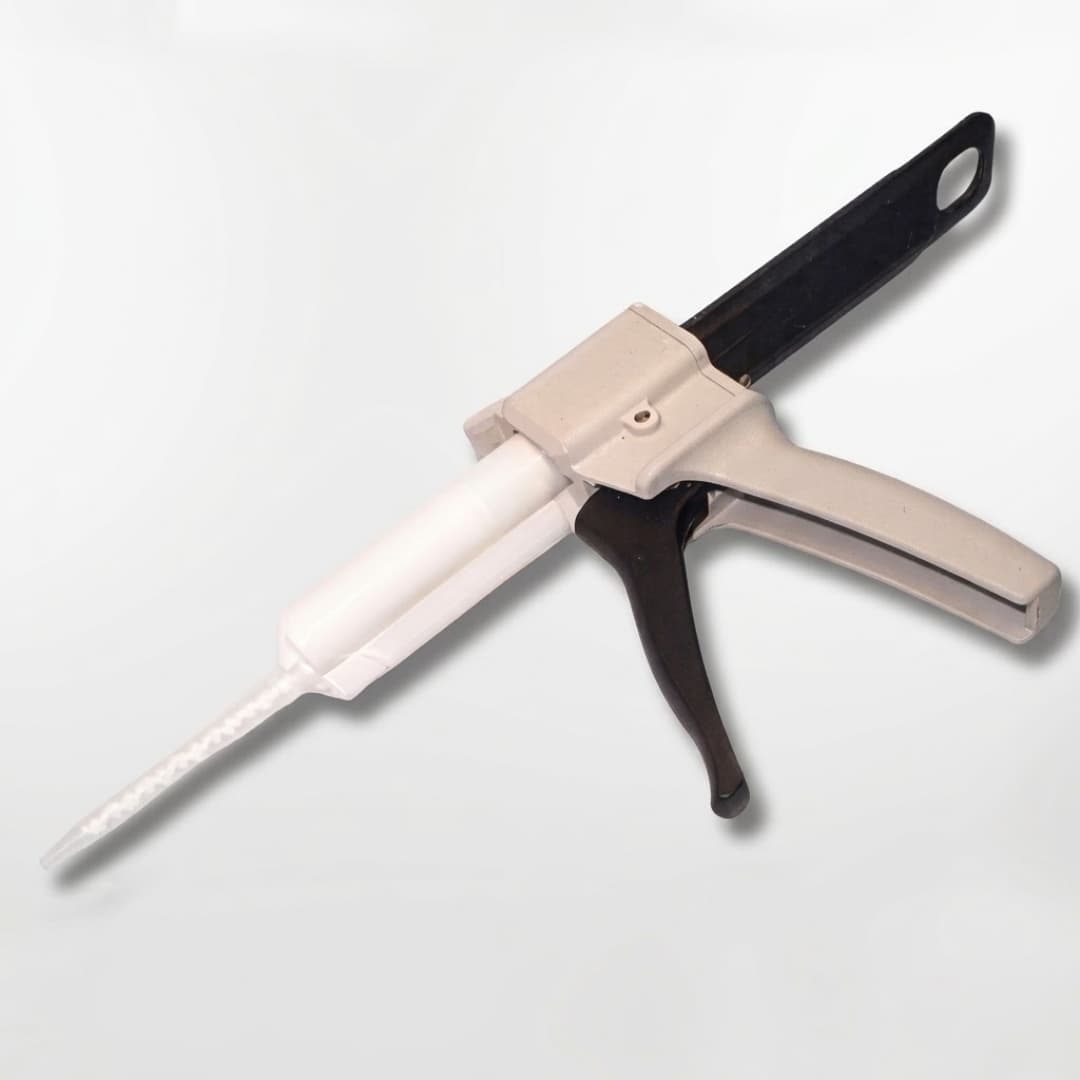
A UV-blocking adhesive cartridge should be approved against the formulation’s light sensitivity, the light reaching the package, and the behavior of the filled assembly. Its color is only a starting clue. To select one, screen the transmission of representative molded parts across the relevant wavelengths, then expose filled packages under defined conditions and compare them with dark controls. The release decision needs both light-protection evidence and acceptable formulation performance; neither a black barrel nor a low transmission reading alone proves shelf life.
Why clear, amber and black are not interchangeable specifications
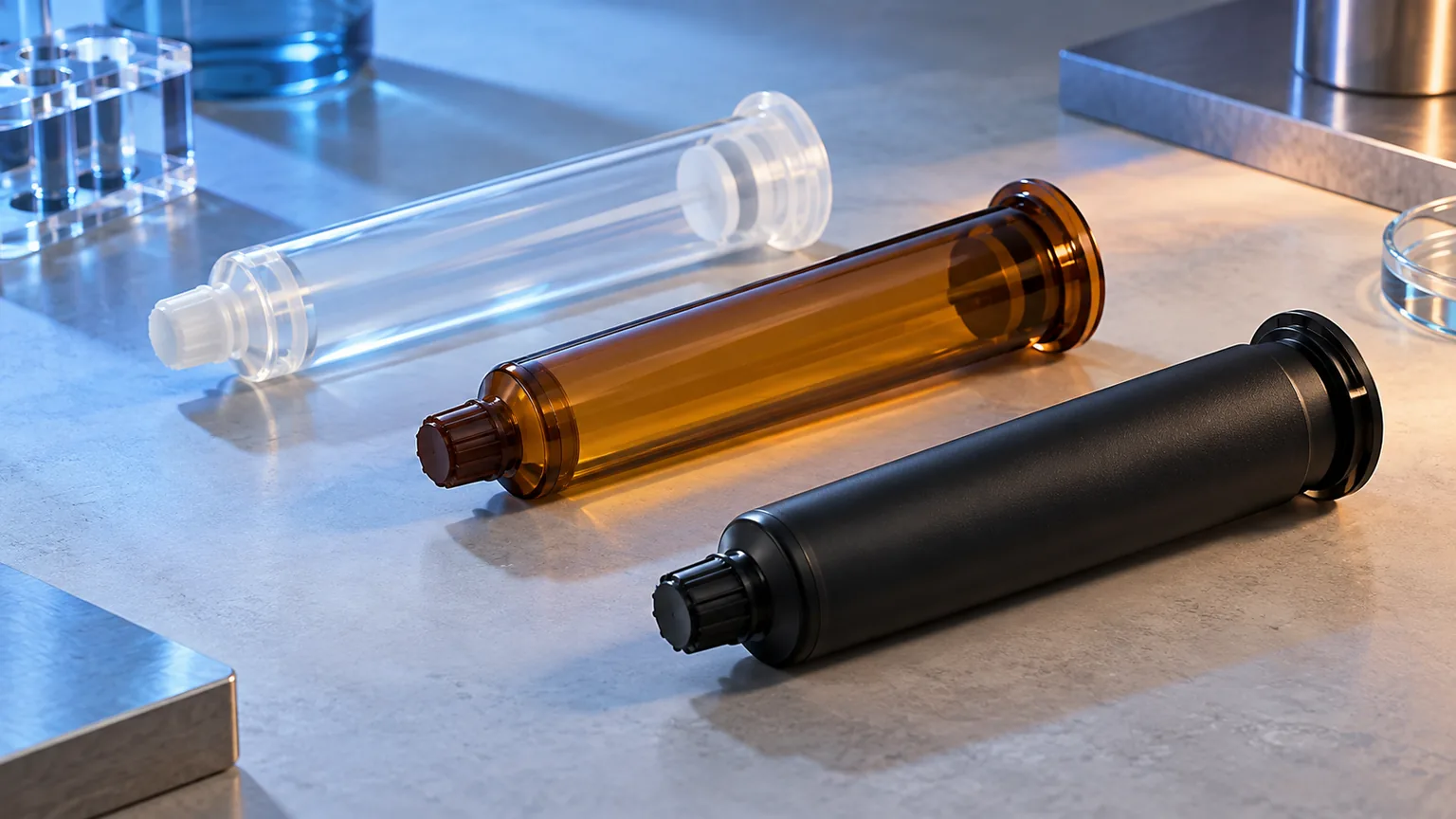
Color describes what the eye sees. A protection specification describes which wavelengths are attenuated, by how much, through a particular part. An amber-looking wall may preserve some visibility of the contents while reducing selected wavelengths. An opaque-looking wall may be a better candidate when broad shielding is required. But neither description identifies the pigment system, wall thickness or measured transmission of your production cartridge. The same brand color can be achieved with different materials and construction.
Nordson EFD’s syringe-barrel range separates clear, amber light-blocking and opaque-black versions into different application roles. That is a useful example of why package variants exist. It is a description of Nordson’s specified syringe products, not a test certificate for a Haijing cartridge or for every amber plastic.1 When comparing suppliers, request the actual optical evidence for the proposed part instead of translating its appearance into another manufacturer’s performance claim.
“UV-blocking” can also be too narrow a description of the requirement. Henkel’s official LOCTITE AA 3526 technical data sheet, for example, describes a light-sensitive adhesive that cures with UV/visible light and calls for minimizing exposure during storage and handling.2 This does not establish the response of your formulation. It shows why its owner must identify the relevant wavelengths: a package assessed only in a UV band may leave a visible-light sensitivity unresolved.

Define the exposure the package actually has to withstand
Before asking for a darker cartridge, describe what happens between filling and the final dispense. A sealed carton in a warehouse, an unpacked cartridge beside a window, and a cartridge mounted near a curing station are different exposures. A useful map identifies the light source, distance and orientation, duration, package temperature, and whether the outer box, label or sleeve remains in place. Separate routine exposure from an exceptional event that requires its own disposition.
- Formulation response. Obtain the adhesive maker’s light-handling instructions, sensitive wavelength range where available, approved packaging, temperature limits and stability endpoints. If an action spectrum or exposure limit is unavailable, use a defined empirical package challenge; do not invent a threshold.
- Incoming light. Identify daylight, room lighting and nearby curing equipment as actual sources. Record the relevant source spectrum or band-specific measurement where available, along with time and geometry. A lamp’s product name or nominal electrical power is not the irradiance at the package.
- Package state. Record filled versus empty, closed versus mounted, outer packing removed or retained, and the caps, pistons and feed path in use. Protection provided by a carton is useful only while that carton is present.
A lux reading alone cannot define UV exposure or the formulation’s response to visible wavelengths. Lux is a photometric quantity weighted for human vision, whereas radiometric measurements describe optical energy and can be spectrally resolved; NIST explains that distinction.3 If a meter reports a broad-band value, document its spectral response and measurement band. Two sources that look equally bright can present different conditions for a light-sensitive material.
Screen the molded wall with a useful transmission measurement
Ask for a spectral transmission curve over the range relevant to the formulation, together with the specimen identity and measurement method. A statement such as “blocks UV” without a wavelength range leaves an important gap. A single average value can also hide a narrow transmission region where the material is sensitive. The acceptance criterion may therefore need a limit across a defined band, at selected wavelengths, or under a specific exposure trial. The formulation owner and packaging team should agree which form answers the application.
For a stated optical geometry, transmission compares the light collected after the specimen with the reference measurement. A percentage report expresses that ratio multiplied by 100. What the detector collects matters: a curved or scattering plastic can redirect light rather than absorb it. Shimadzu’s integrating-sphere guidance explains why collection geometry is relevant for scattering or refracting samples.4 Have the laboratory specify whether it reports direct, diffuse or total transmission and why that measurement is suitable for the molded specimen.
- Identify representative parts. Record polymer grade, colorant or additive specification, molding revision, lot and relevant cavity identifiers. Measure wall thickness at the tested location. A thick demonstration plaque is not automatically representative of a thin production wall.
- Choose specimen preparation. Agree whether the method uses a wall section, a suitably prepared coupon, or an intact component fixture. Cutting, flattening or changing the optical path must be documented so the result is not mistaken for the untouched package.
- Measure the relevant locations. Include thin regions and features that could provide a shorter path. Check distinct cap, plug or piston materials where they can admit light to the contents. Use the drawing and actual assembly to identify those locations.
- Report method and measurement limits. Include wavelength range, sample orientation, thickness, collection mode, baseline and the instrument’s applicable detection limit. “Below detection” is a bounded observation, not proof of mathematical zero transmission.
The optical screen is valuable for rejecting a poorly matched candidate and comparing controlled revisions. It cannot establish chemical compatibility or the shelf life of a filled formulation. Those require separate evidence. If a supplier has only color samples and no optical data, the next step is a representative-part measurement or a controlled package exposure trial—not an unqualified light-blocking claim.
Look for light paths beyond the barrel
A complete package includes closures and interfaces. A protective barrel can still leave a path through a translucent plug, an exposed outlet, a window in a sleeve, or downstream tubing while the cartridge is mounted. Some components may sit behind the opaque wall and contribute little to exposure in one configuration, yet become relevant when the assembly or orientation changes. Inspect the actual closed and in-use states rather than assuming every component has the same optical role.
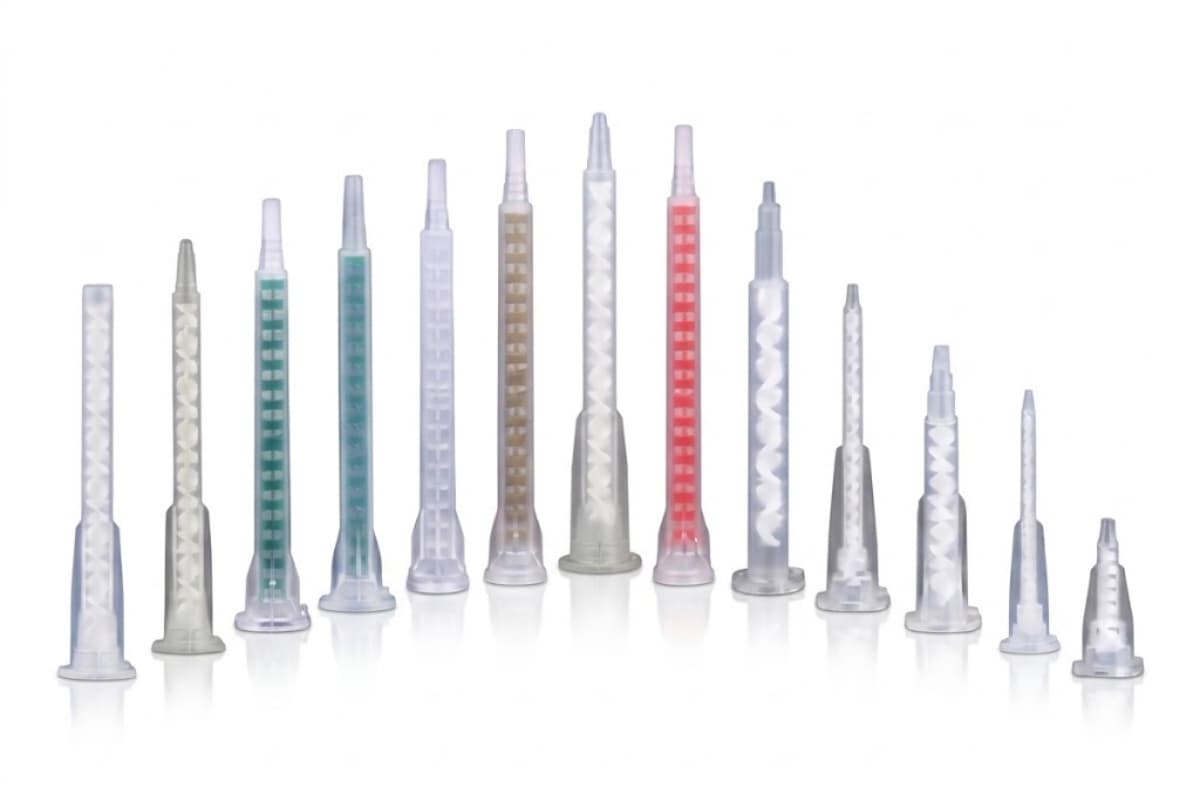
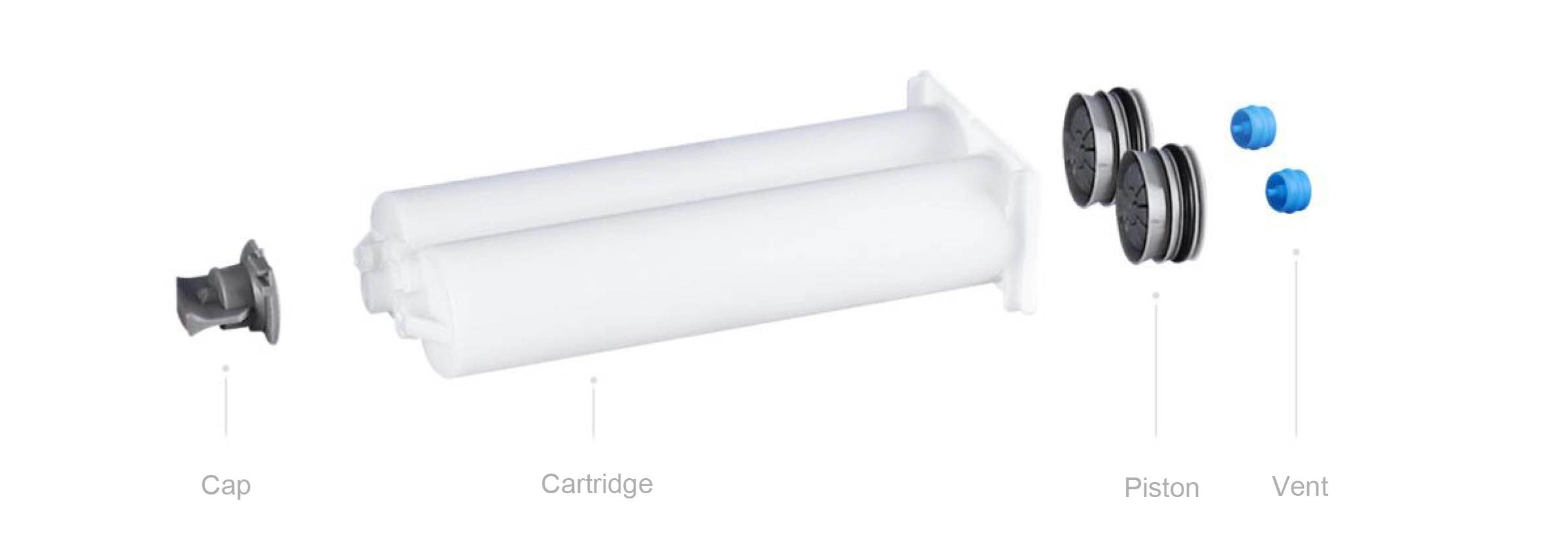
The second photograph shows a cartridge assembly with separate parts. It is useful for defining a bill of materials, not for inferring light protection. On a one-component package, make the same inventory for its barrel, piston, outlet closure and mounted feed path. For a dual package, assess each light-sensitive component’s exposure separately. The capacity and mix-ratio choice remains a different task; our empty-cartridge guide covers broader packaging selection and handling.
Labels and sleeves can contribute protection, but their position, overlap, coverage and durability become part of the approved configuration. If an operator removes the sleeve to see the fluid level, the test should cover that operating state or the work instruction should preserve the approved cover. A transparent inspection strip is a design trade-off to evaluate, not a free addition to an opaque-package specification.
Challenge filled packages and keep a dark control
Once the optical screen identifies a plausible candidate, use the actual formulation in the complete package. Define acceptance before testing: what change in viscosity, dispensing behavior, gel formation, cure response or final performance would make the material unacceptable? Select endpoints that detect the known failure mechanisms of that formulation. Visual color alone may miss a performance change; a single successful dispense may miss partial gel formation or an altered cure response.
Use the same formulation batch, fill procedure, closure method and package revision across the comparison. Control temperature during exposure and record it, because lamp heating can confound a light-protection conclusion. Dark controls should experience comparable elapsed time and temperature without the intended light challenge. If the apparatus cannot separate heating from light, label the result as a combined exposure and arrange the additional control needed to interpret it.
Proposed package light-protection trial matrix
This is a planning template, not Haijing test data. Swipe on a narrow screen to see all columns.
| Trial group | Keep comparable | Purpose | Record or decision |
|---|---|---|---|
| Initial reference | Same formulation batch before the exposure period. | Establish starting properties and the method’s repeatability. | Baseline viscosity/appearance, dispense and cure endpoints using the agreed method. |
| Candidate in the dark | Candidate package, filling, time and controlled temperature. | Identify changes associated with time, package contact or the fill/closure process. | Compare with the initial reference; investigate changes before attributing them to light. |
| Candidate under the light challenge | Same candidate configuration and formulation batch; recorded source and exposure. | Evaluate protection for the specified light condition. | Compare with its dark control against pre-agreed formulation and use criteria. |
| Currently approved package under the same challenge | Same formulation and exposure conditions, where a suitable reference exists. | Benchmark the candidate against an established package. | Do not assume the reference passes a new or more severe condition; record both results. |
| Approved sensitivity check, if needed | A formulation-owner-approved specimen and controlled light exposure. | Confirm the challenge can detect the relevant light-induced change. | Use appropriate fixtures and safe procedures; do not expose reactive material casually. |
Choose sample quantities and measurement intervals from the variability, decision risk and method, not from a universal blog rule. Include more than one representative production sample when the release depends on lot or cavity consistency. Describe where samples were taken and how they were assigned. A result from one unusually thick wall or one hand-selected package should not silently release every manufacturing condition.
For a mounted-use claim, include realistic time outside the outer packaging, normal stops and the intended feed components. Use the adhesive and equipment suppliers’ exposure and handling procedures, including shielding for any UV source. The goal is to reproduce a defined material challenge in a controlled setup, not to find how much unprotected light an operator can apply before the cartridge blocks.
Read the results before choosing the corrective action
If the exposed candidate changes while its matched dark control remains acceptable, the test points toward inadequate protection under that exposure. Review the wall spectrum, closure paths, cover state and specimen variation. If both exposed and dark candidate groups change, the optical result alone cannot explain the failure. Investigate package contact, temperature, elapsed time, filling and closure conditions using the appropriate material methods. If the approved reference also fails, check whether the challenge exceeded the intended handling envelope before declaring the candidate uniquely defective.
These are interpretation branches, not root-cause proof. An opaque material could still be chemically unsuitable for the formulation. Conversely, an amber candidate could be adequate for a defined light source and handling duration even though it transmits some light elsewhere in the spectrum. The useful decision is whether the specified package protects the specified material within the approved conditions—not which color wins in a photograph.
A practical handoff keeps two results separate: optical screening of the named components, and filled-package performance under the named challenge. If either is incomplete, record the open decision. When a failure appears only after mounting, check the in-use light path before changing the whole cartridge polymer. That distinction can prevent an expensive redesign aimed at the wrong component.
Do not convert a lamp challenge directly into a shelf-life claim
A package exposure test supports the conditions it actually covers. Increasing lamp intensity or reducing the distance may also change spectrum, heating and the way the formulation reacts. Without a validated relationship, a shorter, stronger exposure cannot be translated into a longer warehouse life. Real-time stability evidence and a justified accelerated method have their own requirements, including formulation batch, package configuration, temperature and the selected endpoints.
Keep the adhesive manufacturer’s storage and handling requirements in force while the new package is evaluated. Passing a light challenge does not release a change in temperature, chemical contact, moisture barrier or seal design. For the overall sequence from design through samples and production, see Haijing’s OEM/ODM development guide. This article addresses the light-protection decision within that sequence.
Freeze the specification that the production lot must reproduce
Haijing’s cartridge-system page lists custom colors, materials and specialized UV-blocking options. Its customization process provides a route from a packaging requirement to samples and first-article review. Those capabilities support discussing a candidate package; they do not supply a published transmission curve or a ready-made shelf-life claim for your formulation. Agree how any optical work and filled-material testing will be obtained and reviewed.
The release record should retain the following:
- Configuration: part and drawing revisions, barrel and closure components, any sleeve/label, polymer and approved colorant/additive specification.
- Optical evidence: specimen locations, thicknesses, wavelength range, collection method, detection limits and acceptance criteria.
- Application evidence: formulation/batch, filling and closure method, source spectrum or measurement band, exposure time, temperature, controls, endpoints and actual results.
- Release boundary: approved package states and handling conditions, responsible reviewers, outstanding restrictions, and the changes that trigger reassessment.
Changes to resin, colorant, wall geometry, closure, molding process or protective cover deserve an impact review because they can change the evidence behind the approval. Cosmetic color matching does not automatically preserve spectral transmission. Identify affected tests and compare representative revised parts; avoid both an automatic blanket release and an unrelated full test program for every minor change.
Discuss a light-protective cartridge sample
Share your formulation’s light-handling requirements, cartridge format, current package and the exposure you need to cover. Haijing can discuss UV-blocking material and color options; agree the optical evidence and filled-package validation needed before approval.
Questions to settle before ordering
Can I use a transparent window to check the material level?
Possibly, but include its material, dimensions, location and exposure in the package trial. Evaluate whether the material behind it remains acceptable in the actual mounted and handling states. A visibility feature changes the protection configuration.
Does a UV absorber make any cartridge suitable for a light-curing adhesive?
No. Its attenuation must match the relevant wavelength range at the delivered wall thickness, and the complete package must preserve the formulation’s required performance. A UV-focused additive may leave a visible-light response unresolved.
What if the supplier cannot provide a transmission curve?
Obtain representative parts and arrange a suitable optical measurement or a defined complete-package exposure study with controls. Specify what that study can establish. Keep the package’s protection status open until the agreed evidence supports approval.
Technical sources
- Nordson EFD, Optimum syringe barrels — manufacturer-specific clear, amber and opaque-black package roles.
- Henkel, LOCTITE AA 3526 technical data sheet (January 2015) — an example of UV/visible sensitivity and light-handling requirements; its product limits are not transferred to another formulation.
- NIST, Radiometry and photometry — radiometric quantities and human-vision-weighted photometry.
- Shimadzu, Integrating spheres and transmittance measurement — measurement geometry for solid and scattering specimens.