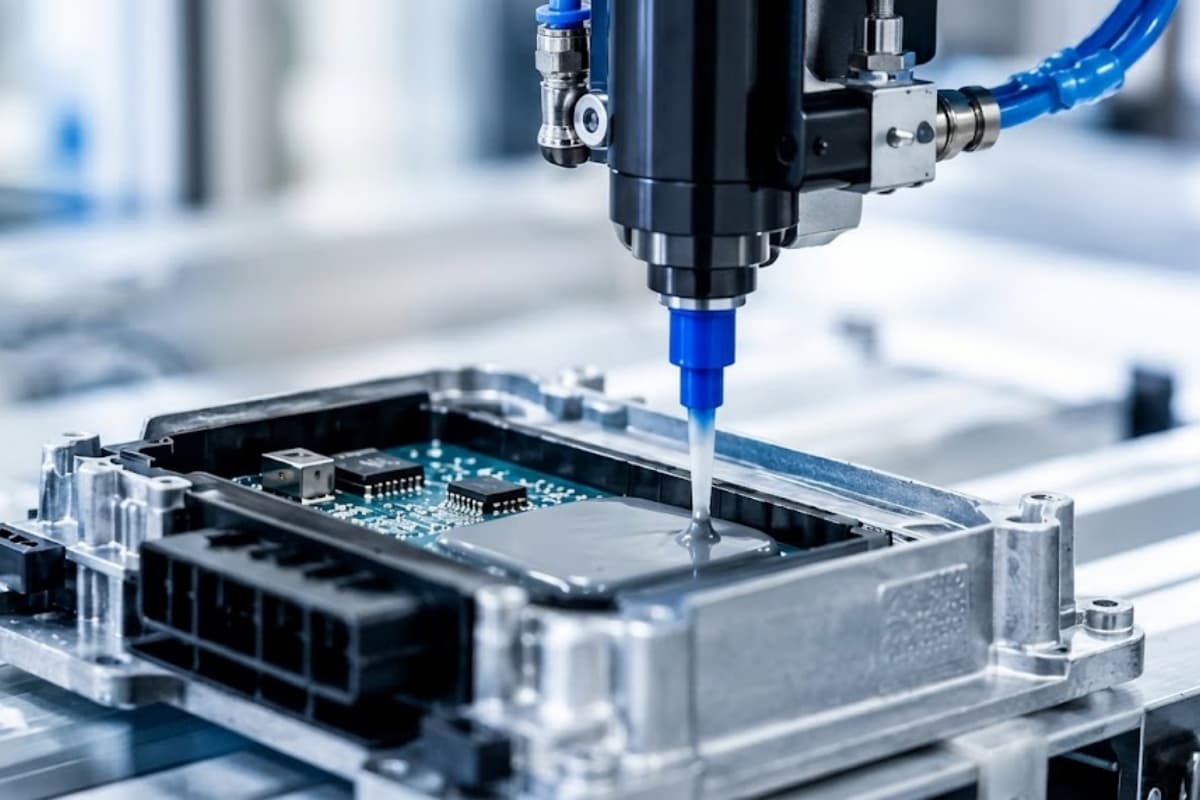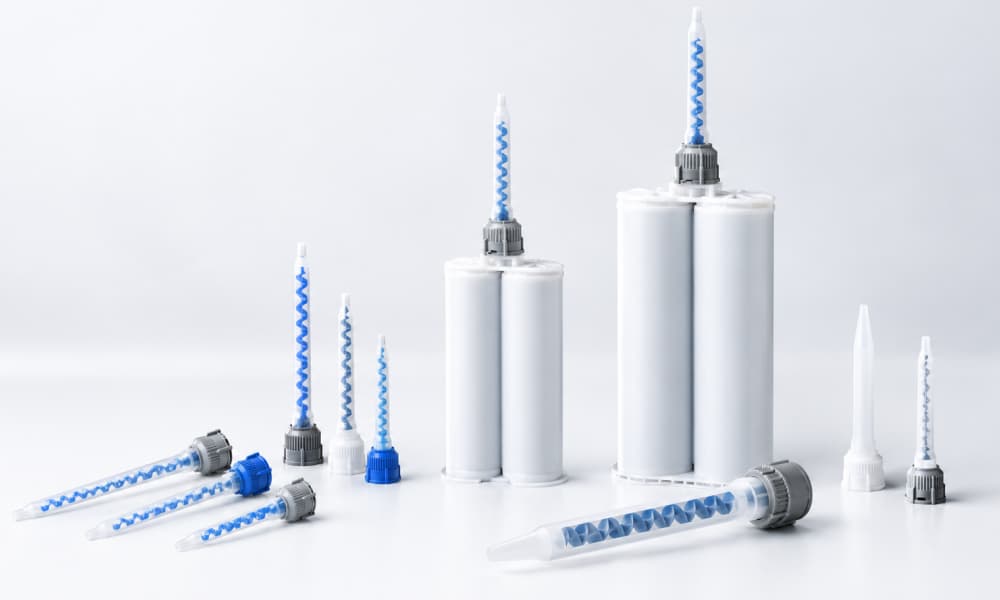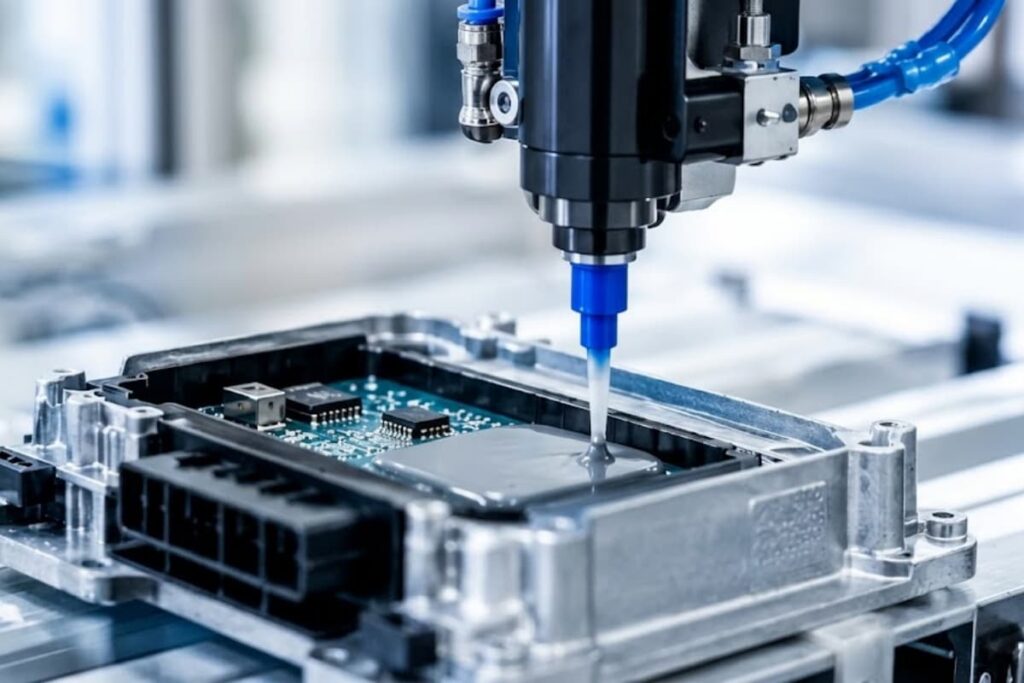
Automotive electronics adhesive dispensing is the set of processes that deposits, mixes, and cures the resins that protect engine-control units, sensors, and battery packs. The short answer for engineers specifying a line is this: the three scenarios—ECU potting, sensor sealing, and battery thermal-interface-material (TIM) dispensing—share the same need for a matched two-component system, but they differ sharply in material viscosity, bead precision, and throughput. Choose the cartridge, static mixer, gun, or robot combination around the adhesive and the failure mode you are protecting against, not around a single product category.
The main decision factors are material chemistry and viscosity, the A/B mix ratio, the required deposit accuracy, the production volume, and the quality checks that prove a void-free, fully cured result. This guide walks through each automotive scenario, shows where dispensing equipment decisions change, and ends with a practical checklist for requesting a quote. Our automotive electronics dispensing solutions page maps these applications to the relevant hardware.
Why Dispensing Quality Is a Make-or-Break Factor in Automotive Electronics
An automotive electronic module lives through temperature swings, constant vibration, humidity, and thermal cycling for a decade or more. A void in a potted ECU, a bubble in a sensor seal, or an incomplete cure in a battery TIM deposit does not fail on the bench—it fails in the field, often intermittently, and usually at high warranty cost.
That is why the supply chain treats component and process qualification seriously. The Automotive Electronics Council defines stress-test qualification for passive components under AEC-Q200 published by the AEC Council, and most manufacturers operate their lines under IATF 16949 quality management. Both frameworks push the same message to the dispensing engineer: a sealed or potted assembly is only as reliable as the process that produced it. The rest of this article explains the process variables that decide that reliability.
ECU Potting: Material and Dispensing Requirements
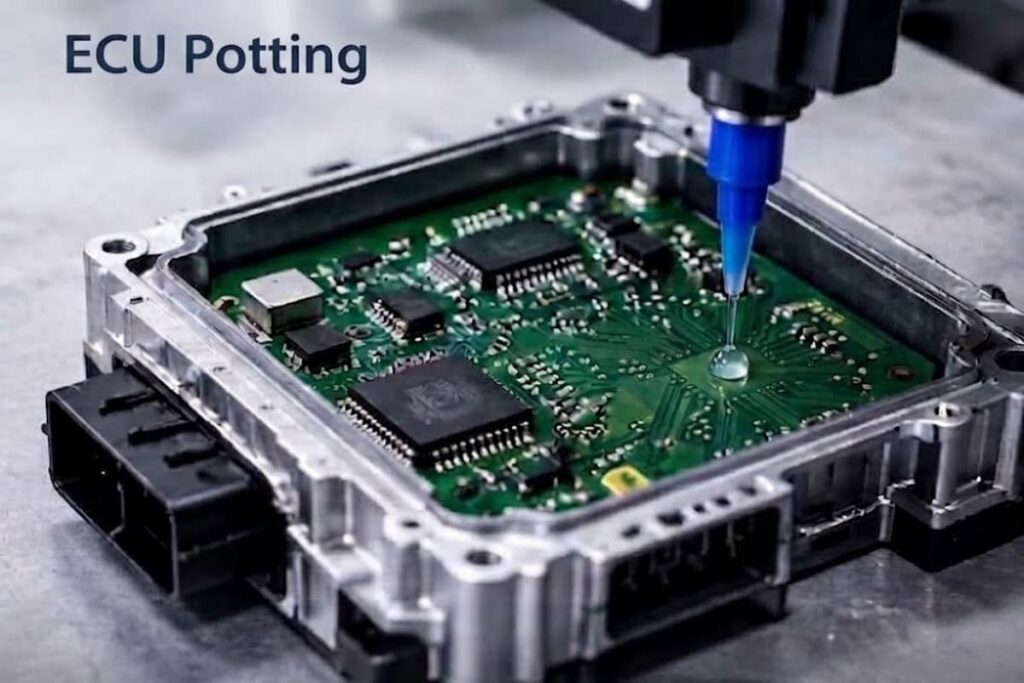
Engine control units, powertrain controllers, and their housings are commonly protected by potting or gasketing with a two-component epoxy or polyurethane. The adhesive must electrically insulate, resist thermal cycling, and bond to the housing without stressing components. The dispensing requirement follows directly from the material.
What the material dictates
A two-part epoxy or polyurethane arrives as separate resin and hardener. The mix ratio, viscosity, and working time (pot life) set the rest of the system. A high mix ratio accuracy requirement—for example 1:1 or 2:1 by volume—means the cartridge and dispensing mechanism must deliver the two streams in the correct relationship, and the static mixing nozzle must homogenize them before deposit.
ECU Potting Specification Checklist
| Adhesive parameter | What it forces in the dispensing system |
|---|---|
| Mix ratio (e.g. 1:1, 2:1) | Cartridge chamber ratio and gun drive must deliver that A/B relationship |
| Viscosity of both parts | Determines mixer element count and dispensing pressure |
| Working time / pot life | Limits mixer residence time and batch size |
| Cure profile | Affects line dwell time and fixture design |
| Filler content | Influences clogging risk and mixer wear |
Because these parameters are tied to a specific adhesive datasheet, the exact values should be confirmed with the adhesive supplier and then matched to a dual component cartridge system and mixer combination. Our guide on how to match cartridges, mixers and guns covers the interface checks in detail.
Sensor Sealing: Precision Dispensing in Miniaturized Assemblies
Sensors—pressure, inertial, temperature, and position devices—are smaller, more numerous, and more sensitive than ECUs. The sealing or encapsulation here is less about filling a large cavity and more about placing a controlled, repeatable bead or droplet on a tiny interface without entrapping air.
Why miniaturization changes the process
Two failure modes dominate sensor sealing. The first is entrapped air: a bubble under a seal becomes a path for moisture ingress or a weak point under thermal shock. The second is over- or under-dosing: too much material can bridge contacts or interfere with moving elements; too little leaves a gap. Both trace back to deposit control, not to the bulk adhesive.
A Practical Sensor-Sealing Process
- Degas or condition the adhesive so dissolved air does not expand during deposit or cure.
- Select a needle or dispense tip sized to the target bead, using our adhesive dispense tips and needles as a starting reference.
- Set deposit volume and pressure against the actual part geometry, then verify with a first-article check.
- Inspect for voids and coverage inline—automated vision or weight checks catch drift before a full batch is sealed.
For very small deposits, the limiting factor is usually the tip and the material preparation, not the cartridge. The two-component material still needs correct mixing, but the precision problem is located at the point of deposit.
Battery Pack TIM Dispensing: Handling High-Viscosity Thermal Materials
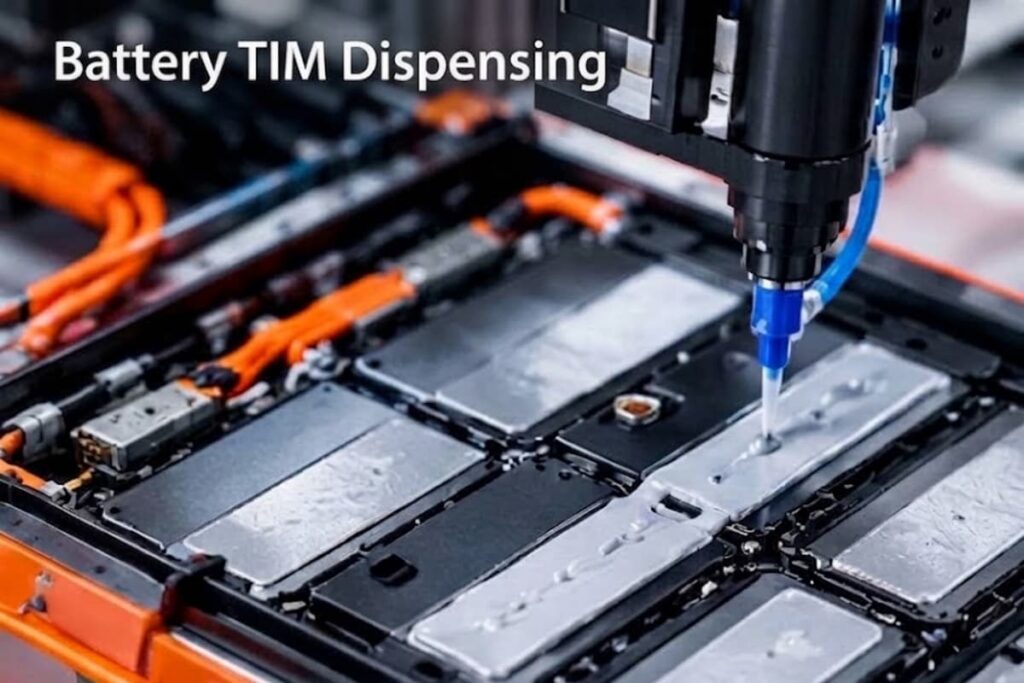
Battery packs move the most material and impose the hardest dispensing conditions of the three scenarios. Thermal interface materials sit between cells or modules and the cooling plate to conduct heat away; many are high-viscosity, filled gels or gap fillers.
What makes battery TIM different
Unlike a free-flowing epoxy, a dispensable thermal gel is loaded with ceramic or boron-nitride filler to reach useful thermal conductivity. That filler raises viscosity and abrasion, which raises the demands on pumps, valves, and meter/mix equipment. A useful reference on battery thermal architecture is the lithium-battery thermal management overview, which describes how gap fillers and potting compounds are positioned in the pack. The thermal gel versus thermal pad comparison is also useful for understanding why dispensable gel is gaining ground over pre-cut pads in automated lines.
Battery TIM Application Matrix
| Application factor | Equipment capability required |
|---|---|
| High filler loading and viscosity | Abrasion-resistant pump and valve, stable metering pressure |
| Variable cell-to-plate gap (tolerances, swelling) | Programmable bead pattern and volume control |
| Large module coverage | High throughput, often robot-mounted dispense head |
| Bubble-free interface | Controlled fill path and pressure to avoid entrapped air |
For cell-to-cooling-plate deposits, an automated dispensing robot is typically the better fit than a hand-held gun, because the bead pattern, volume, and repeatability scale with the pack size. Equipment makers such as Henkel have also introduced two-component thermal materials specifically formulated for high-speed, low-pressure battery application as described in their EV battery materials release.
Building a Matched Dispensing System: Cartridge, Mixer, Gun, and Robot
All three scenarios ultimately converge on the same system logic. A two-component material needs four matched elements: a cartridge that keeps the parts separated, a static mixer that combines them, a gun or robot that drives and deposits them, and a process that verifies the result.
Selection logic by scenario
| Scenario | Material character | Typical system emphasis |
|---|---|---|
| ECU potting | Epoxy / polyurethane, moderate viscosity | Ratio-accurate cartridge + adequate mixer; manual or pneumatic gun |
| Sensor sealing | Controlled low-volume deposit | Fine dispense tip + preparation; precise dosing |
| Battery TIM | High-viscosity filled gel | Meter/mix robot, abrasion-resistant components |
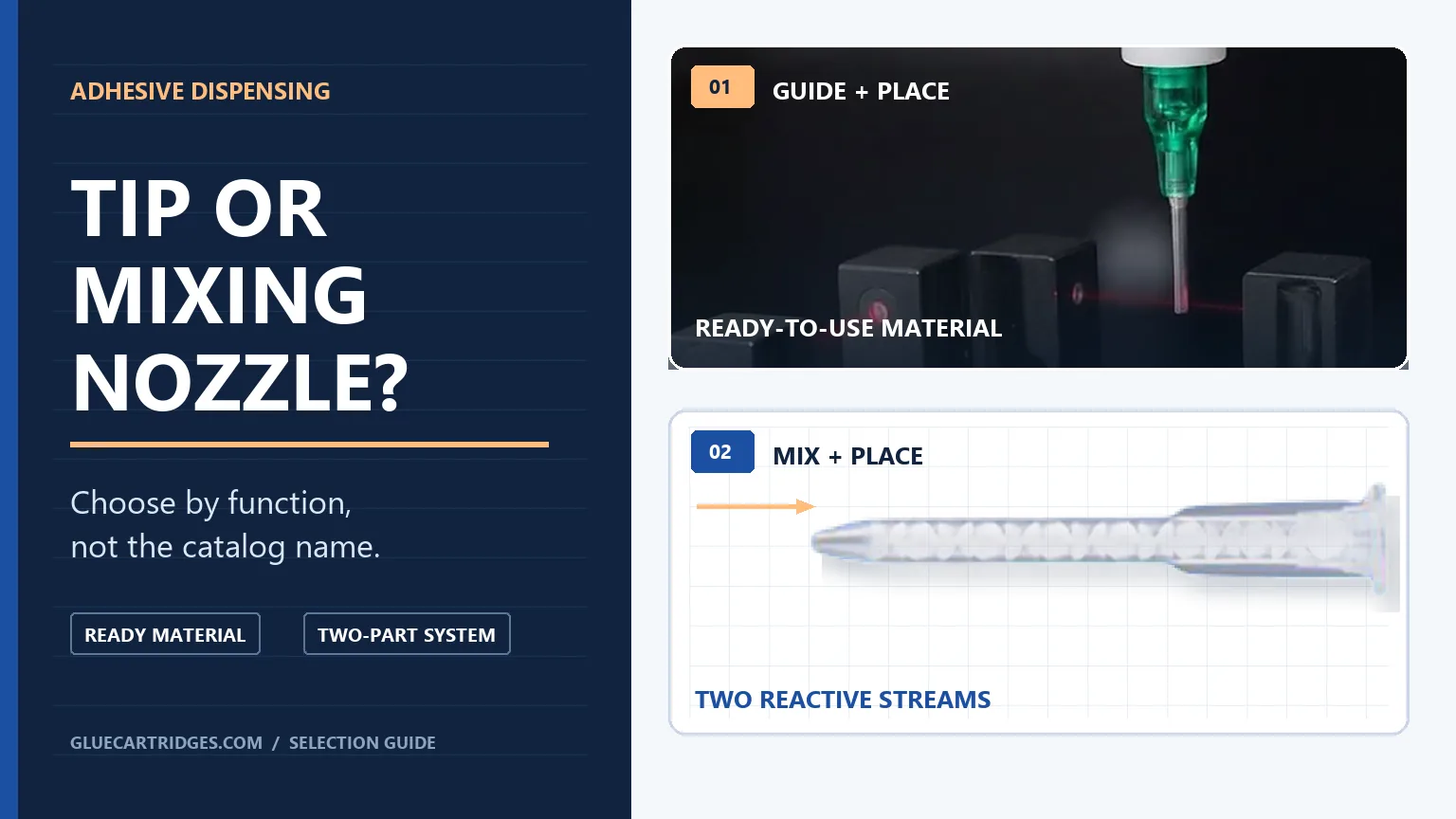
The cartridge, the static mixer, and the dispensing gun must be selected as one combination. A mixer that physically attaches to a cartridge is not automatically the right mixer for the adhesive and flow rate in question, and a gun must accept the cartridge format and deliver the correct A/B relationship. The compatibility matching guide lays out the verification sequence.
Manual, Pneumatic, or Robotic: Matching Automation Level to Production Volume
The automation level should follow volume and accuracy, not habit. The comparison below helps frame the trade-off.
| Selection factor | Manual / pneumatic gun | Coordinate dispensing robot |
|---|---|---|
| Throughput | Operator-paced, limited | High, repeatable cycle |
| Deposit accuracy | Dependent on operator | Programmable, consistent |
| Changeover | Fast for low mix | Program-driven, fast across SKUs |
| Capital | Low | Higher, amortized over volume |
| Best fit | Prototyping, low volume, rework | Series production, complex paths |
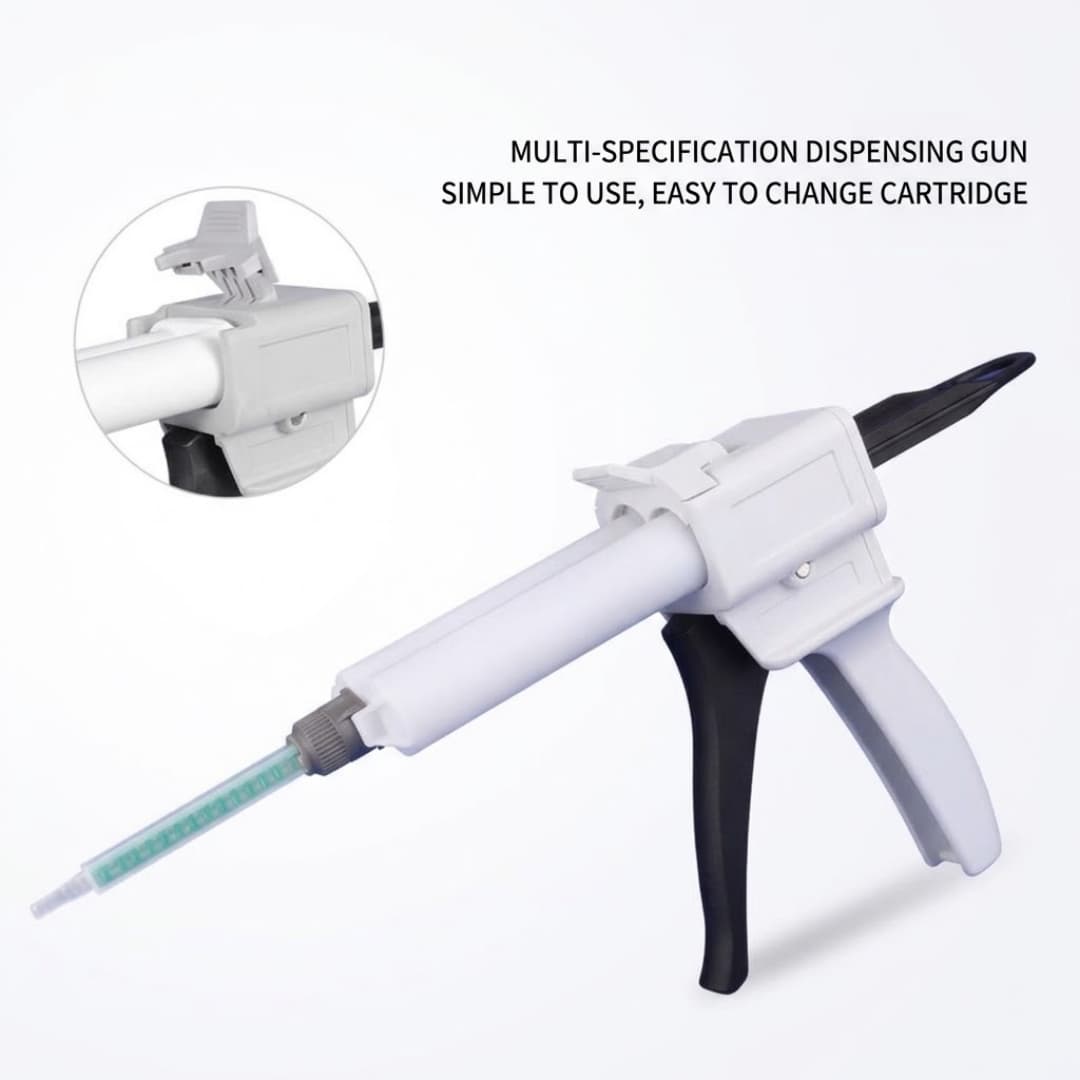
For low-volume validation or service, a manual or pneumatic dispensing gun is practical. Once a battery or sensor line reaches series volume with a fixed bead path, a coordinate applicator pays back through consistency and reduced scrap.
Common Defects in Automotive Potting and How to Prevent Them
Most field failures trace to a small set of process causes. The table maps each defect to where it is introduced.
| Defect | Likely cause | Corrective action |
|---|---|---|
| Air voids / bubbles | Entrapped air in material or poor fill path | Degas material; control deposit path and pressure |
| Incomplete cure | Off-ratio mix or low temperature | Verify ratio and mixer; control line temperature |
| Stringing / tails | Tip or retraction setting | Tune cut-off and tip; check material viscosity |
| Missing or short deposit | Dosing error or blockage | Check tip, pressure, and material flow |
| Poor mixing | Mixer not suited to material | Re-evaluate static mixer length and element type |
The practical rule is to change one variable at a time. Replacing the cartridge, mixer, and gun together makes it impossible to tell which element caused the defect.
From Cartridge Supply to Line Integration: Scaling for Automotive Production
Scaling changes the constraint from “does it dispense” to “does it dispense the same way on the ten-thousandth unit.” The path is staged.
- Sampling: validate the adhesive and the cartridge-mixer-gun set on a bench or small cell.
- Low-volume: run manual or pneumatic dispensing while building process knowledge.
- Automation: move to a robot cell and a cartridge filling machine for consistent cartridge supply.
- Series production: lock the configuration, document it, and monitor ratio, weight, and cure at the line.
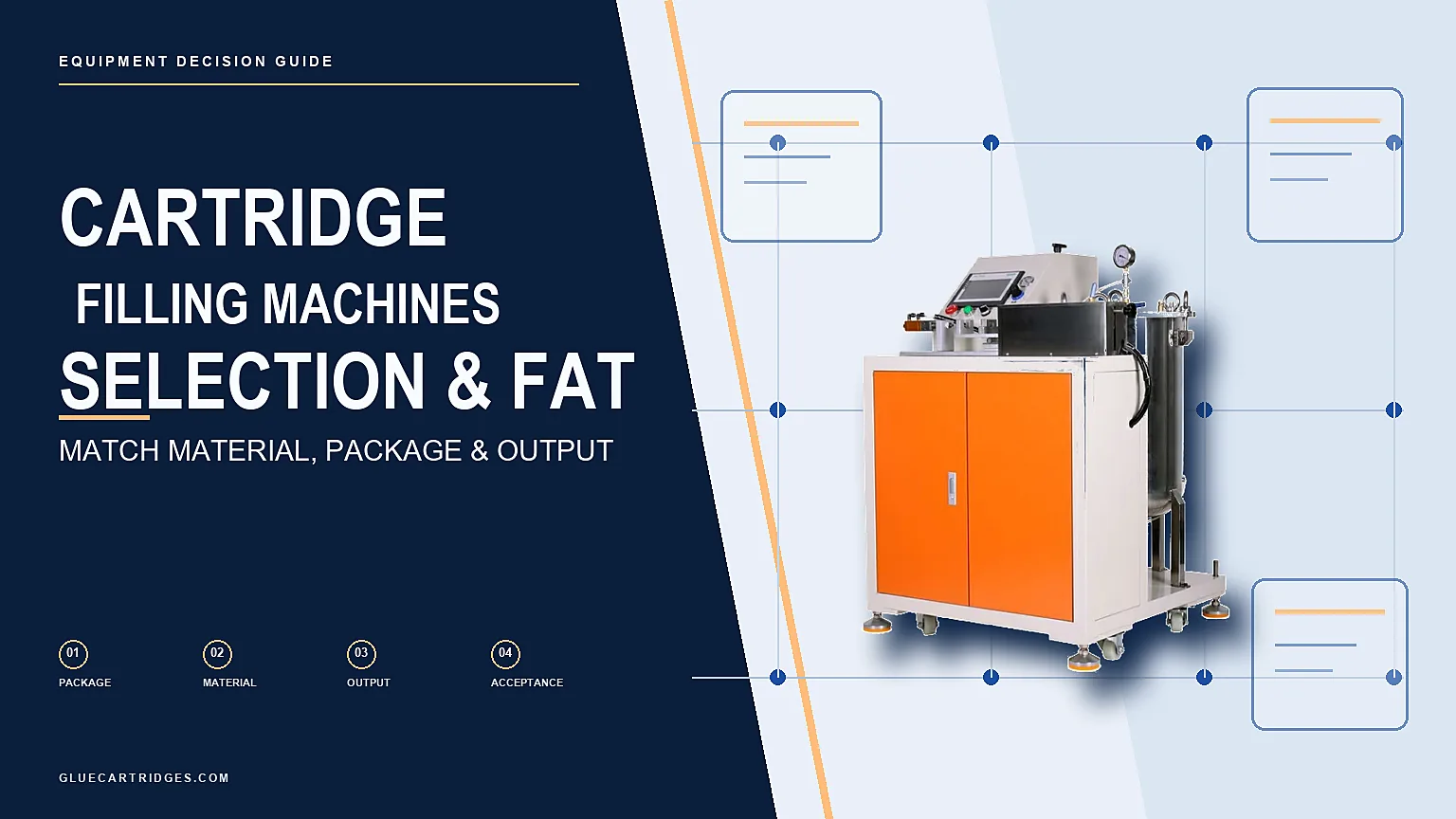
When the team fills its own cartridges, a cartridge filling machine reduces air entrapment and batch variation. For non-standard housings or integrated packaging, our custom dispensing solutions cover mold and material development.
What to Specify When Requesting a Quote (Buyer’s Checklist)
A complete request lets a supplier evaluate the system instead of guessing a part. Provide the following.
- Adhesive type, viscosity, and mix ratio
- Working time / pot life and cure profile
- Cartridge volume and configuration, or existing part numbers
- Required deposit pattern, volume, and accuracy
- Target production volume and cycle time
- Manual, pneumatic, or robotic operation
- Any housing, interface, or cleanliness constraints
If the exact mixer or gun is unknown, send the adhesive and application data and let the supplier propose the matched set, as described in our customization capabilities.
Frequently Asked Questions
What adhesive is used for ECU potting?
Two-component epoxy and polyurethane are common choices because they insulate, resist thermal cycling, and bond to housings. The specific chemistry should be confirmed against the module’s temperature range and the adhesive datasheet.
Can the same dispensing system handle epoxy and silicone TIM?
Not always. Cure chemistry, viscosity, and filler content differ, so the mixer, metering, and cleaning requirements can differ. The system should be evaluated per material rather than assumed interchangeable.
How do I prevent bubbles in two-component potting?
Degas or condition the material, control the deposit path and pressure so air is not trapped, and verify coverage inline. Bubbles are usually a material-preparation or fill-path issue rather than a cartridge issue.
Static or dynamic mixing: which is right for automotive adhesives?
Static mixing covers most cartridge-based two-component deposits and is simpler to integrate. Dynamic mixing is considered when very high viscosity or specific shear conditions require active mixing. The choice follows the material and flow rate.
What information does a supplier need to recommend a dispensing system?
At minimum: adhesive type, viscosity, mix ratio, cartridge volume and configuration, required deposit pattern and accuracy, production volume, and the operating method. Existing part numbers accelerate the matching.
Key Takeaways
Automotive electronics adhesive dispensing for ECU potting, sensor sealing, and battery TIM starts from the material and the failure mode, then drives every equipment choice. The three scenarios share a matched two-component system but diverge on viscosity, deposit precision, and throughput.
The decision sequence is: adhesive → mix ratio → cartridge → static mixer → gun or robot → application → verification. Common defects—voids, incomplete cure, stringing, and poor mixing—are prevented by controlling material preparation, ratio accuracy, and fill path rather than by changing products in isolation.
Talk to the Haijing Engineering Team
If you are specifying dispensing for an ECU, sensor, or battery TIM application, start from the adhesive and the assembly you need to protect. Send your adhesive type, viscosity, mix ratio, cartridge or volume requirements, deposit pattern and accuracy, and target production volume. Our engineering team will recommend a cartridge, static mixer, and dispensing system combination and return a compatibility review, typically within one business day.