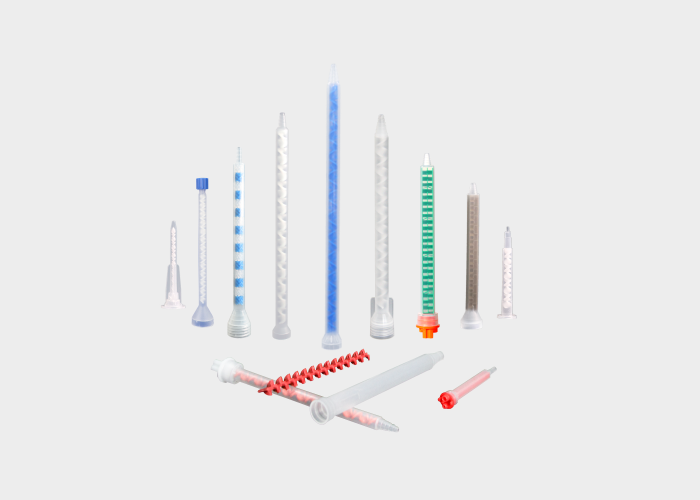
Choosing a static mixing nozzle often starts with a simple question: How many mixing elements do I need?
The problem is that element count alone does not determine mixing performance.
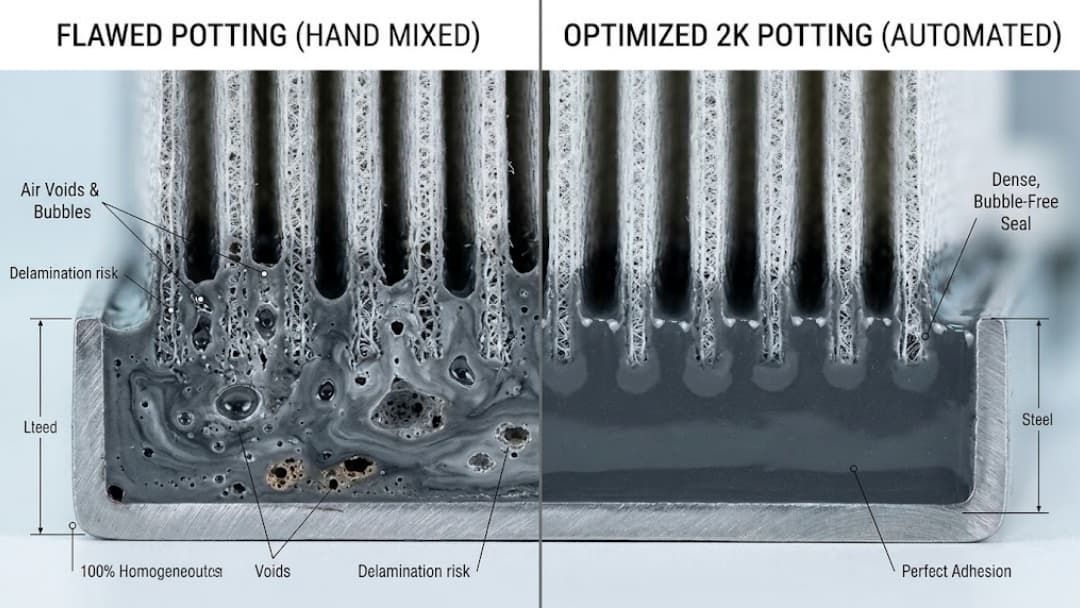
A mixer with too few elements may not provide the required homogenization. A mixer with more elements may improve mixing in some applications, but it can also increase flow resistance, dispensing force, internal volume, and material waste.
For two-component epoxy, polyurethane, acrylic, silicone, and other reactive adhesives, the better approach is to evaluate the entire dispensing system rather than selecting a mixer based on element count alone.
This guide explains how to evaluate element count, mix quality, pressure, waste, cartridge compatibility, and application requirements when selecting a static mixing nozzle.
Key Takeaways
- More mixing elements do not automatically mean better mixing.
- Element count should be evaluated together with mixer geometry, adhesive viscosity, mixing ratio, and flow rate.
- The correct mixer depends on both the adhesive and the cartridge system.
- A higher element count can increase flow resistance and potentially increase material waste.
- The goal is to find the simplest mixer configuration that consistently achieves the required mix quality.
- Testing the selected mixer with the actual adhesive is the most reliable way to confirm suitability.
- For applications that cannot be optimized with a static mixer, a dynamic mixing system may be worth evaluating.
Start With the Adhesive, Not the Element Count
One of the most common mistakes when selecting a static mixing nozzle is starting with the number of elements.
For example, an engineer may compare a 12-element mixer with a 24-element mixer and assume that the 24-element version must provide better adhesive performance.
That assumption is incomplete.
A static mixer works by repeatedly dividing and recombining the two material streams as they move through stationary internal elements. The final mixing result depends on several variables, including:
- Adhesive formulation
- A:B mixing ratio
- Component viscosity
- Flow rate
- Mixer diameter
- Element geometry
- Element count
- Mixer length
- Required mix quality
- Dispensing equipment
This means that element count should be treated as one variable within a larger system.
Before selecting a mixer, first define what the adhesive and application require.
For a broader overview of adhesive mixing equipment, see HaiJing’s static and dynamic mixers range.
What Does a Mixing Element Actually Do?
A static mixing element is a stationary internal structure that changes the direction and distribution of material flowing through the mixer.
When two adhesive components enter the mixer, the internal elements repeatedly divide, redirect, and recombine the streams.
A simplified process looks like this:
Two material streams
→ Flow division
→ Rearrangement
→ Recombination
→ Repeated mixing
→ More uniform adhesive
The exact mixing mechanism depends on the internal geometry of the mixer.
This is important because two static mixing nozzles with the same nominal element count may not produce identical results if their internal geometry, diameter, or length differs.
Therefore, when comparing mixers, do not specify only:
“24 elements”
A more useful specification identifies:
Mixer system + geometry + element count + length + outlet configuration
That gives both the buyer and the static mixer manufacturer a much clearer engineering reference.
Does More Elements Always Mean Better Mixing?
No.
Adding elements creates additional mixing stages, but it also increases the length and complexity of the flow path.
In simplified terms:
More elements → more mixing stages → potentially better homogenization
But also:
More elements → greater flow resistance → potentially higher dispensing force
This creates the central trade-off in static mixer selection.
| Element Configuration | Potential Advantage | Potential Concern |
|---|---|---|
| Lower element count | Lower flow resistance and internal volume | May provide insufficient mixing |
| Medium element count | Balanced mixing and flow performance | Requires application validation |
| Higher element count | More mixing stages | Potentially higher pressure and waste |
The objective is therefore not to select the mixer with the highest available element count.
The objective is to identify the minimum practical configuration that consistently achieves the required mixing quality.
How Viscosity Affects Static Mixer Selection
Viscosity is one of the most important factors when selecting a mixer.
Low-viscosity materials generally move through a mixer more easily, while high-viscosity adhesives can require substantially more dispensing force.
However, viscosity does not provide a universal formula for determining element count.
Two adhesives with similar viscosities may still require different mixer configurations because of differences in:
- Mixing ratio
- Flow behavior
- Formulation
- Cure characteristics
- Required application quality
- Target flow rate
- Dispensing equipment
For this reason, viscosity should be treated as a selection input, not as a standalone element-count rule.
Before selecting the mixer, record:
- Component viscosity
- A:B ratio
- Target flow rate
- Required mixing quality
- Available dispensing pressure
- Cartridge format
- Existing mixer interface
This information gives a static mixer manufacturer enough context to evaluate possible configurations.
Mixing Ratio Matters More Than Element Count Alone
A mixing nozzle for epoxy must be matched to the adhesive’s component ratio as well as its physical cartridge system.
A 1:1 adhesive does not enter the mixer in the same volumetric proportions as a 2:1, 4:1, or 10:1 material.
The mixing ratio influences how the two streams enter and interact inside the mixer.
For this reason, buyers should confirm the ratio before selecting a mixer.
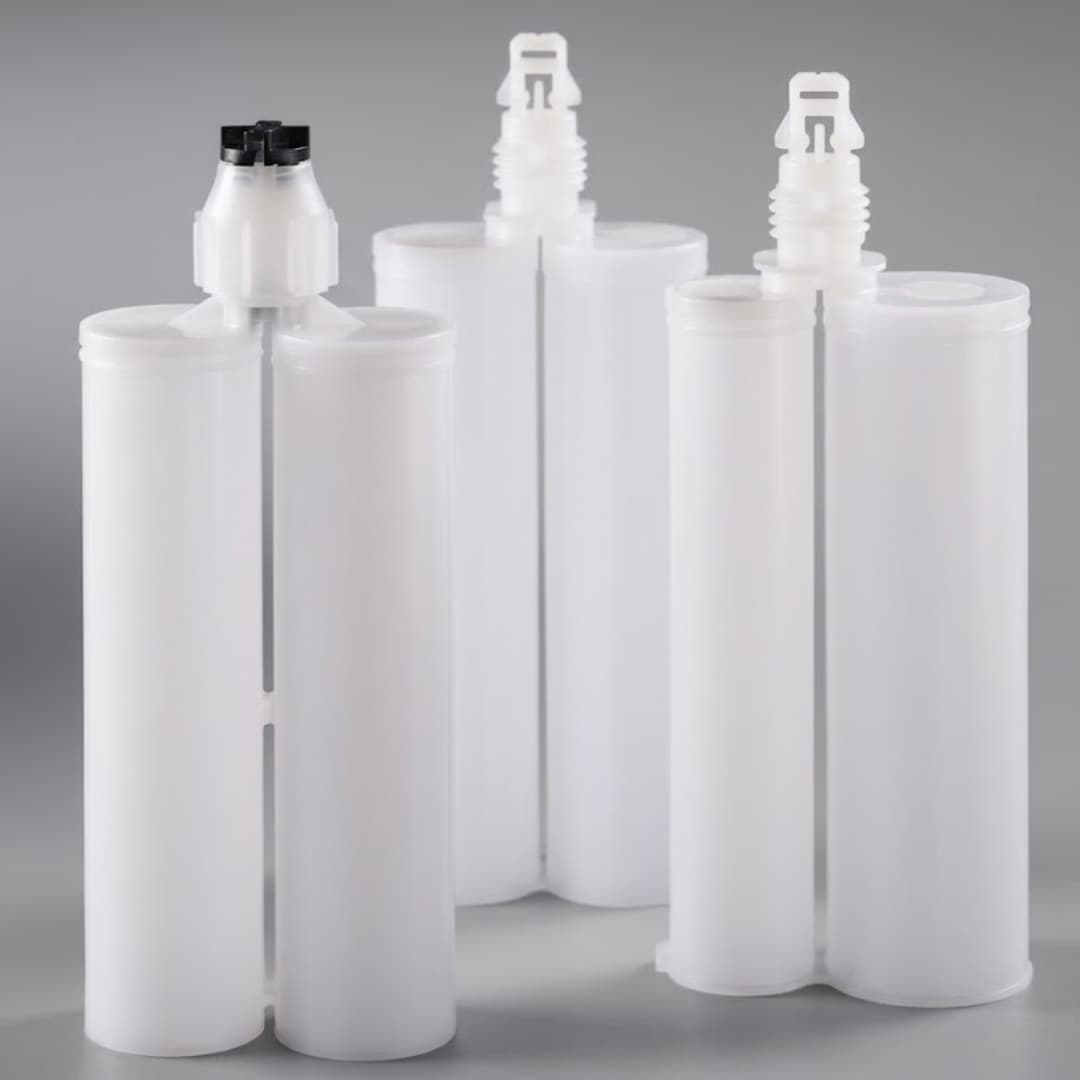
When using a two-component cartridge system, start with the cartridge specifications. HaiJing’s dual-component cartridges provide the appropriate reference point for evaluating cartridge format and component ratio.
Include these parameters in an RFQ:
- A:B ratio
- Cartridge volume
- Adhesive type
- Viscosity
- Target flow rate
- Existing mixer
- Dispensing method
- Required application quality
Do not select element count before confirming the mixing ratio and cartridge system.
Element Count Is Only One Part of Mixer Geometry
A static mixer is not simply a tube containing a certain number of elements.
Its performance depends on the complete internal flow path.
Important geometry variables include:
- Internal diameter
- External diameter
- Element geometry
- Element count
- Mixer length
- Inlet configuration
- Outlet configuration
- Cartridge connection
For example, HaiJing’s A-System static mixers provide different configurations for cartridge-based adhesive dispensing.
The same principle applies when evaluating the B-System static mixers, C-System static mixers, and F-System static mixers.
The important point is:
Element count without mixer geometry is an incomplete specification.
When comparing suppliers, always make sure that the element count refers to a clearly defined mixer design.
The Real Selection Framework: Mix Quality, Pressure and Waste
The most practical way to evaluate a static mixing nozzle is to balance three variables:
1. Mix Quality
Does the adhesive leave the mixer sufficiently homogeneous for the intended application?
2. Dispensing Resistance
Can the cartridge and dispensing gun push the material through the mixer at the required flow rate?
3. Material Waste
How much adhesive remains inside the disposable mixer after dispensing?
These factors are connected.
Increasing element count or mixer length may improve mixing in some applications, but it can also increase resistance and internal material volume.
The best configuration therefore sits at the intersection of:
Required Mix Quality + Acceptable Flow Resistance + Controlled Waste
How Mixer Length Can Affect Material Waste
For disposable adhesive mix nozzles, internal volume is an important production consideration.
After dispensing stops, some adhesive remains inside the mixer. Because the mixer is typically disposable, this material may become process waste.
A simplified relationship is:
Internal volume ≈ flow area × effective mixer length
Therefore, mixer dimensions can affect material utilization.
Consider a high-volume process that uses thousands of cartridges per month. Even a small amount of unnecessary adhesive retained in each mixer can become a meaningful cumulative cost.
For this reason, production engineers should evaluate:
- Mixer length
- Internal diameter
- Expected adhesive consumption
- Mixer replacement frequency
- Residual material
- Required mixing quality
The goal is not simply to minimize mixer volume.
It is to avoid unnecessary mixer volume while maintaining reliable mixing performance.
Do Not Use Element Count to Fix the Wrong Problem
Poor mixing does not always mean that the mixer needs more elements.
Before changing the element count, check the complete dispensing system.
Troubleshooting checklist
If the adhesive appears poorly mixed, verify:
- Is the cartridge ratio correct?
- Are both components flowing properly?
- Is the mixer compatible with the cartridge?
- Is the dispensing gun moving both pistons correctly?
- Is the mixer properly seated?
- Is the flow rate appropriate?
- Is the mixer diameter suitable?
- Is the adhesive within its intended processing conditions?
- Is the mixer geometry appropriate for the material?
Only after these variables have been checked should element count become the primary variable under investigation.
This approach prevents a common mistake:
Using a more complicated mixer to compensate for an unrelated system problem.
Match the Mixer to the Cartridge System
Physical compatibility should be confirmed before optimizing mixing performance.
HaiJing offers multiple static mixer systems designed for different cartridge configurations.
| Mixer System | Selection Focus |
|---|---|
| A-System | Cartridge interface, ratio, element configuration |
| B-System | Cartridge format, separate component paths, ratio |
| C-System | Larger cartridge formats and equipment compatibility |
| F-System | Larger cartridge formats and ratio configuration |
For example, the A-System and B-System can be evaluated for smaller cartridge applications, while the C-System and F-System can be considered for larger cartridge formats.
The exact configuration should always be confirmed against the cartridge and dispensing equipment before ordering.
A better selection sequence is:
Cartridge → Ratio → Interface → Adhesive → Flow Rate → Mixer Configuration
rather than:
Element Count → Mixer
When Should You Increase the Number of Mixing Elements?
Increasing element count can be considered when testing shows that the current mixer does not provide sufficient mixing.
Potential indicators include:
- Visible component streaks
- Inconsistent color distribution
- Non-uniform adhesive appearance
- Application variation
- Incomplete blending
- Inconsistent cured results
However, increasing element count should not be the first response.
Use this sequence:
Step 1: Confirm the adhesive ratio
Make sure the cartridge is delivering the intended A:B proportion.
Step 2: Confirm cartridge compatibility
Verify that the mixer and cartridge interfaces match.
Step 3: Confirm material flow
Make sure both components are entering the mixer correctly.
Step 4: Confirm the target flow rate
Determine whether the existing configuration is being operated outside its practical range.
Step 5: Test the current mixer
Evaluate actual material performance.
Step 6: Compare alternative element configurations
Only then determine whether additional elements are justified.
This creates a controlled engineering process instead of trial-and-error mixer selection.
When Should You Use Fewer Elements?
A lower element count may be appropriate when:
- The adhesive is relatively easy to mix.
- The existing mixer already produces acceptable results.
- Dispensing force is limited.
- A high flow rate is required.
- Material waste is a major concern.
- The application does not require extreme homogenization.
The objective is not to minimize the number of elements at all costs.
Instead, the objective is to avoid unnecessary mixing capacity.
In production, an oversized mixer can create additional operating costs if it requires excessive dispensing force or retains more adhesive than necessary.
Manual or Pneumatic Dispensing: Does the Gun Change the Decision?
Yes.
A static mixer cannot be evaluated independently from the equipment pushing material through it.
If a high-viscosity adhesive is combined with a long mixer and a high element count, dispensing resistance may become an important process variable.
For manual applications, review the available manual dispensing guns alongside the cartridge and mixer.
For applications where pneumatic operation is preferred, compare the available pneumatic dispensing guns as part of the complete dispensing system.
The practical relationship is:
Adhesive viscosity + mixer resistance + flow rate → required dispensing force
Therefore, changing the mixer can affect the dispensing equipment requirements.
When Is a Dynamic Mixer a Better Option?
A static mixer is not the correct solution for every adhesive dispensing application.
Static mixers rely on the movement of the material through stationary internal elements.
Dynamic mixers, in contrast, use mechanically driven mixing elements.
For applications involving challenging materials, automated metering and mixing, or specific process-control requirements, a dynamic system may be worth evaluating.
HaiJing provides dynamic mixers as an alternative mixing architecture.
The decision can be summarized as:
| Requirement | Static Mixer | Dynamic Mixer |
|---|---|---|
| Disposable mixing path | Strong option | Application dependent |
| Simple cartridge dispensing | Strong option | Often unnecessary |
| Stationary internal elements | Yes | No |
| Mechanically driven mixing | No | Yes |
| Automated metering/mixing | Possible | Strong option |
| Difficult mixing requirements | Application dependent | May be worth evaluating |
If achieving the required result would require continually increasing static mixer complexity, it may be more efficient to evaluate whether a dynamic mixing system is appropriate.
How to Validate the Right Element Count
The most reliable way to confirm a mixer configuration is through application testing with the actual adhesive.
Step 1 — Define the material
Record:
- Adhesive type
- A:B ratio
- Viscosity
- Processing conditions
Step 2 — Define the dispensing target
Record:
- Required flow rate
- Cartridge size
- Dispensing method
- Equipment type
- Application requirements
Step 3 — Select candidate mixers
Compare suitable configurations rather than testing only one option.
Step 4 — Run material-loaded trials
Evaluate the actual adhesive instead of relying solely on an empty-fit test.
Check:
- Flow behavior
- Mixing appearance
- Dispensing force
- Application consistency
- Material waste
Step 5 — Compare the results
A simple evaluation table can be used:
| Test Item | Mixer A | Mixer B |
|---|---|---|
| Element count | Record | Record |
| Mixer length | Record | Record |
| Flow rate | Record | Record |
| Dispensing force | Record | Record |
| Mix appearance | Record | Record |
| Application result | Record | Record |
| Residual material | Record | Record |
| Final suitability | Pass / Review | Pass / Review |
The selected mixer should be the configuration that meets the process requirements with an acceptable balance of performance and material consumption.
What Should You Specify When Buying a Static Mixing Nozzle?
When requesting a quotation from a static mixer manufacturer, avoid sending only:
“Please quote a 24-element mixer.”
That description is usually not sufficient.
Instead, provide a complete specification.
Cartridge
- Cartridge volume
- Cartridge system
- Cartridge drawing, if available
Adhesive
- Material type
- A:B ratio
- Viscosity
- Processing conditions
Dispensing
- Manual or pneumatic
- Target flow rate
- Existing dispensing gun
- Application method
Mixer
- Existing mixer model
- Element count
- Diameter
- Length
- Outlet configuration
- Connection interface
Commercial Requirements
- Prototype or production
- Expected usage
- Standard or custom configuration
- Required samples
- Documentation requirements
This information allows an OEM static mixer supplier to evaluate the application instead of simply matching one number to another.
Standard Static Mixer or Custom Configuration?
A standard mixer is often the most efficient choice when an existing configuration already meets the cartridge, adhesive, and application requirements.
Customization becomes more relevant when a project requires a specific:
- Element count
- Mixer length
- Diameter
- Outlet
- Material
- Cartridge interface
- Dispensing configuration
For manufacturers with recurring production requirements, a custom solution can be evaluated after the application requirements are clearly defined.
If your project requires a specific mixer geometry or configuration, see HaiJing’s customization service for further discussion.
The important principle is:
Customize the mixer because the process requires it—not simply because a higher element count appears better.
Final Decision Framework: How Many Elements Do You Actually Need?
Use this sequence when evaluating a new static mixing nozzle:
1. Identify the adhesive
↓
2. Confirm the A:B ratio
↓
3. Confirm the cartridge system
↓
4. Define viscosity and target flow rate
↓
5. Define the required mixing quality
↓
6. Select compatible mixer geometry
↓
7. Compare element configurations
↓
8. Test with the actual adhesive
↓
9. Check dispensing force and material waste
↓
10. Release the final configuration
This makes element count the result of an engineering evaluation, rather than the starting assumption.
Final Procurement Checklist
Before approving a static mixer for production, confirm the following:
Material
- Adhesive identified
- A:B ratio confirmed
- Viscosity documented
- Processing conditions documented
Cartridge
- Cartridge volume confirmed
- Cartridge system confirmed
- Mixer interface verified
Mixer
- Mixer model confirmed
- Element count confirmed
- Geometry confirmed
- Length confirmed
- Outlet confirmed
Process
- Target flow rate defined
- Dispensing equipment confirmed
- Required mix quality defined
- Application test completed
Production
- Dispensing resistance acceptable
- Material waste acceptable
- Mixer availability confirmed
- Final configuration released
For additional information about cartridge-based adhesive dispensing, you can also review HaiJing’s dual-component cartridge solutions.
FAQ
How many elements should a static mixing nozzle have?
There is no universal element count. The appropriate configuration depends on the adhesive, mixing ratio, viscosity, flow rate, mixer geometry, cartridge system, and required mixing quality. The final choice should be validated with the actual application.
Do more static mixer elements always improve mixing?
No. More elements can provide additional mixing stages, but they can also increase flow resistance and internal volume. The correct configuration is the one that achieves the required mixing quality without unnecessary system penalties.
What affects static mixer performance besides element count?
Important factors include element geometry, mixer diameter, mixer length, adhesive viscosity, mixing ratio, flow rate, cartridge interface, and dispensing conditions.
How do I choose a mixing nozzle for epoxy?
Start with the epoxy’s mixing ratio, viscosity, cartridge format, target flow rate, and application requirements. Then select a compatible mixer configuration and validate it with the actual adhesive.
Can the same mixer be used for different adhesive ratios?
Not necessarily. The mixer must be compatible with the cartridge and ratio configuration. Always verify the complete system before using a mixer with a different adhesive ratio.
Does a longer static mixer create more waste?
A longer mixer can have greater internal volume, but actual material retention depends on the mixer geometry and dimensions. Waste should therefore be evaluated together with the required mixing performance.
When should I consider a dynamic mixer?
A dynamic mixer may be worth evaluating when the application requires mechanically driven mixing, automated metering and mixing, or a mixing architecture that cannot be adequately achieved with a practical static mixer configuration.
Can a static mixer be customized?
Custom configurations may be available depending on the manufacturer and application. Typical customization requirements may include element configuration, length, diameter, outlet, material, or cartridge interface. These requirements should be confirmed with the manufacturer.
Conclusion: Optimize the Mixing System, Not Just the Element Count
The question “How many mixing elements do I actually need?” has no single numerical answer.
The correct answer depends on the complete dispensing system:
Adhesive + Ratio + Viscosity + Flow Rate + Mixer Geometry + Cartridge + Dispensing Equipment + Required Mix Quality
More elements are not automatically better.
Too few elements may result in inadequate mixing. Too many may create unnecessary resistance, dispensing difficulty, or material waste.
The better strategy is to identify the simplest mixer configuration that consistently delivers the required adhesive performance.
For manufacturers evaluating a static mixing nozzle, static mixing nozzles, mixing nozzle for epoxy, or mixer nozzles for two part adhesive cartridges, the selection process should begin with the adhesive and cartridge specifications and finish with real application testing.
If a standard configuration does not meet the process requirements, a qualified static mixer manufacturer or OEM static mixer supplier can help evaluate alternative geometries or customized configurations.
Need Help Selecting the Right Mixer?
Send HaiJing your cartridge specification, adhesive ratio, viscosity, target flow rate, and current mixer information.
The more complete the application information, the easier it is to evaluate the appropriate mixer configuration.
Contact HaiJing for static mixer selection and customization support.
Element count should remain tied to the released part record. Use the static mixer code-decoding guide to preserve the supplier legend, drawing revision, and qualification evidence.