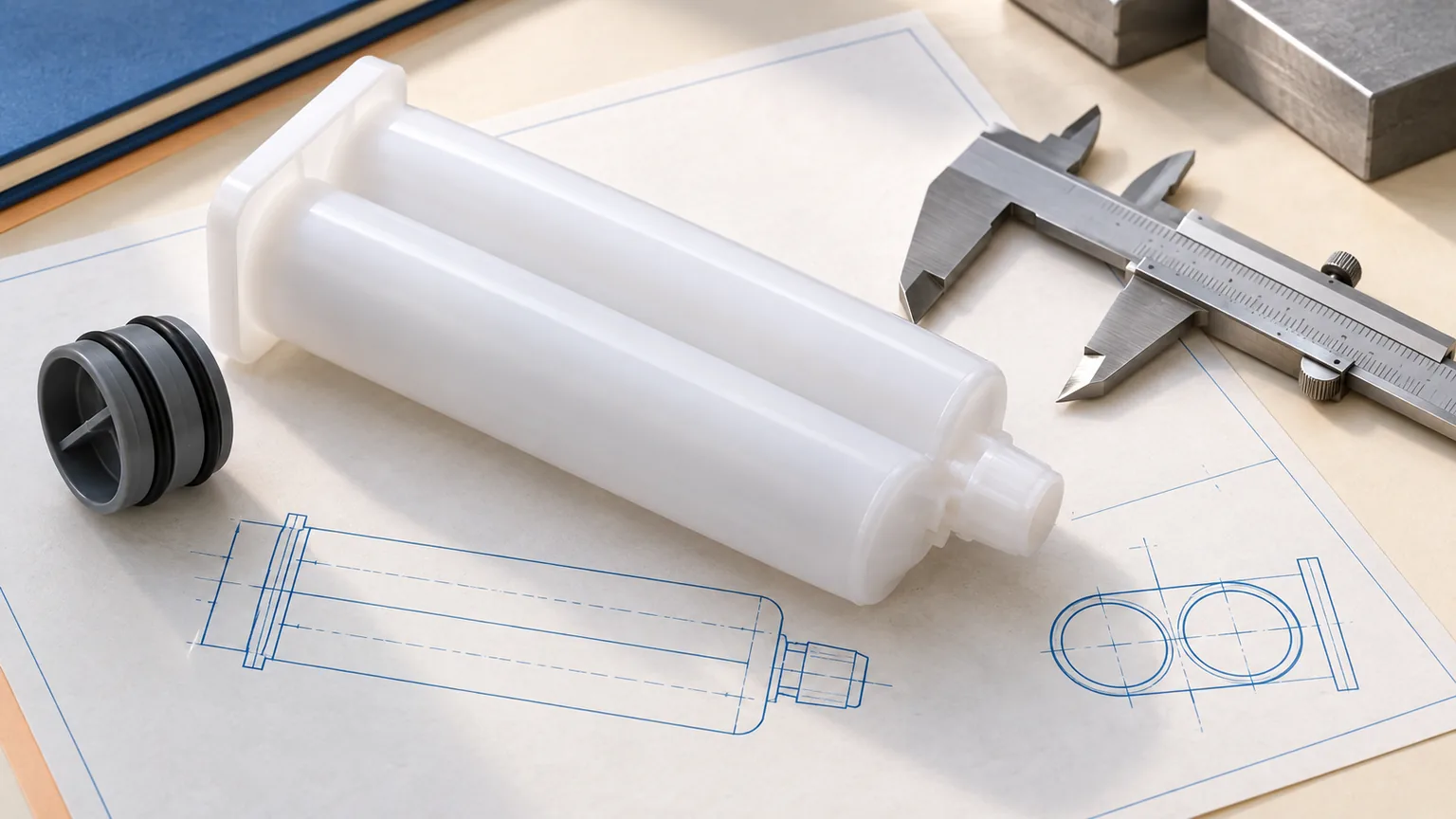
In the era of minimally invasive surgery and single-use instruments, two-part adhesives—surgical sealants, bone cement, cyanoacrylate, and epoxy potting compounds—have become standard in device assembly. Leading producers such as Baxter International, whose TISSEEL fibrin sealant and bone cement families are used in operating rooms worldwide, share a common bottleneck: converting bulk two-part resin into a sterile, ratio-accurate, low-void cartridge kit that a clinician or automated line can use without manual mixing. The core challenge is no longer the chemistry but the delivery. A medical-grade two-component cartridge paired with a static mixing tube meters both parts at a fixed ratio and homogenizes them inline, right before application. This article reviews that system through the lens of surgical-sealant and bone-cement assembly, and the validated performance it delivers.
Solution Background: The Dispensing Dilemma of Two-Part Surgical Sealants & Bone Cement
Two-part medical adhesives cure only when Part A and Part B meet at the correct ratio. In fibrin sealants and bone cement, a deviation of even a few percent changes working time, set strength, and handling margin. For a producer operating at Baxter’s scale and product profile, three pain points dominate the move from bulk to kit:
- Ratio drift. Manual weighing and cup mixing of sealant components produced 1:1 batches that varied ±8–10%, causing inconsistent cure and lot rejections.
- Air entrapment. Hand stirring trapped micro-bubbles; in sealant films and cement voids these became weak points and visible defects, pushing scrap to 8–12%.
- Sterile, single-use packaging. Bulk resin cannot ship as a clinician-ready kit, and the formulation itself is proprietary—requiring NDA handling and batch-level traceability.
These constraints are why a global sealant and bone-cement producer must replace manual mixing with a closed, ratio-fixed system.
Core Solution Upgrade: Medical-Grade Two-Component Cartridge + Static Mixing Tube
We replace manual mixing with a closed, ratio-fixed cartridge-and-mixer system engineered for medical duty:
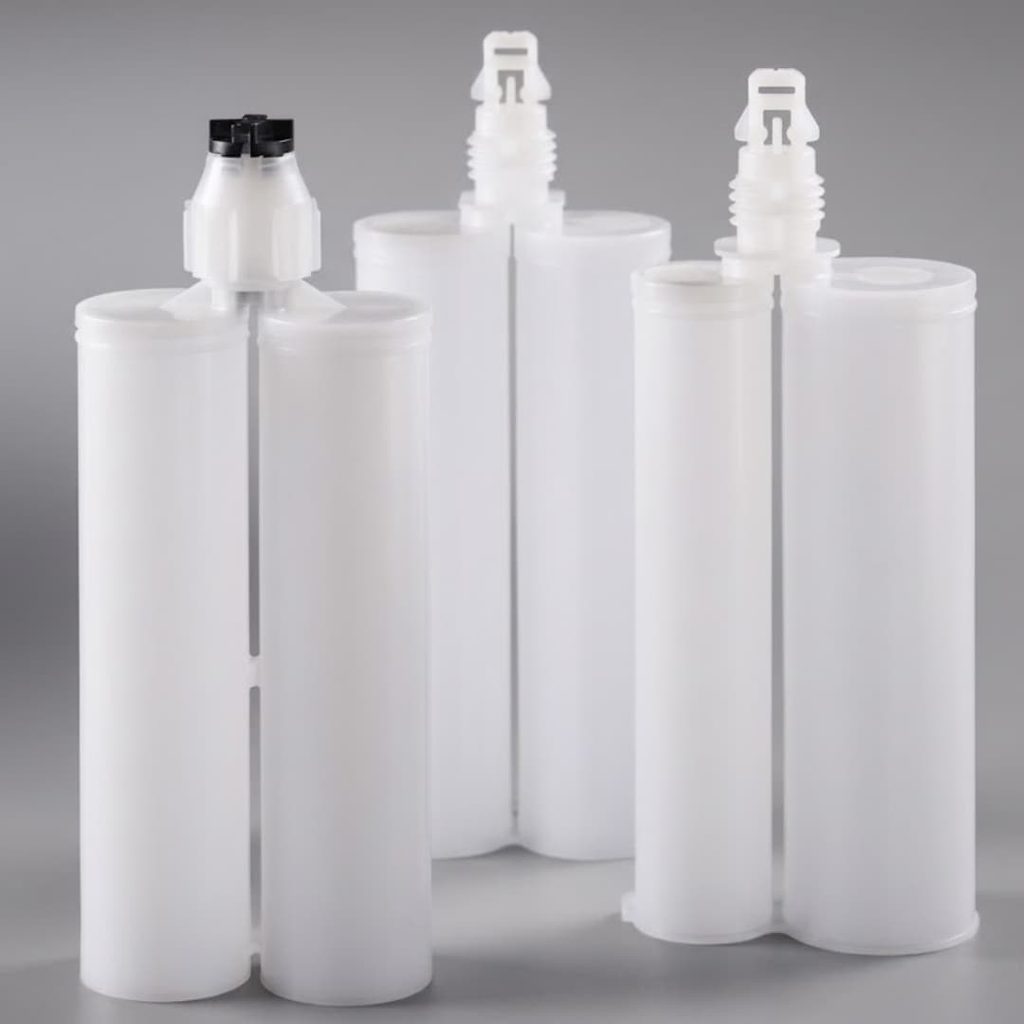
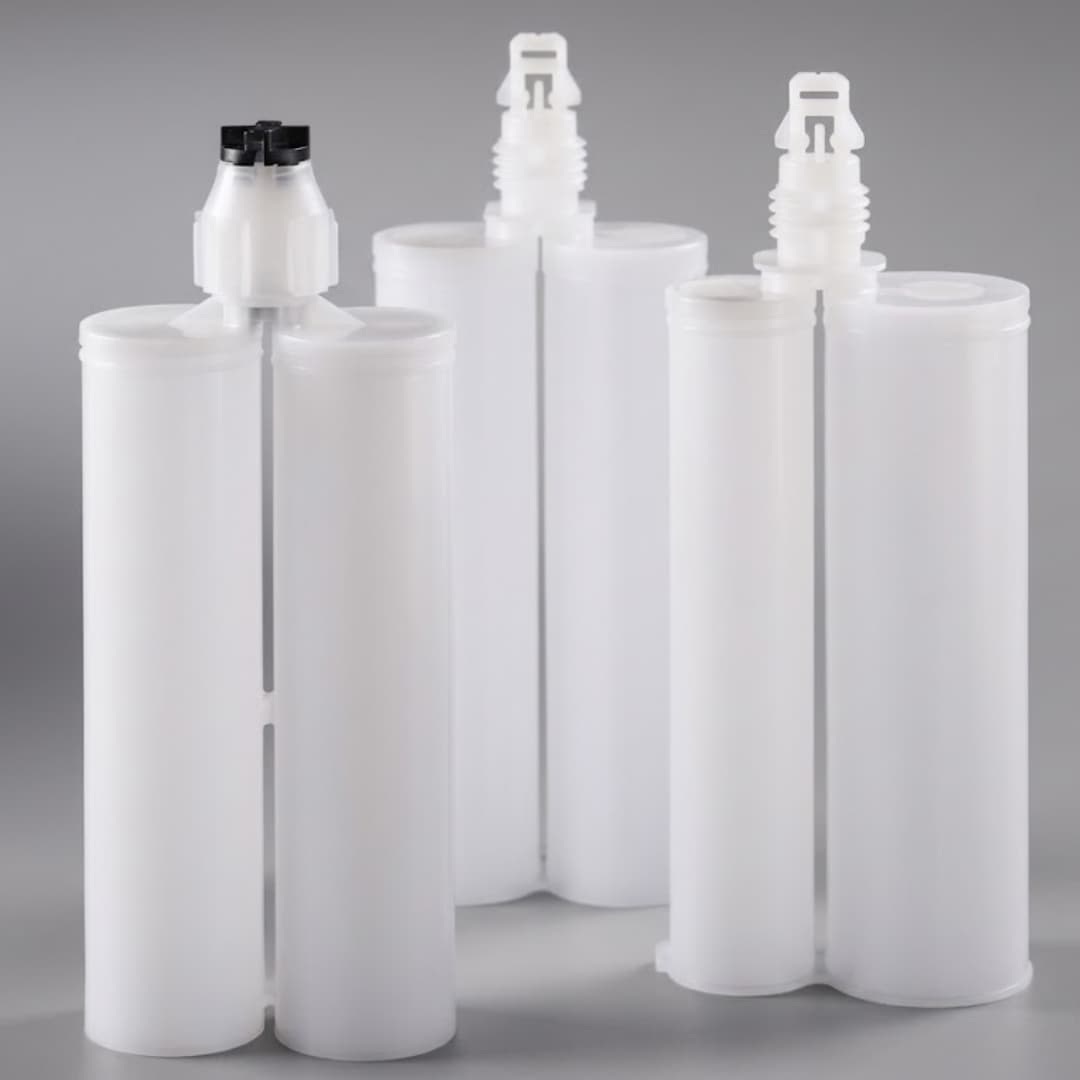
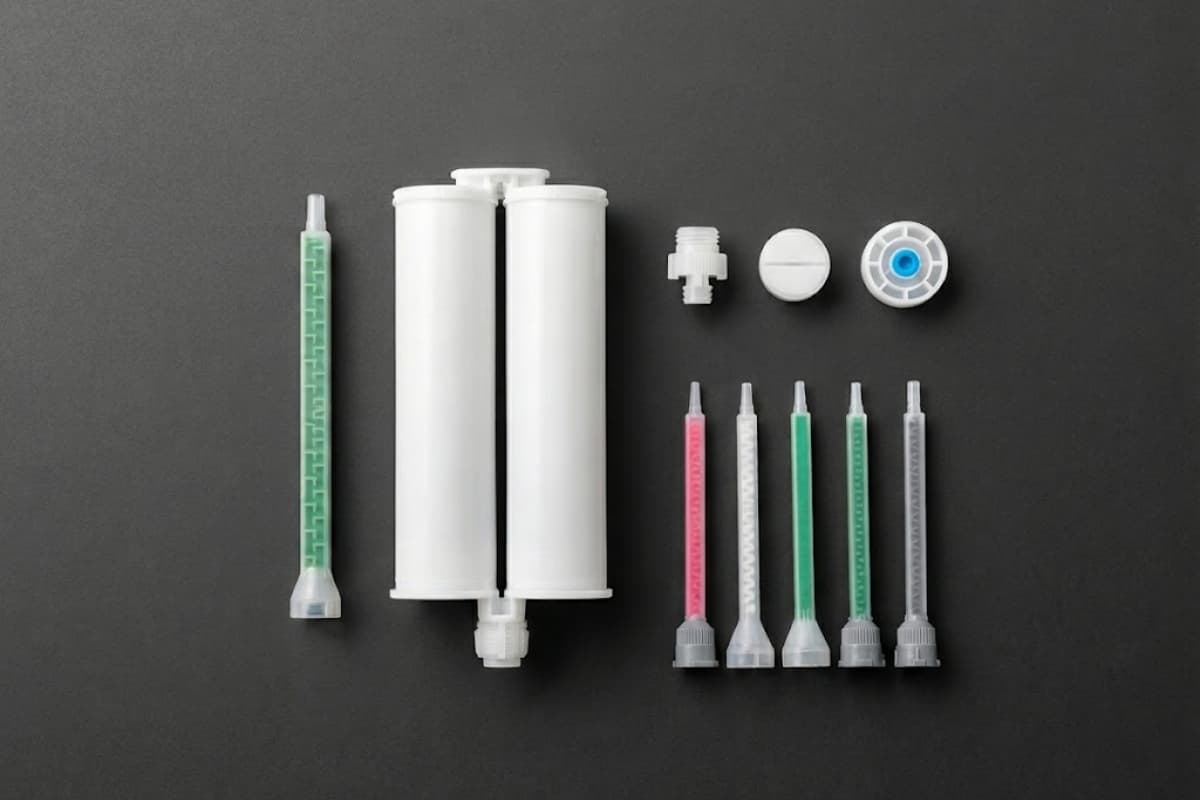
- Two-component cartridge. Molded from medical-grade copolymer (PP/PE family) under ISO 9001 precision injection, with fixed ratios of 1:1, 2:1, 4:1, and 10:1 and volumes from 50 ml to 600 ml. A low-void, tight-tolerance bore keeps both chambers isolated until dispensing and prevents pre-mix at the interface. For fibrin-sealant-class products that are inherently 1:1, the cartridge locks the two components at exactly the intended ratio. The same platform also works as a bone cement cartridge for two-paste cement systems.
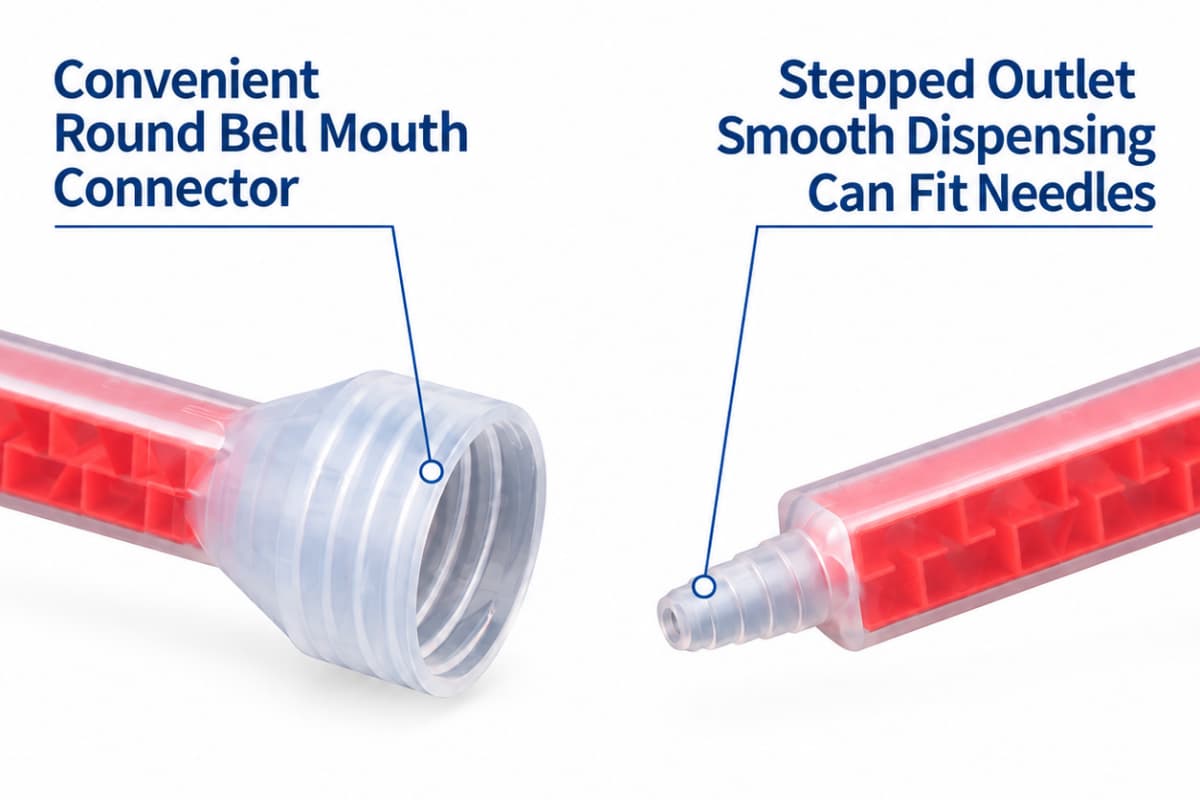
- Static mixing tube / nozzle. Square-tab and helical element geometries, with element counts selectable from 8 to 32, let us match mixing length to viscosity and chemistry—epoxy, polyurethane, acrylate, or silicone—without changing the cartridge. Mixing is isolated and disposable, eliminating cross-contamination between lots.
- High-thrust manual / pneumatic glue guns + semi-auto potting machines. For higher-viscosity bone cement and structural sealants, a high-thrust gun or benchtop potting filler drives both parts at constant pressure, while our semi-auto filler supports low-air-entrapment, no-void potting of connectors and sensors.
The upgrade is what turns a proprietary bulk resin into an “open-and-apply” sterile kit—raising clinical consistency while letting the adhesive brand owner keep formulation control under NDA.
Process Control & Clean Production: Meeting Medical Traceability
For medical duty, material choice is only half the story. We control the process so the cartridge performs the same on every lot:
- CCD-vision dispensing robot. Our automatic dispensing station aligns to part features with CCD vision and holds ±1% repeatability, removing operator variation from micro-dispensing of catheters, needles, and microfluidic seals.
- NDA & batch records. Formulations are handled under confidentiality agreements; each cartridge lot carries batch identification for downstream device traceability.
- Cleanroom-compatible handling. Cartridges and mixers are packed in clean, low-particulate formats suitable for medical assembly environments, with optional sterile or cleanroom presentation on request.
Representative Validation: A Phased “Bulk-to-Kit” Program
Mirroring how we de-risk a new line for a surgical-sealant or bone-cement producer, the program progresses in three phases (metrics are the system’s validated performance for this product class):
- Phase 1 — single-station pilot. Cartridge + static mixer replaced manual cup mixing on a sealant SKU. Ratio held at ±1%, air entrapment fell below 0.5%, and scrap dropped from ~10% to under 2%.
- Phase 2 — line integration. A CCD-vision dispensing robot was added for catheter and needle bonding. Repeatability at ±1% lifted first-pass yield and removed the manual-weigh labor step.
- Phase 3 — multi-site consistency. Across repeated batches the cartridge/mixer combination held ratio and void performance stable, giving the producer confidence to standardize the kit across sites and SKUs.
Solution Results: From Lab Spec to Line Performance
Both pilot data and line feedback confirm the advantages of the cartridge-and-mixer approach for surgical sealants and bone cement. Key indicators:
| Metric | Before (manual mix) | With cartridge + static mixer | Improvement |
|---|---|---|---|
| Ratio accuracy | ±8–10% | ±1% | ~9× tighter |
| Air entrapment (voids) | visible bubbles | <0.5% | near-void-free |
| Assembly scrap | 8–12% | <2% | ~5× lower |
| Labor per kit | manual weigh + stir | open-and-apply | eliminated weigh step |
| Traceability | lot-level only | cartridge-batch ID | device-level |
For a bone-cement or sealant SKU, the combined effect is fewer rejects, steadier cure, and a clinician-ready kit the brand can private-label—exactly the outcome the medical segment needs to scale.
Summary and Outlook: Cartridge-and-Mixer Systems Enable Scalable Medtech Assembly
For producers of surgical sealants and bone cement—Baxter‘s TISSEEL and bone-cement families are the textbook example—the “bulk-to-kit” conversion is the shared bottleneck. A medical-grade two-component cartridge plus a matched static mixing tube resolves ratio drift, air entrapment, and sterile-packaging needs in one closed system, and adapts to each scenario through ratio, element geometry, and dispensing automation.
Looking ahead, we are extending the approach to pre-filled sterile kits, tighter CCD-aligned automation for microfluidic and AR-optic bonding, and regional support so overseas medical OEMs get faster sampling and validation. Our goal is to keep ratio accuracy within ±1% and voids below 0.5% while turning every proprietary formulation into a ready-to-use, traceable medical kit.
Explore Our Medical Dispensing Solutions
- Two-Component Cartridges — 1:1 to 10:1 ratios, 50–600 ml, ISO 9001 medical-grade.
- Static Mixing Nozzles — square-tab & helical elements, selectable 8–32 counts.
- Glue Guns — manual & pneumatic high-thrust dispensing for viscous sealants.
- Potting Machines — semi-auto, low-void potting of connectors and sensors.
- Automatic Dispensing Robot — CCD-vision alignment, ±1% repeatability.
FAQ
What ratio options do medical-grade two-component cartridges support?
Standard fixed ratios are 1:1, 2:1, 4:1, and 10:1, molded to tight tolerance so Part A and Part B always dispense in spec. Custom ratios can be engineered to match a specific formulation—1:1 is typical for fibrin-sealant-class products.
How do you minimize air entrapment in static mixing?
We use selectable square-tab or helical mixing elements (8–32 elements) sized to the adhesive viscosity, combined with a low-void cartridge bore and constant-pressure dispensing. Typical validated void rates are below 0.5%.
Are the cartridges compatible with silicone, acrylate, and epoxy?
Yes. The cartridge-and-mixer system handles epoxy, polyurethane, acrylate, and silicone chemistries. The mixer element geometry is chosen per chemistry to avoid under- or over-mixing.
Can HaiJing provide sterile or cleanroom packaging for medical adhesives?
Cartridges and mixers are supplied in clean, low-particulate formats suitable for medical assembly, with sterile or cleanroom presentation available on request. Formulations are handled under NDA with batch-level traceability.
Do you offer OEM/ODM private-label for medical adhesive brands?
Yes. We provide private-label two-component cartridges, static mixing tubes, and guns as a complete consumable kit, plus semi-auto potting machines and CCD-vision dispensing robots—so adhesive brands can ship a ready-to-use, traceable medical kit under their own name.
Conclusion & Contact us
Two-part medical adhesives win or lose at the point of delivery. A medical-grade two-component cartridge and matched static mixing tube convert bulk resin into a sterile, ratio-accurate, low-void kit—raising yield, steadying cure, and supporting device-level traceability. Contact HaiJing / Sindesun to request samples or a bulk-to-kit validation plan for your surgical sealant, bone cement, or disposable-device adhesive line.