Key Takeaways
- PP is the default. Industrial-grade polypropylene handles most epoxies, polyurethanes, and silicones at the lowest cost.
- PA adds strength. Polyamide housings resist higher pressures and temperatures where PP would creep or soften.
- PBT leads on dimensional stability. Tighter as-molded tolerances and better chemical resistance suit demanding automated lines.
- Chemical compatibility decides. The cheapest nozzle that survives your resin chemistry for the full dispense cycle is the right one.
- Document the material lot. Virgin-polymer certification per batch is what makes a failed part traceable — and a supplier accountable.
Buy a mixing nozzle and you are really buying a polymer decision someone else already made for you. The material molded into that housing decides whether it holds pressure through a 400ml cartridge, survives contact with an aggressive solvent carrier, or holds dimensional tolerance across ten thousand units on a robotic cell.
In short: PP covers most general-purpose work, PA buys mechanical strength, and PBT buys precision and chemical resistance. Pick by chemistry first, cost second.
Why the Housing Polymer Matters
A mixing nozzle looks like a commodity plastic part, but it operates under sustained internal pressure while in contact with reactive chemistry. Fail either condition and the failure mode is ugly: a burst housing sprays mixed adhesive mid-cycle, and a chemically attacked housing sheds softened polymer into your bond line.
Three material families dominate cartridge-style mixers: polypropylene (PP), polyamide (PA, commonly called nylon), and polybutylene terephthalate (PBT). All three are injection-moldable engineering polymers, and all three appear across standard catalog ranges — meaning the choice is genuinely open for most buyers, not a premium-only option.
Quick specs: the three materials at a glance
| Property | PP | PA (Nylon) | PBT |
|---|---|---|---|
| Cost tier | Lowest | Mid | Mid-high |
| Typical role | General-purpose standard mixers | High-strength housings | Precision and chemical-resistance parts |
| Pressure handling | Adequate for standard dispensing | High | High |
| Dimensional stability | Good | Good (moisture-sensitive) | Excellent |
| Chemical resistance | Broad, weak against some solvents | Good, varies by chemistry | Excellent against solvents and oils |
Use the table for triage; the selection logic below is where the actual decision gets made.
Polypropylene (PP): The Workhorse
Industrial-grade PP is the standard housing material for catalog static mixers, and it earns that position. It molds cleanly with excellent chemical resistance across most epoxy, polyurethane, and silicone systems, it resists moisture absorption, and it is the cheapest of the three options by a clear margin.
Its chemical resistance profile comes from the polymer’s nonpolar backbone: most aqueous systems, alcohols, and the resin chemistry of standard two-part adhesives simply have nothing to attack. Where PP struggles is with strong oxidizers and certain nonpolar solvents — aromatic and chlorinated hydrocarbons in particular — which can swell and soften the polymer over sustained contact.
If your formulation carries a solvent carrier in that family, the compatibility question is live, and the answer is usually one step up the material ladder.
Its mechanical limits are equally clear. Under sustained high pressure — think thick structural adhesives driven by pneumatic guns or meter-mix equipment — PP can creep, meaning the housing slowly deforms under load over the dispense cycle.
Where PP creep shows up, and where it never does:
- Manual dispensing — pressure pulses are short; creep never manifests.
- Standard pneumatic setups — within ratings; not a practical concern.
- High-pressure automated lines — sustained load deforms the housing; this is why buyers step up to PA or PBT.
Polyamide (PA): Strength Under Pressure
Polyamide housings carry higher pressure ratings and better mechanical toughness than PP at similar weight. They hold their shape under the sustained loads of pneumatic dispensing and resist the fatigue of repeated cartridge changes on automated cells.
The engineering basis is the amide groups in the polymer chain, which form strong inter-chain hydrogen bonds — the same chemistry that makes nylon a structural fiber. Those bonds give PA its stiffness and toughness, and they also create its one well-known liability: they attract water.
The trade-off is moisture. PA absorbs humidity from the environment, which slightly shifts its dimensions and mechanical properties over time. For a disposable nozzle consumed within weeks of molding this is rarely a practical concern, but it is why PA is a choice for strength-driven applications rather than precision-driven ones.
Two handling notes follow from it: store PA parts in their original sealed packaging, and if a population has sat in a humid warehouse for a season, expect the first article inspection to show slightly different dimensions than the original qualification lot.
PBT: Precision and Chemical Resistance
PBT is the premium tier for parts that must hold tight as-molded tolerances and shrug off aggressive chemistry. Its dimensional stability exceeds both PP and PA, and it resists solvents, oils, and fuels that would attack standard polypropylene.
The practical meaning of “dimensional stability” on a dispensing line is fit. A bayonet interface molded 0.1mm oversize jams in the fixture; one molded undersize leaks under pressure. Semi-crystalline PBT holds its as-molded dimensions across production runs with less shrinkage variation than PP, which is why the interface-critical and wide-ratio parts in cartridge catalogs skew toward it. Its solvent resistance comes from the crystalline domains that do not admit small aggressive molecules the way amorphous regions do.
In cartridge-component catalogs, PBT appears on parts where fit precision matters: bayonet interfaces that must seal reliably under pressure, wide-ratio mixer housings, and components destined for chemically demanding formulations. If your dispensing line jams when a nozzle is out of spec, PBT is the material that keeps the population within tolerance.
Material and Mix Ratio: The Interplay
Material choice and ratio choice interact more than buyers expect. Wide-ratio formulations — 4:1 and 10:1 structural adhesives — tend to arrive in higher-pressure dispensing scenarios and with more aggressive activator chemistry than 1:1 potting compounds.
The combination pushes selection up the ladder twice: once for pressure (PA or PBT over PP) and once for chemistry (PBT if the activator carries solvents).
The reverse holds for standard 1:1 and 2:1 silicones and polyurethanes in manual dispensing: PP is fully adequate on both axes, and paying for PBT buys margin you will never use. The error to avoid is standardizing one material across an entire consumables cabinet when your programs span both worlds — the right cabinet has PP on the silicone line and PBT on the wide-ratio structural line.
Not sure which polymer survives your resin?
Send your adhesive datasheet or chemistry family — we will match the housing material against it and send samples for a compatibility soak test on your own line.
How to Choose: A Three-Question Decision Grid
- Question 1 — What drives the nozzle? Manual gun or standard pneumatic dispensing: start with PP. Sustained high pressure or meter-mix equipment: move to PA or PBT.
- Question 2 — What does the resin contain? Standard epoxy, PU, or silicone chemistry: PP usually passes. Solvent carriers, aggressive plasticizers, or fuel-contact formulations: request the compatibility chart and lean PBT.
- Question 3 — What happens if dimensions drift? Manual dispensing tolerates small drift: any material works. Robotic or automated fitting demands population-level consistency: PBT.
Answer the three questions in order; the first one that forces a move up the ladder settles the material.
Worked scenario: one resin, two nozzles
Consider a manufacturer running a solvent-borne 10:1 structural adhesive who initially qualified standard PP mixers because they were in stock and cheap. Within weeks, housings were softening near the outlet where the solvent concentrated. Moving to PBT housings for that program only — while keeping PP on the 1:1 silicone line in the adjacent cell — solved the failures without repricing the entire consumables budget. The lesson generalizes: material selection is per-program, not per-facility.
Material Quality Is Not Just the Grade
Beyond the polymer family itself, the difference between a reliable nozzle and a problematic one is resin quality and process control. Mixers molded from 100% virgin polymer, with no regrind contamination, behave consistently from lot to lot; regrind streams introduce uncontrolled variation exactly where dimensional and chemical performance matter. This is why material certification and lot traceability belong on your incoming inspection checklist for any high-volume mixer program.
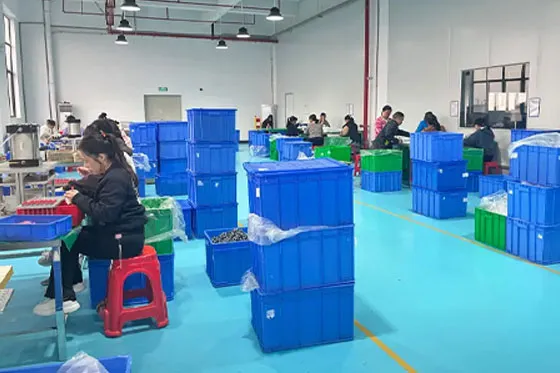
The scale of the operation reinforces the discipline. Our plant molds these components on more than 60 precision injection molding machines spanning 10 to 600 tons of clamping force, producing over 85 million static mixers a year, with full traceability from raw material batch to finished product. At that volume, a material inconsistency is not an anecdote — it is a recall, and the process is built to prevent it.
Commercially, mixer samples ship in 3 to 7 days for compatibility testing, with a standard mixer MOQ of 3,000 pieces for volume programs.
The full material ranges, including PBT variants and custom configurations, are listed under static and dynamic mixers.
Custom Configuration Paths
When stock parts miss, the customization route is shorter than most buyers expect. The standard variables are element count, housing length, body material, and outlet type — and because the tooling for common cartridge interfaces already exists in a mixer factory, a custom PP or PBT variant on a standard interface is an engineering conversation, not a development program.
The trigger for going custom is repeatable borderline performance: stripe tests that pass but with no margin, dimensional reports that sit at the edge of your fixture tolerance, or compatibility soaks that show the first signs of attack. Each of these has a custom answer — more elements for the mixing margin, a PBT body for the tolerance margin, a material change for the chemistry. What does not have an answer is ignoring the margin and hoping the next lot is luckier.
Commercially, the path runs: engineering review of your requirements, a quotation covering tooling if new molds are needed, prototype samples for your own line trials, and volume production once the samples pass. Samples ship in 3 to 7 days for standard configurations; genuinely new tooling adds a development lead time your engineering contact should state precisely rather than estimate optimistically.
Compatibility Testing You Can Run Yourself
You do not need a laboratory to pre-qualify a material against your chemistry. The soak test is the workhorse, and it runs in two stages:
- Expose — contact samples of each candidate polymer with your resin components, at room temperature and at process temperature, for the full worklife of the adhesive plus the time a mounted nozzle sits before disposal.
- Inspect — check for weight gain (swelling), surface softening, discoloration, and any change in fit at the interface.
Two caveats keep the test honest. First, test the molded part, not a raw polymer coupon — molded surfaces, colorants, and processing can all shift compatibility. Second, test the specific lot chemistry you actually buy, because formulation revisions from your adhesive supplier are a silent variable that invalidates last year’s qualification. Pair your soak results with the supplier’s compatibility chart and the two sources of evidence rarely disagree; when they do, trust your soak.
Why We Write This
We mold all three polymers in-house, so this guide is written from the production floor rather than a resale catalog. Our interest is that the material you specify survives your chemistry — a failed nozzle in the field costs both of us more than the price difference between PP and PBT.
References
- Polymer compatibility profiles (PP nonpolar resistance, PA hydrogen-bond toughening and moisture absorption, PBT semi-crystalline solvent resistance) — standard polymer science references for engineering thermoplastics.
- Material families and custom configuration options (PP/PA/PBT, custom element count, length, materials) — gluecartridges.com product pages, 2026.
- Virgin-polymer policy, lot traceability, and plant scale (60+ machines, 10–600 tons, 85M+ mixers/year) — HaiJing manufacturing documentation, 2026.
- Commercial terms (MOQ 3,000, samples 3–7 days) — HaiJing sales terms, 2026.
Material choice is only one part of approval. The epoxy mixing nozzle buying guide adds cartridge fit, sample testing, waste measurement, and incoming inspection controls.
Material selection still needs application evidence. The mixing nozzle qualification protocol verifies the selected polymer and geometry with the real adhesive, tip, dispenser, operating cycle, and cure plan.
Frequently Asked Questions
Is PP good enough for epoxy mixing nozzles?
When is PBT worth the extra cost?
Does nylon absorb moisture in storage?
What is regrind and why avoid it?
Can I get mixers in custom materials?
Which material suits wide-ratio adhesives?