Helical vs Quadro Static Mixers: Which Geometry Fits Your Adhesive?

Anatomical Breakdown: How Helical and Quadro Geometries Work
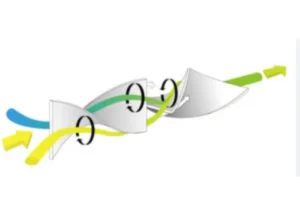
Helical Element Flow Pattern:
[Part A + Part B] —> ( 180° Left Helix ) —> Split Stream —> ( 180° Right Helix ) —> Recombined Stream
Longer axial distance required per layer multiplication.
Quadro Element Flow Pattern:
[Part A + Part B] —> [ Interlocking Square Grid ] —> Short-Distance Division —> [ Compact Recombination ]
Rapid layer multiplication over a significantly shorter physical length.
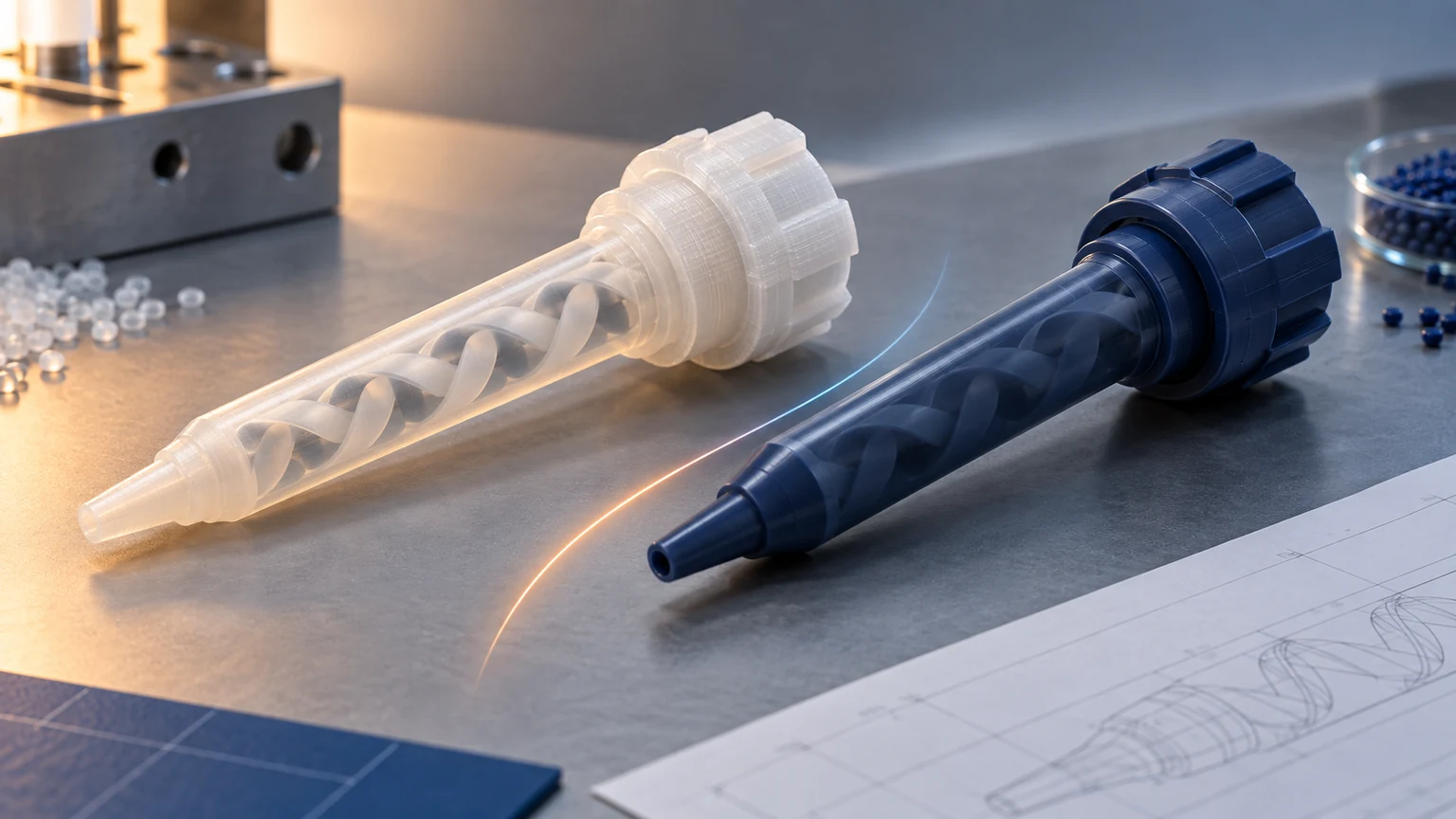
Helical Static Mixer Geometry
-
Division and Recombination: Each element cuts the incoming fluid stream in half and rotates it 180 degrees, shifting the orientation before passing it to the next element positioned at a 90-degree angle.
-
Flow Trajectory: The fluid follows a smooth, continuous axial path along the length of the housing.
-
Mix Quality: The gradual rotation reduces localized shear stress, allowing delicate or filled adhesive systems to blend evenly without localized thermal buildup or excessive backpressure.
Quadro (Square) Static Mixer Geometry
-
Division and Recombination: Rather than rotating the fluid through a gradual spiral, each square element splits the fluid into multiple distinct sub-streams within a significantly shorter axial distance.
-
Flow Trajectory: Fluid is forced through rapid, right‑angle divisions and recombinations. This accelerates the exponential multiplication of layers—where the number of layers equals 2 raised to the power of n, with n being the number of elements—over a fraction of the physical length required by a helical nozzle.
-
Spatial Efficiency: By achieving complete homogenization in fewer linear millimeters, the internal volume of the mixer is drastically reduced.
Engineering Performance Matrix: Helical vs. Quadro
| Engineering Metric | Helical Static Mixers | Quadro / Square Static Mixers |
| Element Geometry | Continuous 180° left/right spiral blades | Compact interlocking square element grid |
| Relative Length | Standard length footprint | ~30% to 50% shorter for equivalent mixing performance |
| Retained Material Waste Volume | Higher waste volume per equivalent element count | Significantly lower residual volume post-dispense |
| Flow Resistance & Pressure Drop | Lower backpressure build-up; smooth fluid transition | Higher pressure drop per unit length due to tight flow paths |
| Shear Rate | Low to moderate shear rate | Higher localized shear rate |
| Primary Advantage | Ideal for high-viscosity pastes and low-force dispensing | Ideal for expensive resins requiring minimal residual waste |
Understanding the Pressure Drop vs. Waste Trade-Off
-
Volume Retention & Cost Control: In automated or high-volume manual dispensing, two-part adhesives left inside a used nozzle cure and must be discarded. Because a Quadro mixer is up to 50% shorter than a helical mixer capable of achieving the same mixing degree, it retains substantially less un-dispensed resin. For high-cost chemistry—such as specialized structural acrylics or medical-grade epoxies—this reduction in material waste directly impacts per-unit production costs.
-
Pressure Drop:Fluid forced through the tight geometry of a Quadro mixer experiences higher shear resistance. According to fluid dynamic principles governing laminar flow in constrained channels, restricted cross-sectional areas generate higher pressure drop. If a dispensing pump or pneumatic gun cannot supply the required pressure, flow rates will drop, or the cartridge housing may experience swelling or leakage at the interface. Helical mixers provide a wider, smoother flow channel that yields lower backpressure at equivalent volumetric flow rates.
Adhesive Compatibility & Selection Framework
[Adhesive Selection Decision Tree]
|
—————————————————–
| |
(Viscosity Evaluation) (Mix Ratio & Cost)
| |
——————————- ——————————-
| | | |
High Viscosity / Low Viscosity / High-Cost Resin / Extreme Ratios
Thixotropic Paste Free-Flowing Fluid Compact Footprint (e.g., 10:1 Ratio)
| | | |
[Helical Mixer] [Quadro Mixer] [Quadro Mixer] [Evaluate Pressure]
Lower backpressure Minimal waste & Reduces fluid loss Quadro (Short length) OR
prevents stall short footprint per purge cycle Helical (Lower force)
1. High-Viscosity Pastes and Thixotropic Systems
-
Recommendation: Helical Static Mixers.
-
Reasoning: The gradual transition along a helical element path prevents excessive backpressure. Pushing high-viscosity materials through a compact Quadro element can exceed the pressure capacity of standard pneumatic applicators or cause manual dispensing guns to jam.
2. Filled Resins and Shear-Sensitive Formulations
-
Recommendation: Helical Static Mixers.
-
Reasoning: Helical geometry imposes lower shear rates on the fluid, preserving filler integrity during the division-recombination process.
3. Low-to-Medium Viscosity Resins and Expensive Formulations
-
Recommendation: Quadro Static Mixers.
-
Reasoning: Since backpressure remains within manageable limits due to lower fluid viscosity, the shorter physical length of the Quadro mixer minimizes material retention without risking equipment stall or cartridge joint failure.
4. Asymmetric Mix Ratios (4:1 and 10:1)
-
Recommendation: Context-Dependent (Evaluate Dispensing Drive Force).
-
Reasoning: A 32-element helical mixer becomes long and holds a higher volume of wasted adhesive. A 24- or 32-element Quadro mixer keeps the nozzle short and manageable, but backpressure must be checked against pump specifications or pneumatic line pressure settings.
When Standard Geometries Fail: Custom Static Mixer Engineering
-
Extreme viscosity differentials between Component A and Component B (e.g., 1,000,000 cPs paste mixed with a 50 cPs liquid hardener).
-
Proprietary cartridge neck geometry or non-standard automated robotic mounting brackets.
-
Abrasive fillers (such as ceramic or aluminum oxide particles) requiring reinforced housing walls or specialized wear-resistant fluoropolymer/polypropylene element materials.
-
Specialized downstream attachments, such as integrated luer-lock tips, stepped spreaders, or extended flexible extension tubes.
Key Takeaways
-
Geometry Principles: Helical mixers use alternating 180-degree spiral blades for smooth axial flow; Quadro (square) mixers use interlocking grid elements for rapid fluid layer division in a shorter footprint.
-
Material Waste Reduction: Quadro mixers reduce residual adhesive waste by 30% to 50% compared to equivalent helical mixers, making them cost-effective for expensive resin formulations.
-
Pressure Drop Considerations: Helical mixers generate lower backpressure (pressure drop), making them superior for high-viscosity pastes, filled resins, and low-force dispensing applicators.
-
Interface Matching: Ensure selected geometries are paired with appropriate cartridge connection standards (System A, B, C, or F) capable of handling the operational backpressure generated during dispensing.