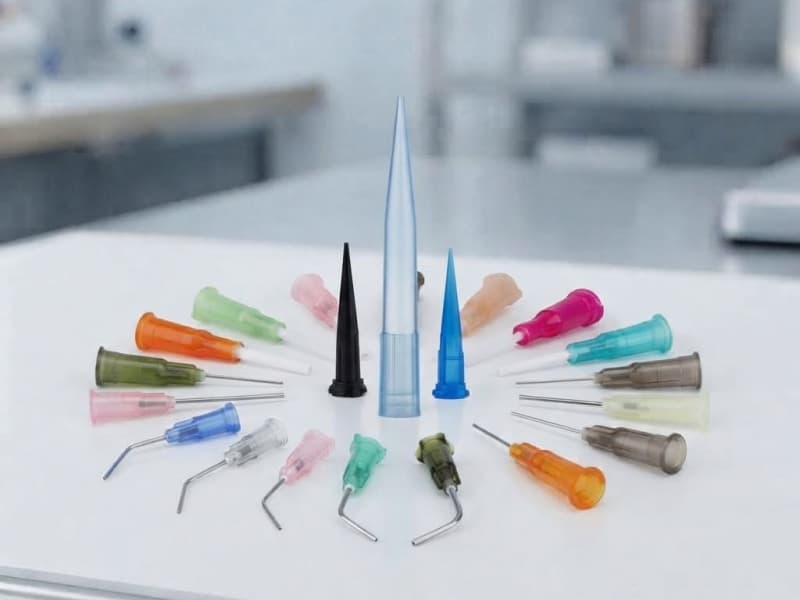
Dispensing tip geometry determines flow behavior more than the gauge number does. Two tips with the same 18G bore — one straight stainless cannula, one molded taper — run at different pressures, leave different residual ooze and produce different bead shapes, because geometry fixes the length and taper of the narrowest section, not just its diameter.
Most tip selection starts and ends with the gauge number, and that is where most dispensing problems begin. Gauge fixes the bore. Geometry fixes everything about how the fluid behaves on the way to that bore: how much pressure it takes to move, whether it stops when the valve stops, and whether the bead lands where you aimed it. If you have ever changed only the gauge and been surprised by the result, geometry was the variable you did not control.
Why geometry outweighs gauge in real lines
Inside a straight cannula, the fluid sees a constant cross-section the whole way down. Inside a taper, the cross-section shrinks progressively. That difference changes three things at once:
- Pressure needed to start flow. A taper reduces the length of the narrowest section, so the same bore can run at lower pressure.
- What happens when the valve closes. Fluid stored under compression in a long straight bore has to go somewhere. It oozes.
- How particles behave. A taper guides filler toward the exit; a straight bore lets it settle along the wall.
Straight stainless needles
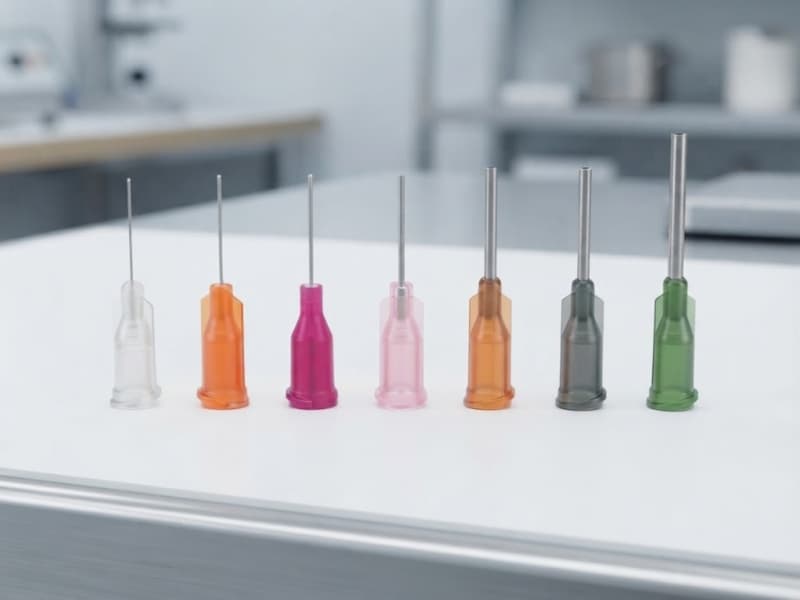
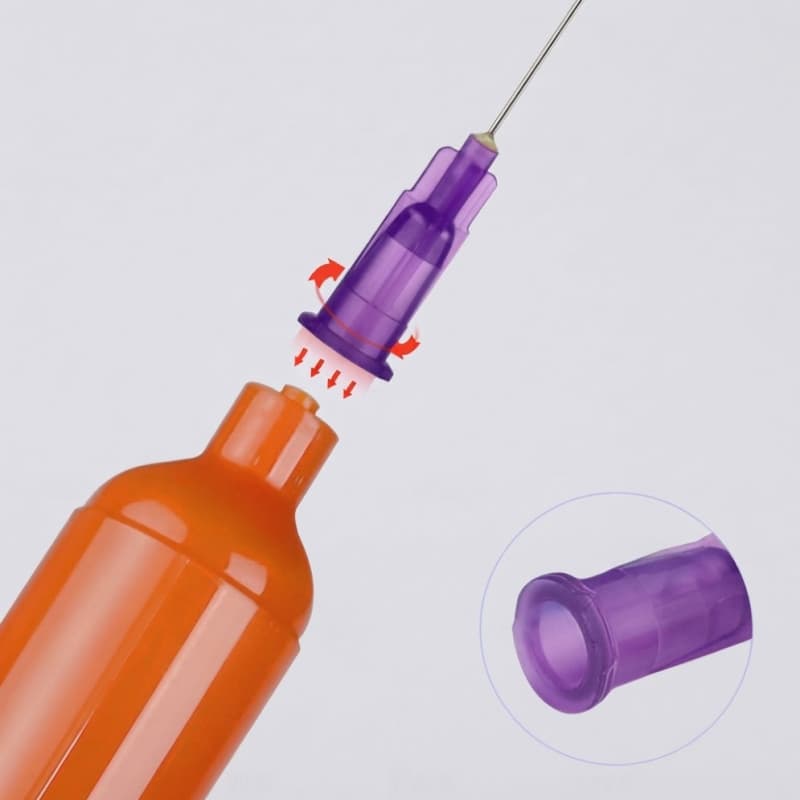
A straight stainless dispensing needle is a rigid 304 or 316 stainless cannula, pressed or bonded into a plastic hub, with standard lengths of 6.4 mm, 12.7 mm and 25.4 mm.
When should you choose a straight stainless needle?
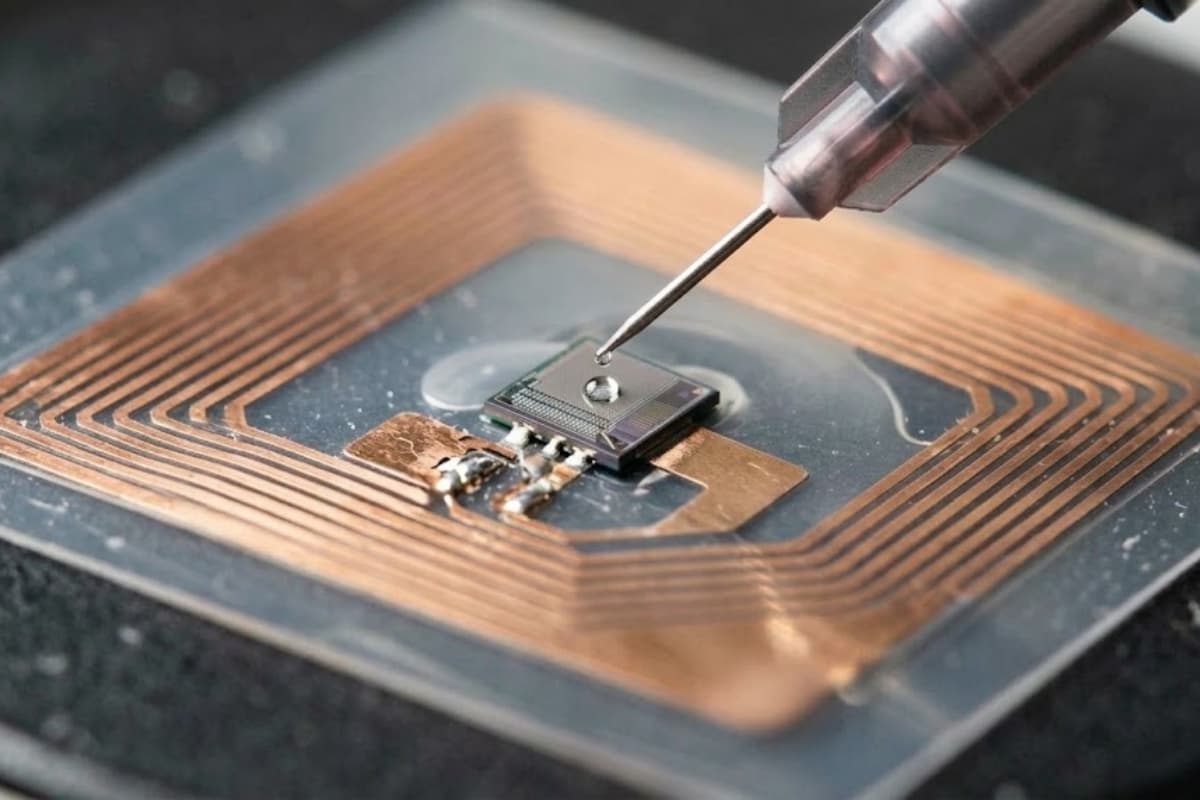
Where it wins: low to medium viscosity fluids that need a predictable, repeatable line or dot — solvents, light oils, unfilled epoxies, conformal coatings. The rigid wall keeps the exit exactly where you put it, which matters on automated gantries where the tip doubles as the Z reference.
Where it fails: thick pastes and gels, where the long narrow bore multiplies pressure drop, and any application where the needle might contact the part. A rigid needle that touches a substrate either scratches it or bends, and a bent cannula is no longer aiming where the program thinks it is.
Tapered tips
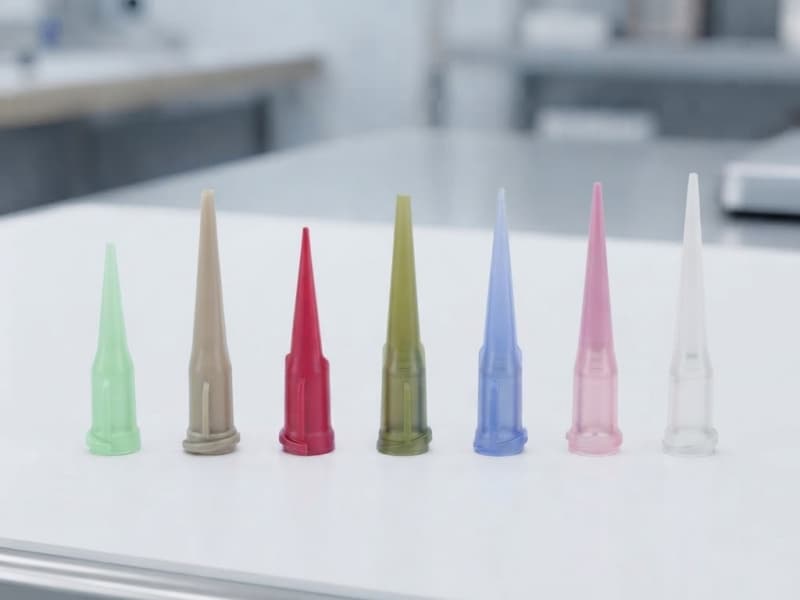
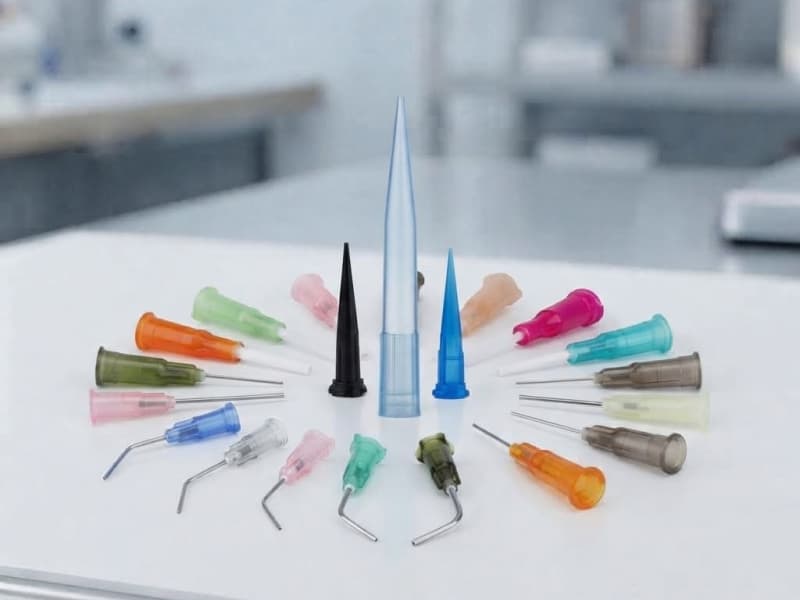
Tapered dispensing tips are molded cones, usually in PE or PP, that narrow from the hub down to the exit. The internal flow path is short and gradually convergent instead of long and constant.
When should you choose tapered dispensing tips?
Where it wins: tapered dispensing tips are the default choice for high-viscosity adhesives, gels, silicones, thermal compounds and particle-filled pastes, and they take over above roughly 5,000 cPs — below that the taper’s shut-off advantage is negligible. The short convergent path cuts pressure drop, which means lower air pressure for the same flow — and that is the real benefit. Lower pressure means less energy stored in the fluid, which means less post-dispense ooze when the valve shuts. Where a paste also carries abrasive filler, the tip wears as well as clogs — see filled adhesives wear tips faster.
Key takeaway: this is the most commonly misunderstood point in tip selection: people reach for tapered tips to dispense faster, and they get speed, but the more valuable effect is cleaner shut-off on thick materials.
Where it fails: fine work on rigid parts. A molded taper is not as dimensionally precise at the exit as a drawn cannula, and the plastic is soft enough to deflect.
Flexible PP tips
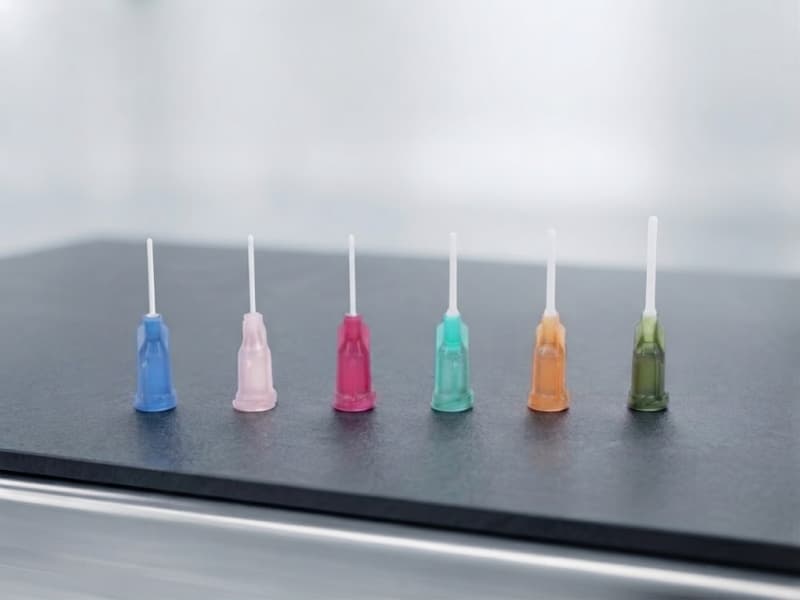
Flexible PP tips follow the same convergent logic as tapered dispensing tips, in a soft polypropylene body, often supplied long and cut to length on site.
When do flexible PP tips outperform rigid needles?
Where it wins: scratch-sensitive substrates, blind holes, recessed cavities, uneven surfaces. The tip can touch down and deflect instead of marring the part. Also useful where the operator needs to reach into a space a rigid needle cannot enter at an angle.
Where it fails: anything requiring positional accuracy at the exit, and high-pressure work where the soft wall balloons.
Bent and angled tips
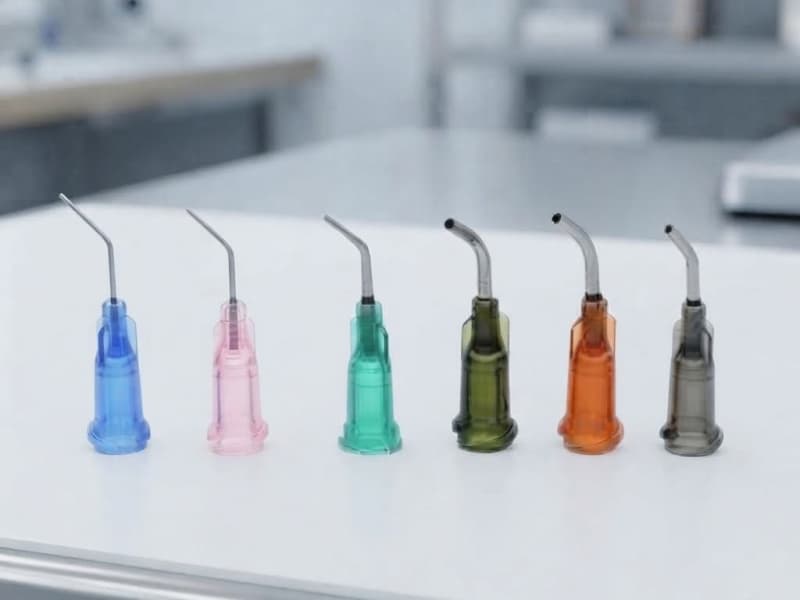
A bent or angled dispensing tip is a cannula bent to 45° or 90°, used for side-fill or for reaching behind a feature.
When is a bent or angled tip necessary?
Where it wins: potting boxes with tall walls, connector shells, and any geometry where a vertical approach is blocked.
Where it fails: the bend is a pressure loss and a dead zone. Fluid sits in the elbow between shots, and with fast-curing materials that pocket is where the clog starts. If you need a bend, keep it as close to the exit as possible and flush more often.
Brush tips
A brush tip is a fiber or foam brush on a hollow stem, fed through the hub.
When should you use a brush tip instead of a needle?
Where it wins: spreading a thin, even film over an area rather than laying a bead — thread lockers, primer, solvent wipe, small-area coating. It replaces a dispensing step and a spreading step with one motion.
Where it fails: any volumetric requirement. A brush delivers a film, not a dose.
Selection table
| Geometry | Typical material | Viscosity fit | Shut-off quality | Scratch risk | Choose when |
|---|---|---|---|---|---|
| Straight needle | 304/316 SS | Low–medium (up to ~10,000 cPs) | Moderate | High | Precise dot or line on a flat, accessible surface |
| Tapered tip | PE / PP | Medium–paste (5,000 cPs and up) | Good | Low | Thick adhesive, ooze or stringing is the complaint |
| Flexible PP | PP | Low–medium | Moderate | Very low | Delicate part, blind hole, or tip must touch down |
| Bent / angled | SS | Low–medium | Poor at the elbow | Moderate | Vertical access is blocked by part geometry |
| Brush | Fiber / foam | Low–medium | Not applicable | Low | You need a film over an area, not a dose |
Length and standoff: the two settings nobody writes down
Two more geometry variables decide bead quality, and both are usually left to whoever set the machine up.
How much does needle length change the pressure?
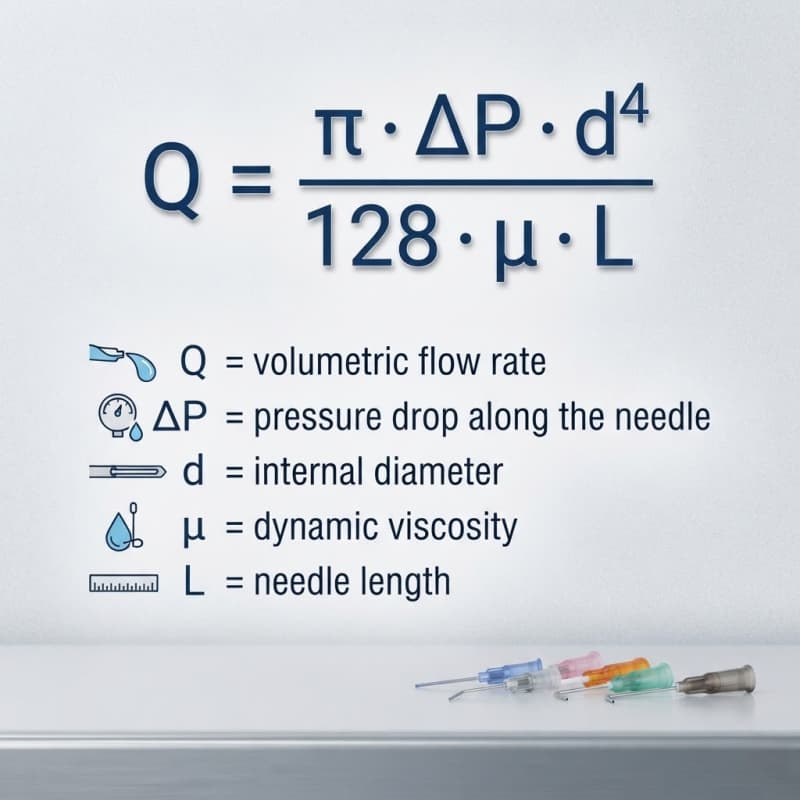
Length. Pressure drop scales linearly with length. Going from a 12.7 mm to a 25.4 mm cannula of the same bore doubles the pressure needed for the same flow. If someone “fixed” a flow problem by fitting a longer needle to reach a deeper cavity, they also doubled the pressure and added stored energy — which shows up later as ooze. For how pressure drop converts into actual flow loss at each gauge, see how pressure drop changes flow rate.
What tip-to-part gap should you set?
Standoff (tip-to-part gap). Too high and the bead lands off-target or curls; too low and the tip wipes the deposit or contacts the part. For a bead, the gap should be roughly the bead height you want. For a dot, contact dispensing is usually needed — the tip touches down, dispenses, then lifts, and surface tension pulls the dot clean.
When geometry is the wrong fix
If the complaint is incomplete mixing rather than bead shape, geometry will not help — the problem is upstream, in the number of mixing elements or the mix ratio. If the complaint is a bead that varies along its length, the problem is usually pressure or speed, not the tip.
How do you tell a geometry problem from a material one?
A useful triage: if the fault follows the tip (changes when you change tips), it is geometry. If it follows the material or the lot, it is chemistry. If it follows the machine or the shift, it is process control. Test in that order before buying anything.
What to specify when you order
What five things should you specify when ordering tips?
Give the supplier five things and the geometry question answers itself: fluid type and filler content, viscosity at dispense temperature, target deposit (dot diameter or bead width × height), cycle time, and the hardware the tip mounts to. Anything less and the supplier is guessing, which is how lines end up with a tip that is technically the right gauge and practically the wrong part.
The full bore-to-viscosity mapping sits in the dispensing needle gauge size chart; the interface side is covered in hub and connection types. Both matter more than the gauge number alone. The available geometries in stainless, PP, PTFE and brush form are listed with dimensions on the dispense tip range, and if the symptom is a blockage rather than a shape problem, start with why dispensing needles clog.
Frequently asked questions
Are tapered tips better than straight needles?
Not universally. Tapered tips are better for medium-to-high viscosity fluids because they reduce pressure drop and improve shut-off. Straight stainless needles are better for low-viscosity fluids and for applications needing precise exit position, because a drawn cannula is more dimensionally consistent than a molded taper.
Can I use a tapered tip for cyanoacrylate?
It is not the usual first choice. Cyanoacrylates are water-thin and cure on contact with moisture, so the wide-bore advantage of a taper is wasted, and the material tends to cure prematurely inside a plastic bore. A straight or PTFE-lined tip in a small gauge is the more common fit.
Does a longer needle change the dispense volume?
It changes the flow rate for a given pressure, because pressure drop scales with length. If the valve opens for a fixed time, a longer needle of the same bore will deliver slightly less material per shot. On timed dispenses, always re-qualify the shot volume after changing needle length.
Why does my bead curl instead of landing flat?
Usually standoff height, not geometry. Too large a gap lets the bead pull into a curve before it touches down. Reduce the tip-to-part gap to roughly the target bead height and re-test. If it still curls, check for a burr at the exit.