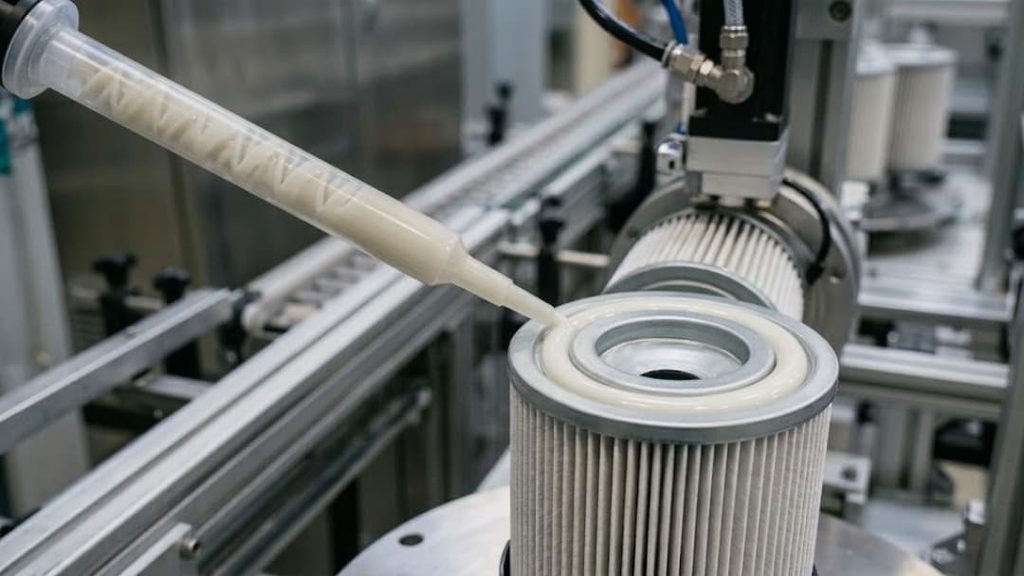
At filtration leaders like Donaldson, the element lives or dies at the bond. End-cap bonding, cartridge potting, and membrane encapsulation all depend on a two-component PU or epoxy that has to seal media to cap — and hold that seal for the life of the element. When that bond is flawed, the element fails leak testing, sealing life drops, and scrap climbs. The root cause is rarely the resin. It’s how the resin gets mixed.
Where Filtration Failures Start: Hand-Mixed Resin
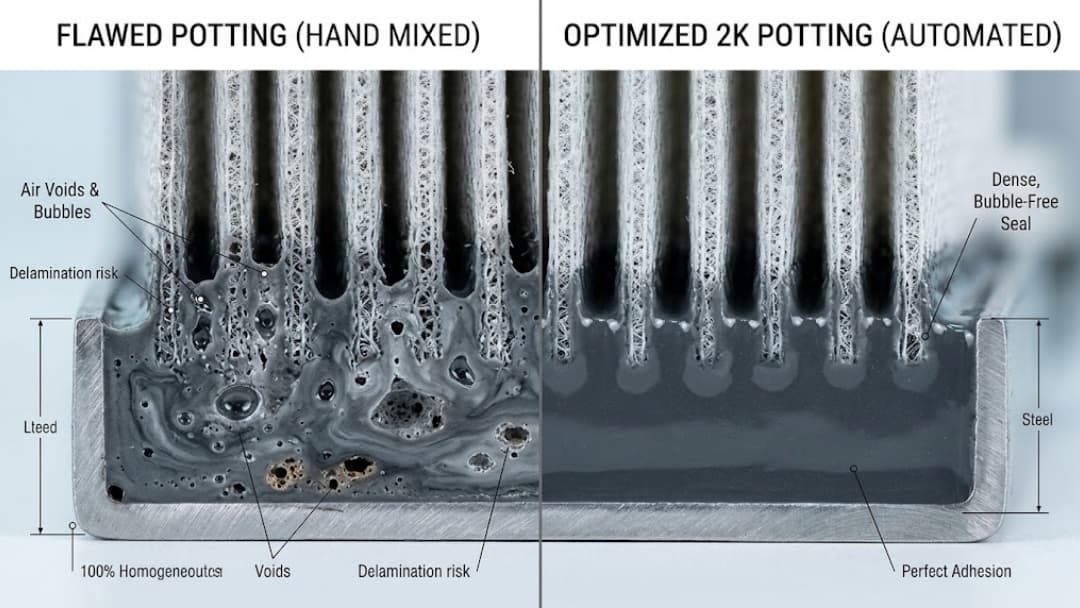
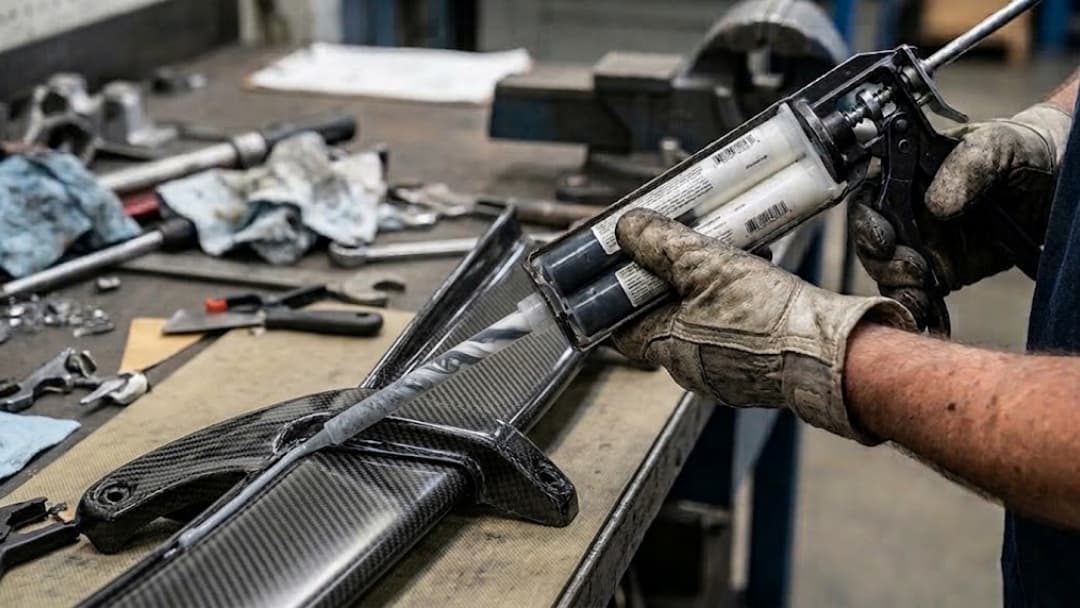
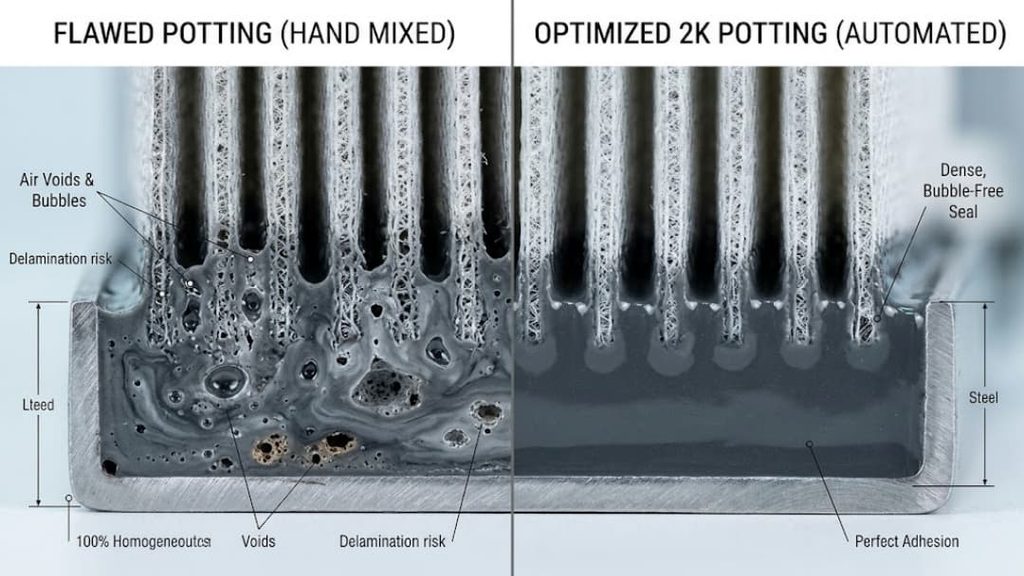
On many lines, two-part resin is still hand-mixed from bulk. The problem is air. Every fold of the stir stick whips atmosphere into the mix, and that entrained air has nowhere to go once the compound is poured against the media pack. It cures into voids right at the media-to-cap interface — the exact place the seal has to be continuous.
Those voids stay silent until test. They pass visual inspection, then surface as leak-test rejects, or worse, as in-field weeps that shorten element service life. Rework and scrap climb, and line yield becomes hostage to operator technique. The fix is not a better resin. It’s removing the operator — and the air — from the mixing step.
The Haijing Fix: A Closed, Metered 2K Dispensing System
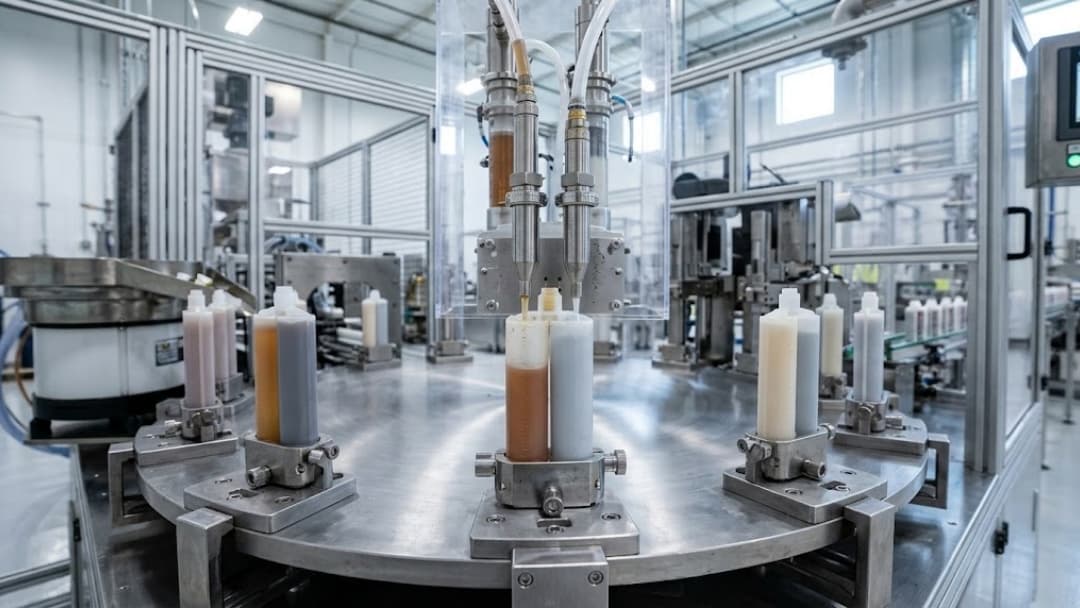
Haijing closes the gap with a closed, metered dispensing system built so the two components never meet air until the moment of dispense. Four elements do the work:
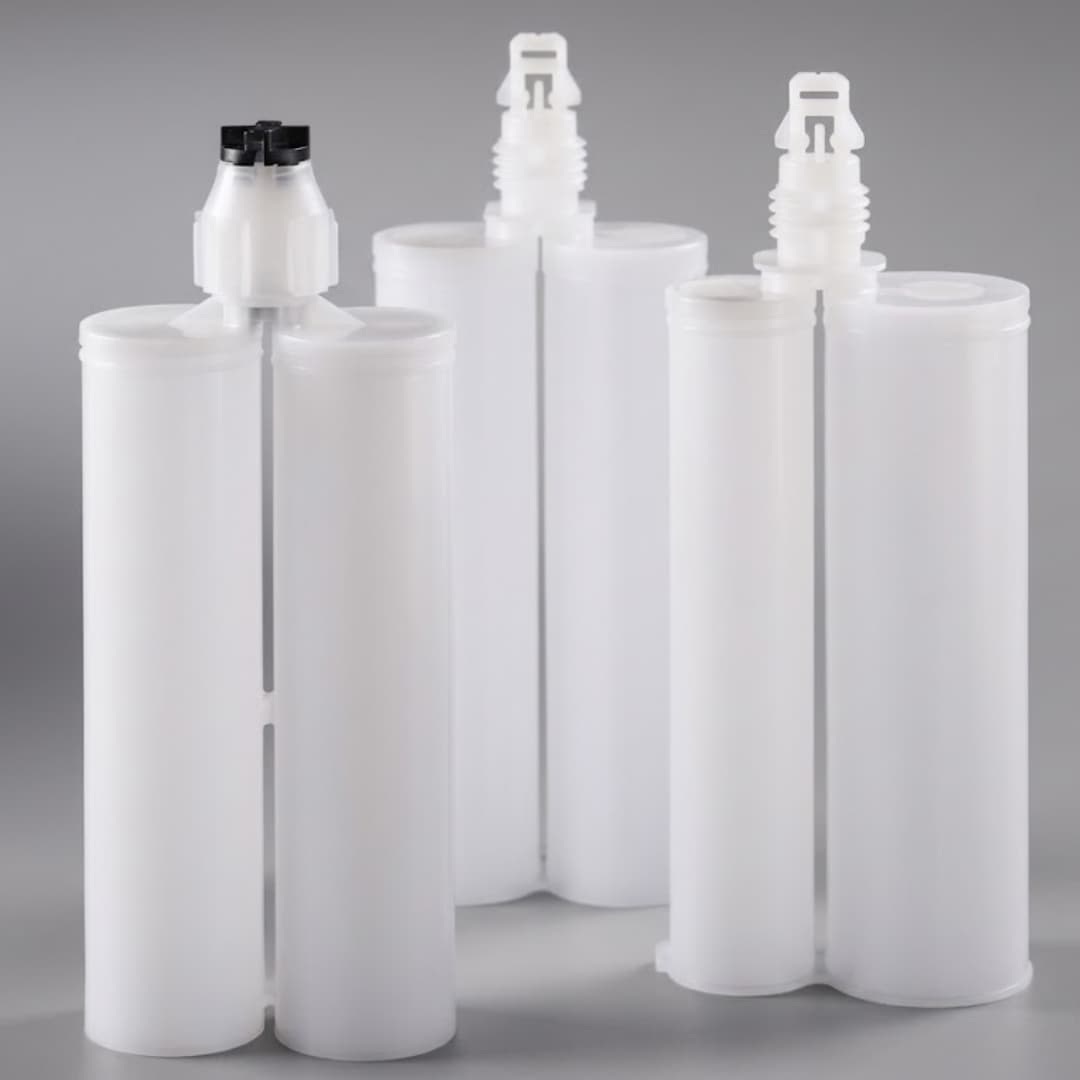
- Factory-degassed dual-component (2K) cartridges with a fixed ratio. Resin and hardener are packaged in side-by-side barrels at a locked volumetric ratio, so the mix can’t drift the way eyeballed hand batches do. Explore our dual cartridges and cartridge systems.
- Static mixers that deliver a void-free mix at the point of dispense. The two streams combine inside a sealed mixing element, eliminating the aeration that open stirring causes. See static and dynamic mixers.
- Semi-automatic filling and potting units engineered for minimal air entrapment. Designed so resin rises through the pleats instead of trapping bubbles against the media, these cartridge filling machines keep the material path clean from bulk to bond.
- Precision dispense tips for fine bead placement. Tapered dispense tips and nozzles lay a controlled bead where the seal actually forms, instead of flooding the cavity and folding in air.
Together they form a delivery chain where metering fixes the ratio first and the mixer and tip protect it — the same principle behind our electronics potting and encapsulation dispensing systems.
The Payoff on the Line
The result is low-air-entrainment, void-free potting: a continuous, bubble-free seal at the media-to-cap interface that extends element service life and cuts leak-test rejects and rework. Because the shot-to-shot ratio is held by the cartridge geometry rather than by hand, the process is repeatable without depending on operator skill — every element comes off the line the same.
For filtration manufacturers running end-cap bonding, cartridge potting, or membrane encapsulation on 2K PU or epoxy, that consistency is the difference between a line that scraps elements and one that ships them.
Build the System for Your Element
Every filter geometry is different. Haijing’s engineering team configures the cartridge ratio, mixer length, potting cell, and tip bore to your media, cavity, and throughput — see our customization capabilities or review cartridge sizing for automated throughput before you spec a line.
Ready to take air — and operator variance — out of your bonding step? Contact Haijing with your material format, mix ratio, and target volume, and we’ll propose a matched 2K dispensing configuration.