When you size an adhesive viscosity dispensing system, three material properties decide most of your equipment choices: viscosity, pot life, and cure speed. Viscosity sets the pump type, nozzle bore, and line pressure you need. Pot life limits how long the mixed material can sit in a mixer before it cures, which pushes short-pot-life formulations toward dynamic or on-demand mixing. Cure speed defines your dispense-to-assembly window and line throughput, and it dictates how often you must flush the system. This article shows how to read each property and translate it into a concrete configuration—pump, mixer, nozzle, and motion system—so your process runs without clogs, bubbles, incomplete mixing, or premature cure.
Why Material Rheology Sets the Limits for Your Dispensing System
A two-component (2K) adhesive only performs if its two parts are metered in the right ratio, mixed completely, and placed before the chemistry moves against you. Three properties control that:
- Viscosity is the fluid’s resistance to flow. It decides whether a material can be pushed through a fine nozzle, how much pressure the pump must generate, and whether the material will shear-thin or stay stubborn.
- Pot life (also called working time) is the period after the two components are mixed during which the adhesive remains usable. Once it expires, the material begins to gel and then solidify.
- Cure speed is how quickly the mixed adhesive reaches a handleable or functionally bonded state. It sets the open time for assembly and the fixture time before parts can move.
For a 2K system these three interact. A high-viscosity material with a short pot life is the hardest case: it needs high pressure to move, yet it cannot dwell in a mixer. You size the system around the tightest constraint, not the average one.
| Material property | Primary equipment impact |
|---|---|
| Viscosity | Pump or dispensing method, nozzle bore, line pressure, shear behavior |
| Pot life | Mixer type (static vs. dynamic), mixed-volume residence time, throughput ceiling |
| Cure speed | Dispense-to-assembly window, line speed, flush and cleaning frequency |
The same logic applies whether you package the chemistry in dual cartridges or feed it from bulk supply: the material’s physics, not the brand of hardware, sets the boundaries.
Adhesive Viscosity: Mapping Rheology to Pumps, Nozzles, and Pressure
Viscosity is normally reported in millipascal-seconds (mPa·s), also called centipoise (cP), and it is almost always temperature-dependent. The number on a data sheet at 25 °C can shift substantially at a cold winter line or a heated hose. For sizing, use the viscosity at your actual process temperature.
Most 2K adhesives, sealants, and potting compounds fall into four practical bands. The bands below describe behavior, not fixed thresholds—exact boundaries move with chemistry, filler loading, and thixotropy, so confirm the working range with the material supplier.
| Viscosity band | Typical behavior | Dispensing approach | Nozzle / pressure trend | Watch for |
|---|---|---|---|---|
| Low (water-like) | Flows freely, drips easily | Low-pressure positive displacement or pressure pot with shut-off | Fine bores possible; low pressure | Drips, air entrainment, inaccurate ratio if not metered |
| Medium (syrup-like) | Smooth, pourable | Piston or auger metering | Moderate pressure, standard bores | Starvation if pump undersized |
| High (paste-like, filled) | Holds shape, resists flow | High-pressure servo piston or screw metering | Larger bore, elevated pressure | Pressure drop, filler settling, abrasion |
| Very high (highly filled paste) | Stiff, trowelable | Helical screw / kneading feed, large ports | Large bore, preconditioning often needed | Clogging, inconsistent fill, heat build-up |
Two behaviors matter more than the single number. Shear-thinning materials (common with filled pastes) flow more easily under pressure, so a pump that applies shear can move a “thick” material through a smaller nozzle than you would expect—until the shear stops at the nozzle tip and the deposit firms up. Thixotropy affects whether the material slumps after placement. Both change how you specify the pump and nozzle, and both should be read from the rheology curve, not just the stated viscosity.
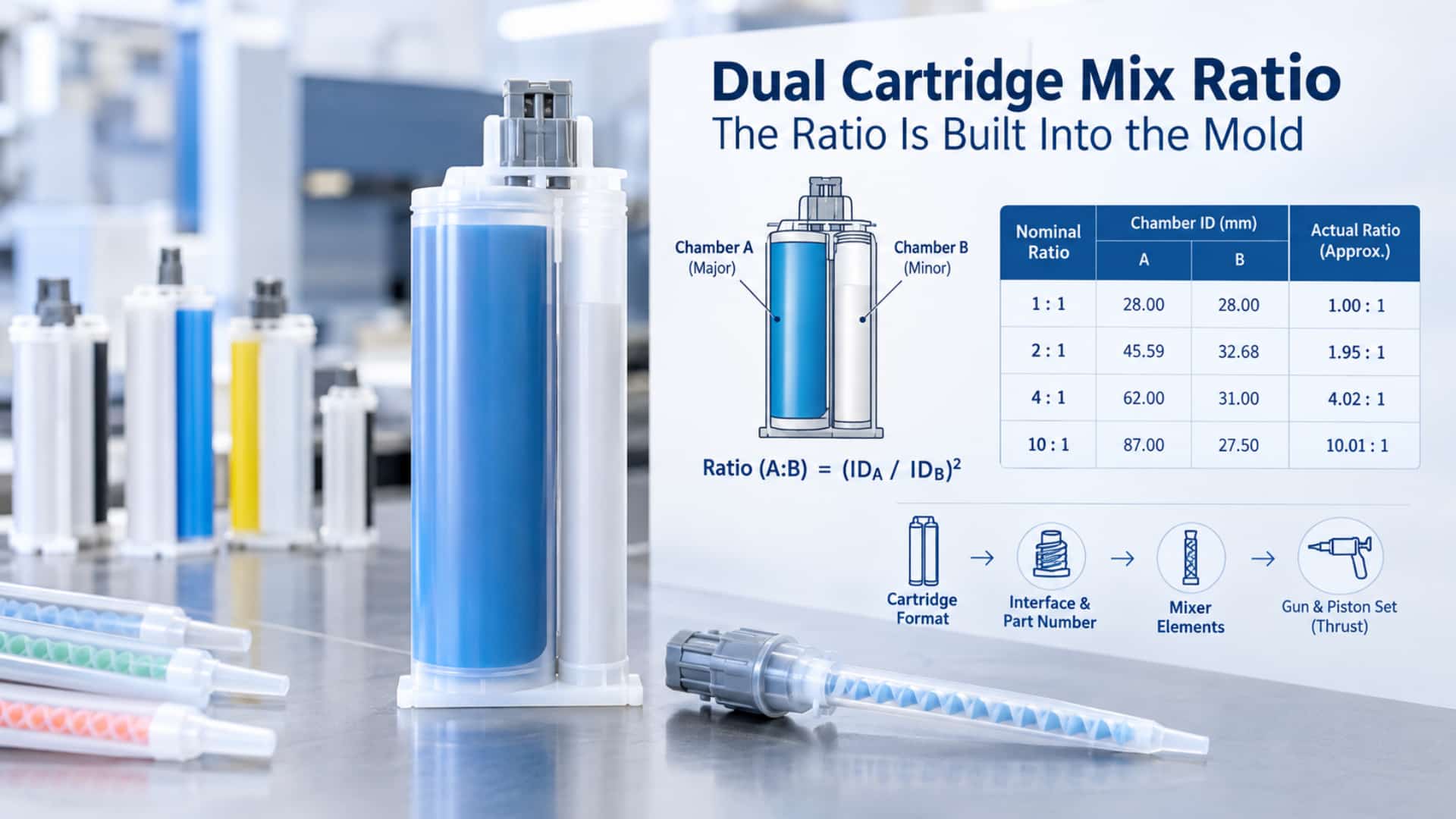
For metering two components accurately, prefer a positive-displacement method so each side is delivered by volume regardless of minor viscosity differences. The volumetric ratio you need is set by the formulation; the mechanics of holding that ratio while viscosities differ is covered in our guide to mix ratios and cartridge geometry.
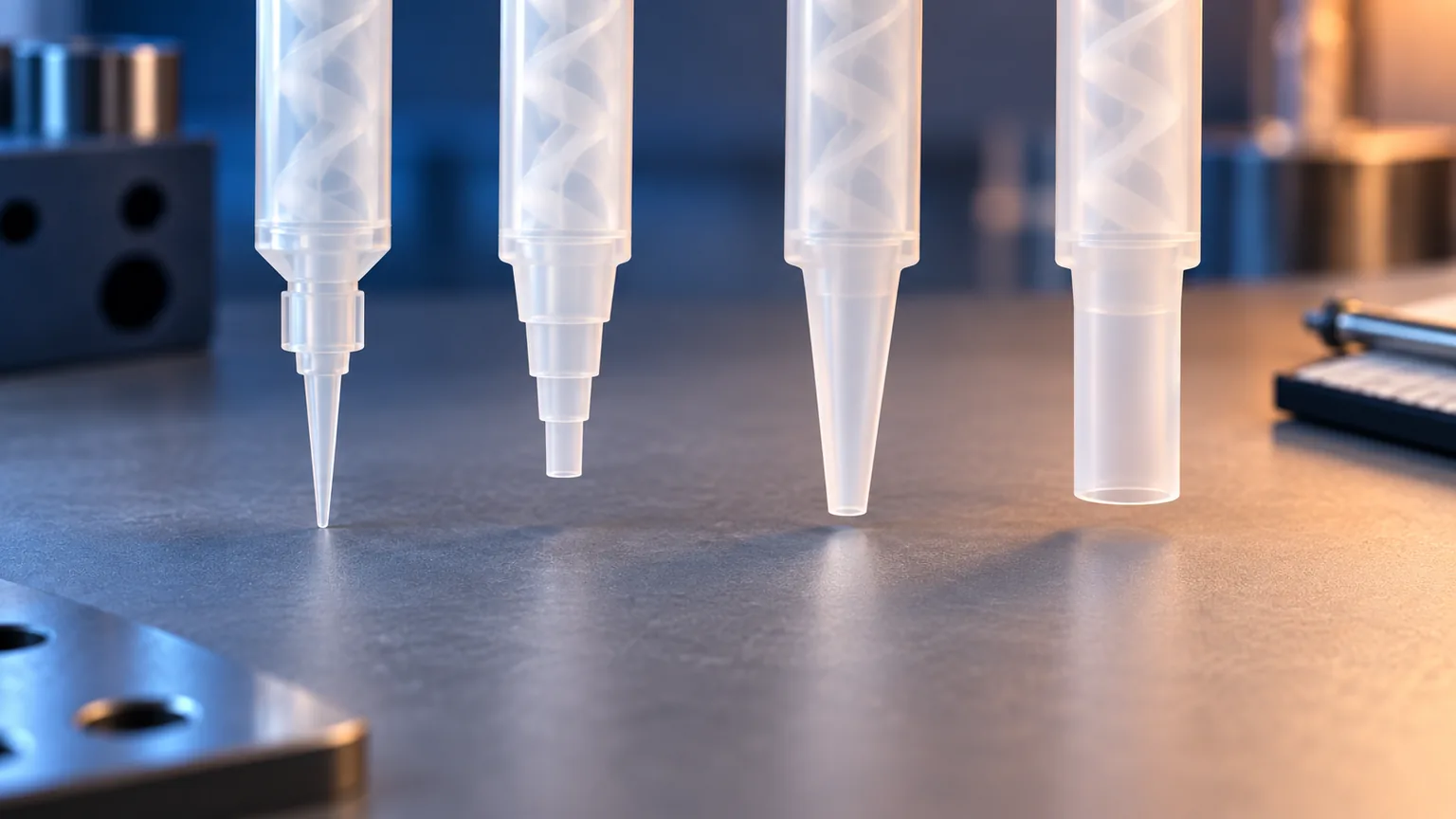
Nozzle selection follows directly: a dispense tip or nozzle bore that is too small for the viscosity forces pressure up until either the deposit suffers or the system stalls. Bore that is too large loses deposit control on fine parts. Match the bore to the deposit geometry and the material’s flow at process temperature.
Pot Life: Sizing the Mixing Window (Static vs. Dynamic Mixing)
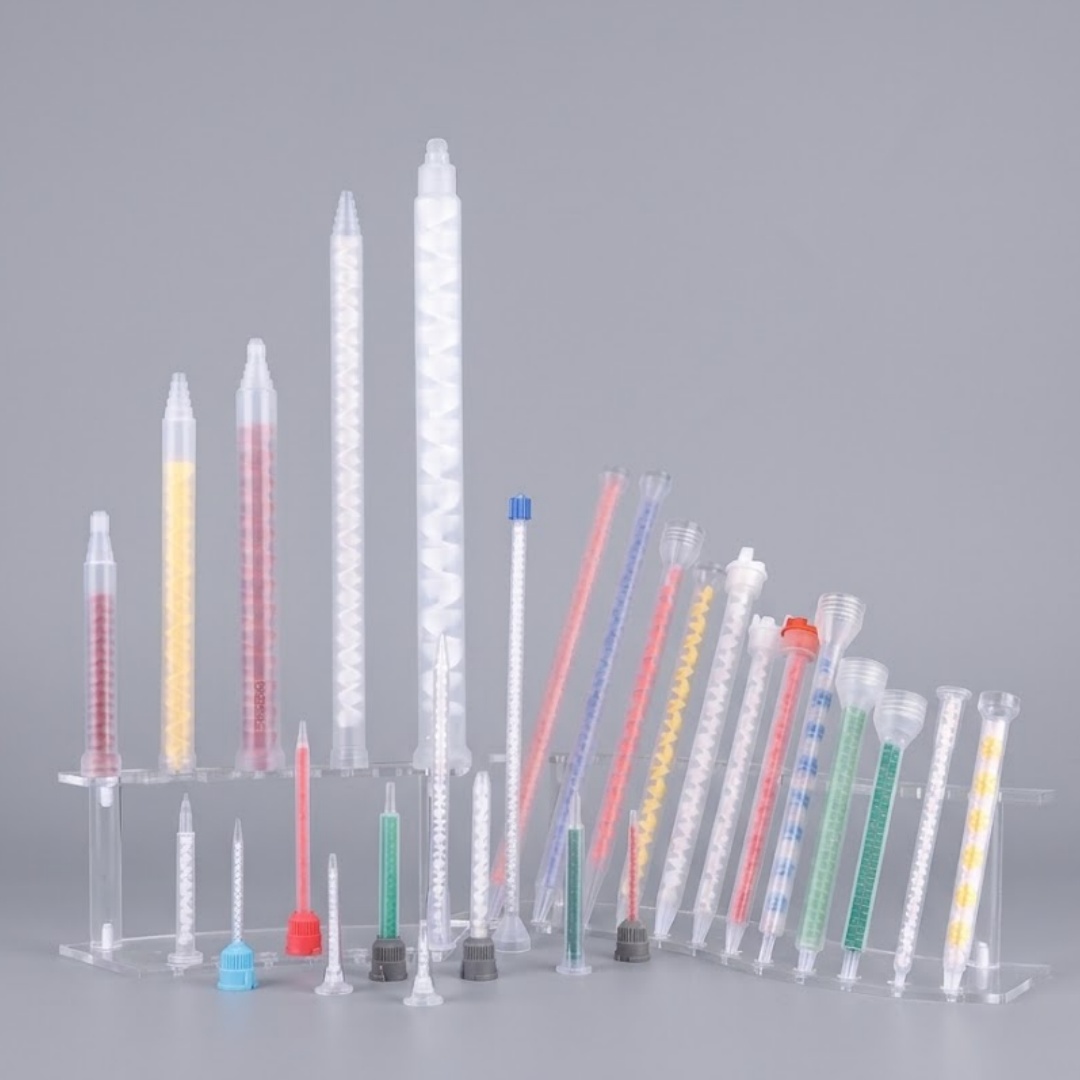
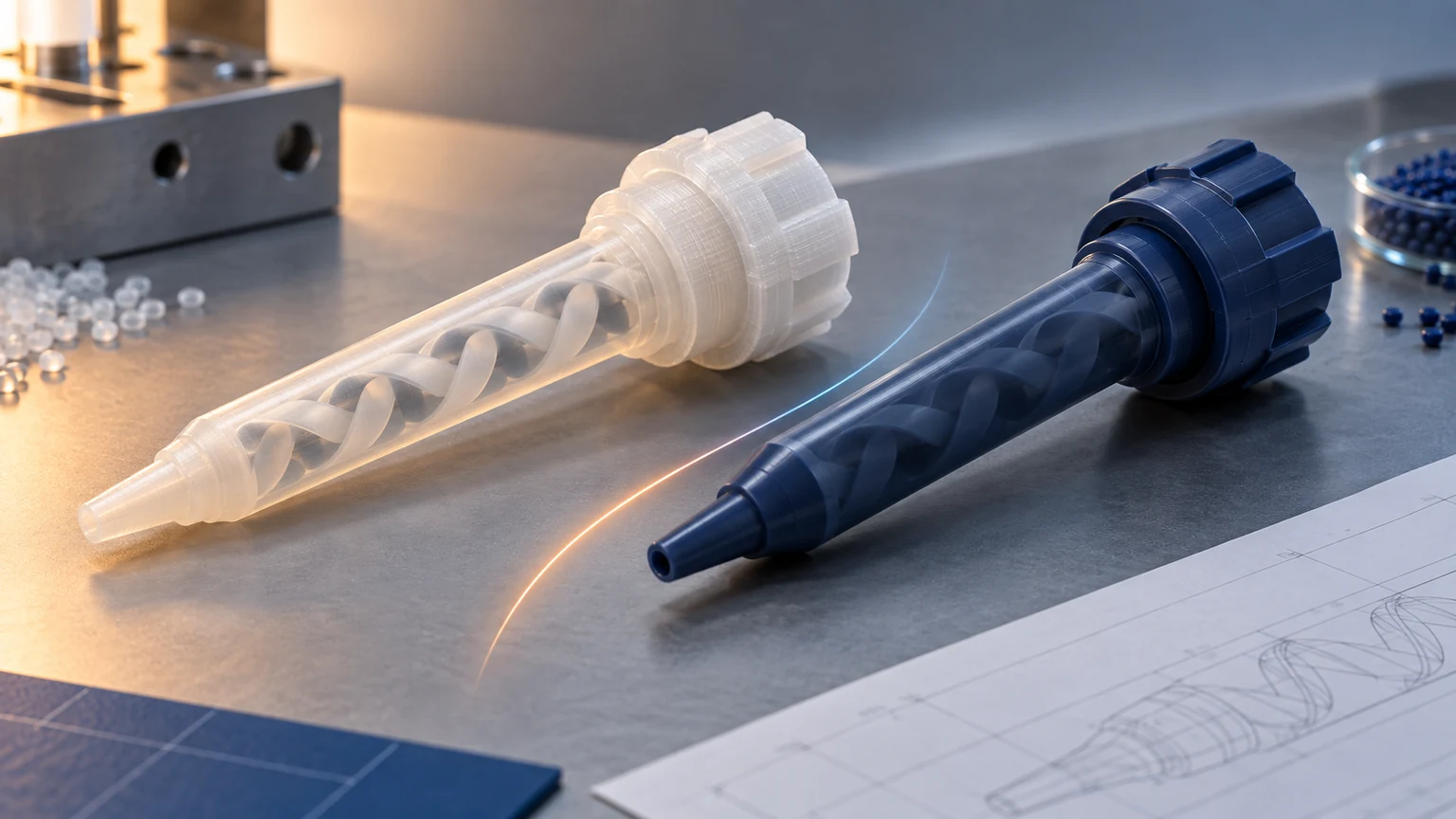
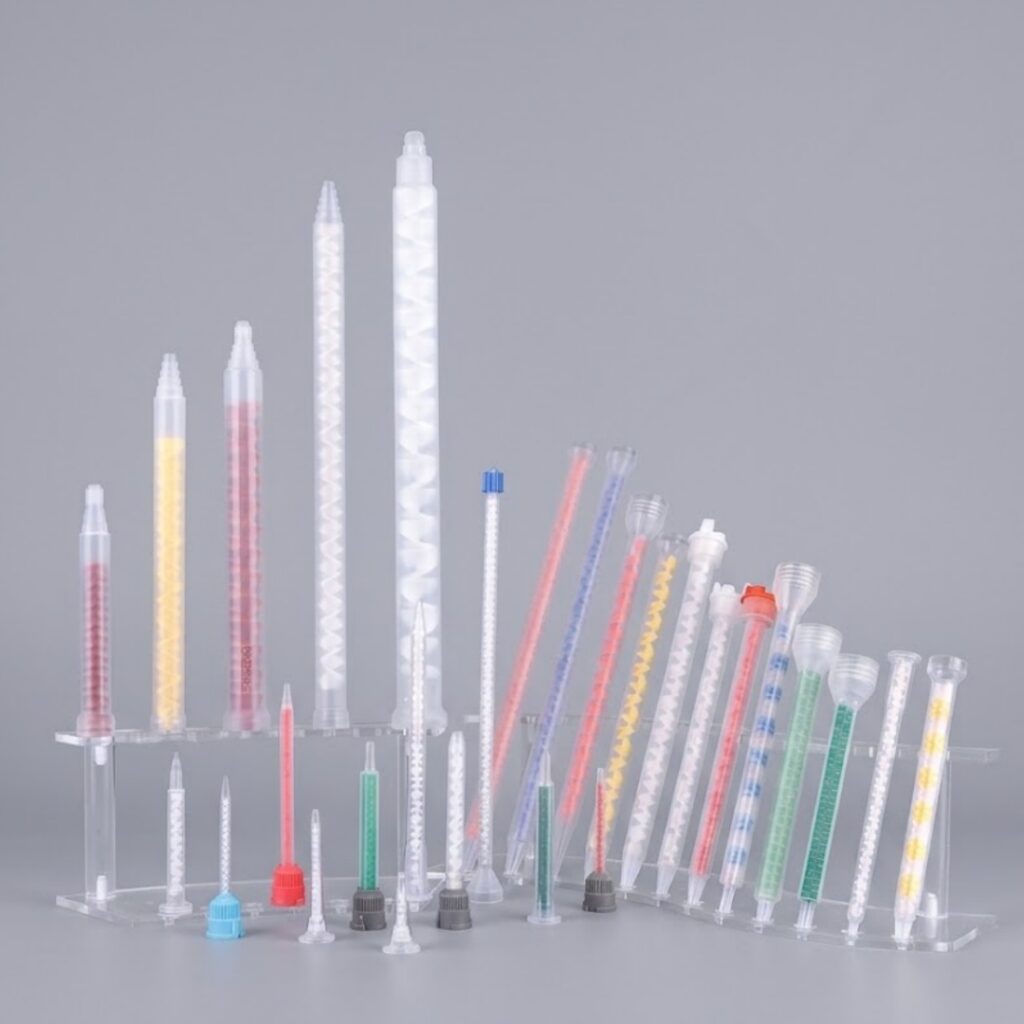
Pot life is the clock that starts the moment the two components meet. In a static mixer, the mixed material flows through a series of fixed elements; its residence time equals the mixer’s internal volume divided by the flow rate. If that residence time—plus any idle dwell—approaches the pot life, the adhesive begins to cure inside the mixer and blocks it. A longer static mixer gives a more uniform mix but also more residence time, so pot life caps how many elements you can use at a given flow.
A dynamic mixer uses a rotating element in a small chamber. The mixed volume is tiny, so residence time is minimal even at meaningful flow rates. That makes dynamic or on-demand mixing the right answer when pot life is short relative to throughput. In the most reactive cases, the two parts are kept separate until the point of use and combined by impingement or a very short dynamic stage.
Use this decision rule rather than a fixed timer:
- Pot life comfortably longer than throughput requires → a static mixer is usually the lower-cost, maintenance-light choice with no moving mixing parts.
- Pot life short, or flow must be high → move to a dynamic mixer or on-demand mixing to keep mixed volume small.
- Pot life very short or chemistry highly reactive → keep components separated until the dispense point and mix in a minimal dynamic stage; review with an applications engineer.
Premature cure is preventable if you respect residence time. The common triggers:
- Reduced flow rate raises residence time in a static mixer—cure risk climbs when you slow down.
- Idle time with material left in the mixer lets pot life run out in place.
- Exotherm in a larger mixed volume accelerates curing locally.
- High ambient temperature shortens pot life and should be designed for, not ignored.
Haijing supplies both static and dynamic mixers, and the choice between them is driven by exactly this pot-life-versus-residence-time balance rather than by preference.
Cure Speed and Open Time: Throughput, Line Speed, and Cleaning
Cure speed determines open time—the period after dispensing during which a part can still be joined or fixtured. A fast-curing adhesive gives you a short open time, so you must dispense and assemble within that window; a slow-curing adhesive gives more assembly latitude but longer fixture time and larger in-process buffer.
Size throughput against cure like this:
1. Read the open time and cure profile from the material data sheet.
2. Define the maximum dispense-to-assembly window your process allows.
3. Set the line cycle time below that window, with margin for handling.
4. Match the motion system—manual, semi-automatic, or a coordinate applicator (dispensing robot)—to the required cycle.
5. Set the flush interval: if the adhesive begins to cure in wetted parts during any idle period, flush before that point, not after.
Fast-cure materials favor automated, repeatable motion because the human hand cannot hold the open-time window consistently. High-volume potting favors a cartridge filling machine tuned so fill speed, not cure, sets the takt. The mistake is designing for average speed and forgetting that cure waits for no one during jams, changeovers, or breaks.
The Sizing Decision Framework: From Material Data to Equipment
Bring the three properties together with the material’s mix ratio, and the equipment configuration follows. Start from the data sheet, then walk the matrix.
Step 1 — Collect material data: viscosity at process temperature, pot life, open time / cure profile, mix ratio, filler content, thixotropy, and temperature range.
Step 2 — Apply the decision matrix:
| Viscosity | Pot life | Cure speed | Starting configuration |
|---|---|---|---|
| Low–Medium | Long | Slow | Static mixer + piston/auger metering + manual or semi-auto |
| High | Long | Slow–Medium | High-pressure piston + larger bore + static mixer |
| Any | Short | Fast | Dynamic or on-demand mixing + servo metering + automated line |
| High | Short | Fast | Most constrained: dynamic mixing + temperature-controlled path + robotic dispense; engineer review |
Step 3 — Confirm the residence-time check: mixed volume ÷ flow rate must stay under pot life at your minimum flow.
Step 4 — Confirm the open-time check: motion system cycle time must stay under open time with handling margin.
Step 5 — Define the flush plan from cure speed and expected idle.
Before you request a quote, send the supplier a complete data package. A useful specification checklist includes: viscosity at temperature, pot life, cure profile, mix ratio and tolerance, filler type and loading, thixotropy, substrates, and operating temperature range. Haijing’s customization team sizes pump, mixer, and nozzle from exactly this data set rather than from guesswork, and the same data protects you from ordering hardware that cannot move your material.
Component Sizing Checklist: Pump, Mixer, Nozzle, and Motion
Use this as a pre-order verification list. Each item should be confirmed against your material, not assumed.
Pump / metering
- Viscosity measured at process temperature, not only at 25 °C
- Positive-displacement method chosen for ratio accuracy
- Maximum pressure verified against line and nozzle resistance
- Filler abrasion accounted for in seal and cylinder choice
Mixer
- Static vs. dynamic selected from the pot-life rule above
- Element count balances mix quality against pressure drop
- Mixed-volume residence time below pot life at minimum flow
- Clean-out or flush path defined
Nozzle
- Bore sized to viscosity and deposit geometry
- Anti-drip or shut-off specified for low-viscosity materials
- Material compatibility confirmed (solvent, cure chemistry)
- Tapered vs. straight chosen for the deposit pattern
Motion / system
- Robot or filling-machine cycle time below open time
- Throughput matched to line takt, not peak-only
- Flush window set from cure speed and idle risk
- Temperature-controlled path if viscosity is temperature-sensitive
Frequently Asked Questions
What viscosity range can a static mixer handle?
Static mixers work across a wide viscosity range, but pressure drop rises as viscosity climbs. Low- to medium-viscosity materials pass through easily; high-viscosity or highly filled pastes need larger elements, higher drive pressure, or a dynamic mixer to avoid stalls. The practical limit depends on your pump’s pressure capability and flow rate, so confirm it against your material’s curve rather than a single number.
Can a manual dispensing gun handle high-viscosity adhesives?
Manual guns can move moderately high-viscosity materials, but they rely on operator force and give inconsistent ratio and deposit when the material is stiff or filled. For paste-like or highly filled formulations at any volume, a high-pressure pneumatic or servo-driven gun—or a bulk metering system—holds ratio and reduces fatigue. The deciding factor is whether the required dispense pressure exceeds what a manual trigger can deliver repeatably.
How do I stop the adhesive from curing inside the mixer?
Keep the mixed-material residence time below the pot life at your lowest flow rate, avoid leaving material idle in the mixer, control ambient temperature, and flush on the schedule your cure speed demands. If pot life is short, switch from a static mixer to a dynamic or on-demand mixer so the mixed volume stays minimal.
Does temperature change viscosity, and how should I compensate?
Yes. Most adhesives thin as temperature rises and thicken as it falls, sometimes sharply. Measure viscosity at the actual process temperature, and if the line temperature varies, add a temperature-controlled hose or material conditioning so pump pressure and deposit size stay predictable.
What is the difference between pot life and cure time?
Pot life is the usable working window after mixing—the time before the adhesive gels and becomes unworkable. Cure time is how long it takes to reach a bonded or functional state. A material can have a long pot life but a slow cure, or a short pot life and a fast cure; they set different constraints, with pot life governing mixer residence and cure speed governing open time and throughput.
Conclusion
Viscosity, pot life, and cure speed are the three constraints that size every 2K dispensing system. Viscosity selects the pump, nozzle bore, and pressure. Pot life selects the mixer type and caps how long mixed material can reside in it. Cure speed selects your line throughput and your flush discipline. Read all three from the material data sheet at process temperature, run the residence-time and open-time checks, and the equipment configuration—pump, mixer, nozzle, and motion—falls out of the framework instead of from trial and error.
If you have a data sheet and a target cycle time, the fastest next step is to let an applications engineer turn those numbers into a configuration.
Contact Us: Send us your adhesive’s TDS—our engineers will size the pump, mixer, and nozzle for your process. → customization