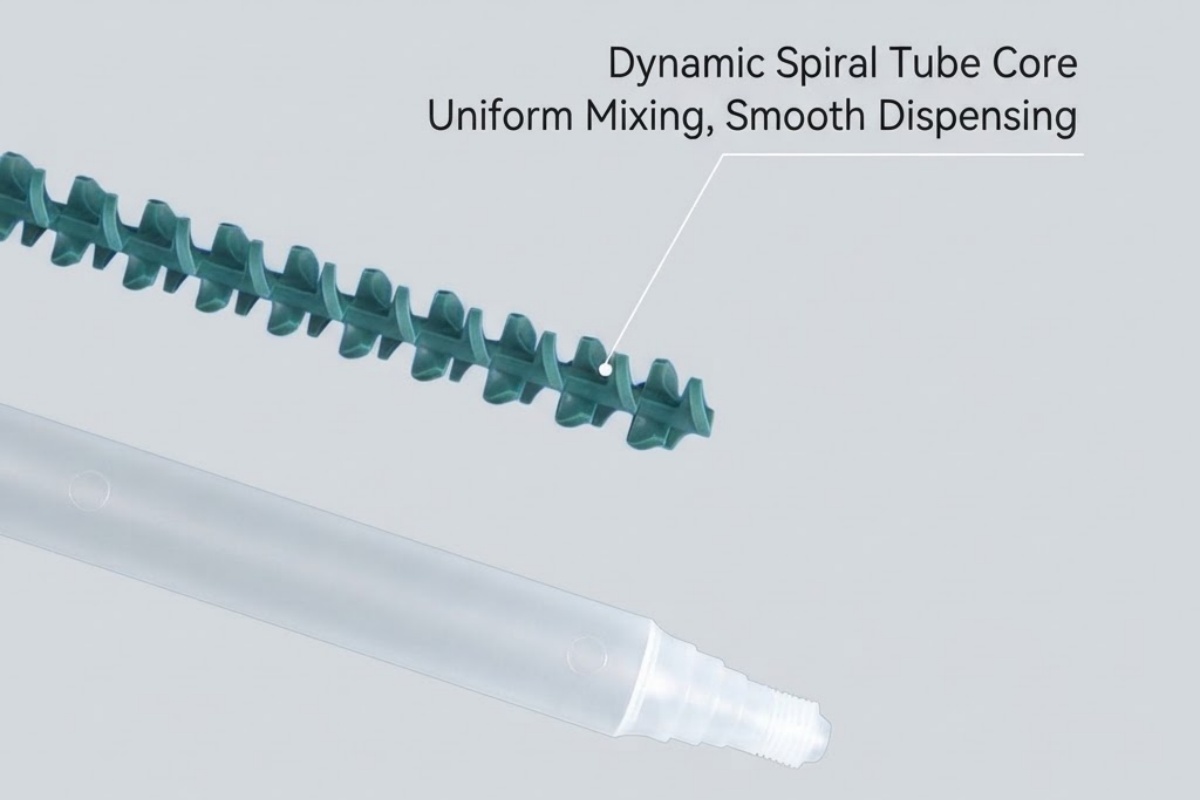
Choosing a dual component adhesive dispensing system is not simply a matter of selecting a cartridge, mixer, and dispensing gun separately. These components need to work together mechanically and functionally.
The cartridge must fit the dispensing gun, the cartridge outlet must connect correctly to the static mixer, and the mix ratio must be supported by the dispensing mechanism. Adhesive viscosity, required flow, application method, and production frequency can also affect the final configuration.
For B2B buyers, the most practical approach is to evaluate the complete system in this order:
Adhesive → Mix Ratio → Cartridge → Static Mixer → Dispensing Gun → Application Requirements → Compatibility Verification
This guide explains the main compatibility checks, how to select the appropriate components, common problems to avoid, and what information to provide when requesting a complete 2K dispensing solution.
The Three Components of a Dual-Component Adhesive Dispensing System
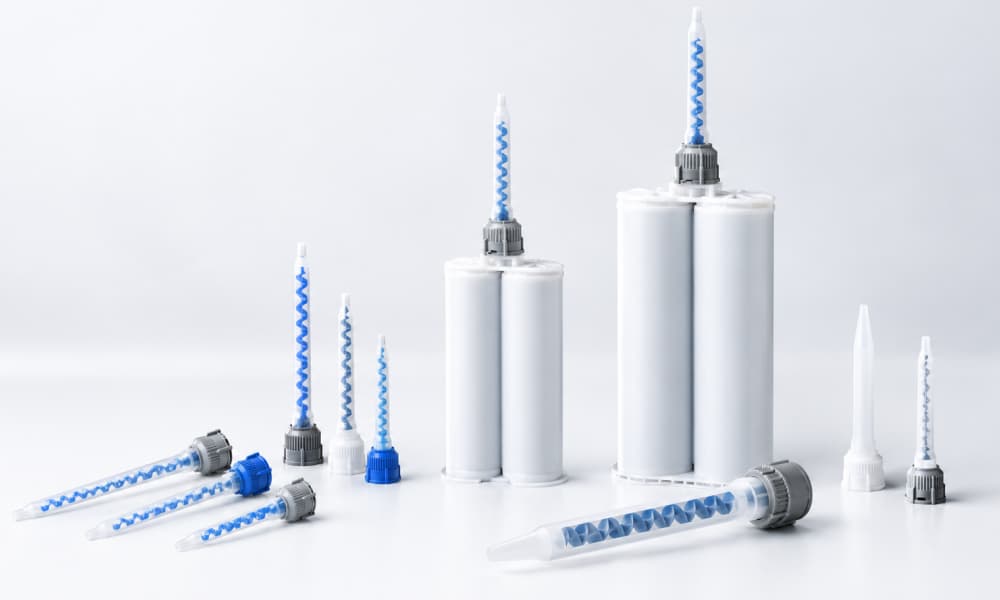
A typical two-component adhesive dispensing system consists of three connected components: a dual-component cartridge, a static mixer, and a dispensing gun.
Each component performs a different function, but its specifications can affect the selection of the other components.
Dual-Component Cartridge: The Starting Point
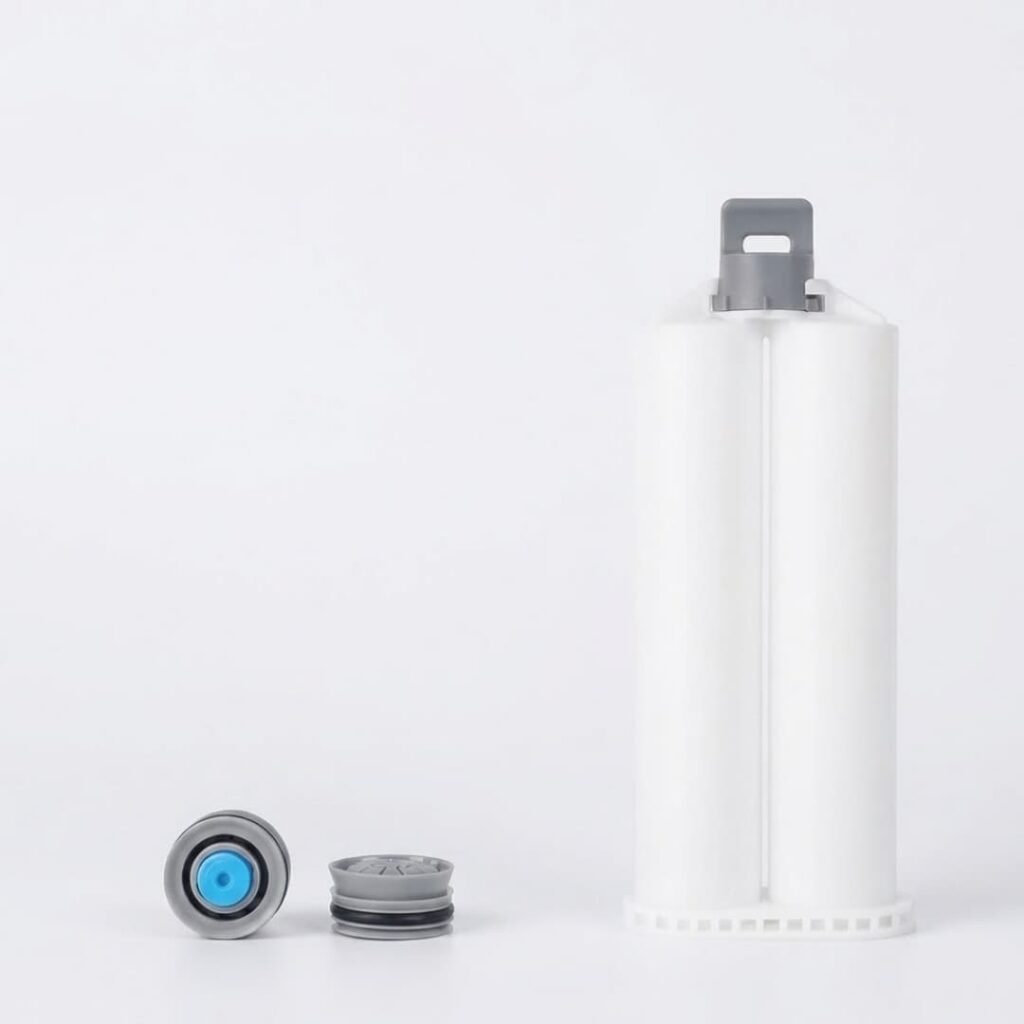
A dual-component adhesive cartridge keeps two materials separated until they reach the dispensing and mixing stage. The cartridge configuration therefore establishes several important parameters for the rest of the system.
Before selecting equipment, buyers should confirm:
- Cartridge volume
- Cartridge configuration
- A/B mix ratio
- Outlet configuration
- Piston arrangement
- Required dispensing method
For example, a cartridge used with a 1:1 adhesive system should be matched with a dispensing mechanism designed to deliver the two components in the required relationship.
For cartridge options, see HaiJing’s dual-component adhesive cartridges.
Static Mixer: Where the Two Components Become One
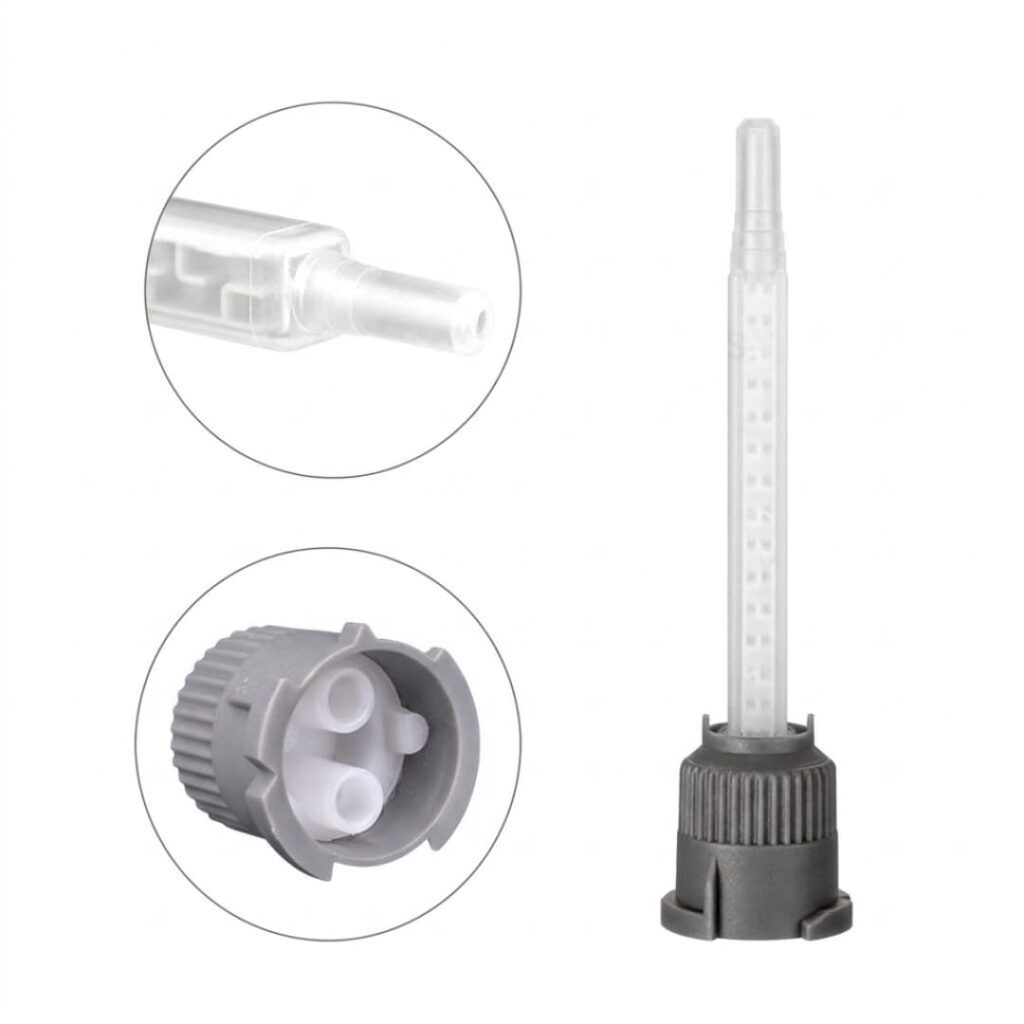
The static mixer receives the two separate adhesive components and mixes them as they pass through the internal mixing elements.
A compatible static mixer needs to match the cartridge interface, but mechanical fit is only one consideration. The adhesive itself also affects mixer selection.
Relevant factors can include:
- Adhesive viscosity
- Mix ratio
- Required mixing quality
- Required flow rate
- Mixer geometry
- Mixer element configuration
- Outlet requirements
A mixer that physically attaches to a cartridge is not automatically the correct choice for every adhesive or application.
HaiJing’s static and dynamic mixer systems provide a useful starting point when evaluating mixer configurations.
Dispensing Gun: The Mechanical Interface
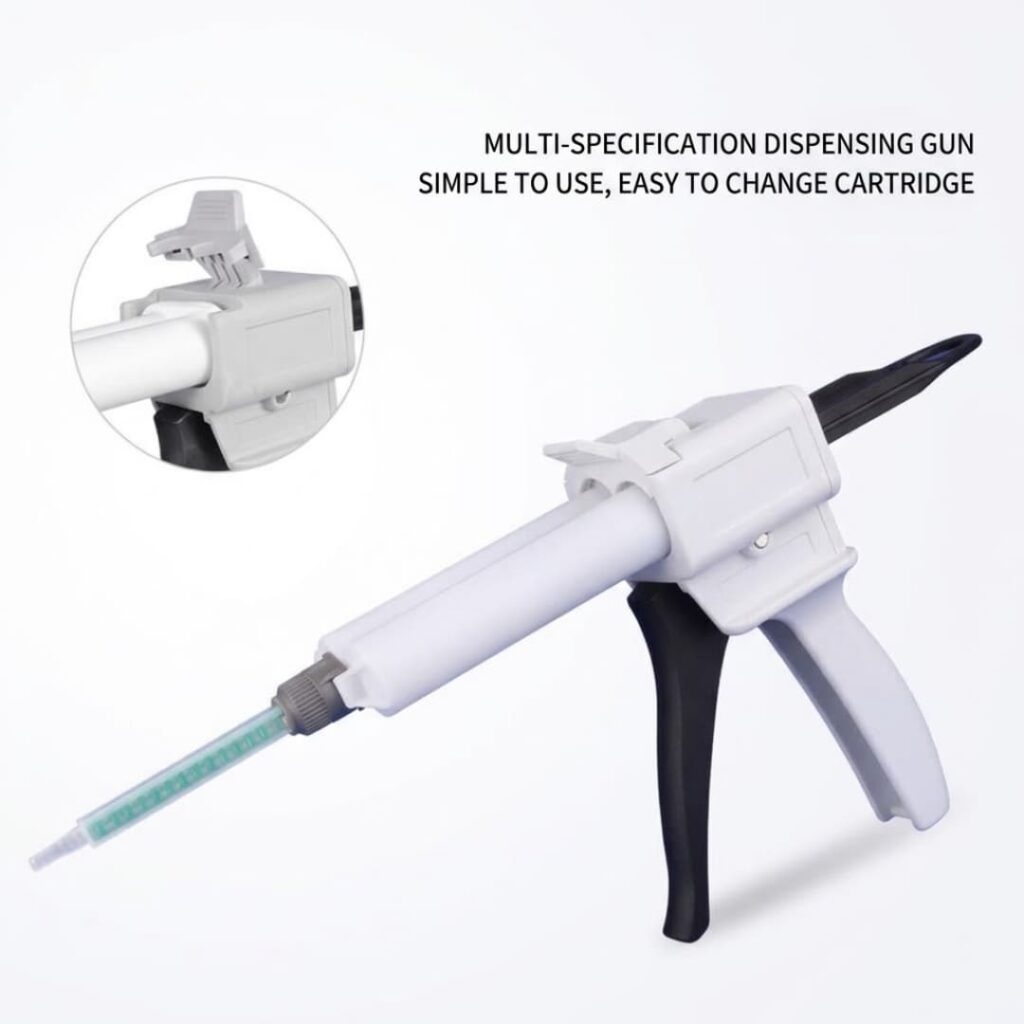
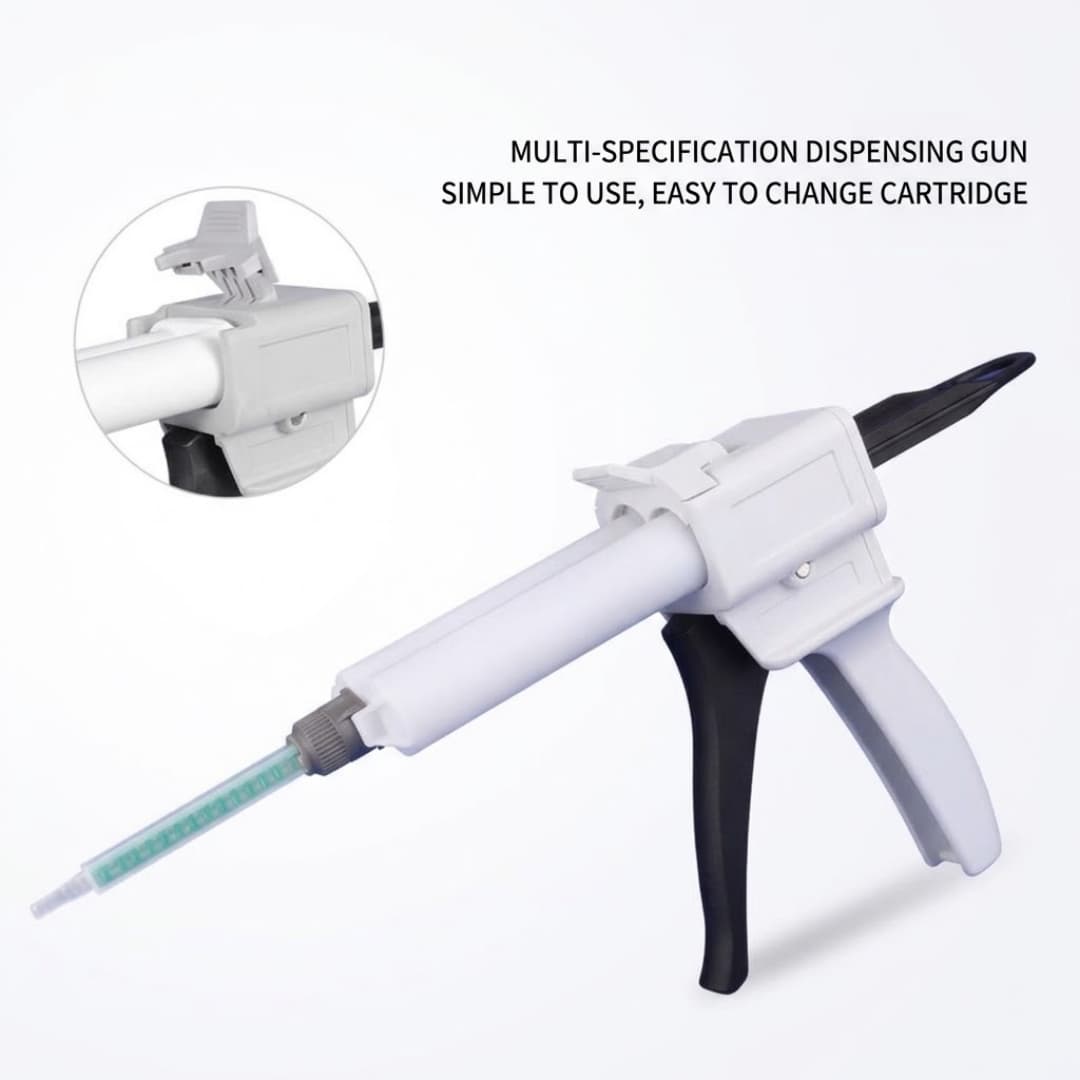
The dispensing gun connects the cartridge to the operator or dispensing equipment. Its primary compatibility requirements include the cartridge format, mounting arrangement, mix ratio, and drive mechanism.
Manual and pneumatic systems can serve different production conditions. A manually operated gun may be suitable for operator-controlled applications, while a pneumatic system can be considered when dispensing is repetitive or when the process requires a different actuation method.
The key point is that gun selection should begin with the cartridge rather than treating the gun as an independent product.
The 5 Compatibility Checks to Make Before Ordering
Before ordering a complete 2K adhesive dispensing system, buyers should verify five groups of parameters.
Check 1: Cartridge Volume and Format
Start by confirming the cartridge volume and physical configuration.
The cartridge determines whether the dispensing gun can accept and properly drive it. A larger or differently configured cartridge may require a different mounting or dispensing arrangement.
Check:
- Cartridge volume
- Cartridge configuration
- Chamber arrangement
- Outlet design
- Piston arrangement
- Gun compatibility
Do not assume that two cartridges with similar capacities will necessarily use the same dispensing gun.
Check 2: Mix Ratio
The adhesive’s mix ratio is another fundamental selection parameter.
Common industrial two-component systems can use different A/B ratios, such as 1:1 or 2:1. Other ratios may also be used depending on the adhesive formulation.
The cartridge and dispensing gun must be configured to deliver the two components in the required relationship.
| Mix Ratio | What to Verify |
|---|---|
| 1:1 | Cartridge and dispensing mechanism must support equal component delivery |
| 2:1 | Cartridge and dispensing mechanism must support the required A/B relationship |
| Other ratios | Confirm the complete cartridge and gun configuration with the supplier |
The mix ratio should therefore be specified before selecting the dispensing gun or static mixer.
Check 3: Cartridge-to-Mixer Connection
The connection between the cartridge and static mixer is a critical mechanical interface.
Before ordering, confirm:
- Cartridge outlet configuration
- Mixer inlet configuration
- Locking method
- Sealing interface
- Mixer attachment method
- Outlet requirements
A mixer should not be selected only because its internal mixing design appears appropriate. The cartridge-to-mixer interface also needs to be verified.
This is particularly important when replacing an existing mixer with another model.
Check 4: Cartridge-to-Gun Compatibility
The next step is to confirm whether the dispensing gun can physically and functionally accept the cartridge.
Check:
- Cartridge format
- Cartridge volume
- Cartridge mounting
- Plunger arrangement
- Drive mechanism
- Mix ratio
- Dispensing method
If an existing dispensing gun is already being used, provide its model or configuration to the supplier when requesting replacement cartridges or mixers. This can reduce compatibility uncertainty during procurement.
Check 5: Adhesive Viscosity and Required Flow
Cartridge volume and mix ratio are not enough to determine a dispensing configuration.
Adhesive viscosity can affect the force required to move the material through the cartridge and mixer. Required flow rate and application volume also influence the dispensing process.
For example, a high-viscosity adhesive may behave very differently from a low-viscosity material even when both use the same cartridge format.
When evaluating a system, provide:
- Adhesive type
- Viscosity
- Mix ratio
- Required bead or dispensing volume
- Desired dispensing frequency
- Application method
The exact equipment configuration should be confirmed according to the actual adhesive and process conditions.
How Cartridge Size, Mix Ratio, and Adhesive Viscosity Work Together
A common purchasing mistake is to select a dispensing gun based only on cartridge volume.
In practice, three factors should be considered together:
| Variable | Primary Selection Impact |
|---|---|
| Cartridge volume | Physical cartridge and gun compatibility |
| Mix ratio | A/B dispensing relationship |
| Adhesive viscosity | Dispensing force and flow requirements |
The relationship can be simplified as:
Cartridge format → determines physical compatibility
Mix ratio → determines component delivery relationship
Viscosity + required flow → influence dispensing requirements
This is why a complete 2K dispensing system should be evaluated as a combination rather than as three unrelated components.
Manual vs. Pneumatic Dispensing Guns: Which System Fits Your Process?
The choice between a manual and pneumatic dispensing gun depends on the application and production conditions.
When a Manual Dispensing Gun Makes Sense
Manual dispensing can be considered when:
- The operator controls each dispensing operation.
- The application is relatively straightforward.
- Portability is important.
- The process does not require a pneumatic actuation system.
- Production conditions allow manual operation.
The primary selection question remains cartridge compatibility. The gun must correctly accept and drive the selected cartridge.
See HaiJing’s manual dispensing guns when evaluating manually operated systems.
When to Consider a Pneumatic Dispensing Gun
A pneumatic dispensing gun can be considered for applications involving repetitive dispensing or where pneumatic actuation fits the production process.
Factors to evaluate include:
- Cartridge compatibility
- Required dispensing frequency
- Adhesive viscosity
- Required flow
- Available pneumatic equipment
- Operator requirements
- Process integration
For applications where pneumatic operation is appropriate, review the available pneumatic dispensing guns together with the cartridge configuration.
| Selection Factor | Manual Gun | Pneumatic Gun |
|---|---|---|
| Operation | Hand operated | Air assisted |
| Portability | Generally straightforward | Depends on system setup |
| Repetitive dispensing | Application dependent | Often considered for repetitive processes |
| Process integration | More limited | Can support equipment integration |
| Main selection concern | Cartridge and operator requirements | Cartridge, pneumatic setup and process requirements |
The comparison should always be made against the actual production process rather than assuming one operating method is universally suitable.
How to Choose a Compatible Static Mixer for Your Cartridge
Static mixer selection should begin with the cartridge interface and then move to the adhesive and mixing requirements.
Start With the Cartridge Interface
First verify:
Cartridge outlet → Mixer inlet → Locking/sealing interface
The mixer needs to attach securely and provide the required material path from the two cartridge chambers into the mixing elements.
Then Consider Adhesive Characteristics
Next evaluate:
- Adhesive viscosity
- Mix ratio
- Working time
- Filler content
- Required flow rate
These characteristics can influence the appropriate mixer configuration.
Finally Verify Mixing Requirements
Only after the basic interface is confirmed should the buyer evaluate:
- Mixer geometry
- Element configuration
- Mixer length
- Required mixing quality
- Pressure or flow considerations
This approach avoids choosing a mixer based only on its physical connection.
For more detailed product selection, the static and dynamic mixer systems can be evaluated according to the specific cartridge and adhesive requirements.
Common Compatibility Problems in 2K Dispensing Systems
Compatibility problems often occur because one component was selected without checking the complete system.
| Problem | Possible Compatibility Issue | What to Check |
|---|---|---|
| Mixer cannot attach | Cartridge/mixer interface mismatch | Outlet and mixer inlet |
| Gun cannot load cartridge | Physical configuration mismatch | Cartridge format and mounting |
| Uneven A/B output | Ratio mismatch | Cartridge and dispensing mechanism |
| High dispensing resistance | Process or equipment mismatch | Viscosity, mixer and dispensing setup |
| Leakage at mixer connection | Interface or sealing issue | Connection and seal |
| Poor mixing | Mixer configuration may not suit the adhesive | Mixer geometry and adhesive characteristics |
When troubleshooting, change one variable at a time where possible. Replacing the cartridge, mixer, and gun simultaneously makes it difficult to identify the actual source of the problem.
A Practical Compatibility Verification Process
A structured verification process can reduce mistakes before bulk purchasing.
Step 1 — Identify the Adhesive
Record:
- Adhesive type
- Viscosity
- Mix ratio
- Working time
- Filler characteristics, if relevant
Step 2 — Define the Cartridge
Confirm:
- Cartridge volume
- Cartridge configuration
- A/B ratio
- Outlet interface
- Existing cartridge model, if applicable
Step 3 — Match the Static Mixer
Confirm:
- Cartridge connection
- Mixer inlet
- Mixing configuration
- Outlet requirements
- Adhesive suitability
Step 4 — Match the Dispensing Gun
Confirm:
- Cartridge fit
- Mix ratio
- Plunger/drive arrangement
- Manual or pneumatic operation
- Application requirements
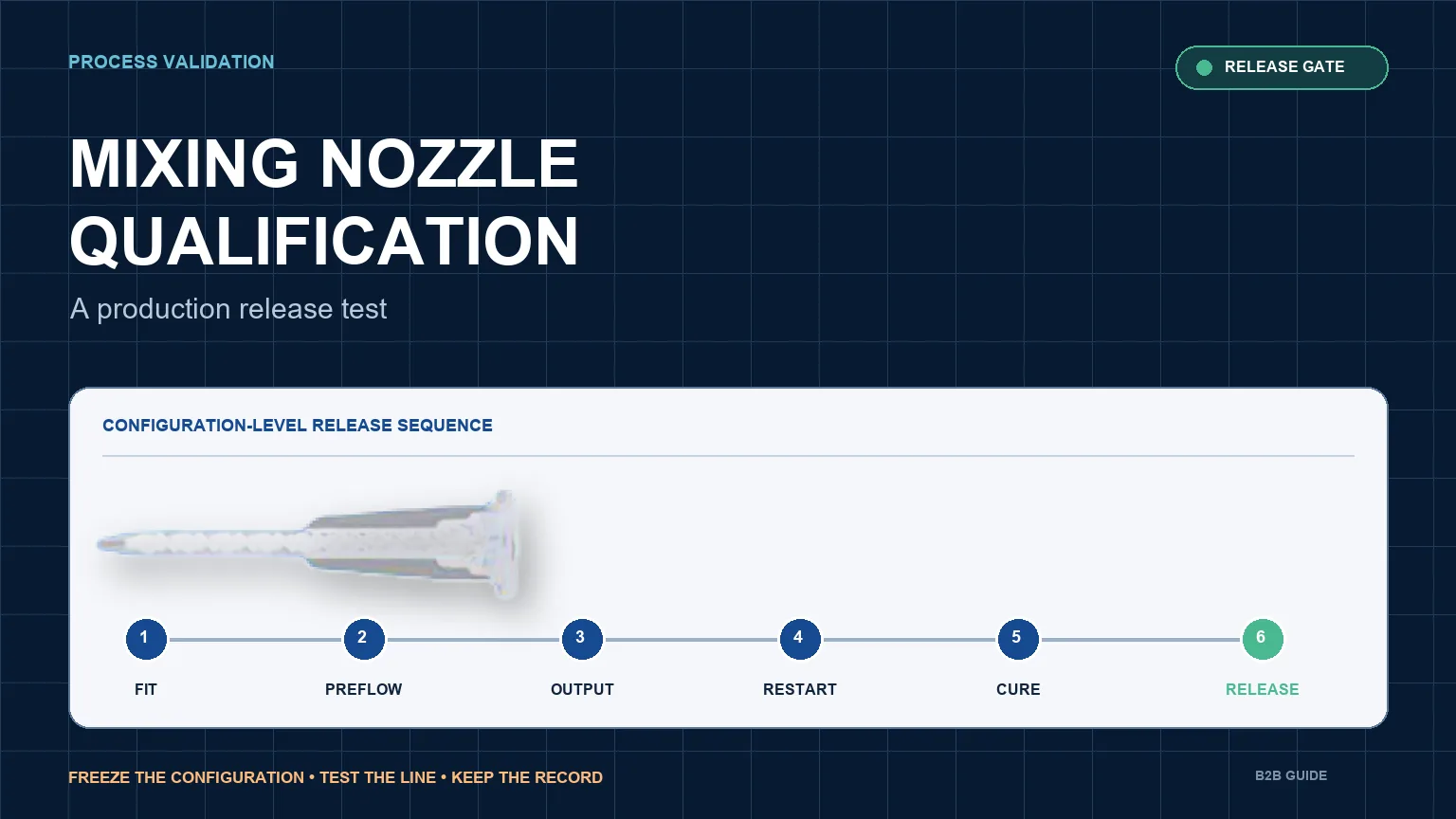
Step 5 — Test the Complete System
Before committing to a production configuration, verify the complete combination under actual process conditions.
Check:
- Material flow
- A/B dispensing relationship
- Mixing quality
- Bead consistency
- Operator handling
- Connection integrity
Actual performance can vary according to the adhesive, equipment configuration, and process conditions.
Step 6 — Approve the Configuration for Production
Once the cartridge, mixer, and gun have been verified together, document the approved configuration so purchasing and production teams use the same component combination.
What to Include in an RFQ for a 2K Adhesive Dispensing System
When requesting a quotation or compatibility recommendation, incomplete technical information can lead to unnecessary back-and-forth.
A useful RFQ should include:
2K Dispensing System RFQ Checklist
- Adhesive type
- Adhesive viscosity
- Mix ratio
- Cartridge volume
- Cartridge configuration
- Existing cartridge, mixer, or gun model
- Required mixer type, if known
- Application method
- Required dispensing volume
- Manual or pneumatic operation
- Target production frequency
- Required customization
- Any existing interface requirements
If the exact mixer or gun is not known, provide as much information as possible about the adhesive and application. The supplier can then evaluate the complete configuration rather than recommending a component in isolation.
For businesses that require a combination of packaging and dispensing components, HaiJing also provides custom adhesive packaging and dispensing solutions.
When You Need a Custom Cartridge, Mixer, or Dispensing Solution
Standard components may not always match a particular dispensing process.
Additional evaluation may be required when the application involves:
- An unusual cartridge configuration
- A specific mix ratio
- A non-standard interface
- A particular dispensing process
- Special mixer requirements
- Integration with existing equipment
- A combination of packaging, mixing, and dispensing requirements
In these cases, provide the complete process information rather than requesting only a replacement part.
The objective is to establish a compatible system around the adhesive and application requirements.
How to Build a Matched 2K Dispensing System
The selection process can be reduced to seven steps:
1. Identify the adhesive
Determine viscosity, mix ratio, working characteristics, and other relevant material properties.
↓
2. Confirm the mix ratio
Establish the required A/B dispensing relationship.
↓
3. Select the cartridge
Confirm volume, configuration, outlet and piston requirements.
↓
4. Select the static mixer
Match the mixer interface to the cartridge and evaluate the mixing requirements.
↓
5. Select the dispensing gun
Confirm physical cartridge compatibility, ratio, drive arrangement, and operating method.
↓
6. Check the application requirements
Consider required flow, dispensing frequency, bead size, operator requirements, and production conditions.
↓
7. Verify the complete configuration
Test the cartridge, mixer, and gun as one system before final production approval.
This process is more reliable than selecting each component independently because it exposes compatibility issues before they reach production.
Frequently Asked Questions
Can any static mixer be used with a dual-component cartridge?
No. The mixer needs to be compatible with the cartridge outlet and connection system. Adhesive viscosity, mix ratio, required mixing quality, and flow requirements should also be considered.
Does the adhesive mix ratio affect the dispensing gun?
Yes. The dispensing system needs to deliver the two adhesive components in the required A/B relationship. The cartridge and gun configuration should therefore be checked together.
How do I know if a dispensing gun fits my cartridge?
Check the cartridge volume, physical configuration, mounting arrangement, piston/drive arrangement, and mix ratio. If the information is unclear, provide the cartridge model or complete cartridge specifications to the supplier.
Does adhesive viscosity affect dispensing gun selection?
Yes. Viscosity can affect the force and flow conditions required to dispense the adhesive through the cartridge and mixer. The actual configuration should be evaluated against the process requirements.
Can I use a different brand of static mixer?
A different mixer should not be assumed to be compatible simply because it appears physically similar. The cartridge interface, sealing method, mixing configuration, and adhesive requirements should be verified before use.
Should I buy the cartridge, mixer, and gun separately?
They can be purchased separately, but the three components should be treated as one dispensing system during the selection process. Confirm compatibility before placing a bulk order.
What information should I send to a supplier for system matching?
At minimum, provide the adhesive type, viscosity, mix ratio, cartridge volume, cartridge configuration, required dispensing method, application requirements, and any existing cartridge, mixer, or gun model.
Key Takeaways
A dual component adhesive dispensing system should be selected as a complete configuration rather than as three independent products.
The main decision sequence is:
Adhesive → Mix Ratio → Cartridge → Static Mixer → Dispensing Gun → Application → Verification
Before ordering, confirm five critical areas:
- Cartridge volume and format
- Mix ratio
- Cartridge-to-mixer interface
- Cartridge-to-gun compatibility
- Adhesive viscosity and required flow
For B2B procurement, a complete RFQ should include the adhesive properties, cartridge requirements, dispensing method, application conditions, and any existing equipment information.
If the application involves a non-standard interface, special ratio, or integrated packaging and dispensing process, the complete configuration should be reviewed before production approval.
Please contact the HaiJing technical team for support
If you are selecting a 2K adhesive dispensing system, start with the adhesive and application requirements rather than choosing a dispensing gun or static mixer first.
For a compatibility review, provide your adhesive type, viscosity, mix ratio, cartridge volume, cartridge configuration, required dispensing method, and application requirements. This information provides the basis for evaluating the cartridge, mixer, and dispensing gun as one matched system.