Key Takeaways
- Quadro cuts waste. Square-element mixers hold roughly 30–50% less retained adhesive than helical tubes of equal mixing capability, which matters most with high-cost structural resins.
- Helical is the default. Round spiral elements are the industry-standard geometry for common 1:1 and 2:1 formulations and fit every budget tier.
- Wide ratios favor Quadro. At 4:1 and 10:1, aggressive square folding prevents the low-viscosity component from channeling through unmixed.
- Both share interfaces. A-, B-, C-, and F-system cartridges accept either geometry, so switching is a line trial, not a redesign.
- Backpressure is the hidden trade-off. Aggressive square shear means slightly higher dispensing force — a real constraint on manual guns, rarely one on pneumatic feed.
Ask ten process engineers which mixing nozzle geometry they run, and most will say helical without a second thought — habit dressed up as principle. The spiral element has been the default for decades, and for most two-component work it earns its place. But for wide mix ratios, expensive resins, and robotic dispensing, the square (Quadro) element quietly outperforms it on the metrics that show up on your scrap report.
In short: helical wins on cost and universality; Quadro wins on retained volume, housing length, and tip rigidity. This guide breaks down both geometries with the numbers you need to make the call for your own line.
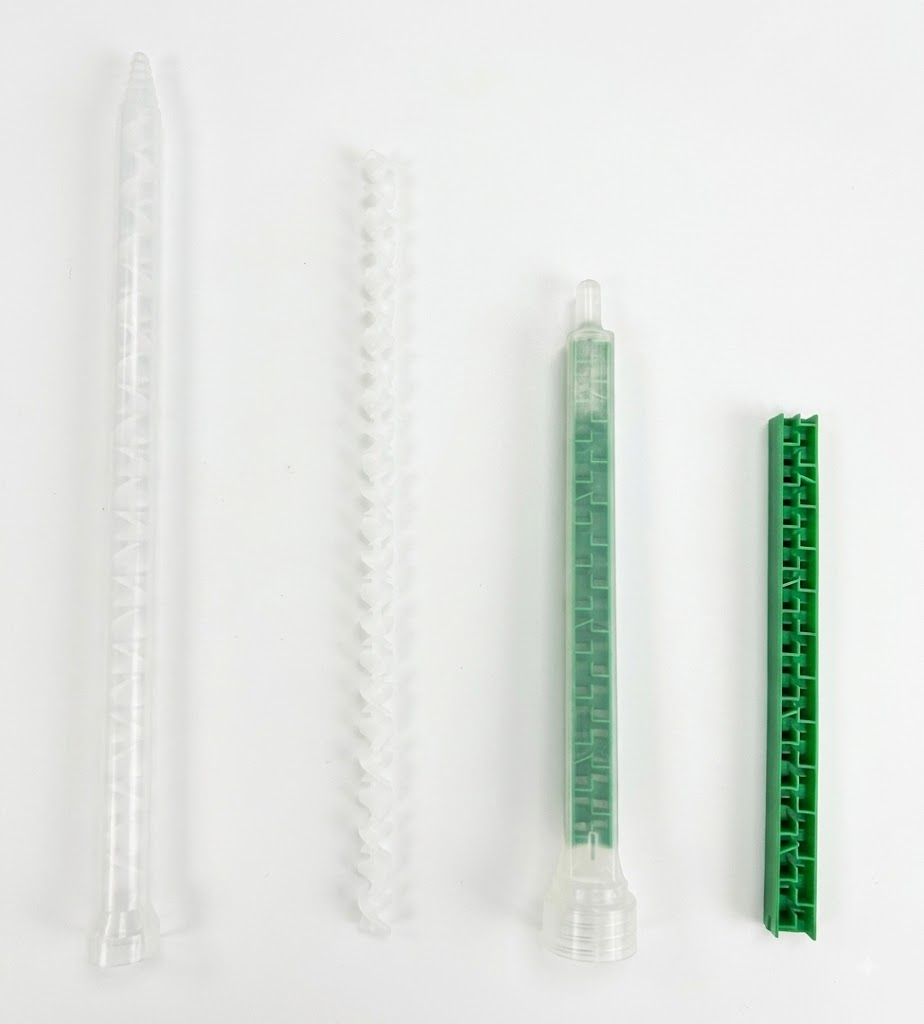
How Each Geometry Mixes
Both are static mixers: motionless molded elements inside a disposable housing, driven only by dispensing pressure. The difference is what the elements do to the fluid streams on their way through.
Helical (round) elements
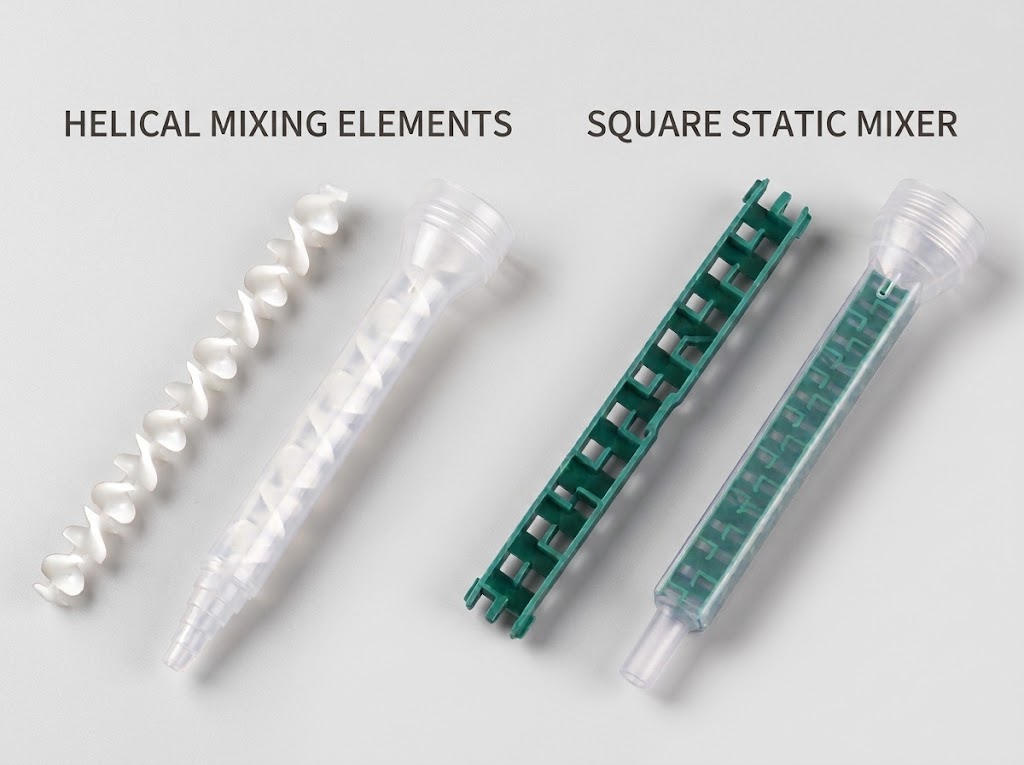
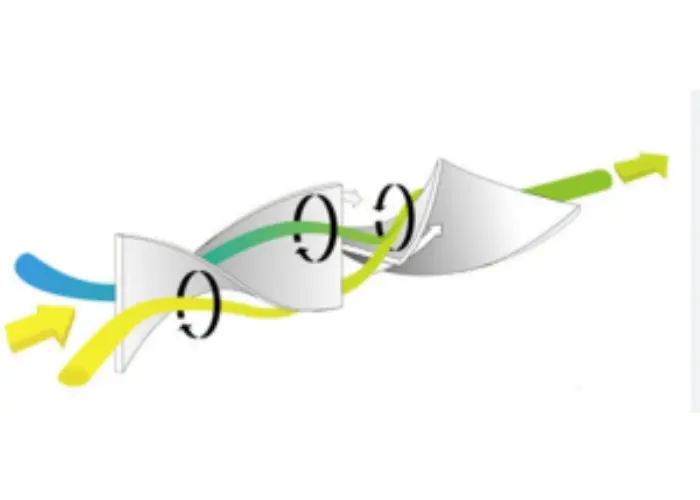
A stack of twisted spiral vanes. Each element splits the flow in half, rotates it about 90 degrees, and hands it to the next element, which twists the opposite way. Layer count doubles at every junction per the 2^N progression, and after a full stack the two components have been folded into thousands of thin laminae. The geometry is forgiving, well understood, and cheap to mold — the reason it dominates catalog ranges.
Quadro (square) elements
A matrix of interlocking flat baffles set at alternating perpendicular angles. Instead of gently spiraling the flow outward, each baffle slices the stream and folds it sharply back toward the center. The result is the same 2^N layer doubling, reached with more aggressive shear per element and without the stagnant boundary layer that can form along a curved housing wall.
Why the boundary layer matters
Round housings have a classic fluid-mechanics weakness: fluid near the curved wall moves slower than fluid at the center, so components can ride that slow lane partway through the mixer without fully folding into the blend.
What that slow lane does to your bead, and what square geometry does about it:
- Slow-lane streaking — components riding the wall region reach the outlet less folded, showing as faint marbling at the bead edges.
- Flat velocity profile — square cross-sections keep flow speed uniform, pushing every stream through the folding zones.
- On-plate evidence — the difference is a footnote on paper and a visible marbling pattern on your dispensing plate.
Waste: Retained Volume per Nozzle
Every static mixer is thrown away with cured adhesive inside it. That retained volume is pure material loss, multiplied by every shift change and every cartridge swap across a year. The interface families and outlet options for both geometries are listed on our static and dynamic mixers page.
Square elements reach target homogeneity in a shorter housing — typically in the range of 16 to 24 elements where a helical design of equal capability runs about 24 to 32. Less housing length means less internal volume, and less volume means less resin in the trash. On production lines that swap nozzles between batches, moving from a helical to a square format cuts the cured waste per swap by roughly 30 to 50%.
Whether that matters depends on what you dispense. For a commodity construction sealant, the saving is rounding error. For filled structural epoxies, optical polyurethanes, or thermally conductive potting compounds, the per-swap saving compounds into real money over a year of production.
The per-swap cost math, worked through
Run the arithmetic on a hypothetical line — no prices, just structure. Take a station that changes nozzles once per shift across three shifts a day. Each discarded helical nozzle holds some retained volume of mixed resin; call it V milliliters of a two-part structural adhesive. Switching to a square format with a 30% smaller retained volume saves 0.3 × V per swap, three times a day, every production day of the year.
Whether that product is significant is decided entirely by the resin’s cost per milliliter and the number of dispensing stations — which is why the switch decision belongs to your cost-of-materials spreadsheet, not to a catalog page. The structural point stands regardless of the numbers you plug in: waste reduction is linear in swap frequency and resin value, and geometry is one of the few levers that reduces it without touching the process itself.
Length and Access
A shorter housing is not only about waste. Long nozzles create a lever arm between the operator’s hand and the joint, obscuring the dispensing point in recessed cavities and narrow channels. Square mixers bring the outlet roughly 40–50% closer to the workpiece for equal mixing performance, which improves both line-of-sight and wrist ergonomics over an eight-hour manual shift.
Consider where your parts actually live. Encapsulated electronics housings, deep battery trays, and channel-shaped castings all put the bond line centimeters below the surrounding structure. A long nozzle approaching that joint at an angle touches the structure before the outlet reaches the deposit point; a short one fits the approach vector.
Operators compensate for long nozzles by tilting the gun, which changes bead geometry in ways nobody documents — and which shows up later as inconsistent bond-line thickness.
Robotic Dispensing: Rigidity and Repeatability
On automated equipment the same physics applies in reverse: a long round nozzle can flex during rapid acceleration and cornering, drifting the bead off its programmed path. A shorter square profile is stiffer, keeping the dispense point on tolerance through fast moves.
The failure mode is subtle. A deflecting nozzle does not miss the joint entirely — it deposits the bead a fraction of a millimeter late in the corner, which passes visual inspection and fails downstream when the bond-line thickness falls outside the qualified window.
Teams chase this as a controls problem for weeks before anyone points at the consumable. If your robot’s bead tolerance is tighter than the nozzle’s deflection under acceleration, the nozzle is the problem, and square geometry is the standard fix.
Backpressure: The Hidden Trade-Off
Aggressive shear is not free. The abrupt folding of square elements generates more flow resistance than a gentle spiral of equal diameter, which translates into higher dispensing force at a given flow rate. On a pneumatic gun or meter-mix pump this is absorbed by the pressure source and rarely noticed.
On a manual lever gun driving a high-viscosity structural adhesive, the extra effort lands in the operator’s hand across an entire shift — and operator fatigue is a quality variable, not just a comfort one.
The practical reading: if your dispensing is powered, treat backpressure as a specification to check and move on. If it is manual and your resin is thick, qualify both geometries with the operators who will actually pull the trigger, and weigh the ergonomic difference against the material saving. The right answer sometimes differs between the manual repair cell and the powered production cell within the same building.
Mix Ratio Performance
Where the two geometries genuinely diverge is wide volumetric ratios. At 1:1 and 2:1, both deliver a homogeneous blend with standard element counts — helical is entirely adequate.
At 4:1 and 10:1 the risk profile changes. The low-volume component, usually a thin activator or catalyst, tends to streak along the housing wall of a helical mixer without fully integrating into the higher-viscosity resin.
The abrupt directional shifts of square elements force both streams through high-shear transition zones repeatedly, which is why wide-ratio programs are the textbook case for switching geometry.
Diagnose before you switch, though. Streaking has other causes, and each has its own check:
- Off-ratio cartridge — verify with a gravimetric check before blaming the nozzle.
- Worn piston — one chamber leading the other distorts the ratio mid-dispense; compare first-drop and last-drop weights.
- Under-primed nozzle — unmixed material from the first stroke is a purge problem; fully purge before judging geometry.
If the streaks persist with a verified ratio and a fully primed nozzle, geometry is the remaining suspect and the square trial is justified.
| Metric | Helical (round) | Quadro (square) |
|---|---|---|
| Elements for target mix | ~24–32 | ~16–24 |
| Housing length | Standard | ~40–50% shorter |
| Retained volume | Baseline | ~30–50% lower |
| Backpressure at equal flow | Lower | Higher (aggressive shear) |
| 1:1 / 2:1 performance | Fully adequate | Fully adequate |
| 4:1 / 10:1 wide ratios | Streaking risk | Aggressive folding, preferred |
| Robotic tip rigidity | Moderate flex on fast moves | Stiffer, tighter path tolerance |
| Manual ergonomics (thick resin) | Lower trigger force | Higher trigger force |
The table is the quick view; the trade-offs deserve the prose above — read both before qualifying a switch.
Worked scenario: one line, two programs
Consider a single dispensing cell running two adhesives: a 1:1 polyurethane potting compound for enclosure sealing, and a 10:1 structural methacrylate for bracket bonding. The rational setup keeps helical nozzles on the 1:1 potting program, where they are cheap and fully sufficient, and qualifies square nozzles only for the 10:1 methacrylate, where the wide ratio and the high resin cost both argue for the square format. There is no reason to standardize one geometry across both programs if the trials support the split.
Customization: When Neither Stock Geometry Fits
Catalog mixers cover standard cartridge systems and common ratios, but qualified programs sometimes need geometry that is not on the shelf. Element count, housing length, and body material are all customizable — a polyamide housing for a pressure-heavy meter-mix feed, a longer element stack for a difficult 4:1 resin, a PBT variant for a solvent-bearing formulation. If your stripe tests consistently show borderline results with stock parts in either geometry, a custom element configuration is the next step rather than a compromise between two imperfect options.
Unsure which geometry your resin needs?
Send your adhesive viscosity, mix ratio, and cartridge size — the HaiJing engineering team will recommend an element geometry and send test samples so you can run a stripe test on your own line.
Switching Costs Almost Nothing
Because both geometries mount on the same interface standards, a geometry trial does not touch your dispensing hardware. If your line runs B-system 50/75/100ml cartridges or F-system 200/400ml cartridges, a square mixer in the same bayonet or twist-lock fitting is a drop-in swap. The only real cost of the trial is the nozzles themselves and the qualification time.
The correct way to qualify either geometry is a stripe test, run in three steps:
- Dispense onto a flat plate at your normal production speed.
- Inspect for color streaks or marbling that indicate incomplete blending.
- Cure-test the deposit to confirm full mechanical properties.
A nozzle that passes on paper but streaks on your material has failed, whatever the element count says.
Pair the trial with the packaging it mounts to — cartridge formats and outlet systems are covered under cartridge systems.
Why We Write This
We manufacture both geometries in the same plant — 85 million-plus static mixers a year across helical and square element designs — so this guide has no horse in the race beyond matching your adhesive to the right housing. If your formulation works on helical, that is the answer we will give you.
References
- Static mixer laminar-flow layer theory (2^N geometric division) — standard chemical-engineering principle for motionless mixers.
- Quadro (square) element performance ranges (housing length reduction 40–50%, retained volume reduction 30–50%, element counts 16–24 vs 24–32) — HaiJing product engineering data, 2026.
- Cartridge interface systems A/B/C/F and ratio coverage (1:1 to 10:1) — gluecartridges.com product pages, 2026.
- Dynamic mixer ratio ceiling (100:1) — gluecartridges.com dynamic mixers page, 2026.
Frequently Asked Questions
Is Quadro always better than helical?
Do I need new guns or cartridges to switch geometry?
Why does a shorter mixer waste less adhesive?
How do I verify a mixer is mixing properly?
Can square mixers handle 10:1 methacrylates?
Does switching to square increase dispensing force?
Can I order custom element counts or materials?