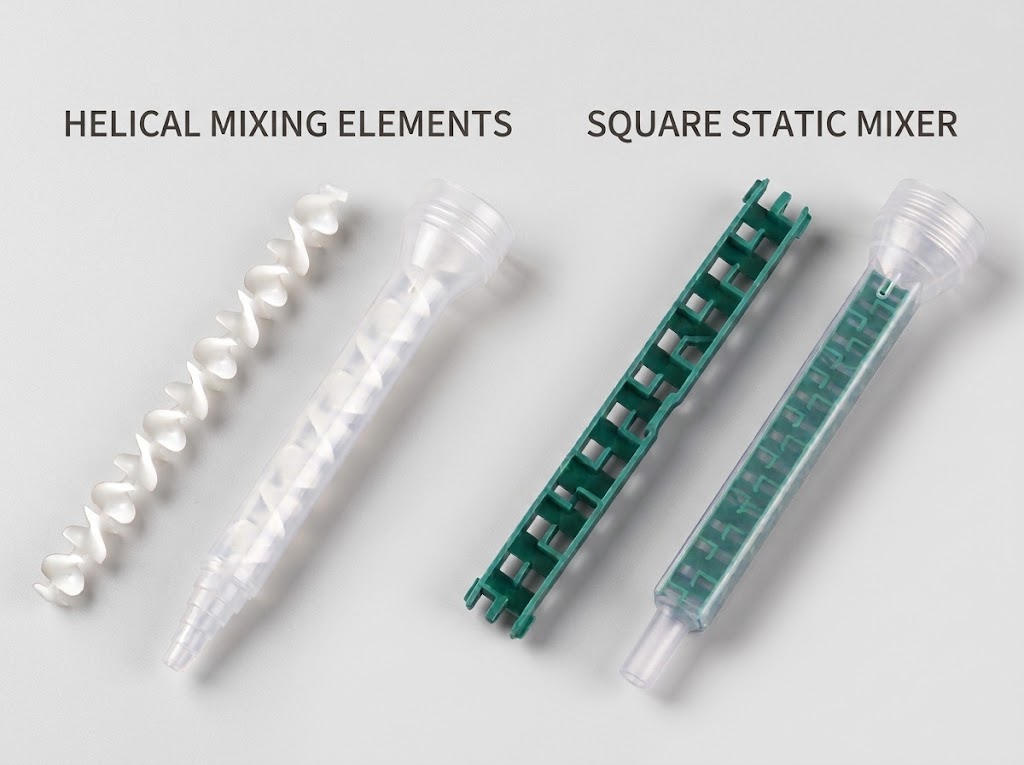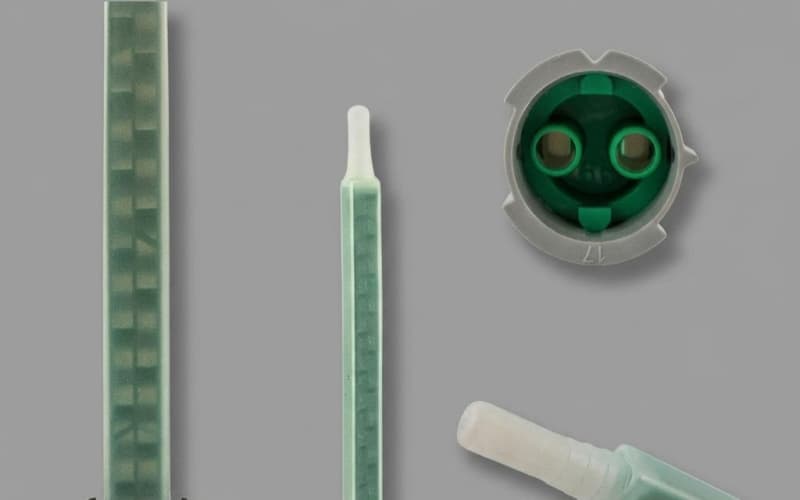
A square static mixer (also known as a Quadro mixer) is an engineered dispensing attachment that uses alternating square-shaped internal baffles to divide, shear, and blend two-component (2K) reactive adhesives. Compared to traditional round helical nozzles, the primary advantages of a square static mixer include a 40% to 50% reduction in overall housing length, a 30% to 50% decrease in retained material waste, and enhanced positional accuracy for both manual operators and robotic dispensing systems. By optimizing internal fluid paths, square mixing elements deliver homogeneous mixing in a significantly shorter footprint without creating excessive backpressure.
Selecting the right static mixing nozzle directly affects plant-level material expenditure, cycle times, and bonding consistency across industrial assembly lines.
1. Engineering Mechanism: How Square Element Geometry Works
Traditional round static mixers rely on spiral or helical elements that split fluid streams down the center and spiral them toward the outer housing wall. While functional, this method requires a long fluid travel path to achieve complete blending.
Square static mixers optimize this process through a compact matrix of interlocking, perpendicular flow channels:
-
2^N Geometric Division:At every element junction, the fluid stream is sliced in half and directed toward the outer perimeter before being folded back into the center. Each additional element doubles the number of distinct fluid layers according to the geometric progression 2^N (where N is the element count).
-
Elimination of Stagnant Boundary Layers: Round geometries often suffer from fluid dragging along the curved outer wall, creating uneven residence time. The flat, defined geometry of a square mixer maintains a uniform velocity profile across the entire cross-section.
-
Shorter Chamber Length for Equal Homogeneity: Because the flow is folded and re-centered more aggressively at each stage, an operator can achieve the same mixing quality using approximately 16 to 24 square elements that would otherwise require 24 to 32 helical elements.
2. 4 Core Advantages of Square Static Mixers in Manufacturing
2.1. Drastic Reduction in Adhesive Waste (Lower Cost-in-Use)
In high-volume manufacturing, two-part structural epoxies, polyurethanes, and acrylics represent significant recurring material costs. Because static mixers are disposable consumables discarded after the adhesive cures, all material remaining inside the nozzle when work stops is lost.
-
Lower Internal Volume: The shorter body of a square mixer holds 30% to 50% less fluid volume than a standard helical tube of comparable mixing capability.
-
Quantifiable Material Savings: On production lines where nozzles are swapped during shifts, shift changes, or work pauses, switching to a square format eliminates gallons of cured, wasted resin per station annually.
2.2. Compact Footprint and Improved Ergonomic Visibility
Long mixing nozzles extend the distance between the operator’s hand and the joint line, creating an awkward lever arm during manual application.
-
Line-of-Sight Access: A compact square nozzle brings the dispensing tip closer to the part, eliminating the visual obstruction caused by long tubes when applying adhesive into recessed seams or narrow channels.
-
Operator Comfort: Bringing the dispensing point closer to the grip reduces wrist fatigue and hand tremor when using manual dispensing guns over eight-hour shifts.
2.3. Enhanced Stability for Automated Dispensing Platforms
Automated gantry systems and 6-axis robotic arms require rigid tooling to maintain programmed path tolerances.
-
Reduced Tip Deflection: Long round nozzles can flex or whip slightly during rapid acceleration, deceleration, and sharp cornering. A shorter square nozzle provides structural rigidity, preventing bead misalignment.
-
Low-Torque Integration: Using shorter nozzles reduces the cantilevered load on automated valves and pneumatic dispensing guns, ensuring tighter bead repeatability on complex 3D toolpaths.
2.4. Consistent Performance Across Asymmetric Mix Ratios (1:1 to 10:1)
Blending components with vastly different viscosities or wide volumetric ratios (such as 4:1 or 10:1 structural methacrylates) is challenging. Helical mixers can allow low-viscosity activators to streak along the housing walls without fully integrating into high-viscosity resins. The continuous splitting and folding within a square nozzle forces both streams through high-shear transition zones, preventing soft spots, incomplete cures, or compromised mechanical shear strength.
3. Technical Comparison: Square (Quadro) vs. Helical Static Mixers
| Engineering Metric | Quadro (Square) Static Mixer | Helical (Round) Static Mixer | Operational Impact |
| Nozzle Length | 40%–50% shorter | Standard full length | Enables access to tight cavities; reduces tool overhang |
| Internal Retained Volume | Low (30%–50% reduction) | Higher retained volume | Direct material cost savings on high-value resins |
| Elements for Target Mix | Typically 16–24 elements | Typically 24–32 elements | Shorter mixing chamber with equivalent shear |
| Robotic Path Rigidity | High (minimal tip deflection) | Moderate (prone to flex during fast moves) | Tighter bead tolerance on automated lines |
| Operator Clearance | Direct line-of-sight to joint | Obstructed by extended nozzle barrel | Higher manual assembly accuracy; fewer rejects |
| Common Interface Standards | B-System, F-System, Threaded | Bayonet, Bell, Threaded, Integral Nut | Direct drop-in replacement across systems |
4. Typical Industrial Applications for Square Static Mixers
Square mixing nozzles are widely deployed in industrial sectors where high-performance resins and tight assembly tolerances are required:
-
Automotive and Transportation Bonding: Dispensing structural methyl methacrylates (MMA) and polyurethanes for composite panel bonding, battery module potting, and bracket attachment where cycle times and waste minimization govern production economics.
-
Electronics and Semiconductor Encapsulation: Precision micro-potting and dispensing of thermally conductive epoxies into miniature enclosures where long nozzles cannot fit.
-
Aerospace Structural Adhesives: Applying flame-retardant structural epoxies to honeycomb panels and composite brackets requiring verified stoichiometric uniformity.
-
Medical Device Manufacturing: Dispensing medical-grade silicones and UV/curable formulations where micro-deposits must remain consistent and air entrapment must be strictly avoided.
5. Engineering Selection and Interface Compatibility
Integrating square static mixers into your current process does not require redesigning your dispensing equipment. Square nozzles are manufactured to match standard industrial cartridge interfaces:
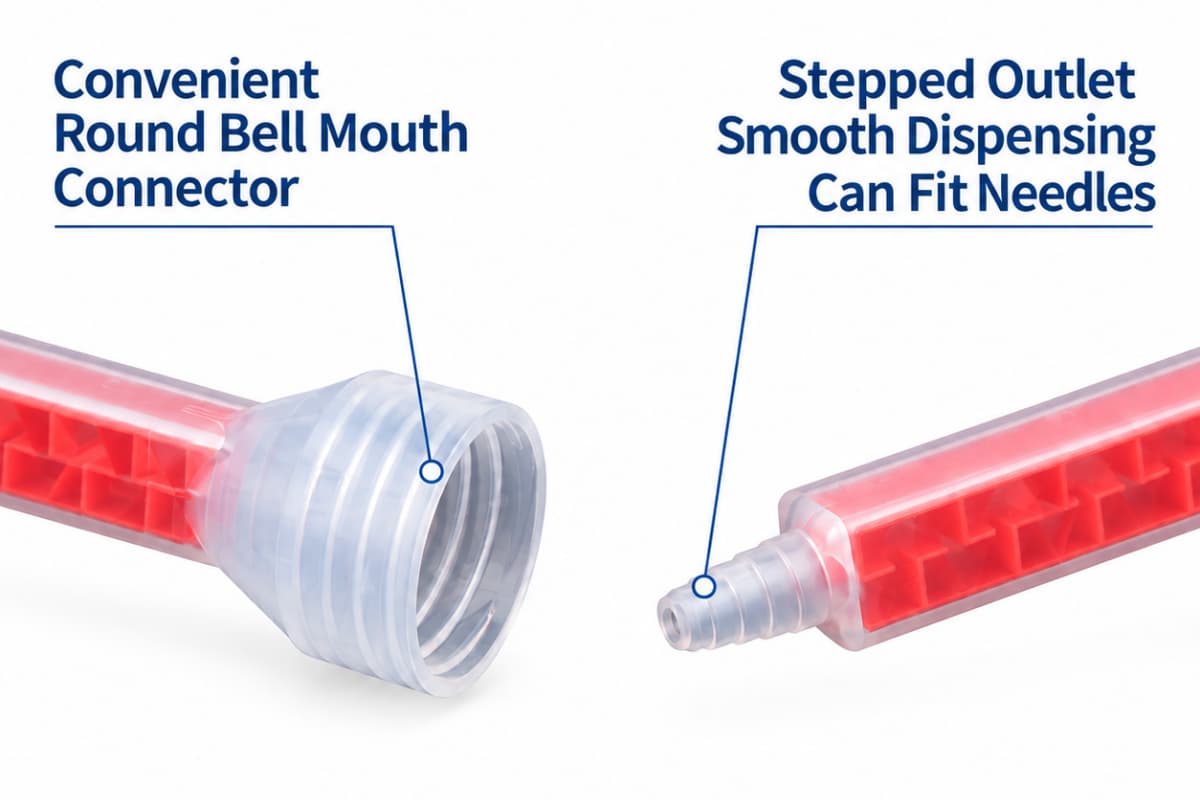
The adhesive dispensing system follows a sequential flow: starting from the adhesive cartridge, the material is directed into the inlet connection, which is available in either B System or F System interface standards. From there, the two components enter the square element core – the static mixing section that ensures thorough homogenization. Finally, the mixed adhesive exits through the outlet, which can be configured as either a stepped tip or a Luer Lock fitting, depending on the application requirements.
-
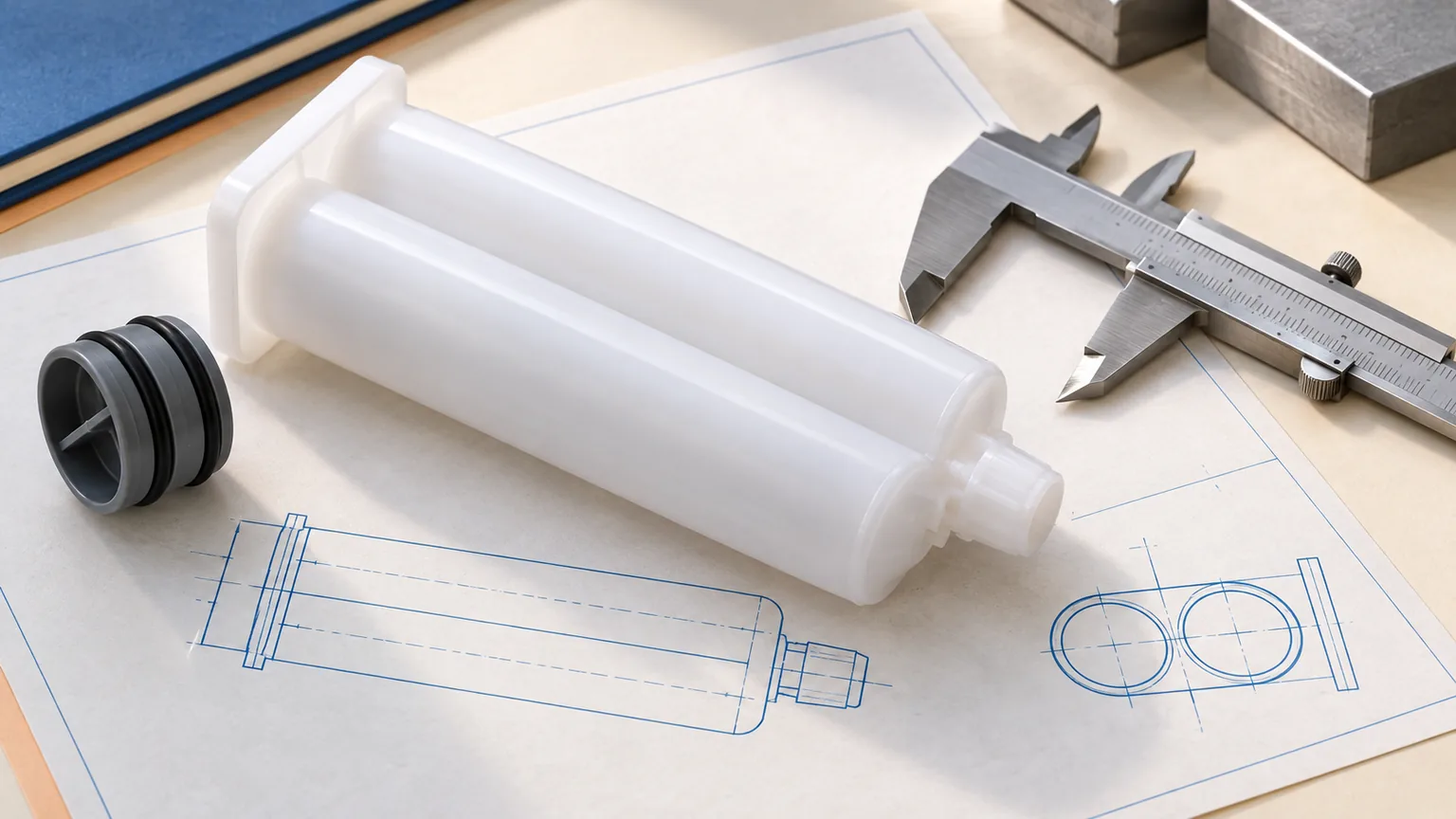
B-System Static Mixers: Designed primarily for 50 mL dual-barrel cartridges. The compact twist-lock interface ensures quick replacement and positive alignment for 1:1 and 2:1 applications.
-
F-System Square Nozzles: Used with larger 200 mL and 400 mL two-component adhesive cartridges. The F-System features separate component outlet ports at the cartridge interface, preventing chemical cross-contamination and premature tip clogging at the nozzle base.
-
Outlet Configurations: Available with stepped tips (which can be cut to adjust bead diameter) or integrated Luer Lock fittings for attaching precision stainless-steel dispensing needles.
6. Process Engineer’s Selection Checklist: Square vs. Round
Use this checklist during process qualification to decide if upgrading to a square static mixer is recommended:
-
Adhesive Unit Cost: Is the adhesive a high-cost specialty formulation (e.g., optical polyurethane, filled thermal epoxy)? If yes, switch to Square to minimize residual waste.
-
Dispensing Space Constraints: Is the application point recessed inside a deep housing or shielded by adjacent brackets? If yes, choose Square for improved line-of-sight and clearance.
-
Automation Speed: Does the XYZ robot operate with high-speed indexing where nozzle deflection causes bead drift? If yes, choose Square for enhanced tip rigidity.
-
High Mix Ratio Discrepancy: Are you running 4:1 or 10:1 formulations with significant component viscosity differences? If yes, prioritize Square for higher mechanical shear and mixing efficiency.
7. Key Takeaways
-
Material Conservation: Square mixers reduce fluid waste inside the nozzle by 30% to 50%, providing direct cost reductions on two-component adhesive lines.
-
Compact Geometric Design:By using 2^N laminar flow splitting, square nozzles achieve full blending at roughly half the length of conventional helical mixers.
-
Process Stability: The shorter profile enhances manual joint visibility and eliminates dynamic tip flex on automated robot arms.
-
Broad Interface Compatibility: Standardized B-System, F-System, and threaded inlets allow direct replacement on existing 50 mL, 200 mL, and 400 mL cartridge setups.
8. Frequently Asked Questions (FAQ)
Can square static mixers handle high dispensing pressure in automated meter-mix systems?
Yes. Industrial square static mixers are molded from high-grade polyolefins (such as polypropylene and POM) with reinforced wall thicknesses designed to withstand standard pneumatic and meter-mix pumping pressures without barrel expansion or rupture.
Are square static mixers compatible with 10:1 ratio methacrylate (MMA) resins?
Yes. The intersecting geometry of square elements is particularly effective for wide-ratio formulations (4:1 and 10:1) because the abrupt directional shifts prevent low-viscosity catalysts from channeling through the resin core without mixing.
Can I replace my current round helical nozzles with square nozzles without changing my cartridge guns?
Yes. As long as the inlet connection matches your cartridge standard (e.g., standard B-System 50 mL bayonet or F-System 200/400 mL interface), square nozzles serve as direct form-and-fit replacements.
How do square static mixers prevent air bubbles in optical or potting applications?
The compact element layout provides a shorter fluid transition zone that purges air rapidly upon initial prime, minimizing the internal void spaces where air can become trapped compared to longer round tubes.
9. Partner with HaiJing for Dispensing Solutions
HaiJing manufactures a comprehensive range of industrial-grade two-component fluid packaging and dispensing consumables. From precision B-System and F-System square static mixers to specialized custom static mixer OEM solutions, our products are engineered for dimensional stability, burst resistance, and reliable batch-to-batch mixing performance.
To qualify the optimal mixing nozzle for your resin chemistry and dispensing hardware, contact the HaiJing technical team with your adhesive viscosity, mix ratio, cartridge size, and production volume to request engineering test samples.