Adhesive Cartridges: The Complete Guide to Sizes, Materials, and Selection
Industrial dispensing precision depends as much on the fluid packaging container as it does on the automated valve or dispensing gun. Selecting the correct adhesive cartridge sizes, structural configurations, and barrel polymers prevents common manufacturing defects such as ratio drift, premature chemical curing, air entrapment, and burst barrels under pneumatic pressure.
Whether packaging single-component sealants or two-part reactive chemistries, engineering teams must align cartridge volume, internal wall thickness, barrier polymer properties, and mixer interface geometry. This guide outlines standard volumetric dimensions, polymer compatibility matrices, interface standards, and procurement benchmarks to streamline cartridge selection for automated and manual production lines.
Engineering Fluid Packaging: Why Adhesive Cartridge Selection Dictates Dispensing Precision
An adhesive dispensing cartridge functions as a dynamic pressure vessel during application. When a pneumatic ram or manual actuator applies forward thrust, internal pressures can rise significantly depending on adhesive viscosity and flow restrictors.
[Actuator Thrust] ──> [Piston Travel] ──> [Hydraulic Pressure in Barrel] ──> [Static Mixing Elements] ──> [Orifice Dispense]
Using an improperly rated or poorly molded barrel causes four primary mechanical failures:
-
Barrel Ballooning & Volumetric Inaccuracy: Insufficient wall thickness allows the cylindrical barrel to expand radially under hydraulic load. This causes the adhesive to surge unevenly once pressure drops, leading to inconsistent bead profiles.
-
Piston Bypass & Back-Leakage: Minor ovality tolerances along the barrel diameter compromise the multi-lip piston seal, allowing resin components to bleed behind the plunger and foul the applicator mechanism.
-
Off-Ratio Metering in Dual Systems: In a two component cartridge, asymmetrical wall flexing between the resin and hardener barrels alters the intended volumetric displacement ratio, resulting in uncured bond lines.
-
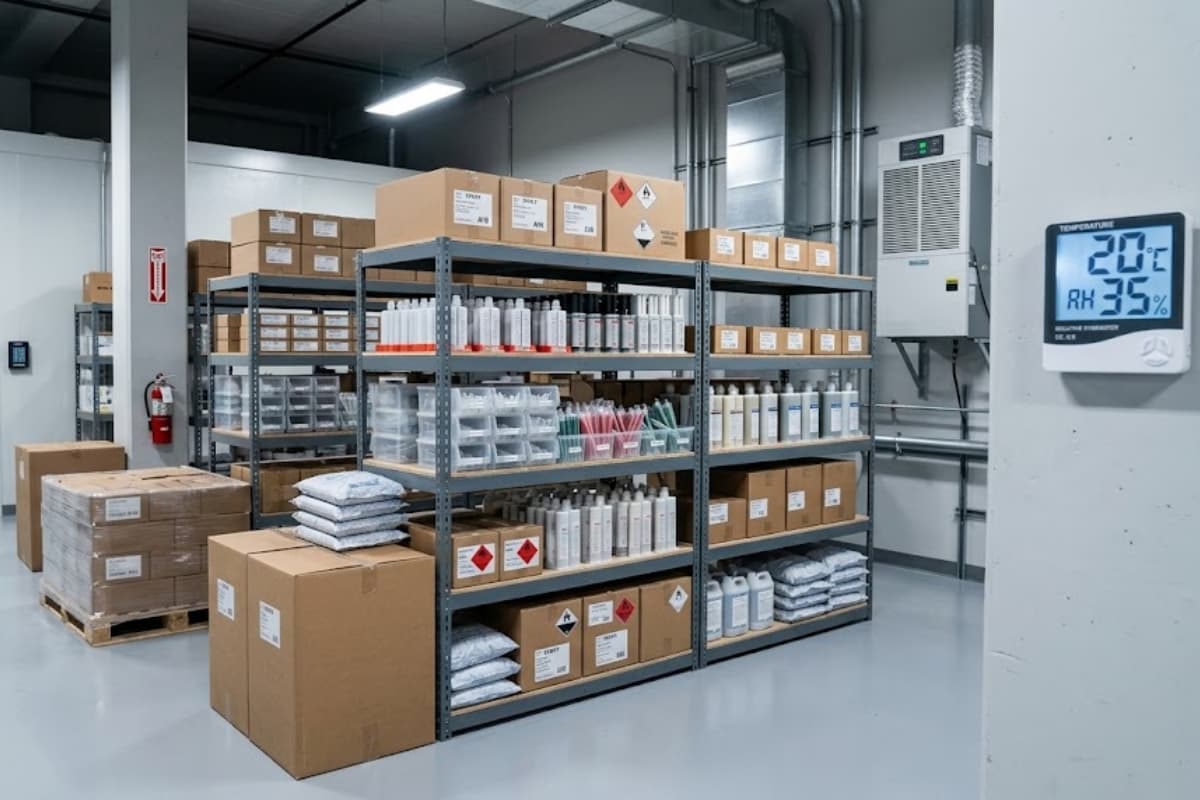
Moisture Ingress and Degradation: Inadequate polymer barrier properties allow ambient water vapor to permeate the casing, initiating premature polymerization of moisture-curable polyurethanes and silicones before packaging leaves storage.
Engineers must specify precision cartridge systems that match both the chemical reactivity of the formulation and the operational pressures of the dispensing environment.
Standard Adhesive Cartridge Sizes: Single-Component vs. Dual-Component Configurations
Fluid packaging divides into two distinct mechanical configurations: 1K single-barrel cylinders and 2K integrated dual-barrel structures.
Single-Component (1K) Cartridge Dimensions & Capacities

Single-component packaging houses pre-mixed, air-curing, or moisture-curing adhesives such as RTV silicones, MS polymers, and industrial polyurethanes. Standard single-component cartridges feature an industry-standard 1/4″ or specialized threaded front orifice and a floating rear wiper plunger.
-
100 ml – 150 ml: Compact barrels utilized in fine-pitch electronics, localized potting, and tight mechanical rework.
-
300 ml – 310 ml (Euro-Cartridge Standard): The primary industrial format for manual and pneumatic bead application in manufacturing, electronics assembly, and construction.
-
400 ml – 600 ml (Sausage/Rigid Hybrids): High-volume configurations engineered for extended line uptime in automated sealing cells.
Two-Component (2K) Dual Barrel Volumes & Mixing Ratio Standards
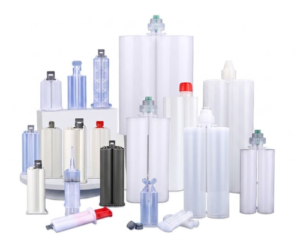
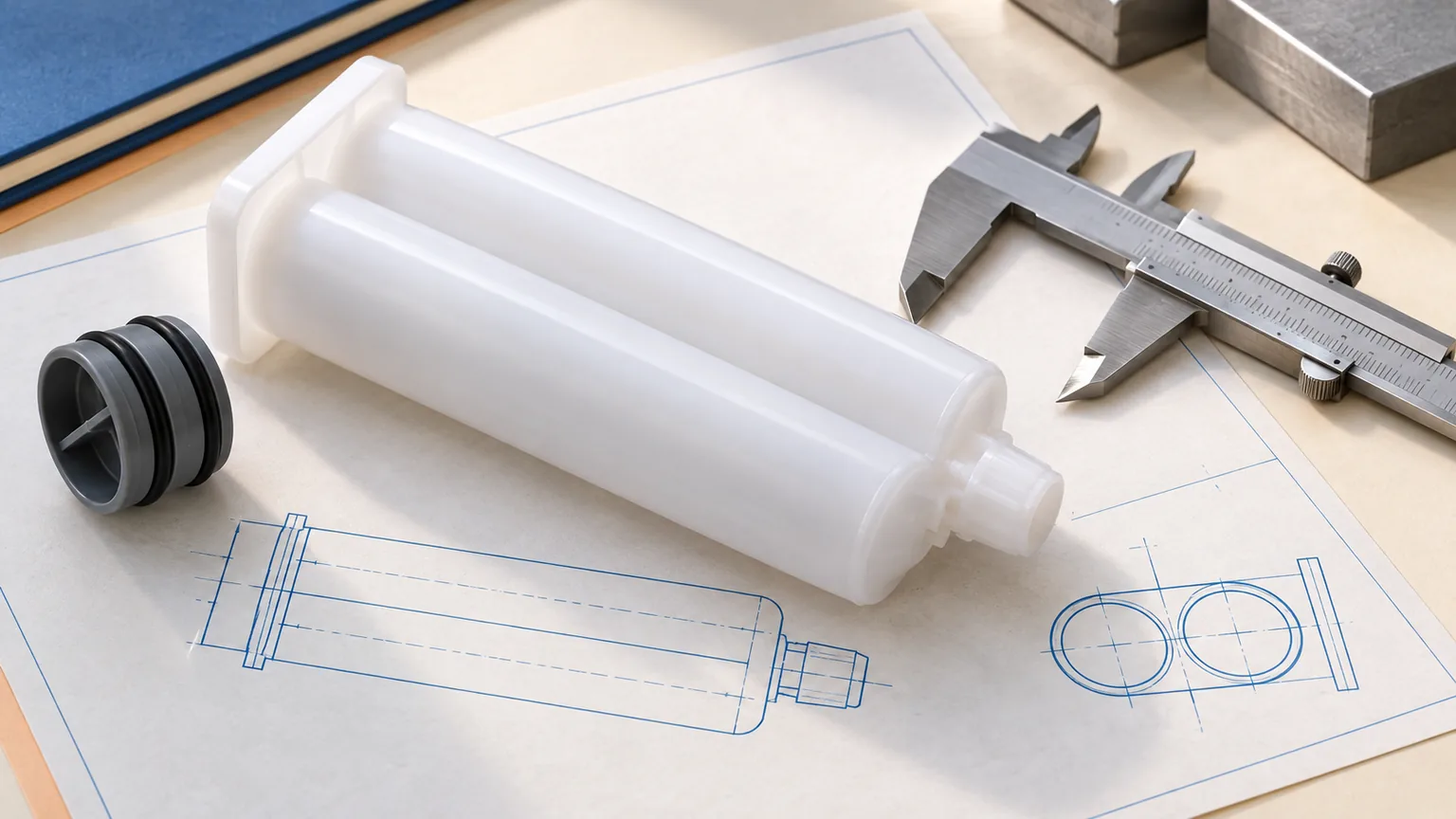
Reactive structural adhesives—including epoxies, structural acrylics (MMA), and two-part polyurethanes—require isolated storage of Part A (Resin) and Part B (Hardener). A dedicated dual barrel cartridge features two parallel cylinders joined by a structural bridge and an integrated manifold.
Volume and geometry vary by ratio:
-
50 ml Series: Standard for precision assembly in electronics and semiconductor packaging and medical device assembly. Common ratios include 1:1, 2:1, 4:1, and 10:1.
-
200 ml Series: Medium-scale structural bonding format designed for balanced manual handling and intermediate automated dispensing.
-
400 ml – 490 ml Series: The heavy-duty industrial benchmark for automotive panels, composite bonding, and renewable energy applications.
| Cartridge Type | Nominal Volume | Mix Ratio Options | Typical Interface System | Primary Production Application |
| 1K Standard | 300 ml – 310 ml | 1:1 (N/A) | Threaded / Euro-Nozzle | Bead dispensing, gasketing, threadlocking |
| 2K Micro/Lab | 2.5 ml – 10 ml | 1:1, 2:1 | Luer-Lock / Custom | Micro-potting, localized semiconductor rework |
| 2K Precision | 50 ml | 1:1, 2:1, 4:1, 10:1 | B-System / Bayonet | Electronics potting, optics, medical bonding |
| 2K Industrial | 200 ml – 250 ml | 1:1, 2:1, 10:1 | C-System / Twist-Lock | Composite structural joints, bus/rail assembly |
| 2K Heavy-Duty | 400 ml – 490 ml | 1:1, 2:1, 4:1, 10:1 | F-System / Slide-Loc | Wind turbine blades, automotive battery packs |
Cartridge Material Selection: Matching Polymers to Chemical Formulations
The chemical composition of a plastic adhesive cartridge must resist solvent degradation, prevent monomer leaching, and control gas transmission rates.
[Material Choice] ──> [Chemical Inertness] + [Moisture/UV Barrier] + [Hoop Tensile Strength]
Polypropylene (PP) vs. PBT vs. Polyamide (PA/Nylon)
-
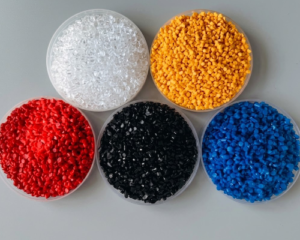
Polypropylene (PP): The standard baseline material for an empty sealant cartridge. PP provides broad chemical resistance against acids, bases, and polar solvents. It exhibits natural lubricity for smooth piston glide but has moderate moisture barrier capabilities and lower tensile limits under elevated operating temperatures.
-
Polybutylene Terephthalate (PBT): A high-performance engineering polymer chosen for aggressive methacrylate adhesives (MMA) and aromatic solvent carriers. PBT exhibits minimal swelling, high dimensional stability, and superior resistance to chemical permeation.
-
Polyamide (PA / Nylon): Specified for operations requiring exceptional hoop strength and burst resistance under high pneumatic pressure. PA is mechanically rugged but hygroscopic, meaning it requires dry storage conditions prior to filling.
Polypropylene (PP) ───> Standard Epoxies
Silicones, General Adhesives PBT ───> Aggressive MMAs, Esters
Volatile Solvents Polyamide (Nylon) ───> High-Pressure Mechanical Dispensing Systems
Barrier Additives and Light-Sensitive Chemistries
-
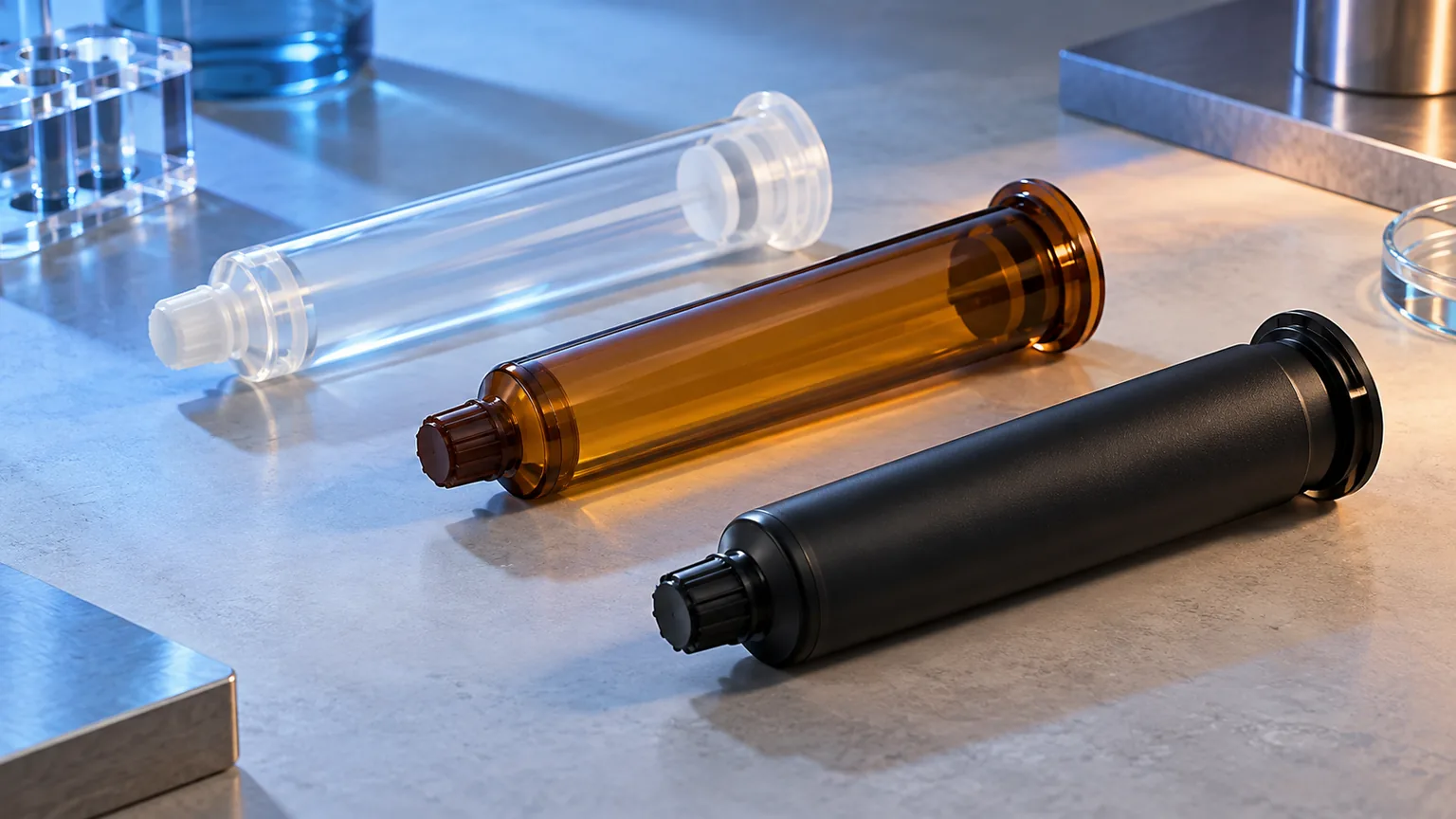
UV and Light Blocking: Light-curing acrylates and UV-curable epoxies require opaque black or deep amber UV-blocking formulations to prevent unintended curing inside the nozzle neck.
-
Moisture-Vapor Barriers: High-density polyethylene (HDPE) or specialized multi-layer blends are essential for moisture-reactive isocyanate hardeners to prevent skinning and viscosity changes during transit and warehouse storage.
Dispensing Interface Compatibility: Connecting Cartridges to Mixers and Guns
A cartridge cannot perform reliably in isolation. Total dispensing reliability depends on absolute compatibility between the barrel outlet, internal pistons, and external actuation equipment.
DISPENSING SYSTEM > Cartridge System > Sealed Pistons >
├─> B / C / F Interface > Static Mixer
└─> Dispensing Gun / Automated Actuator
Interface Standards (B-System, C-System, F-System)
When configuring empty cartridges for two part adhesives, selecting the correct outlet connection interface prevents cross-contamination at the fluid boundary:
-
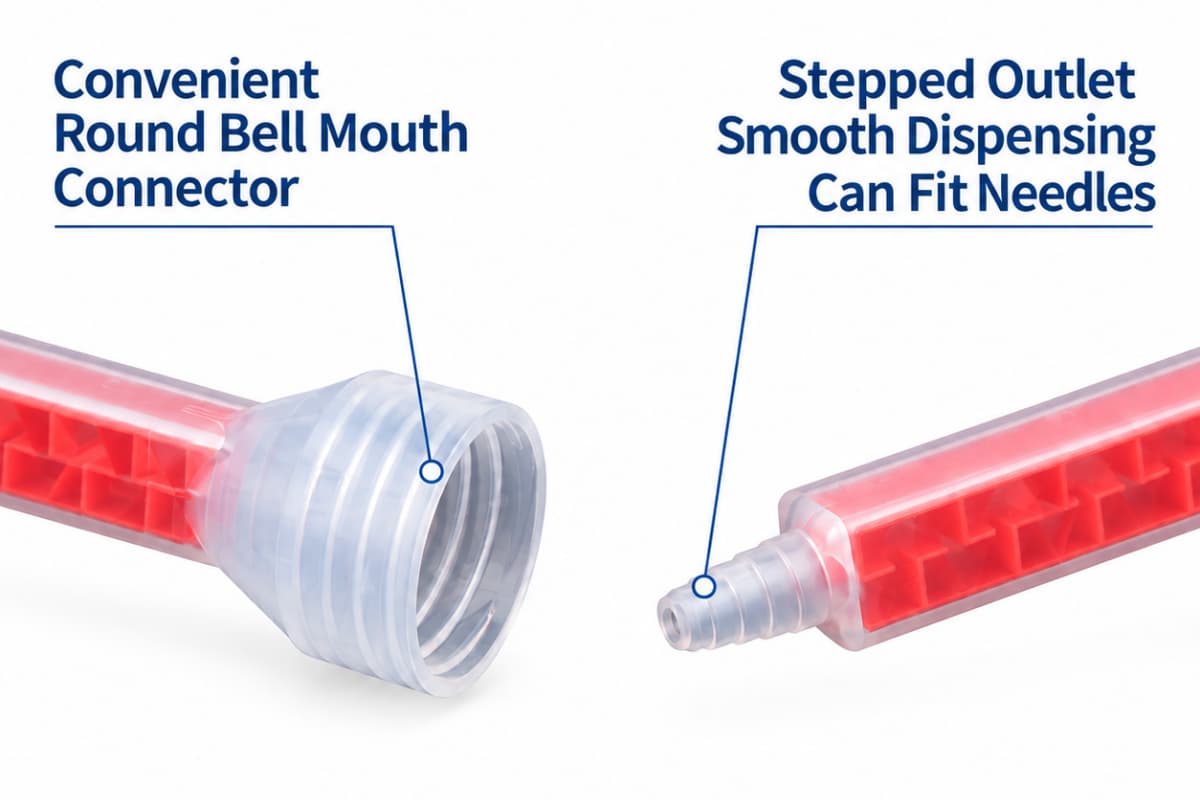
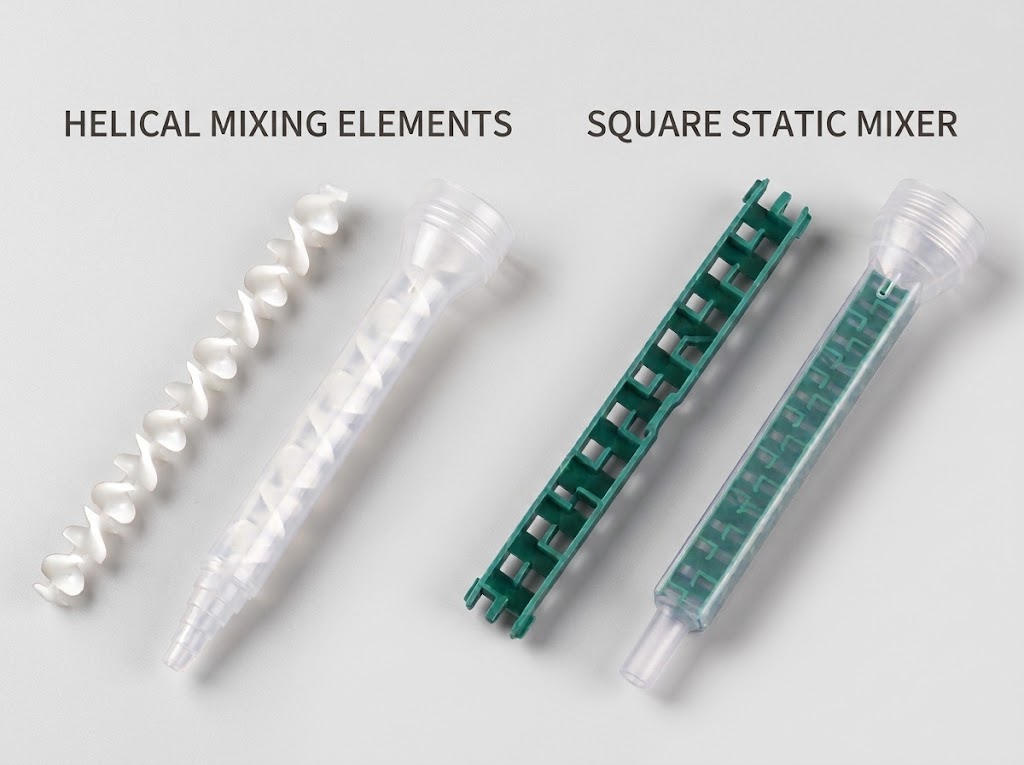
B-System (Bayonet Connection): Features dedicated alignment keys for 50 ml systems. Using a static mixer B-system guarantees that Part A and Part B remain strictly separated until fluid enters the dynamic or static mixing elements.
-
C-System & F-System (Industrial Twist-Lock & Slide-Lock): Engineered for 200 ml and 400 ml dual-barrel platforms. Utilizing F-system static nozzles ensures high-pressure fluid seals capable of withstanding industrial pneumatic cycles without detachment.
Piston Dynamics and Air-Free Priming
The piston functions as a sliding hydraulic seal. Single-lip wiper pistons are sufficient for low-viscosity greases, whereas double-lip and multi-lip elastomer-ring pistons are mandatory for thixotropic pastes. In vacuum-assisted packaging, bleeding-vent pistons allow air pockets to escape during insertion, eliminating internal bubbles that cause dispensing drool and spluttering.
Actuator Matching
-
Manual Applicators: Suited for maintenance, field repairs, and low-volume manual assembly.
-
Pneumatic Dispensers: Pneumatic dispensing guns deliver uniform force across both cylinders, preventing operator fatigue and ensuring steady volumetric output across high-viscosity structural adhesives.
-
Automated Filling Lines: High-throughput packaging plants integrate automated filling machines to fill, vent, and seal raw barrels at designated cycle speeds.
OEM Sourcing Checklist: Evaluating Empty Sealant Cartridge Manufacturers
Procurement managers and process engineers evaluating an industrial sealant cartridge manufacturer should assess dimensional quality, cleanroom packaging standards, and precision tooling capabilities.
[Quality Auditing] ──> [Barrel Concentricity] + [Weld Line Integrity] + [Tooling Scalability]
Critical Manufacturing Benchmarks
-
Wall Thickness Uniformity: Minimal wall variation along the length of the cylinder eliminates localized weak spots that could rupture during high-pressure pneumatic cycles.
-
Flange and Neck Rigidity: High mechanical integrity at the cartridge retention lip prevents ejection or dislodgement under high pneumatic actuation forces.
-
Mold Parting Line Precision: Seamless inner bores ensure constant wiping contact with the piston, avoiding residual chemical waste.
Custom Tooling and Private Labeling
When proprietary chemistries demand non-standard volume ratios (e.g., 3:1 or 5:1) or specialized packaging branding, companies can leverage custom cartridge tooling and OEM services to develop dedicated multi-cavity injection molds, laser etching, and custom resin color matching.
Key Takeaways
-
Size Dictates Duty Cycle: Single-component cartridges center on the 300 ml–310 ml standard, while two-component operations utilize 50 ml for precision tasks and 200 ml–400 ml formats for heavy structural bonding.
-
Polymer Compatibility Controls Shelf-Life: Polypropylene serves general epoxy and silicone packaging; PBT is mandatory for aggressive MMAs, and high-barrier polyolefins protect moisture-sensitive polyurethanes.
-
Interface Integrity Prevents Failures: Standardized B, C, and F connection systems isolate components at the outlet, preventing cross-contamination and off-ratio dispensing.
-
Dimensional Accuracy Is Non-Negotiable: Uniform wall thicknesses and high inner bore concentricity prevent barrel deformation and fluid bypass during high-speed actuation.
Frequently Asked Questions
What is the most common size for two-component adhesive cartridges in automated assembly lines?
The 50 ml dual-barrel cartridge (1:1 and 2:1 ratios) is the standard for precision electronics, medical devices, and sensor potting. For high-volume automotive and structural assembly, the 400 ml format is preferred to minimize line stoppage during cartridge changeovers.
Can empty plastic adhesive cartridges be cleaned and reused?
Industrial adhesive cartridges are designed as single-use consumables. Cleaning cured or reactive polymer residue from the inner barrel walls compromises dimensional tolerances, scratches internal surfaces, and degrades piston seal performance, leading to leaks and dispensing failures.
How do I determine whether my application requires an F-System or B-System cartridge?
Cartridge capacity generally dictates the interface: 50 ml dual barrels use the B-System bayonet mount, whereas 200 ml to 400 ml heavy-duty dual cartridges use C-System or F-System slide/twist locking mechanisms to withstand higher hydraulic fluid pressures.
What cartridge material is recommended for moisture-sensitive polyurethanes?
High-density polymers with specialized moisture-barrier additives or opaque, thick-walled polypropylene compounds are recommended. For extreme shelf-life requirements, barrier-coated or desiccated packaging options should be verified with the manufacturer.
Please contact Haijing for technical support
Optimize Your Dispensing Line with High-Precision Cartridge Systems
Selecting fluid packaging requires matching chemical formulation, barrel geometry, and dispensing equipment. HaiJing provides OEM/ODM manufacturing of precision single-component and dual-component cartridges, static mixing nozzles, and custom tooling tailored to your chemical formulations and automated lines.
To evaluate dimensional fit, barrel burst limits, and polymer compatibility for your assembly process, contact our technical engineering team to request free engineering sample kits or discuss custom mold development specifications.