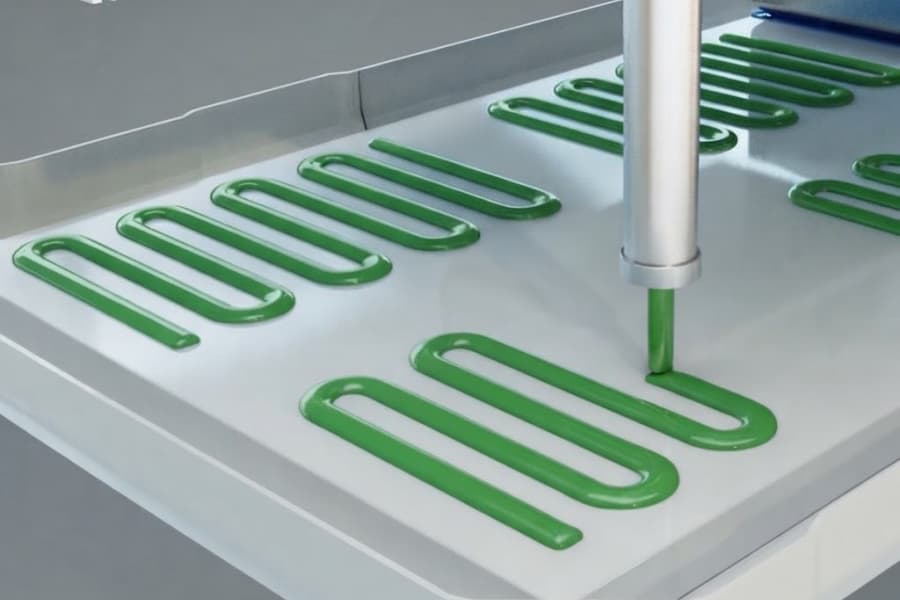
Dispensing thermal interface material (TIM) in EV battery packs requires careful coordination between the material, cartridge, mixer, dispensing equipment, and application method. Unlike lower-viscosity adhesives, many TIM formulations can contain high levels of thermal fillers and may create substantial flow resistance during dispensing.
For EV battery process engineers, equipment selection should therefore begin with the material and application requirements. Viscosity, filler characteristics, component ratio, required dispensing force, bead geometry, application speed, and positioning accuracy all influence the final configuration.
This guide explains the main equipment requirements for thermal interface material dispensing, how to evaluate high-viscosity and filler-filled adhesives, and how to select cartridges, mixers, dispensing guns, and coordinate applicators for EV battery applications.
Why Thermal Interface Materials Are Challenging to Dispense
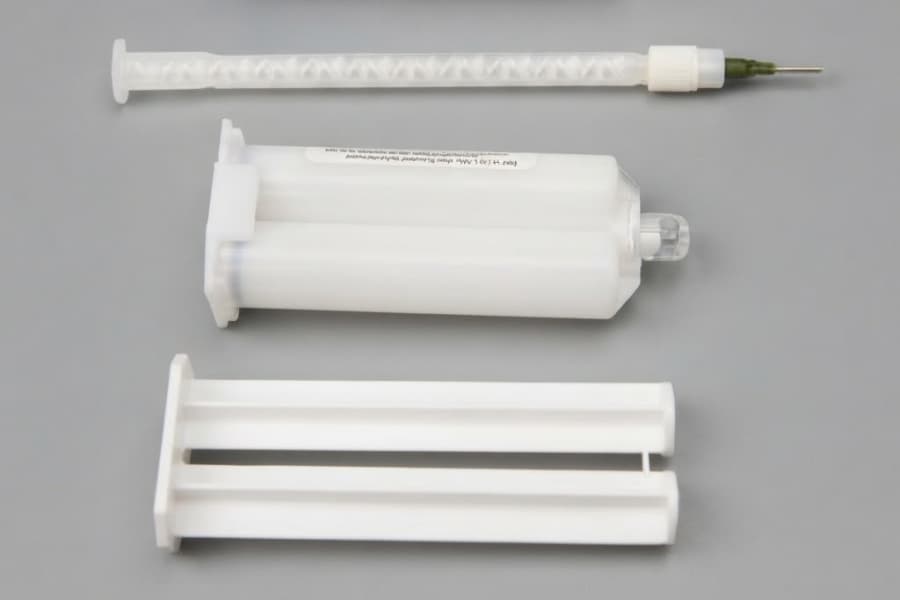
TIM dispensing is influenced by several material and process characteristics. Understanding these factors before selecting equipment can prevent problems such as unstable flow, excessive dispensing resistance, poor mixing, or inconsistent bead placement.
High Viscosity and Flow Resistance
High-viscosity thermal adhesives require more force to move through the material path. Resistance can come from the cartridge outlet, static mixer, nozzle, and other flow restrictions.
The required dispensing force therefore depends on more than viscosity alone. Engineers should consider:
- Material viscosity
- Cartridge design
- Mixer configuration
- Nozzle geometry
- Material flow path
- Required dispensing speed
- Target bead size
- Processing conditions
A dispensing system designed for a relatively fluid adhesive may not provide the same results with a high-viscosity TIM.
Filler-Loaded and Abrasive Adhesives
Thermal adhesives commonly rely on fillers to provide the required thermal characteristics. Depending on the formulation, these fillers can increase material resistance and may cause greater wear on components that remain in contact with the adhesive.
For an abrasive filled adhesive, equipment selection should include an evaluation of:
- Cartridge compatibility
- Mixer configuration
- Nozzle selection
- Material-contacting components
- Expected wear
- Replacement requirements
The actual abrasiveness varies according to the formulation, so equipment compatibility should be confirmed with the material supplier or through application testing.
Two-Component Thermal Adhesives
Some TIM products are supplied as two-component materials. These systems require controlled delivery of both components and adequate mixing before the material reaches the application surface.
The cartridge and static mixer should therefore be selected together with the dispensing equipment.
Important information includes:
- Component ratio
- Material viscosity
- Cartridge configuration
- Static mixer requirements
- Required output
- Working time
- Application conditions
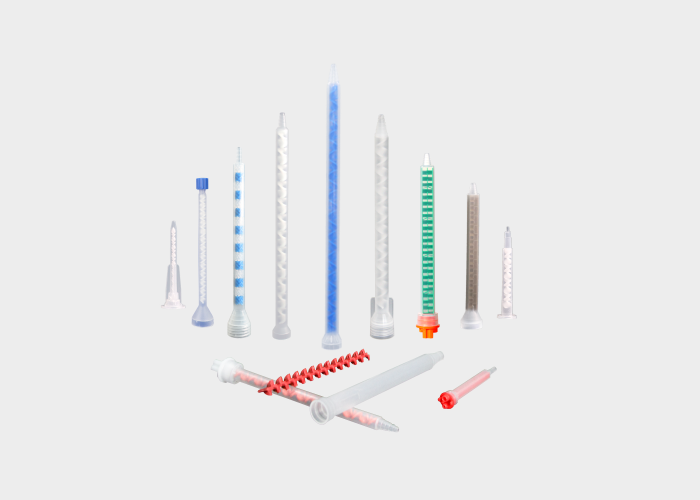
HaiJing provides static and dynamic mixer solutions for adhesive dispensing applications. The exact mixer configuration should be confirmed according to the material and process.
Key Equipment Requirements for EV Battery TIM Dispensing
A TIM dispensing system should be evaluated as a complete material-delivery and application system.
| Equipment Requirement | Why It Matters | What Engineers Should Check |
|---|---|---|
| Dispensing force | Overcomes material and flow-path resistance | Required force under actual conditions |
| Flow control | Influences bead consistency | Stability of material delivery |
| Material compatibility | Reduces compatibility problems | Cartridge and material-contact components |
| Mixing performance | Important for two-component TIM | Mixer configuration and material ratio |
| Wear resistance | Relevant to filled materials | Mixer, nozzle, and contact components |
| Positioning | Determines where TIM is applied | Application method and positioning accuracy |
| Maintenance | Affects production practicality | Cleaning and replacement requirements |
These factors are connected. For example, changing to a more restrictive mixer may increase flow resistance and consequently increase the force required from the dispensing system.
How Dispensing Force Affects TIM Application
High-thrust dispensing becomes particularly relevant when a thermal adhesive has high flow resistance.
When Does a TIM Application Need Higher Dispensing Force?
Higher dispensing force may be required when the system is handling:
- High-viscosity material
- Highly filled adhesive
- Restrictive mixer passages
- Small nozzle openings
- Long material flow paths
- Higher dispensing rates
However, a material should not be classified as requiring high thrust based on viscosity alone. The complete dispensing path determines the actual resistance.
For example, a high-viscosity TIM flowing through a relatively restrictive mixer may require a different equipment configuration from the same material used with a different flow path.
Standard Dispensing vs. High-Thrust Dispensing
| Factor | Standard Dispensing | High-Thrust Dispensing |
|---|---|---|
| Flow resistance | Lower or moderate | Higher |
| Required dispensing force | Lower | Higher |
| High-viscosity TIM | Application-dependent | Requires closer evaluation |
| Filler-loaded adhesive | Application-dependent | May require additional evaluation |
| Main concern | Stable delivery | Sufficient force and flow stability |
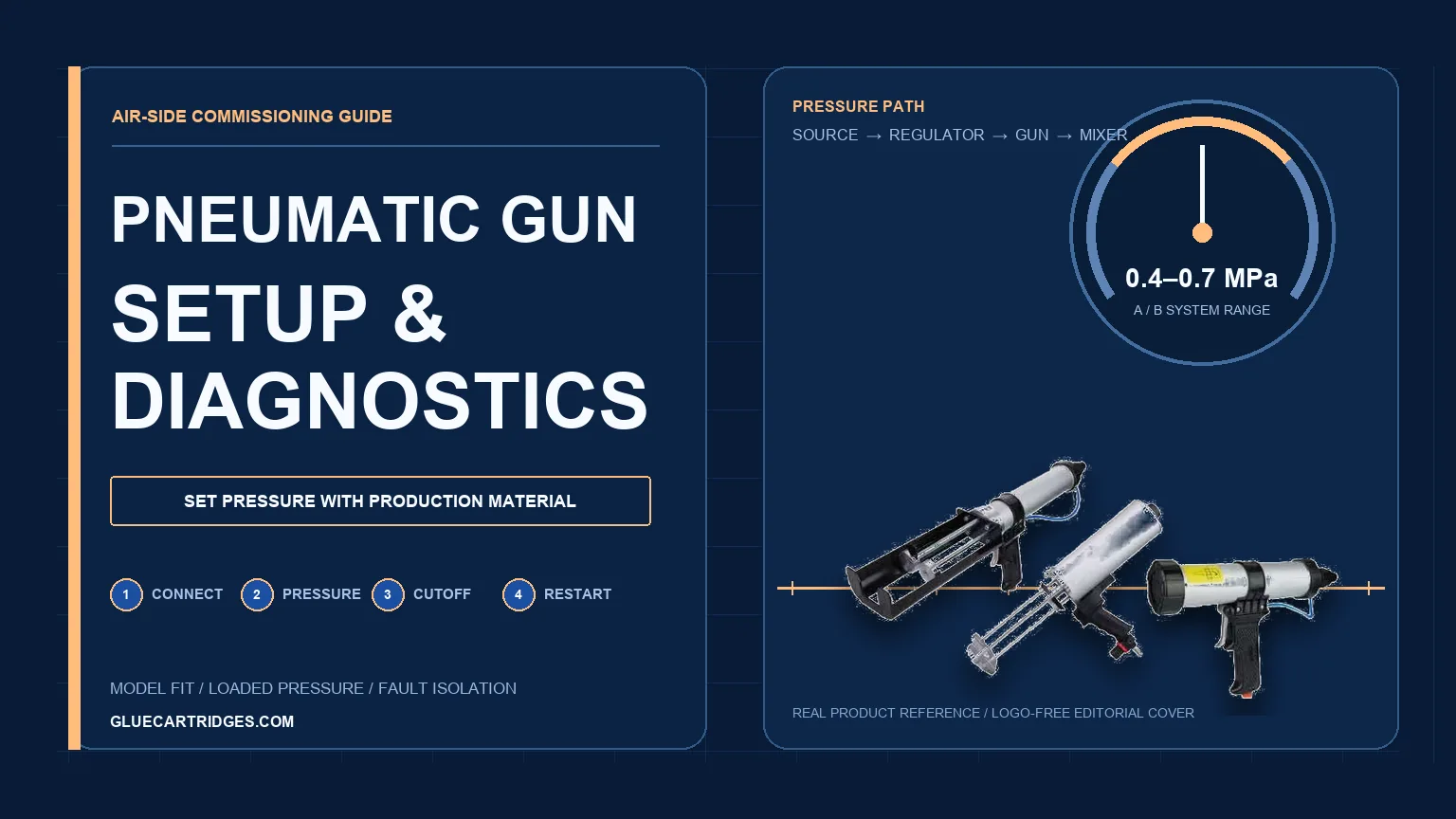
For cartridge-based adhesive applications, pneumatic dispensing guns can be evaluated according to the material and application requirements.
Exact force and pressure requirements should be confirmed from the actual equipment configuration rather than assumed from general material categories.
Choosing the Right Dispensing Equipment Configuration
Different battery manufacturing applications may require different levels of dispensing control. Three equipment categories are particularly relevant.
Pneumatic Dispensing Guns
Pneumatic dispensing guns can be used for controlled cartridge-based adhesive dispensing.
When evaluating a pneumatic dispensing system, engineers should check:
- Cartridge compatibility
- Material viscosity
- Required dispensing force
- Mixer compatibility
- Application speed
- Manual or automated operation
The goal is to maintain controlled material delivery under the intended process conditions.
Coordinate Applicators
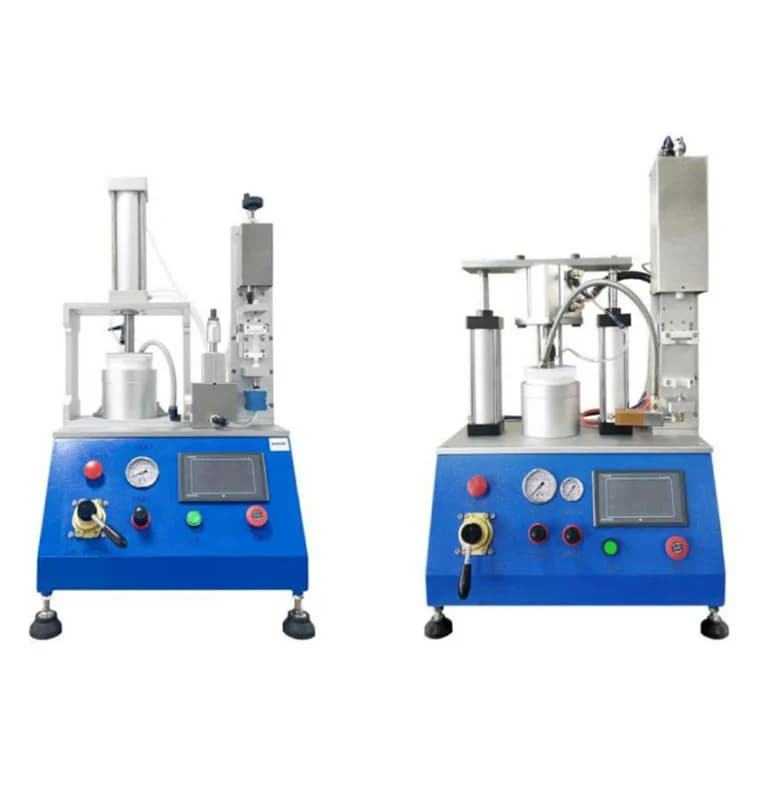
A coordinate applicator is useful when material needs to be deposited along a controlled path.
Compared with manually positioning a dispensing gun, a coordinate-based system can be considered when the process requires:
- Repeatable positioning
- Defined bead paths
- Consistent application locations
- Programmed movement
- Integration with a production process
For battery components with specific application patterns, the movement system becomes just as important as the dispensing mechanism.
HaiJing offers a coordinate applicator for applications where controlled dispensing movement needs to be evaluated.
Static Mixer Systems
For two-component TIM, the static mixer is a key part of the material delivery system.
Mixer selection affects:
- Mixing performance
- Flow resistance
- Material residence time
- Required dispensing force
- Final material consistency
A mixer should not be selected independently from the cartridge or dispensing gun. The entire material path needs to be considered.
HaiJing’s static mixer system can be evaluated according to the material ratio and dispensing requirements.
TIM Dispensing Equipment Selection Matrix
The following matrix provides a practical starting point for equipment selection.
| Application Condition | Main Challenge | Equipment Priority |
|---|---|---|
| High-viscosity TIM | High flow resistance | Evaluate dispensing force |
| Filler-filled TIM | Flow resistance and potential wear | Evaluate contact components |
| Two-component TIM | Mixing consistency | Cartridge + static mixer |
| Defined bead path | Positioning | Coordinate applicator |
| Cartridge dispensing | Material delivery | Cartridge compatibility |
| Controlled bead application | Output consistency | Evaluate dispensing and positioning control |
This matrix should be treated as a decision framework, not a fixed specification. Actual equipment requirements depend on the material and production setup.
Selecting the Cartridge and Static Mixer
The cartridge and mixer form an important part of the dispensing path and should be selected together.
Cartridge Compatibility
Before selecting a cartridge system, confirm:
- Material type
- Number of components
- Mixing ratio
- Required cartridge volume
- Material viscosity
- Connection interface
- Dispensing equipment compatibility
A cartridge that is mechanically compatible may still require additional evaluation for the material and process.
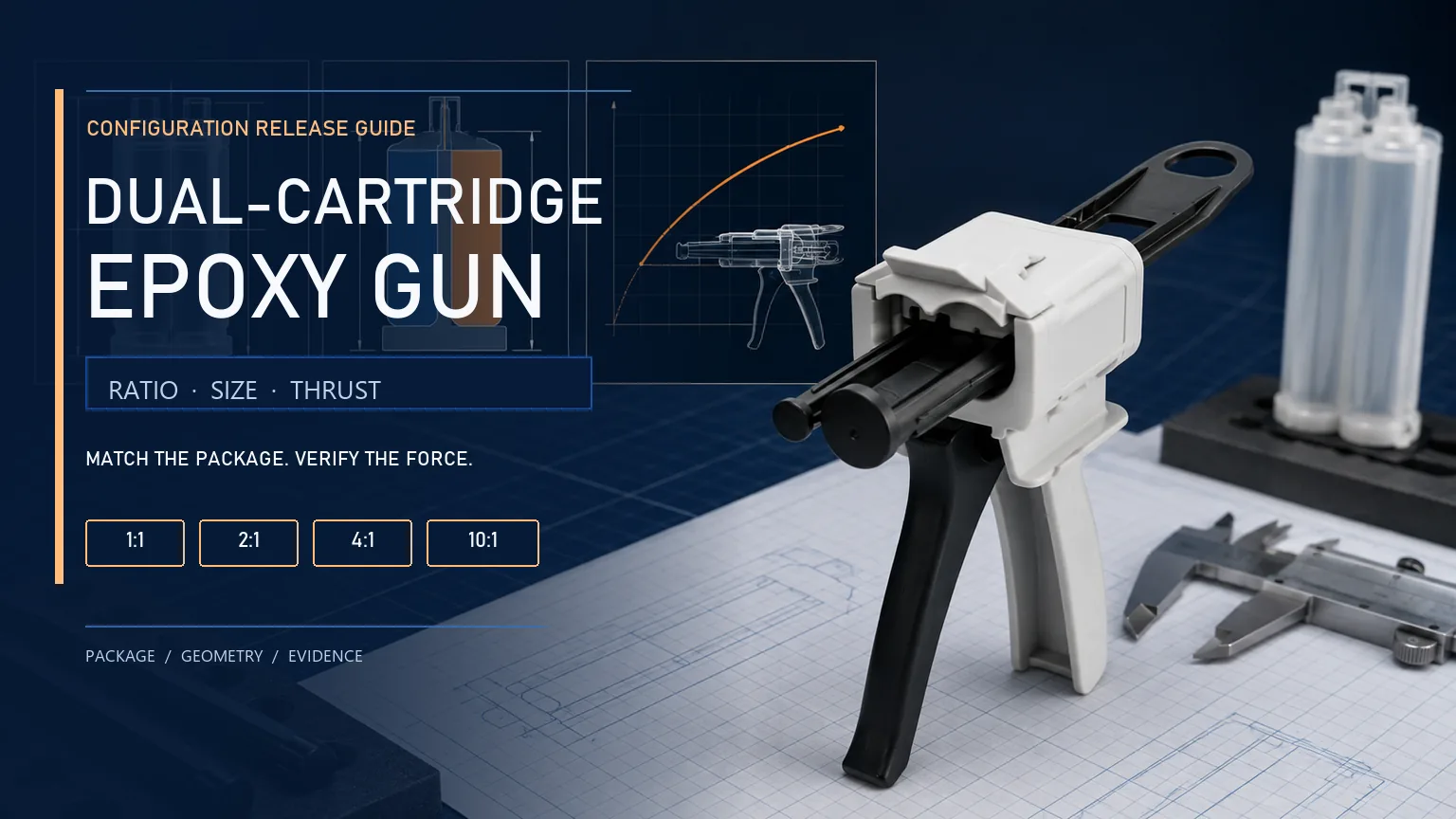
HaiJing provides cartridge and cartridge systems for adhesive dispensing applications. The appropriate configuration should be confirmed based on the actual TIM.
Static Mixer Selection
The static mixer should provide the required mixing performance without creating unnecessary restrictions in the material path.
Engineers should consider:
- Material ratio
- Viscosity
- Filler characteristics
- Required output
- Flow resistance
- Mixing requirements
- Nozzle compatibility
For high-viscosity or filler-loaded materials, mixer selection can directly affect the force required from the dispensing system.
A Practical TIM Dispensing Selection Process
A step-by-step evaluation can help engineers avoid selecting equipment based on only one material parameter.
Step 1: Identify the TIM
Start with the material supplier’s technical information.
Confirm:
- One-component or two-component formulation
- Mixing ratio, if applicable
- Viscosity
- Filler information
- Working time
- Recommended processing conditions
Step 2: Evaluate Material Flow Characteristics
Next, identify the properties that affect material delivery.
Check:
- Viscosity
- Filler loading
- Potential abrasiveness
- Temperature sensitivity
- Flow behavior
If exact material data is unavailable, it should be confirmed before final equipment selection.
Step 3: Define the Application Pattern
Determine how the TIM must be applied.
Important parameters include:
- Target bead size
- Application area
- Bead path
- Dispensing speed
- Positioning requirements
- Manual or automated operation
A simple manual bead and a programmed application path can require very different dispensing configurations.
Step 4: Match the Equipment
Evaluate the complete configuration:
Cartridge → Dispensing Gun → Static Mixer → Nozzle → Application Surface
For applications requiring controlled movement:
Cartridge → Dispensing System → Mixer → Nozzle → Coordinate Applicator → Application Surface
The exact configuration should be based on the material and production requirements.
Step 5: Validate the Complete System
Before production, evaluate the actual configuration for:
- Flow consistency
- Mixing quality
- Bead consistency
- Material compatibility
- Component wear
- Application coverage
- Process repeatability
Actual performance may vary according to the material and process setup.
Common TIM Dispensing Problems and What to Check
| Problem | Possible Cause | What to Check |
|---|---|---|
| Inconsistent bead | Unstable material delivery | Dispensing system and process conditions |
| Excessive resistance | High viscosity or flow restriction | Material, mixer, nozzle, and cartridge |
| Poor mixing | Mixer configuration | Mixer and material ratio |
| Component wear | Filler characteristics | Material-contact components |
| Incomplete coverage | Application path or flow issue | Bead pattern and dispensing setup |
| Air bubbles | Material or system handling | Cartridge loading and dispensing process |
Troubleshooting should consider the complete material path.
For example, replacing the dispensing gun may not solve excessive resistance if the primary restriction comes from the static mixer or nozzle.
Procurement Checklist for EV Battery TIM Dispensing
Before requesting a dispensing equipment recommendation, engineers should prepare the following information.
Material Information
- Material type
- One-component or two-component
- Mixing ratio
- Viscosity
- Filler information
- Abrasive characteristics
- Working time
- Processing conditions
Application Information
- Target bead size
- Application area
- Bead path
- Required dispensing speed
- Positioning requirements
- Production requirements
- Manual or automated application
Equipment Information
- Cartridge requirements
- Required dispensing force
- Mixer requirements
- Nozzle configuration
- Equipment interface
- Maintenance requirements
Providing these details allows the supplier to evaluate the complete dispensing configuration instead of recommending a component based only on the adhesive name.
How to Match TIM Properties With Dispensing Equipment
A simple decision framework can help narrow the equipment configuration.
Is the TIM highly viscous?
→ Evaluate dispensing force and total flow resistance.
Does the material contain abrasive or high filler content?
→ Evaluate material-contacting components and potential wear.
Is the TIM two-component?
→ Evaluate the cartridge and static mixer together with the dispensing equipment.
Does the application require a specific bead path?
→ Consider a coordinate applicator.
Does the process require repeatable bead placement?
→ Evaluate dispensing control and positioning requirements.
This approach gives engineers a more practical starting point than selecting equipment based on one specification.
What Information Should You Provide to a Dispensing Equipment Supplier?
When discussing an EV battery TIM application with a supplier, provide:
- Material name and type
- One-component or two-component formulation
- Mixing ratio
- Viscosity
- Filler information
- Cartridge requirements
- Target bead size
- Application pattern
- Required dispensing speed
- Production requirements
- Automation requirements
- Existing equipment or interface requirements
The supplier can then evaluate the cartridge, mixer, dispensing gun, and applicator as a complete system.
Choosing a TIM Dispensing Partner
For EV battery applications, equipment selection should focus on the relationship between the material and the dispensing process.
A suitable supplier should be able to discuss:
- Material characteristics
- Cartridge configuration
- Mixer selection
- Dispensing force
- Application method
- Equipment compatibility
- Customization requirements
- Process validation
HaiJing provides products and customization services for adhesive packaging, mixing, and dispensing applications. For application-specific requirements, custom dispensing solutions can be evaluated according to the material and production process.
Conclusion
Selecting equipment for thermal interface material dispensing in EV battery packs starts with understanding the material and application rather than choosing a dispensing gun alone.
High-viscosity TIM may require higher dispensing force. Filler-filled materials require attention to flow resistance and component wear. Two-component materials require compatible cartridges and static mixers, while controlled bead paths may require coordinate application.
The basic selection sequence is:
Material → Flow Characteristics → Application Pattern → Cartridge → Mixer → Dispensing Equipment → Validation
By evaluating these factors together, process engineers can develop a dispensing configuration that is better matched to the actual EV battery manufacturing process.
Key Takeaways
- Evaluate TIM viscosity, filler characteristics, and component ratio before selecting equipment.
- High-viscosity materials may require high-thrust dispensing.
- Abrasive filled adhesive requires attention to material-contacting components.
- Cartridge, mixer, nozzle, and dispensing gun should be evaluated as one system.
- Coordinate applicators are useful to consider for controlled dispensing paths.
- Two-component TIM requires appropriate cartridge and static mixer selection.
- Actual equipment requirements should be confirmed under the intended process conditions.
FAQ
What is thermal interface material used for in EV battery packs?
Thermal interface material is used between mating surfaces in thermal management assemblies to support heat transfer. Consistent application is an important consideration when designing the dispensing process.
Why is thermal interface material difficult to dispense?
High viscosity, filler loading, abrasive characteristics, and two-component mixing requirements can increase flow resistance and make equipment selection more demanding.
Does high-viscosity TIM require high-thrust dispensing?
It may. The actual force requirement depends on material viscosity, filler content, cartridge, mixer, nozzle, flow path, and dispensing speed.
How do abrasive fillers affect dispensing equipment?
Abrasive fillers can increase flow resistance and may contribute to wear on material-contacting components. The actual effect depends on the material formulation and process conditions.
What mixer is suitable for two-component TIM?
The static mixer should be selected according to the component ratio, viscosity, filler characteristics, output requirements, and required mixing performance.
When should I use a coordinate applicator?
A coordinate applicator can be considered when the process requires controlled movement, repeatable positioning, or a defined bead path.
How do I choose a dispensing gun for thermal adhesive?
Start with the material properties, cartridge, mixer, target bead, dispensing speed, and application method. Then evaluate the dispensing force and compatibility of the complete system.
What information should I provide to a dispensing equipment supplier?
Provide material type, viscosity, mixing ratio, filler information, cartridge requirements, bead size, application pattern, dispensing speed, and automation requirements.
SEO Title
Thermal Interface Material Dispensing for EV Batteries
Meta Description
Learn how to select thermal interface material dispensing equipment for EV batteries based on viscosity, fillers, mixing, dispensing force, and application needs.
URL Slug
/thermal-interface-material-dispensing-ev-battery-packs/
Suggested Image Alt Text
- Thermal interface material dispensing in EV battery packs
- EV battery thermal adhesive dispensing equipment
- High-viscosity thermal interface material dispensing
- High-thrust dispensing gun for thermal adhesive
- Static mixer system for two-component TIM
- Coordinate applicator for EV battery adhesive
- EV battery TIM dispensing equipment selection
- Cartridge and mixer system for thermal adhesive
Internal Link Placement Summary
| Anchor Text | Recommended Location |
|---|---|
| static and dynamic mixer solutions | TIM material challenges |
| pneumatic dispensing guns | High-thrust dispensing |
| coordinate applicator | Equipment configuration |
| static mixer system | Two-component TIM |
| cartridge and cartridge systems | Cartridge selection |
| custom dispensing solutions | Supplier selection |
Final CTA
Have a high-viscosity or filler-filled TIM application? Provide your material type, viscosity, component ratio, cartridge requirements, mixer requirements, target bead size, and application method to HaiJing. The dispensing configuration can then be evaluated according to your actual process conditions.