Teflon-Coated vs. Stainless Steel Dispense Needles: Preventing Glue Buildup
Selecting the right dispensing needle directly impacts production yield, fluid flow consistency, and maintenance frequency in automated or manual assembly lines. When dispensing industrial adhesives such as UV-curable resins, instant glues, or two-component epoxies, fluid residue and tip clogging are primary causes of downtime and dispensing errors. Choosing between a standard stainless steel dispensing needle and a specialized surface-treated option depends on adhesive chemistry, surface energy dynamics, and required cleaning intervals. This article covers the root causes of glue accumulation, a direct material comparison, operational impacts, and an engineering selection framework to help technical teams optimize their dispensing processes.
The Root Cause of Glue Buildup in Dispensing Needles
Adhesive accumulation inside and at the tip of a dispensing needle stems from surface wetting properties, fluid curing behavior, and residual capillary action. When liquid adhesive flows through a standard metal channel, the interaction between polar or reactive chemical groups in the polymer and the metallic inner wall creates a strong boundary layer attraction.
As dispensing cycles pause, residual adhesive remaining at the exit orifice is exposed to ambient air, UV light, or moisture depending on the adhesive type. Standard metal surfaces possess relatively high surface energy, allowing thin films of adhesive to wet out, spread across the tip face, and initiate premature polymerization or drying. Over successive cycles, this initial layer builds up into hardened clogs, causing fluid deflection, droplet spitting, or complete flow blockage. Controlling this phenomenon requires altering the interfacial tension between the inner wall, the tip face, and the dispensed fluid. Engineers can explore various solutions by reviewing standard specifications available on the adhesive dispense tip resource page.
Technical Comparison: Teflon-Coated vs. Stainless Steel Dispensing Needles
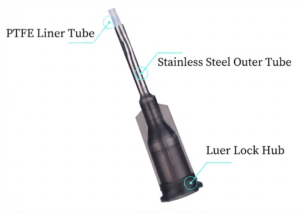
Evaluating physical and chemical performance differences helps engineers determine which needle construction suits specific assembly requirements. Stainless steel tubes offer high mechanical rigidity, precise inner diameter tolerances, and robust structural integrity under high pneumatic pressure. However, untreated stainless steel presents a high-energy metallic surface that readily attracts reactive liquid polymers.
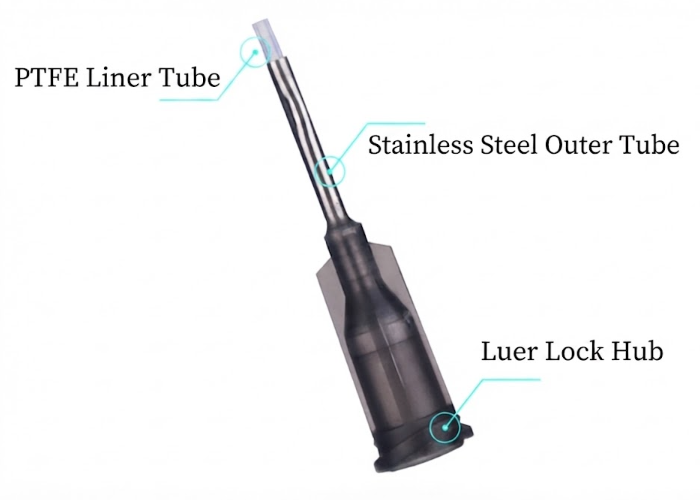
Teflon (PTFE) coatings introduce a low-energy, non-wetting barrier over the base metal substrate. This hydrophobic and oleophobic coating significantly reduces the contact angle of liquid adhesives, preventing fluids from creeping up the outer cannula or forming stubborn rings of cured material around the exit orifice.
| Performance Factor | Stainless Steel Dispensing Needle | Teflon-Coated Dispensing Needle |
| Surface Energy | High (encourages fluid wetting and creep) | Low (repels fluid, prevents wetting) |
| Anti-Adhesion Property | Moderate; requires frequent solvent cleaning | High; minimizes residue and stringing |
| Fluid Flow Friction | Standard friction depending on inner diameter polish | Reduced friction for smooth viscous flow |
| Mechanical Durability | Rigid, resistant to bending and mechanical wear | Coating can be scratched by abrasive fillers |
| Typical Applications | General dispensing of non-reactive or low-tack fluids | Fast-curing UV adhesives, cyanoacrylates, tacky epoxies |
For custom geometrical requirements or specialized internal diameters, technical teams often evaluate tailored customization options to match specific fluid viscosity parameters.
Evaluating Anti-Adhesion Performance Across Adhesive Types
Adhesive formulations react differently to needle materials based on their curing mechanisms. Rapidly curing or high-tack formulations present distinct challenges during high-speed automated dispensing.
-
Cyanoacrylates (Instant Glues): Cure rapidly upon contact with trace moisture on metal surfaces. Untreated metal accelerates nozzle clogging, whereas non-wetting coatings reduce residual film formation.
-
UV-Curable Resins: Highly sensitive to ambient light exposure near the dispense head. Residue clinging to a standard tip cures instantly under stray light, whereas smooth-release surfaces limit clinging areas.
-
Two-Component Epoxies: Often formulated with high filler loads or viscous bases. While fillers can cause abrasive wear on soft coatings, maintaining smooth internal walls prevents stagnant pockets where mixed resins can cross-link and cure prematurely.
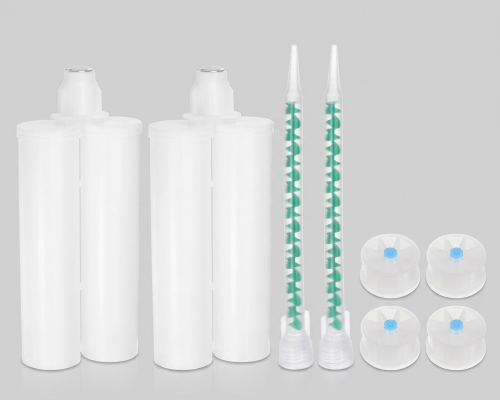
When deploying single-component adhesives through automated systems, ensuring consistent flow from single-component cartridges into the feed line helps maintain steady hydraulic pressure at the needle inlet.
Operational Impact: Throughput, Maintenance, and Yield Rates
Preventing adhesive buildup directly influences overall manufacturing OEE (Overall Equipment Effectiveness). When dispensing tips clog, operators must pause production to clean or replace nozzles, introducing micro-stops that reduce daily throughput. Furthermore, partial clogs alter the fluid vector, leading to misaligned dots or inconsistent bead volumes that fail quality inspections.
Using anti-adhesion needle variants reduces the frequency of manual purging and solvent cleaning cycles. Although component acquisition costs may vary, the reduction in scrap rates and labor downtime often offsets the initial material differential. Actual performance and maintenance intervals vary based on the specific adhesive formulation, ambient humidity, and cycle time setup. Detailed parameters should be confirmed based on the specific application requirements.
Selection Guide for Engineers: Choosing the Right Needle for Your Process
Selecting the correct dispensing tip requires a systematic evaluation of fluid properties, dispensing frequency, and precision thresholds. Engineers should follow a structured decision process:
-
Identify Fluid Chemistry: Determine whether the adhesive is moisture-curing, UV-reactive, or thermally cured.
-
Evaluate Clogging Frequency: Review historical maintenance logs to see if current stainless steel tips suffer from frequent tip-loading or stringing.
-
Assess Mechanical Constraints: Check if the application involves physical contact with the substrate or abrasive filler particles that might compromise surface coatings.
-
Define Inner Diameter and Flow Rate: Match the gauge size to the required volumetric output while ensuring pressure limits remain within safe operational bounds.
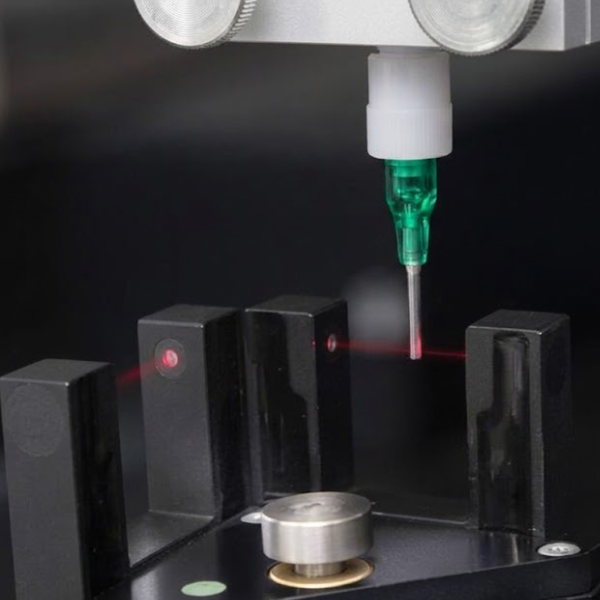
For specialized integration with automated dispensing equipment, engineers can review comprehensive dispensing needle specifications to align gauge sizes with specific volumetric requirements.
Partnering with HaiJing for Reliable Dispensing Solutions
Optimizing fluid control assemblies requires reliable hardware matched precisely to production demands. HaiJing supports international manufacturers with engineered dispensing consumables designed to minimize maintenance overhead and improve fluid placement accuracy. Whether your assembly line requires standard precision components or bespoke configurations, collaborating closely with experienced technical support ensures optimal process integration. To discuss your production parameters and explore custom dispensing solutions, connect with our engineering team.
Key Takeaways
-
Glue buildup on dispensing tips is driven by high surface energy and fluid wetting, leading to premature curing and nozzle clogging.
-
Teflon-coated needles provide a low-energy barrier that repels reactive adhesives, reducing stringing and residue compared to standard metal tips.
-
Stainless steel needles offer superior rigidity and abrasion resistance, making them ideal for standard or high-filler fluid applications.
-
Selecting the appropriate needle material depends on adhesive chemistry, curing speed, and acceptable maintenance frequency.
-
Production efficiency improves when tip maintenance intervals and cleaning downtime are minimized through proper component selection.
FAQ
Why does glue accumulate on the tip of a dispensing needle?
Glue accumulates due to surface wetting, capillary action, and exposure of residual adhesive to ambient air or light at the exit orifice, causing premature curing and buildup.
How does a Teflon coating prevent clogging compared to stainless steel?
Teflon coatings provide a low-energy, non-wetting surface that repels fluid, preventing adhesive from creeping up the cannula or forming hardened rings around the tip opening.
Are Teflon-coated needles suitable for abrasive adhesives?
Depending on the filler material, highly abrasive loaded adhesives may wear down coatings over extended cycles; abrasive compatibility should be evaluated against operational lifespan requirements.
What factors should engineers consider when selecting a dispensing needle?
Engineers should evaluate adhesive chemistry, curing mechanisms, fluid viscosity, required inner diameter precision, and historical maintenance frequency.
How can I request customized dispensing needle specifications for my assembly line?
Technical requirements and custom geometry inquiries can be reviewed directly with our engineering team to ensure compatibility with your production setup.
Contact HaiJing for technical support
To discuss your specific adhesive dispensing requirements, fluid viscosities, and custom needle configurations, please Contact HaiJing engineering team to request a technical consultation.